The home fragrance ribbed winter beanies Unit Cost Review is useful because the product looks simpler than it is. A ribbed beanie seems like an easy seasonal add-on until the first quote arrives and every “small” choice starts adding up: yarn grade, cuff height, stitch density, decoration, packing, and the amount of handwork needed to make the thing look retail-ready. That is where margins get protected or quietly erased.
For home fragrance brands, ribbed beanies make sense for a reason that has nothing to do with apparel fashion cycles. They feel giftable, they bundle naturally with candles and diffusers, and they carry a winter mood without needing a loud logo to justify their place in the box. The best versions are restrained. They feel like part of the set, not an item that wandered in from a different category.
The buying mistake is usually the same: treating a knit accessory like blank commodity stock. Ribbed structure changes the production behavior, and it changes the decoration math too. A spec that looks cheap on paper may still cost more than expected once the supplier adds sampling, setup, and packaging. A spec that looks premium may still be attainable if the details are controlled. That gap is where the real review happens.
Why Ribbed Beanies Win in Winter Merch Drops
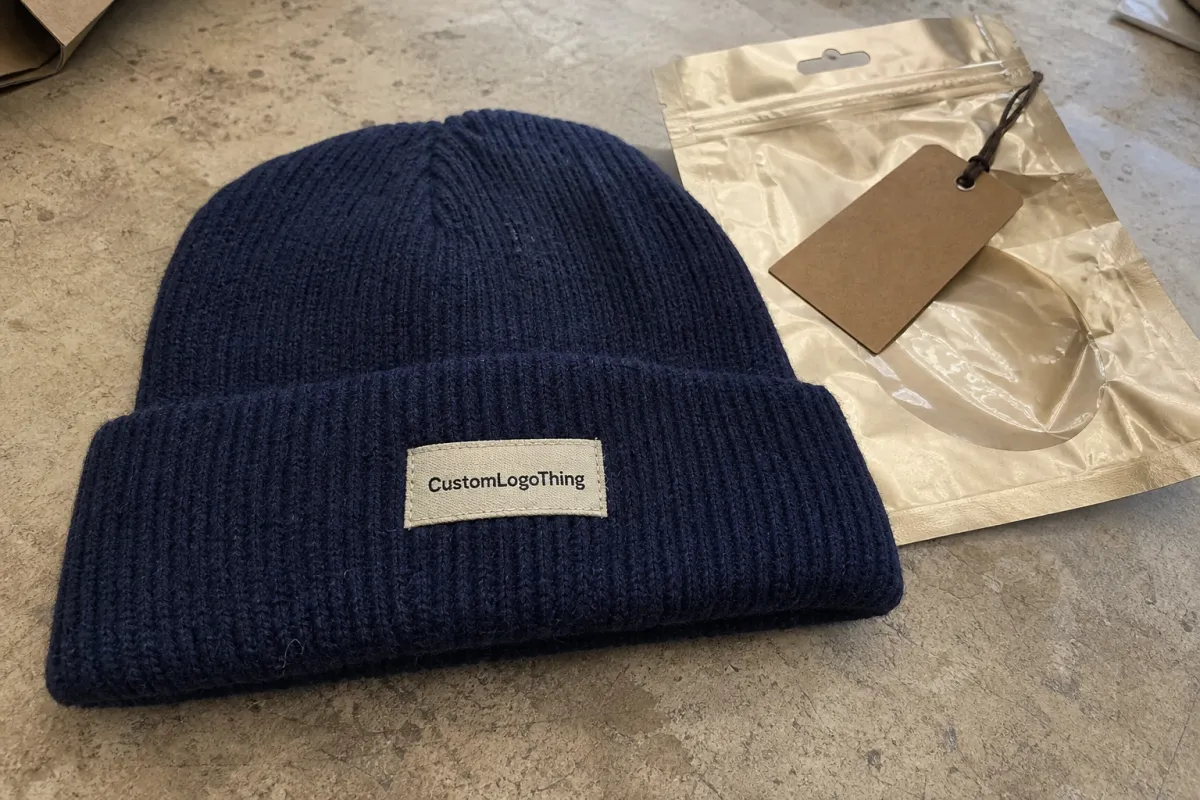
Ribbed construction tends to read as more premium than flat knit because the vertical texture adds depth and gives the fabric more visual structure. It also hides minor knitting variation better than a smooth surface, which helps the final piece look more consistent across a run. That does not mean ribbed beanies are automatically expensive. If the gauge is sensible and the decoration is kept simple, they can sit in a workable cost band for seasonal merchandise.
That matters for home fragrance programs, where a winter accessory is often attached to a retail bundle or VIP mailer. A beanie can raise perceived value without forcing the team into a full clothing line. It works for holiday sets, event giveaways, loyalty gifts, and limited-edition box builds. The product is small, but the perception shift can be large if the handfeel and finish are right.
What buyers often miss is that the beanie’s job is not to carry a huge story. It needs to fit the brand mood and survive basic wear. A cuff that sits too shallow looks unfinished. A yarn that feels scratchy gets rejected quickly. A crown that collapses after one stretch makes the item feel disposable, even if the print is clean. Small construction choices influence whether the beanie feels like a premium add-on or a filler item dressed up for winter.
Rib tension deserves attention too. Tighter ribbing usually gives better shape retention and a cleaner silhouette, especially around the cuff. Looser ribbing can reduce cost slightly, but it can also make the beanie feel limp after a few wears. That tradeoff is easy to miss if the buyer only looks at the first sample photo instead of checking how the piece behaves in hand.
Premium in this category is usually about handfeel, balance, and finishing discipline, not dramatic claims. If the beanie feels comfortable, holds shape, and looks deliberate on the head, the product is doing its job.
Fiber Blend, Fit, and Cuff Specs Buyers Should Lock In
The first specification that matters is the fiber blend. Basic acrylic still dominates this category because it keeps unit cost down and gives consistent results across larger runs. It is not luxury fiber, but a clean acrylic with a decent knit structure can look entirely appropriate in a gift set. Acrylic-wool blends cost more because the yarn itself costs more and the knitting process can be less forgiving, yet the payoff is a warmer handfeel and a more natural feel against the skin.
That handfeel question is not cosmetic. Buyers often talk themselves into technical yarn language, then reject the sample the moment it feels rough. For home fragrance bundles, comfort matters more than any claim sheet. If the beanie is meant to sit in a candle-and-diffuser gift box, it should feel pleasant enough that a customer would actually wear it after the holiday packaging is gone.
Fit needs to be written down clearly. Ask for crown depth, relaxed width, stretched width, cuff height, and the head circumference range the supplier is building toward. A typical adult ribbed beanie may land around 20 to 23 inches relaxed, with cuff depth somewhere between 2.5 and 3.5 inches depending on the silhouette. Those numbers are not glamorous, but they determine whether the beanie looks modern or just oversized in a bad way.
Stretch recovery is another quiet quality marker. A ribbed knit should recover well after being pulled on and off. If the beanie sags or twists, it will look tired quickly, even if the yarn itself is decent. Buyers reviewing quotes should ask whether the sample was checked before and after stretch, because that is where weak construction often shows up.
Useful specs to request in the brief:
- Fiber blend: 100% acrylic or acrylic-wool blend, with yarn weight stated clearly
- Gauge: stitch density or knitting gauge so construction can be compared properly
- Cuff height: fixed measurement in inches or centimeters
- Crown depth: to avoid a shallow or oversized fit
- Fit range: relaxed and stretched circumference
- Handfeel target: soft, medium, or structured
There are also hidden costs that do not show up in a simple product photo. Knit goods do not need molding tools the way hard goods do, but they still involve setup charges, yarn matching, sample fees, and decoration preparation. A woven label may look minor, yet it can add a separate production step. Embroidery setup is another line item. The quote gets clearer when those items are named instead of folded into one vague total.
Decoration Choices That Stay Sharp on Ribbed Knit
Decoration on ribbed knit has constraints that a flat garment does not. The surface moves. The ribs create breaks in the visual field. That means the artwork has to fit the fabric instead of trying to dominate it. Buyers who ignore that usually end up with logos that look fine in the artwork proof and oddly distorted on the sample.
Embroidery is usually the safest option for durability and perceived value. It holds up well in wear, and it reads as permanent rather than temporary. The limit is detail. Tiny text disappears fast on knit, especially if the stitch count is low or the logo has thin elements. Compact wordmarks, icons, and short monograms work better than crowded graphics. If the design needs to say too much, it is probably too much for the hat.
Woven labels offer another clean route. They preserve small logo details better than many embroidered designs and give the beanie a sharper retail finish. That makes sense for home fragrance bundles, where the accessory should feel intentional but not aggressive. A neatly placed woven label on the cuff or seam can provide enough branding without turning the piece into a billboard.
Patches can work if the goal is stronger visibility. They need restraint. Oversized patches can overwhelm the beanie and make it feel heavier or less refined, which may fit some streetwear programs but usually clashes with a calm home fragrance aesthetic. The item should support the package, not compete with it.
What to avoid:
- Oversize graphics that fight the rib texture
- Micro text that disappears into the knit valleys
- High-contrast placements that look detached from the fabric
- Gradient-heavy or photographic art that loses clarity on knit
If a supplier can show the decoration on an actual ribbed sample rather than a flat mockup, that is a better sign. The difference matters because knit stretch changes placement and readability. A logo that looks centered on a screen can drift once it wraps around a head. Seeing the stitch-out at size is far more reliable than looking at a perfect digital proof.
For a home fragrance Ribbed Winter Beanies Unit Cost review, the cleanest approach is usually one primary decoration plus one supporting detail. An embroidered cuff mark with a woven internal label, for example, gives the beanie enough identity without crowding the surface. That combination tends to hold up in both cost and appearance.
Unit Cost, MOQ, and Quote Math That Actually Matters
Unit cost is driven by a handful of factors that show up again and again: fiber blend, knit density, decoration count, packaging method, and order volume. If the supplier includes custom Pantone matching, extra labeling, or custom folding and bagging, the price rises. Usually not catastrophically. But enough to change the economics if the buyer did not model it up front.
For a standard custom ribbed beanie, rough pricing often lands around $2.80-$4.20 per piece at larger volumes with simple decoration. More finished versions commonly sit around $4.50-$7.50 per unit depending on yarn quality, labeling, and packaging. Smaller runs can move above that fairly quickly, and that is normal. MOQ is not a formality; it is the mechanism that spreads setup cost across the order.
Quote comparisons get messy when each supplier is pricing a different version of the same product. One may quote a thin acrylic knit with basic embroidery. Another may quote a denser rib, better handfeel, and a more finished pack-out. Those are not interchangeable numbers. Comparing them as if they were the same object creates a false bargain.
| Option | Typical MOQ | Approx. unit cost | Best for | Watch-outs |
|---|---|---|---|---|
| Basic acrylic, single embroidery | 300-500 pcs | $2.80-$4.20 | Giveaways, staff gifts, simple bundles | Less soft, lighter retail feel |
| Acrylic-wool blend, woven label + embroidery | 500-1,000 pcs | $4.50-$6.80 | Seasonal retail bundles, holiday launches | Higher sample and setup charges |
| Heavier knit, premium finishing, custom packaging | 1,000+ pcs | $6.50-$9.50 | Gift sets, premium brand drops | Packaging can move cost fast |
MOQ affects more than price. It affects risk. A smaller order may look safer, but the unit cost climbs quickly because setup costs get spread across fewer pieces. A larger order may improve the per-piece number, but only if the product is likely to move. The right answer depends on sell-through confidence, not just the lowest quoted line.
Ask every supplier for the same items so the quotes can be compared cleanly:
- Landed unit cost, not only factory cost
- Setup charges for embroidery, labels, or color matching
- Sample fees and whether they are refundable
- Rework costs if a correction is needed after approval
- Packing cost if the beanie ships in an individual bag or custom box
For this category, it helps to request two pricing tiers side by side: one standard and one upgraded. That makes the margin impact visible without guesswork. A basic acrylic version against an acrylic-wool blend with improved packaging tells you more than a dozen vague adjectives ever will.
Production Steps, Lead Time, and Sampling Timeline
A clean production process should be predictable. The work typically moves from brief to tech pack review, yarn sourcing, sample knitting, decoration approval, bulk production, inspection, and packing. If a supplier cannot explain the sequence clearly, the order will probably be less orderly than it should be. Knit goods reward structure.
Sampling is where buyers save money and time later. A precise tech pack cuts revision cycles. If the logo size, cuff height, yarn color, and fit target are already settled before sampling starts, the first version has a much better chance of being close to final. If those details are still moving, every correction adds time. Seasonal programs rarely forgive that.
Typical lead times vary with complexity and season. Simple sampling may take 7-14 business days. Bulk production often lands around 15-30 business days after approval, though custom yarn matching, revised embroidery, or custom packaging can extend the schedule. Q4 queues usually make everything slower. The calendar does not care whether the launch window is convenient.
Delays usually come from a few predictable places:
- Artwork revisions after the first proof
- Late approval of sample photos or strike-offs
- Unclear cuff depth or fit targets
- Packaging changes after bulk knitting has already started
- Color matching that requires multiple correction rounds
Quality control should be more than a glance at a finished stack. Ask whether the supplier checks stitch consistency, cuff uniformity, and logo placement against a measured spec. A supplier that can talk in tolerances and defect types usually has a more controlled process than one that only talks about “good quality.” That phrase means very little without a method behind it.
Shipping and packing deserve attention too, especially if the beanie is headed into gift sets. Carton strength, folding method, bagging, and insert placement all affect how the item arrives. The ISTA reference is useful when you want to think beyond the product itself and into how it holds up in transit. For a bundled fragrance launch, that matters as much as the knit spec.
Packaging also sets the tempo for the order. If the beanie is going into a holiday box with a candle, wax melts, or a fragrance mist, the box dimensions, tissue, insert cards, and outer shipper all need to move on the same schedule. Delays often come from the pack-out plan rather than the hat itself. That is a planning problem, not a knitting problem.
What to Compare Before You Approve a Supplier
Mockups are useful, but they are not proof. A polished render can hide a thin knit, an awkward cuff, or a logo that will not hold detail at actual size. Ask for finished photos, close-ups of the cuff and crown, and a sample shot that shows the decoration at scale. Then compare those items across quotes using the same lens every time.
Good supplier behavior usually shows up in the details that do not make it into sales decks. Do they explain defects clearly? Do they show tolerances for width and depth? Do they tell you where variation is normal and where it is not? Can they rework a sample without turning it into a drama? Those answers matter more than a slick PDF.
For brands that care about packaging claims or traceability, separate the beanie review from the packaging review. The two are related, but they are not the same thing. If you plan to use certified paper packaging or inserts, check the documentation on the paper side directly. The FSC reference is a useful starting point for that side of the order. It does not certify the knit itself, and it should not be presented that way.
Use this comparison lens when reviewing suppliers for a home fragrance Ribbed Winter Beanies Unit Cost review:
- Proof quality: Are the sample photos clear, measured, and consistent?
- QC detail: Do they check stitching, shape, and logo placement?
- Communication speed: Do answers include numbers instead of broad claims?
- Spec discipline: Can they hold cuff height and fit across runs?
- Issue handling: Do they describe how corrections are handled before bulk?
There is also a brand-fit question that gets ignored too often. If the beanie is sitting next to candles or diffusers, the visual language should stay calm. Heavy graphics can pull the item away from the rest of the set. A restrained ribbed beanie usually feels more deliberate and more aligned with a fragrance-led product than a loud merch piece trying to be the focal point.
The best quote is not automatically the cheapest. It is the one that matches the use case, the quality target, and the margin plan without introducing avoidable risk. That may sound plain, but in seasonal buying, plain usually saves money.
Next Steps to Price and Order With Less Guesswork
Better pricing starts with a better brief. Send the supplier the target quantity, fiber blend, cuff height, logo size, decoration type, and packaging method in one place. If the request is vague, the quote will be vague. If the request is precise, the pricing becomes much easier to compare.
Ask for two versions of the same order whenever possible. Standard acrylic with embroidery is a useful baseline. Then compare it with a slightly upgraded option, such as an acrylic-wool blend with a woven label and cleaner packaging. That side-by-side view shows where the money goes and whether the premium version earns its place in the bundle.
If you are comparing vendors for a seasonal drop, keep the same yardstick across all of them: unit cost, MOQ, setup charges, sample fee, production lead time, and packing method. A polished sales quote and a detailed production quote are not the same thing. Treating them like they are equal leads to bad apples-to-apples math.
For most home fragrance brands, the sweet spot is a beanie that feels giftable, costs responsibly, and does not rely on complicated decoration to justify its place in the set. That is why the home fragrance Ribbed Winter Beanies Unit Cost review matters: it turns a seasonal accessory into a clear pricing decision instead of a hopeful one.
What affects home fragrance ribbed winter beanies unit cost the most?
Yarn blend, stitch density, and decoration method usually move cost first. Packaging upgrades and low-MOQ orders can push the unit price up faster than many buyers expect. If the supplier adds custom labeling or special bagging, that shows up too, sometimes more than the decoration itself.
What MOQ should I expect for custom ribbed winter beanies?
MOQ varies by supplier, but custom knit and custom decoration usually need a meaningful baseline run. Smaller orders are possible, though the per-piece cost often rises because setup charges are spread across fewer units. Pricing usually improves once the run reaches an efficient production size.
Which decoration works best on ribbed knit beanies?
Embroidery and woven labels usually perform best because they stay readable on textured knit. Oversized prints and tiny details are riskier because the rib stretch can distort the artwork. For a cleaner retail look, a small embroidered mark with a woven label is often the safest combination.
How long does sampling and production usually take?
Sampling moves fastest when the tech pack is clear and the artwork is final before the first quote. Production lead time often lands around 15-30 business days after approval, but color matching, revisions, and peak-season demand can extend that window. Late changes are usually what slow the order down.
Can ribbed winter beanies work in home fragrance gift sets?
Yes, they work well as seasonal bundle items, VIP gifts, and higher-value add-ons. Keep branding clean so the beanie supports the fragrance set instead of competing with it. A restrained logo and decent fabric choice usually add more perceived value than a loud graphic does.