Small packaging choices can carry outsized weight in hotel retail. A frosted zipper bag sits at the intersection of presentation, practicality, and brand control. Put the logo in the wrong spot and the package starts to feel improvised. Place it with care and the bag works like a quiet sales tool, moving with the guest from counter to room to home.
The hotel retail frosted zipper plastic Bags Logo Placement guide matters because the bag is doing more than holding merchandise. It is often the first branded object a guest handles after a purchase, and in hotels that moment influences how premium the item feels. Frosted film softens the contents and can make even simple packaging look more polished, but the same surface also reduces contrast, blurs thin detail, and exposes weak layout choices quickly.
That means logo placement is not just a design preference. It is a production decision shaped by zipper lines, material finish, viewing distance, and how the bag will be displayed. A mark that looks balanced on a screen may read too low, too crowded, or too faint once it is printed on film. In hotel retail, the best result is usually restrained and deliberate rather than loud.
What frosted zipper retail bags are and why logo placement matters
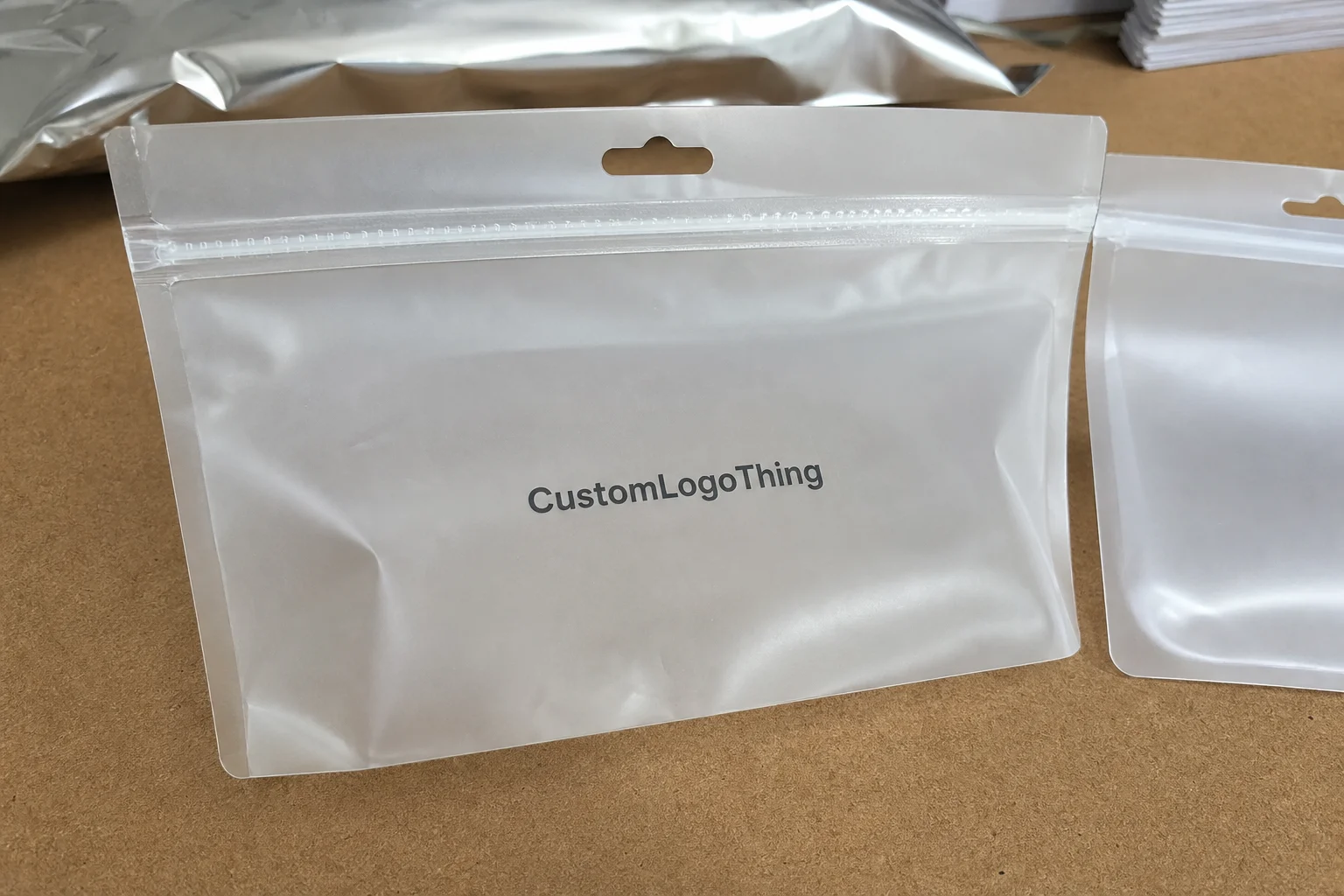
Frosted Zipper Bags are typically made from polyethylene film with a matte-translucent finish. They are common in hotel retail for soap sets, spa accessories, apparel, travel items, and small gift-shop products. The zipper closure adds reuse value, while the frosted surface gives the packaging a cleaner, less industrial appearance than a standard clear poly bag.
Buyers often choose them because they sit in a useful middle ground. They are not as delicate as paper pouches, not as plain as generic poly bags, and not as expensive as rigid retail boxes. That middle ground is also why logo placement matters so much. A bag like this has to look intentional without drawing attention away from the product or making the brand feel overproduced.
The frosted finish changes how the eye sees the logo. Fine serif details can soften. Light-colored inks can wash out. Dense artwork may lose definition if the bag is semi-opaque or the print is too close to seams. In practice, a simple logo with strong shape and enough empty space often performs better than a highly detailed lockup.
“On frosted film, clarity beats ornament. If the logo needs a second look from five feet away, the layout is probably doing too much.”
Hotel retail teams usually want packaging that supports the product without competing with it. That is especially true in properties where the packaging has to match the room rate. A pouch for a luxury spa item does not need the same visual treatment as a mass-market souvenir bag. The logo should reflect that difference.
How logo placement works on frosted zipper bags
Most Frosted Zipper Bags have a front panel, a back panel, and sometimes side gussets. In theory, that sounds like a lot of printing space. In practice, the usable area is tighter than many buyers expect. The zipper track, seal lines, tear notches, and seams all reduce the safe print zone. Once artwork is transferred to film, even a few millimeters can change how balanced the finished bag looks.
The most common placements are simple:
- Front-center placement for maximum visibility.
- Lower-third placement for a more understated premium look.
- Corner branding for minimalist identity systems.
- Multi-panel branding for retail programs that want heavier shelf presence.
Front-center is usually the clearest option when the bag needs to be seen quickly on a shelf or counter. It gives the brand immediate recognition, especially for smaller hotel retail displays where the eye has only a second or two to register the packaging. Lower-third placement often feels calmer and more refined, particularly on larger bags where the contents are visible through the frosted film. Corner marks work best when the brand already has strong recognition and the packaging needs to stay visually quiet.
Repeated or wraparound branding is possible, but it tends to work better in fashion-oriented retail programs than in hotel packaging. On frosted material, multiple marks can start to feel busy before they feel luxurious. The more layers you add, the more careful the spacing has to be.
Orientation matters as much as position. A bag hung vertically on a hook is viewed differently from one laid flat in a drawer or stacked on a counter. If the bag is meant to hang, the logo should read cleanly from eye level and stay clear of the zipper. If it is part of an amenity kit or welcome set, the top third of the front panel often gets the most attention. The correct answer depends on the display method, not just the artwork.
Viewer distance changes the rule
A logo viewed from two feet away can tolerate more detail than one viewed across a retail floor. That simple difference affects every placement decision. At close range, the shopper can process smaller type and finer lines. At a distance, the print has to survive the frosted surface and still read instantly.
That is one reason the hotel retail frosted zipper plastic bags logo placement guide cannot be copied directly from a clear-bag spec. Frosted film reduces contrast and visually softens the edges. The same logo may look crisp on clear plastic and slightly washed out on frosted film, especially if the ink is pale or the artwork is too intricate.
Key factors that affect logo visibility, durability, and brand fit
Logo placement works only when several variables line up. Size and color are obvious. Print method, film thickness, handling, and the actual retail use case matter just as much. A bag used once for takeaway merchandising has different requirements from one opened, closed, and reused by guests over several days.
Bag dimensions define the canvas. A compact 6 x 9 inch pouch can feel crowded fast if the logo is oversized or placed too close to the closure. A larger 10 x 14 inch bag offers more freedom, but that also means a tiny logo can disappear unless it is proportioned carefully. The balance changes again if the bag includes a gusset, since that can alter how the front panel lies when filled.
Film thickness also affects the final look. Common retail zipper bags may range around 2 to 4 mil depending on use. Thicker film usually feels stiffer and holds a cleaner face, which helps the logo sit more evenly. Thinner film can work for light-use packaging, but it is easier to wrinkle, and wrinkles make print look less precise.
The print method matters just as much. One-color screen printing is often the most economical and can look strong on frosted film when the artwork is simple. Multi-color printing can create richer branding, but it also increases the chance of edge softness, especially if the design includes delicate lines or small type. For many hotel retail programs, a single dark ink on frosted film reads more upscale than an overcomplicated full-color layout.
Durability is not only a question of whether the ink stays on the bag. It also includes scuff resistance and visual stability during handling. Bags are stacked, rubbed, filled, moved, and sometimes reused. Fine lines may remain intact but still appear weaker after handling if the artwork is too thin. If the hotel expects guests to reuse the bag, bolder strokes and fewer tiny details usually age better.
Brand fit is the final filter. A city hotel with a polished luxury position may want a small centered icon and substantial negative space. A resort gift shop may need the logo larger because the packaging plays a larger role in the sales pitch. Neither approach is universally right. The bag should match the guest experience the hotel is selling.
| Placement style | Visual effect | Best use case | Typical cost impact |
|---|---|---|---|
| Front-center | Highest visibility | Retail displays, gift shops, general merch | Usually standard |
| Lower-third | More premium, less promotional | Spa retail, upscale amenities | May require extra proofing |
| Corner logo | Minimal and understated | Luxury hotel identity programs | Often efficient |
| Multi-panel branding | High brand exposure | Retail programs with strong shelf presence | Usually higher |
Packaging tests are worth asking for, especially when the bag will travel with other merchandise. If the supplier can point to any transit or drop testing references, such as ISTA protocols, that gives buyers a better sense of whether the bag will hold up in distribution. If the wider retail package includes paper inserts or tags, FSC documentation may matter for the program even when the bag itself is plastic. The more complex the retail set, the more important it becomes to verify every component rather than assume the print will solve a handling issue.
Cost, pricing, MOQ, and quote drivers to expect
Pricing for custom Frosted Zipper Bags comes down to a few main variables: bag size, film thickness, zipper type, print method, number of colors, print coverage, and order quantity. Logo placement affects nearly all of them. A small front print is easier to set up than front-and-back branding. A simple wordmark costs less to print than a full design that wraps into multiple zones. Even the choice between centered and lower-third placement can affect proofing time if the artwork has to be adjusted around the zipper line.
MOQ has a real effect on unit price. Smaller runs are useful for boutique properties testing a retail program, but the per-bag cost is usually higher because setup expenses are spread across fewer units. Larger runs tend to lower the unit rate and improve color consistency, since the printer can run longer batches with fewer resets. That is one reason repeat orders often become more economical than first-time orders.
For a buyer comparing quotes, the main price drivers usually look like this:
- Front-only one-color print: usually the most economical branding option.
- Two-side print: adds visibility and setup complexity.
- Full-panel or wrap branding: better shelf presence, higher cost.
- Special finishes or heavier film: may raise material cost.
- Custom zipper color or special sizing: can add sourcing complexity.
Small custom runs can be reasonably priced at higher quantities, while low-volume orders with complex branding often climb fast. It is not unusual for a simple custom bag to sit in a lower per-unit range at scale, while a smaller run with multi-location print and custom sizing moves materially higher. The hidden cost is usually not the print itself. It is the combination of setup, proofing, plate charges, freight, and any revisions after the first mockup.
That is where many hotel buyers get tripped up. A quote with a low unit price can still produce a high landed cost once shipping and sample charges are added. Ask for the whole picture early.
A practical quoting checklist helps prevent mismatches:
- Bag size and film thickness.
- Exact quantity and acceptable MOQ.
- Print method and number of colors.
- Logo placement, with artwork showing safe margins.
- Whether freight is included or billed separately.
- Proofing and sample charges.
Using that checklist makes the hotel retail frosted zipper plastic bags logo placement guide far more useful in procurement discussions because it forces apples-to-apples comparisons instead of vague estimates.
Process, timeline, and production steps from proof to delivery
The production path is usually predictable. It starts with artwork review and bag selection, then moves to proofing, sample approval if required, printing, curing, finishing, inspection, and shipment. The biggest delay is rarely the press run itself. It is almost always the time spent getting the proof right.
Clean artwork moves faster. Vector files, clear placement instructions, and a defined logo size reduce back-and-forth. A one-color front print can move quickly if the file is ready and the buyer knows exactly where the logo should sit. A more complex program with multiple print locations or revisions to the artwork can add several business days, sometimes more.
Common causes of delay include:
- Logo files supplied as low-resolution JPGs instead of vectors.
- Unclear instructions about front, back, or corner placement.
- Color corrections after proofing begins.
- Resizing artwork after the first mockup shows crowding.
- Waiting for sign-off from operations, retail, and marketing.
For simple custom runs, the timeline can be fairly short. Multi-color or multi-location branding usually takes longer, and sample approval can add another step. Rush orders are possible in some cases, but they are easier to manage when the artwork is finalized early and freight is already planned. Holiday retail resets and seasonal launches make that margin smaller very quickly.
From a buyer’s point of view, the proof should be reviewed at true size on the actual bag style, not just as a digital file. That is the only way to see how much space remains between the logo and the zipper, how the frosted film affects contrast, and whether the branding still reads once the bag is filled. That practical review is where the hotel retail frosted zipper plastic bags logo placement guide becomes useful rather than theoretical.
Common logo placement mistakes hotels make
The first mistake is placing the logo too close to the zipper or seal lines. That creates a cramped look and increases the chance of distortion. Even a small shift in registration can make the top edge feel uneven. On frosted film, this problem shows faster because the surface already softens the print.
The second mistake is assuming that bigger artwork equals stronger branding. Often it does the opposite. Oversized graphics can make the bag feel like a promotional giveaway instead of a retail product, which is a poor fit for higher-end hotel environments. A guest can read that difference immediately, even if they do not name it.
Thin fonts cause trouble as well. Ornate crests, light strokes, and low-contrast colors may look elegant in a stationery mockup but disappear on plastic. Frosted film tends to reward simple shapes, clear hierarchy, and generous spacing. If the logo has multiple elements, the smallest one is usually the first to fail.
Another frequent miss is approving a proof only on a screen. Flat files hide a lot. They do not show how the logo behaves against the opacity of the film or how the bag looks once it is filled. In hotel operations, that gap matters. A bag that looks balanced empty may feel off-center once it holds merchandise.
Packaging inconsistency creates problems too. Different departments often order separate versions for spa, minibar, and retail. If those versions are not governed by the same artwork rules, the brand system starts to drift. Guests notice that drift faster than teams usually expect.
The core issue is simple: the packaging is being treated as inventory, but guests read it as a signal of quality.
Expert tips for sharper branding and smarter placement decisions
Start with one focal point. A clean logo on the front panel usually works better than filling every available space with branding. Frosted film already creates a visual effect; the artwork should support that effect, not fight it. Too many marks make the bag feel busy and less premium.
Test the artwork against the actual merchandise. A folded shirt, a tube, or a boxed amenity changes how the bag reads. Contents can block the logo, shift the silhouette, or make the design appear too high or too low. Mockups should show the product inside the bag, not just the empty pouch.
It also helps to separate branding from operational information. Let the logo occupy the primary visual zone. Put care notes, barcode data, or other required text in a secondary area if needed. That keeps the front panel clean while still leaving room for practical labeling.
Different hotel settings call for different visual behavior:
- Lobby boutiques: clearer, more visible branding for shelf impact.
- Spa counters: softer, more restrained placement.
- Minibar programs: compact marks with easy readability.
- Welcome kits: low-key branding that supports the room experience.
Matte-frosted film usually works best with simpler artwork. If the hotel wants more visual depth, it can be smarter to use tags, tissue, stickers, or inserts instead of crowding the bag itself. That layered approach often looks more expensive than trying to print the whole brand story on the pouch.
Ask the supplier for the safe zone and minimum line thickness before approving the artwork. A capable printer should know how close the logo can sit to the zipper edge and how small a stroke can print cleanly on the selected film. That is not an extra detail. It is basic quality control.
Next steps: how to spec the right bag and approve it with confidence
Start with a one-page spec sheet. Include bag size, material finish, zipper style, intended product, quantity, logo file type, preferred placement, and any color targets. Be specific about the use case. A bag for spa retail should not be specced the same way as one for minibar items or guest amenities, because the viewing conditions and handling differ.
Then ask for a proof that shows the logo at true scale on the actual bag style. Not a floating logo on a blank board. Not a generic mockup. The real bag. That is the only way to judge spacing, balance, and contrast against frosted film.
When comparing quotes, make sure the assumptions line up:
- Same MOQ.
- Same print method.
- Same number of logo placements.
- Same freight terms.
- Same proofing or sample expectations.
If the bags support a premium hotel retail program, a sample or pre-production approval is usually worth the time. It catches problems that are difficult to see on screen: weak edges, awkward centering, a logo that fades more than expected, or a placement that looks correct until the bag is filled. For properties that need consistent presentation across departments, that step is cheap insurance.
The most practical way to use the hotel retail frosted zipper plastic bags logo placement guide is to judge the finished bag on three points: the logo should look intentional from a few feet away, still make sense when the bag is filled, and remain readable after handling. If it meets those tests, the packaging is doing its job.
Where should a logo go on hotel retail frosted zipper plastic bags?
Front-center is the most visible choice for retail display, but lower-third or corner placement can feel more premium depending on the brand. Keep the logo away from zippers, seams, and edges to reduce distortion and trimming issues. The best position depends on where guests see the bag first.
What logo size works best on frosted zipper bags?
The right size depends on bag dimensions, viewing distance, and the amount of contrast the artwork has against frosted film. Simple logos can usually be larger without looking crowded, while detailed marks need more space. A proof at actual size is the safest way to confirm readability.
Does logo placement change the price of custom frosted zipper bags?
Yes. More print coverage, multiple print locations, and complex artwork usually increase setup and production cost. Single-location, one-color logos are generally more economical than multi-panel branding. Order quantity also affects the price; higher volume usually lowers unit cost.
How long does production usually take for custom hotel retail bags?
Timeline depends on artwork readiness, proof approvals, printing complexity, and whether samples are required. Simple jobs move faster than multi-color or multi-location branding. Clean vector files and quick approvals can shorten the process noticeably.
What should hotels send when requesting a quote for branded zipper bags?
Provide bag size, quantity, zipper style, material finish, logo file, desired placement, and color requirements. Include whether the bags are for spa retail, gift shop sales, minibar programs, or guest amenities. Ask for itemized pricing so setup fees, printing, and freight are easier to compare.


