Buyer Fit Snapshot
| Best fit | Package Pallet Shipments projects where brand print, material claims, artwork control, MOQ, and repeat-order consistency need to be specified before quoting. |
|---|---|
| Quote inputs | Share finished size, material target, print colors, finish, packing count, annual reorder estimate, ship-to region, and any compliance wording. |
| Proofing check | Approve dieline scale, logo placement, barcode or warning zones, color tolerance, closure strength, and carton packing before bulk production. |
| Main risk | Vague material claims, crowded artwork, missing packing details, or unclear freight terms can make a low unit price expensive after revisions. |
Fast answer: Package Pallet Shipments: Material, Print, Proofing, and Reorder Risk should be specified like a repeatable production item. The safest quote records material, print method, finish, artwork proof, packing count, and reorder notes in one written spec.
Production checks before approval
Compare the actual filled-product size with the drawing, then confirm tolerance on folds, seals, hang holes, label areas, and retail display edges. Reserve space for logos, QR codes, warning copy, and material claims before decorative graphics fill the panel.
Quote comparison points
Review material grade, print process, finish, sampling route, tooling charges, carton quantity, and freight assumptions side by side. A quote is only useful when the supplier can repeat the same color, closure quality, and packing count on the next order.
How to Package Pallet Shipments: Practical Freight Guide
Ask ten warehouse teams how damage happens and you will hear some version of the same answer: movement. Not impact alone. Not bad weather alone. Movement. A load shifts, a corner gets pinched, a stack breathes under vibration, and the pallet rolls into the receiving dock looking like it lost an argument with gravity. A well-built pallet does the opposite. It stays square, tight, and almost boring. Freight rewards boring.
That matters whether the shipment holds printed cartons, retail kits, display materials, or bulk product headed to a distributor. How to package pallet shipments is not a narrow warehouse chore. It sits at the intersection of protection, carrier rules, and total cost. Miss one of those and the bill shows up later as damage claims, repacking labor, or accessorial charges that seemed to appear out of nowhere. They did not. They were waiting.
From the packaging buyer's seat, the job looks simple: keep the cartons aligned, shield the edges, and stop the load from drifting during handling. Everything else is detail. Some of it is crucial detail, the kind that decides whether the shipment survives a terminal transfer without drama.
Good pallet packaging does not promise invincibility. It makes the load stable enough that normal freight handling does not turn it into a mess.
That is the right frame for how to package pallet shipments. Wrap alone does not save a loose stack. Tape does not rescue a weak pallet. A good build creates a unit load that can take forklift entries, trailer vibration, staging, and the occasional rough handoff without collapsing into a claim. The rest of this guide breaks the process down in plain language, with enough specifics to use the next time an LTL pickup is on the calendar.
How do you package pallet shipments for safe transit?
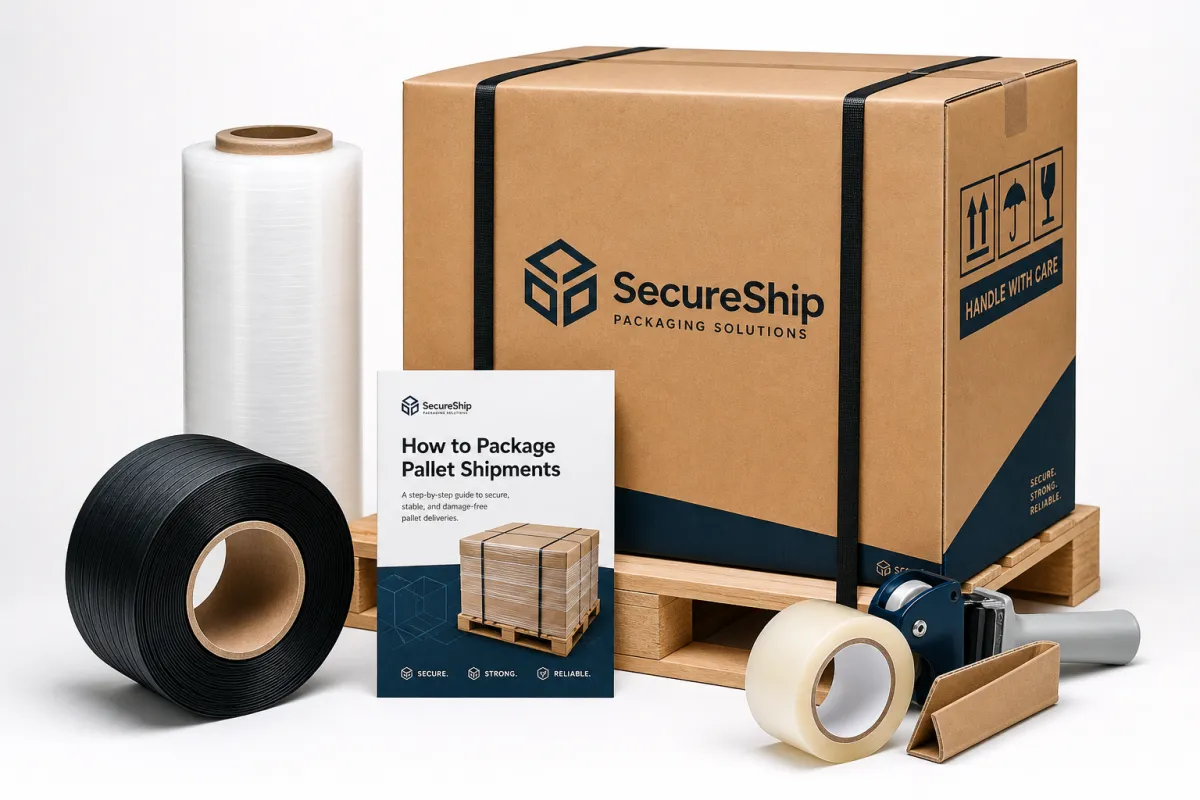
How to package pallet shipments for safe transit starts with a simple rule: build the load so it can move as one unit. That means a sound pallet, a squared-off stack, and securement that limits shifting during forklift handling, trailer vibration, and terminal transfers. If the cartons can slide before the wrap is finished, the build is already behind. I have watched otherwise clean freight fail because the bottom layer was never properly squared. It is a small mistake with a big appetite.
The fastest way to reduce damage is not a mystery formula. It is a sequence of practical choices. Use the right pallet footprint, keep heavy cartons low, protect the edges, and apply stretch wrap with enough tension to contain the load. Add corner boards or straps when the freight is tall, dense, or likely to settle. Those small decisions matter more than any single piece of tape.
Think of the whole palletized freight unit as one object, not a pile of boxes. That shift in perspective changes everything: how the stack is arranged, how the labels are placed, and how the carrier handles the shipment. A load that behaves like one object is easier to move, easier to stage, and far less likely to create a claim later.
How to Package Pallet Shipments
The simplest definition comes first: pallet shipments are goods stacked on a pallet and secured so the load moves as one unit. That sounds basic because it is basic, and that is exactly why how to package pallet shipments matters. LTL carriers place multiple shipments in the same trailer, which means your freight is handled, scanned, staged, shifted, and handled again. A loose stack is asking for damage long before it reaches the receiving dock.
Pallet freight usually beats parcel shipping once the shipment becomes too heavy, too bulky, or too awkward for a small-package network. A few cartons of apparel can still go parcel. A few hundred pounds of printed cartons, kits, or product usually belong on a pallet. There is no mystery formula. Weight, dimensions, handling risk, and landed cost do the sorting.
The core of how to package pallet shipments is simple enough to remember under pressure: keep the load square, protect the weak points, and stop motion. That means the base needs to be solid, the middle needs compression, and the top needs restraint or coverage so the stack does not drift when nudged. If the cartons are sliding before wrap even starts, the build already has a problem.
Carrier compliance matters too. Unstable freight can be rejected, repalletized, or delayed, and none of those outcomes are friendly to margin. A pallet that looks unsafe can be flagged before it leaves the dock, which turns a packaging mistake into a scheduling problem and sometimes a billing dispute. In practice, how to package pallet shipments is protection, documentation, and common sense working together. Freight is not glamorous. It is expensive when handled badly.
The strongest pallets often look a little too disciplined to casual eyes. Tight corners. Clean edges. No random overhang. No loose straps flopping in the breeze like the load was assembled during a fire drill. That visual order is not cosmetic. It usually signals a unit load that will hold up under actual transport.
Printed cartons and branded packaging add another layer. Crushing the outside of the box can ruin presentation even if the contents survive. That is why how to package pallet shipments for retail-facing goods often needs more edge protection than a plain industrial load. A shipment can arrive technically intact and still look like it went through a wrestling match.
How to Package Pallet Shipments: Process and Timeline
The cleanest way to think about how to package pallet shipments is as a sequence: measure the load, choose the pallet, build and secure the stack, label it, then schedule pickup. Skip a step and the rest becomes harder. Freight rarely forgives improvisation.
For a simple shipment, same-day prep can work if the cartons are ready, the pallet is on site, and the carrier details are already confirmed. Standard freight usually needs 24 to 48 hours because someone still has to check dimensions, gather materials, and stage the load correctly. Export paperwork, custom crates, or special handling stretch that window. That is not a delay. It is the job.
Missing weight and dimensions slows people down more than almost anything else. So do bad labels, a missing dock appointment, or a pallet that is too tall, too weak, or too wide for the carrier's limits. Those are avoidable problems, which makes them more irritating. A shipment can be built well and still sit on the dock because the bill of lading says one thing and the pallet count says another.
Timing influences packaging decisions too. If tape needs a little set time, stage the pallet so it is not moved too early. If corner boards, straps, or top caps are required, keep them close before the stack starts. Once people begin hunting for materials mid-wrap, shortcuts creep in. Loose supplies scattered across the floor are basically a signal to rush.
Labor planning benefits from a realistic breakdown. A simple pallet build might take 10 to 20 minutes once the cartons are boxed and sorted. A dense or mixed-SKU shipment can take 30 to 45 minutes. Add time for weighing, labeling, photos, and booking the carrier. How to package pallet shipments properly is never just "wrap it and go."
Timing becomes even more serious when the freight is tied to a launch, a trade show, or a retail receiving window. Late freight can cost more than the product itself when inventory is time-sensitive. That is why how to package pallet shipments should be planned backward from pickup, not forward from "we will finish it when we can."
Key Factors That Affect Pallet Packaging
The first factor in how to package pallet shipments is the load itself. Total weight matters. Center of gravity matters too. A 1,200-pound pallet on a small footprint behaves very differently from a 600-pound pallet spread across a wider base. Carriers care about both, and the packaging plan should care first.
Pallet footprint comes next. A standard 48 x 40 pallet is common in North America, but the right size depends on the product. Once the load hangs over the edge by more than a small amount, the corners become easy targets for crushing and fork damage. The practical rule is simple: keep the freight inside the footprint unless there is a real reason not to. Short on pallet sizes is not a real reason.
Product type changes the build. Fragile goods need edge protection and a more controlled stack pattern. Dense products, such as bottled goods or boxed hardware, need stronger pallets and better compression because their own weight encourages settling. Mixed SKUs are trickier because uneven box sizes do not lock together naturally, which means the layer plan needs more attention than usual.
Carrier route matters too. A local shuttle on a short lane is not the same as long-haul LTL moving through several terminals. Weather changes the risk profile as well. Rain, humidity, and cold can weaken cartons, soften labels, and affect adhesive performance. Once the load is likely to be handled several times, the packaging needs to assume more abuse than anybody would prefer.
Materials make a visible difference. Stretch wrap provides the baseline. Corner boards add compression and edge protection. Straps help hold a load that wants to drift. Anti-slip sheets reduce layer movement. Top caps and top sheets add protection from dust and moisture. Pallet quality matters more than people admit, because a damaged pallet can spoil every other decision stacked on top of it.
For transport testing methods, the ISTA site is worth a serious look. Their protocols treat packaging like a real transport problem rather than a theory exercise. If wood sourcing matters in your supply chain, the FSC standards help frame certified material choices without turning sustainability into decoration.
Three questions usually decide the spec: how much the load weighs, how far it travels, and how fragile the outer cartons are. If any of those is severe, the packaging should get stronger. That is not overengineering. That is avoiding the kind of claim that eats the margin off a whole week of clean shipments.
Presentation still matters even in freight. Retail-ready cartons, merch kits, and branded boxes should arrive without scuffs, crushed corners, or bent tops. The contents can be perfect while the outside looks tired. Buyers, stores, and kitting teams notice that difference immediately, and so does anyone trying to photograph incoming inventory for a receiving record.
How to Package Pallet Shipments Step by Step
Here is the practical version of how to package pallet shipments without the fluff. Step one: inspect the pallet. Look for broken boards, cracked stringers, loose nails, moisture damage, and contamination. If the pallet is visibly weak, do not build on it just because it is close. Bad pallets fail in ways that feel almost insulting.
Step two: set the bottom layer correctly. Heavy boxes go low. Softer cartons should not carry the base of the stack. Align the edges so the load forms a squared-off block instead of a random tower with ambitions. The cleaner the cube, the easier it is to secure. Freight dislikes strange shapes.
Step three: build a stable stack pattern. Interlock cartons where it helps, but do not force a pattern that crushes the boxes or creates voids. For many shipments, a column stack works best because it sends weight straight down. Mixed product may need alternating sizes so the load does not walk around on the pallet. The point of how to package pallet shipments is not to solve a puzzle. It is to create a rigid unit load.
Step four: add containment. Stretch wrap is the base layer, but the wrap has to be tight enough to hold the load together without distorting cartons. Start at the pallet base and work upward with overlapping passes. Tall loads or smooth cartons often need corner boards before wrapping so the edges do not get chewed up. Dense freight that tends to settle may need straps to keep the unit load locked in place.
Step five: protect the top. A top sheet or top cap can reduce dust, dirt, and incidental moisture. Softer tops or mixed cartons sometimes benefit from a top board that adds compression and keeps the upper layer from shifting. Small detail, real payoff. It is one of the most skipped parts of how to package pallet shipments.
Step six: label clearly. Place shipping labels on at least two sides if carrier rules allow it, and make sure barcodes are readable. If the shipment needs special handling, mark it visibly. Fragile? Mark it, but do not trust the label alone. Labels are instructions, not armor.
Step seven: do a push test. Nothing fancy. Push the load from multiple sides. If it wobbles, shifts, or leans, it is not ready. A good pallet should feel like one solid object, not a stack of cartons pretending to be a freight unit. If you can move the top layer by hand, the carrier can move it faster and with less patience.
Step eight: document the shipment. Record weight, dimensions, pallet count, and photos before pickup. That helps with claims, billing questions, and any disagreement over how the freight left the dock. For anyone serious about how to package pallet shipments, documentation is not bureaucracy. It is evidence.
One practical note: if the load may sit before pickup, avoid wrapping the very top in a way that traps moisture. A tight build is good. A damp build wrapped like a greenhouse is not.
How Much It Costs to Package Pallet Shipments
The cost side of how to package pallet shipments is where people start estimating from memory, which is usually a mistake. Real packaging cost has several pieces: the pallet, wrap, tape, corner boards, straps, top protection, labor, and any equipment time needed to stage the load. If only the wrap gets counted, the math is flattering rather than accurate.
For low-risk freight, basic materials can stay inexpensive. A standard or used pallet may cost very little in volume, stretch wrap might add only a few dollars, and tape is minor. Labor changes the picture. Even a simple pallet takes time, so a straightforward carton load often lands in a rough range of $15 to $45 in materials and labor combined, depending on how standardized the operation is and whether supplies are bought in bulk.
Standard freight that needs more containment usually costs more. Corner boards, stronger wrap, straps, and a cleaner build can push the total into the $40 to $120 range for materials and labor, again depending on volume and handling needs. That range is not glamorous. It is just useful. How to package pallet shipments cheaply is easy. Doing it cheaply without causing damage is the hard part.
Fragile, export, or high-value loads climb higher because the build may require heavier pallets, extra cushioning, top caps, moisture barriers, or custom crating. Those shipments can move well above $150 once materials and labor are included. That is not waste. It is risk reduction. If the freight is valuable enough to protect, it is usually valuable enough to package properly.
| Packaging Option | Typical Material Range | Typical Labor Range | Best For |
|---|---|---|---|
| Basic pallet wrap-only build | $8-$20 | $10-$25 | Durable cartons, short lanes, low damage risk |
| Standard secured pallet | $20-$60 | $20-$60 | Most LTL freight, mixed handling, longer transit |
| Heavy-duty protected pallet | $60-$180 | $50-$120 | Fragile goods, dense loads, higher value shipments |
| Custom crate or export-ready unit | $120-$400+ | $75-$200+ | Oversized, international, or highly sensitive freight |
The cheapest build is not always the lowest-cost build. One damage claim can erase the savings from several clean shipments. A rework can do the same. So can a refusal at the dock. That is why how to package pallet shipments should be measured against total landed cost, not just the line item on the packing supply invoice.
Indirect costs matter too. Bad packaging can trigger reclassification if the dimensions are wrong. It can create accessorial fees if the carrier needs liftgate service, extra handling, or repalletizing. It can also slow down your receiving team, which becomes a hidden cost the moment a dock is backed up with freight that should never have arrived in that condition.
If you want to save money without inviting damage, standardize pallet sizes, buy wrap and corner boards in volume, train staff on load patterns, and measure every pallet before pickup. That approach usually beats improvisation. It also keeps the process from depending on one person who "just knows how to make it fit." Useful person. Not a process.
Freight savings usually come from fewer mistakes, not from thinner materials. If the packaging is too light for the lane, the shipment will explain that later, usually through a claim or a damaged return.
In practice, how to package pallet shipments economically means choosing the lightest build that still survives a real handling test. Not a theory test. A real one.
Common Mistakes When You Package Pallet Shipments
The classic failure in how to package pallet shipments is overhang. Boxes that extend past the pallet edge get crushed by forks, stacked badly in transit, and damaged at the corners. Overhang also makes the load feel unstable, which invites more abuse. It is one of those mistakes that seems small until the pallet arrives looking as if it backed into a wall.
Uneven weight distribution causes plenty of trouble too. If the heavy cartons sit on one side, the center of gravity shifts off-center and the pallet becomes easier to tip or rack up damage on one face. Tall loads with a narrow base are just as troublesome. They sway. They lean. They make warehouse workers nervous, usually for reasons that turn out to be correct.
Loose wrap is another familiar problem. Wrap applied without enough tension or overlap stabilizes nothing. It only makes the pallet look finished. That is a poor disguise. A properly wrapped pallet should feel compact, with enough containment that the cartons do not shift when the pallet is nudged. If the wrap peels away with almost no resistance, it is decorative. Decorative wrap is not the goal.
Stretch wrap alone is also a false economy when the shipment really needs corner boards, straps, or a stronger pallet. Wrap helps. Wrap does not perform miracles. Dense or tall pallets often need more than one securement method because each part does a different job. Wrap contains. Corner boards protect. Straps compress. The point of how to package pallet shipments is to combine the right tools instead of hoping one material solves everything.
Paperwork mistakes create their own kind of damage. Missing ship-to information, unreadable barcodes, wrong pallet counts, and unclear handling notes all slow the shipment down. Carrier staff are not going to infer meaning from a blurry label. If the freight needs to stay upright, stay dry, or receive extra care, that needs to be visible and consistent with the bill of lading.
Weak pallets are easy to underestimate. One broken board can throw off stability when a forklift enters from the wrong side. One cracked stringer can fail under dynamic handling. Inspection matters before the load leaves the dock. How to package pallet shipments is not only about what sits on the pallet. The pallet itself has to earn the job.
Another mistake deserves mention: assuming the carrier will fix the load for you. Sometimes they will, often for a charge. Sometimes they refuse. Either result is worse than staging the load correctly at the dock. Freight is not a cleanup service for a bad build.
Next Steps Before You Ship a Pallet
Before pickup, run a simple checklist. Measure the load. Weigh it. Photograph it from all sides. Confirm that the pallet is strong enough for the trip. Check that the cartons are aligned and the top layer is not floating around like it has no plan. Do that every time and how to package pallet shipments becomes much easier to standardize.
Carrier rules should be confirmed before the truck arrives. Height limits, weight limits, pallet count, labeling, and accessorial requirements all need a quick check. A shipment that fails on paperwork or handling rules is still a failure, even if the wrap is gorgeous. Yes, gorgeous pallets exist. They can still be wrong in exactly the ways carriers notice first.
Fragile, oversized, and export freight usually deserves an upgrade now rather than a lesson later. If the cartons are delicate, add corner boards and a stronger base. If the shipment is tall, cut the height or add compression. If the load will travel far, build for movement rather than comfort. That is the part teams miss most often. They package for the dock, not for the journey.
Standards help keep guesswork from taking over. ISTA test methods are useful for thinking about transport hazards, and FSC-certified materials may matter if your sourcing story needs to show where wood components came from. Standards do not replace experience, but they do keep the process from drifting into habit.
For branded goods, printed packaging, and retail inventory, the outside of the carton is part of the product experience. Scuffed boxes, crushed corners, and bent tops make a shipment look careless even when the contents are fine. How to package pallet shipments well protects function and presentation, and that combination matters more than people admit.
The takeaway is simple enough to remember under pressure: how to package pallet shipments is about reducing movement, not just covering boxes. Build the pallet as a stable unit, protect the weak points, document the load, and respect the carrier's handling rules. Do that, and freight gets a lot less annoying.
FAQ
How do I package pallet shipments for LTL freight?
Start with a pallet that matches the load footprint and is in good condition. Stack the heaviest cartons on the bottom, keep the edges aligned, and secure the load with stretch wrap plus corner protection if the boxes can move. If the pallet wobbles during a push test, it is not ready for pickup. That is the short answer, minus the sales pitch.
What is the best pallet type for heavy shipments?
Choose a strong hardwood or grade-A pallet with intact stringers and no cracked boards. The pallet should fit the load without major overhang so the weight stays centered. For very dense freight, confirm the pallet can handle both static weight and handling stress from forklifts and terminal transfers. A weak pallet under a heavy load is a cheap mistake with an expensive ending.
How high can you stack boxes on a pallet?
Stack only as high as the load stays stable and within carrier limits. Lower, denser stacks are safer for fragile goods and mixed cartons. If the top layer starts leaning or the stack narrows too much near the top, reduce the height or add straps and corner boards. Tall works only when tall still behaves like a single unit.
How much does it cost to package pallet shipments?
Basic packaging costs are usually driven by the pallet, wrap, tape, and labor. Extra protection like corner boards, straps, and top caps increases cost, but it can prevent claims and rework. The cheapest build is not always the least expensive overall if it triggers damage, delays, or repalletizing charges. Freight bills have a way of teaching that lesson in public.
How long does it take to prepare a pallet shipment?
A simple pallet can often be built the same day if the materials and paperwork are ready. Most standard shipments need 24 to 48 hours once you include measuring, wrapping, and scheduling pickup. Custom, fragile, or export shipments can take longer because they need more prep and documentation. Good planning cuts the chaos. It also turns how to package pallet shipments into a process instead of a scramble.
Related packaging resources
Use these related guides to compare specs, costs, quality checks, and buyer decisions before making the final call.