A customer may handle the pouch, box, tray, or travel case before touching the necklace inside. That makes logo Patches Unit Cost for jewelry brands more than a trim expense. It is a merchandising decision tied to perceived margin, giftability, and the way a small product feels at point of sale.
Jewelry packaging is physically small. Obvious, but consequential. A bracelet pouch, ring box, or travel roll has far less usable branding space than an apparel hangtag, cosmetics carton, or giftware sleeve, so every detail has to earn its place. A 1-inch woven patch can carry more tactile authority than a flat printed sticker if the artwork, backing, and material are chosen correctly.
That does not mean every jewelry brand needs the thickest or most expensive patch. Often, the better buying decision is cleaner construction: a woven label on a velvet pouch, a debossed faux leather patch on a watch roll, or a slim printed fabric label on a cotton drawstring bag. The right patch can protect brand recognition and make packaging feel reusable after the sale. The wrong one becomes a stiff, expensive distraction.
Logo Patches Unit Cost for Jewelry Brands Starts With Perceived Value
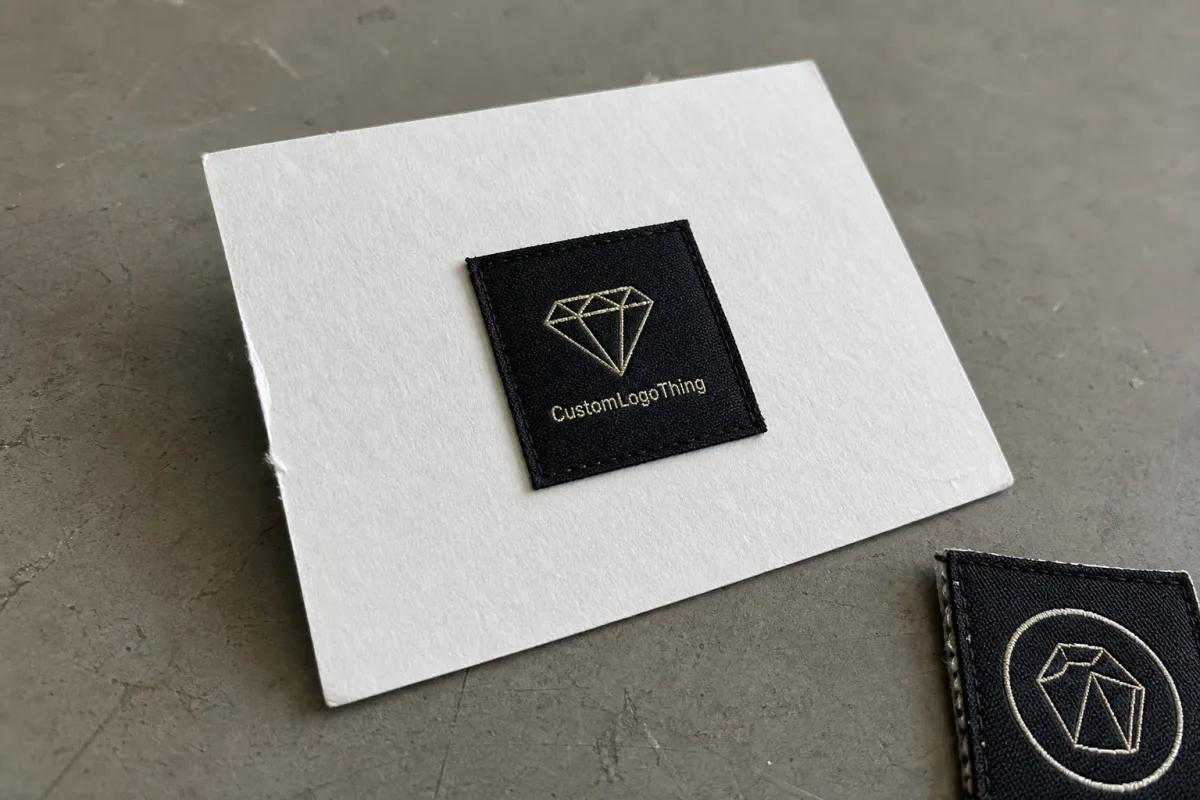
Here is the retail problem: a $40 bracelet, a $200 pendant, and a $1,000 ring can all be damaged by packaging that feels temporary. Not physically damaged. Commercially damaged. If the pouch looks flimsy or the logo label is fuzzy, crooked, or peeling, the brand has already lost some pricing authority.
Flat printing still has a role. Printed boxes, tissue, cards, and stickers can be efficient, especially at high volume. Patches add something different: texture, permanence, and boutique tactility. A woven patch stitched to a velvet pouch suggests “kept item.” A faux leather logo patch on a travel case suggests “part of the product experience.” A PVC label on a festival jewelry kit suggests durability rather than disposable wrapping.
The economics are practical. A patch may add a few cents to several dollars to the packaging cost per piece, depending on size, construction, quantity, backing, and finishing. That increase is not automatically justified. It has to be weighed against the selling price, wholesale presentation, reorder rate, gifting expectations, and the chance that customers will reuse the packaging.
Packaging buyer rule: do not judge a patch only by the invoice line. Judge it by whether it improves durability, brand recall, color accuracy, and the perceived value of the jewelry inside.
Strong buyers evaluate patch cost alongside customer-facing function. Will the label survive shipping abrasion? Is the thread color close enough to the brand palette? Is the patch too stiff for a satin pouch? Can a customer reuse the case without the logo lifting after two weeks? Those details decide whether the patch is decoration or a useful brand asset.
Patch Types That Fit Jewelry Packaging Without Overbuilding
Patch choice should start with scale. Jewelry logos are often delicate: thin serif type, monograms, fine line icons, botanical marks, initials, or small wordmarks. The construction that works on a denim jacket may fail on a 0.75-inch pouch label.
Woven patches are often the strongest fit for fine logos and small typography because thread density can capture detail better than raised embroidery. If the brand mark includes thin lettering or a compact crest, woven construction usually gives cleaner edges and better legibility at small sizes.
Embroidered patches bring more visible texture. They suit bolder logos, western jewelry lines, bridal accessory brands, heritage marks, and handmade collections where craft is part of the story. The limitation is bulk. Raised thread can close up tiny letter counters, especially when the finished patch is under about 1 inch wide.
Faux leather and genuine leather patches are useful for watch rolls, travel cases, ring organizers, necklace pouches, and higher-ticket gift packaging. Faux leather often keeps unit cost lower and gives more consistent color. Genuine leather has natural variation, which some premium brands like and others reject because it complicates color control and repeat orders.
PVC or rubber patches make sense for sporty, waterproof, festival, permanent jewelry, or travel-focused lines. They are durable and dimensional, but they can feel too heavy for delicate satin or velvet. Printed fabric patches can handle gradients, tiny artwork, or photographic effects better than thread, though they usually feel flatter than woven or embroidered options.
| Patch Type | Best Jewelry Packaging Fit | Typical Strength | Watch-Out |
|---|---|---|---|
| Woven | Velvet pouches, cotton bags, display cards | Fine detail and small type | Less raised texture than embroidery |
| Embroidered | Handmade lines, bridal, heritage branding | Tactile thread texture | Can overwhelm tiny marks |
| Faux leather | Travel rolls, watch holders, rigid cases | Premium look with controlled cost | Heat and adhesive compatibility must be checked |
| PVC | Reusable cases, sporty packaging, festival kits | Durability and moisture resistance | May feel heavy on soft pouches |
| Printed fabric | Artwork with gradients or very complex graphics | Color range and image detail | Less dimensional feel |
Overbuilding is a common mistake. A thick patch may look impressive on apparel, yet feel clumsy on a ring box or delicate pouch. The best construction is usually the lowest-cost option that still protects legibility, brand feel, and attachment performance.
Specifications That Move the Price Up or Down
A patch quote is built from variables. The major ones are size, shape, thread count, base material, backing, border type, color count, logo detail, order quantity, and packing method. Change two or three of those, and the unit cost can move quickly.
Size is not always linear. A 0.75-inch patch is not automatically half the price of a 1.5-inch patch because setup charges, digitizing, cutting, proofing, and handling still exist. Small pieces can even be harder to produce cleanly because the tolerance window is tighter. A tiny registration shift that would disappear on an apparel patch may be obvious on a ring pouch.
Shape matters too. Circles, rectangles, squares, and simple ovals are usually more efficient than intricate contours with narrow points or internal cutouts. A laser-cut floral outline may look beautiful in a render, but production can add tooling fees, slower handling, and higher scrap risk.
Backing choices should match the packaging substrate:
- Sew-on: dependable for reusable pouches, cotton bags, and fabric travel cases.
- Iron-on or heat press: efficient for compatible fabrics, but must be tested on velvet, satin, and synthetic blends.
- Adhesive: useful for short-term display, cards, inserts, or rigid boxes, but weaker on textured fabric.
- Hook-and-loop: rarely needed for jewelry packaging unless the label is designed to be removable.
- No backing: practical when the pouch maker or case factory will attach the patch during assembly.
Borders affect both price and appearance. Merrowed edges are cost-efficient for standard circles and rectangles. Laser-cut edges suit custom silhouettes. Satin-stitched borders can look more refined on boutique jewelry packaging, but they add production time and may not be necessary for every order.
Color and detail need a sober review. Metallic thread can lift perceived value, but it may increase unit cost and can be less flexible than standard thread. Gradients usually require woven simulation, printed fabric, or artwork simplification. Tiny lettering may need a larger patch, a bolder typeface, or fewer words.
Before requesting pricing, confirm finished size, substrate, attachment method, Pantone targets, logo file format, and whether the patch must survive shipping abrasion or daily reuse. ASTM packaging and material test methods can be relevant when brands formalize durability expectations; buyers can review standards activity through ASTM International.
Pricing, MOQ, and Unit Cost Breaks for Jewelry Labels
Quantity usually drives unit cost first. Construction, size, and finishing complexity come next. That is why Logo Patches Unit Cost for jewelry brands should be quoted at more than one quantity instead of treated as a fixed number.
Many custom patch orders become more efficient once setup and sampling are spread across a meaningful production run. A test batch of a few dozen pieces may be possible, but the cost per piece will often look high because the same proofing, machine setup, and handling steps are being absorbed by fewer units.
Jewelry startups often ask for the lowest MOQ because cash is tight and packaging demand is uncertain. Established brands usually chase the better bulk pricing break for seasonal packaging, wholesale accounts, influencer mailers, and launch kits. Neither approach is wrong. The mistake is ordering 300 pieces without checking whether 500 pieces would sharply lower the unit cost.
| Quantity Tier | Typical Pricing Behavior | Best Use | Buyer Caution |
|---|---|---|---|
| 100 pieces | Higher setup absorption per unit | Launch testing, sample kits, limited drops | Cost per piece may look inflated |
| 500 pieces | Cleaner unit cost structure | Standard small-brand reorder | Confirm storage and packaging forecast |
| 1,000+ pieces | Better bulk pricing potential | Wholesale, seasonal programs, multi-channel packaging | Lock artwork before committing |
Hidden cost factors deserve attention. Rush production, metallic thread, complex contour cutting, adhesive backing, individual polybagging, multiple design versions, and unusual color matching can all increase the quote. Physical samples may add cost, but on high-value packaging they can prevent far more expensive remakes.
A clean quote request should include artwork, dimensions, quantity tiers, patch type, backing preference, packaging substrate, delivery address, and target in-hands date. If those details are missing, the supplier has to guess. Guessing creates vague pricing, and vague pricing makes margin planning harder.
Custom Logo Things focuses on factual quoting: cost drivers, tradeoffs, and the most efficient production route. If a woven patch gives the brand better legibility at a lower price than embroidery, that is the better recommendation.
Process and Timeline From Artwork Review to Finished Patches
The production path is straightforward, but each step protects money. A typical order moves through inquiry, artwork review, material recommendation, quotation, digital proof, optional physical sample, production approval, manufacturing, quality check, and shipping.
Artwork readiness can speed up the front end. Vector files such as AI, EPS, PDF, or SVG usually allow faster quoting and proofing. Low-resolution screenshots, social media logos, or flattened images may need cleanup before production. That cleanup can affect timing and sometimes cost.
During proofing, review logo proportions, thread or material colors, border style, backing, finished size, and placement. Do not approve a patch proof only because the logo looks correct on screen. A 1-inch woven patch behaves differently from a 5-inch digital mockup.
Timeline depends on whether the brand needs a digital proof only or a physical pre-production sample. Digital proofing is faster. A physical sample is slower, but it can reveal whether the patch is too stiff for a pouch, too large for a box lid, or too textured for a refined bridal brand.
Several factors can change turnaround: quantity, seasonal production load, patch complexity, material availability, sample rounds, approval delays, and shipping method. Brands should order patches before final pouch or box assembly deadlines, not after. In many programs, labels must arrive at the pouch maker, sewing facility, or packaging assembler before the finished packaging can be completed.
Build in internal approval time. A founder may care about logo nuance. A merchandiser may care about shelf consistency. A wholesale team may care about how the patch photographs in line sheets. If all three people need to approve the same proof, approval is not a five-minute task.
For shipping performance and transit testing, brands that move larger wholesale kits may review resources from ISTA, especially if packaging assemblies need to withstand parcel handling or distributor movement.
Quality Checks That Prevent Expensive Small-Format Mistakes
Jewelry branding leaves little room for error. Tiny marks, thin scripts, metallic palettes, and pale neutrals can fail quietly. The patch may be technically “correct” while still looking weak at final size.
Key quality checks include logo legibility, thread density, edge finish, backing adhesion, color match, patch thickness, stitch consistency, and attachment compatibility. For logo patches Unit Cost for Jewelry brands, quality control is directly tied to waste. A failed adhesive, puckered pouch, or unreadable monogram can force a reorder and delay packaging assembly.
A logo that works on a website header may fail on a 0.75-inch patch. Letter counters close up. Fine lines disappear. Spacing that looked elegant in digital form becomes noise in thread. Woven construction can help, but some artwork still needs simplification.
Color control needs realistic expectations. Thread, faux leather, genuine leather, PVC, and printed fabric do not reproduce color the same way ink does on coated paper. Close matching is often possible. Exact digital-screen matching should not be assumed. Pantone references help, but material behavior still matters.
Attachment testing is just as important as logo testing. Satin pouches, velvet bags, cotton drawstrings, vegan leather cases, and rigid cardboard boxes interact differently with heat, sewing, and adhesive. Adhesive may lift on textured fabric. Heat may damage delicate synthetics. Sewing can pucker thin substrates if the patch is too stiff or the stitch tension is wrong.
Apparel labels can often tolerate larger dimensions. Jewelry packaging compresses brand information into a smaller branding field, so small errors are magnified. A supplier should review artwork and application details before production rather than treating every patch like a generic clothing label.
How Custom Logo Things Approaches Jewelry Patch Orders
Custom Logo Things produces Custom Logo Patches, custom labels, and packaging-style branding elements used across jewelry presentation. The goal is not to push the most expensive option. The goal is to match the patch to the package, the price point, and the attachment method.
Jewelry brands often need smaller, cleaner, more tactile branding than apparel brands. A patch for a hoodie can be bold and oversized. A patch for a ring pouch may need to be slim, soft, and readable from 12 inches away under retail lighting.
Use cases vary: velvet pouches, cotton drawstring bags, leatherette cases, travel rolls, watch holders, ring boxes, gift sets, retail displays, and wholesale packaging kits. One brand may need woven patches for everyday pouches and faux leather patches for higher-ticket gift sets. Another may need PVC labels for reusable travel cases.
Consultative quoting helps buyers compare woven versus embroidered, faux leather versus genuine leather, adhesive versus sew-on, and low MOQ versus better unit cost breaks. The best supplier is not always the one with the lowest first quote. It is often the one that prevents remakes, delays, and packaging incompatibility.
Custom Logo Things can also help align patches with other branded packaging components such as boxes, bags, cards, stickers, tissue, and labels. For examples of how branding details change presentation across product categories, review the Case Studies section.
For buyers comparing jewelry patch pricing, the practical advantage is clarity. Submit specifications, compare production routes, and make the order decision with real numbers instead of vague premium claims.
What to Confirm Before You Request a Patch Quote
Prepare the basics before asking for pricing: logo file, target dimensions, packaging material, quantity range, preferred patch style, backing method, delivery location, and deadline. A complete request usually gets a cleaner answer and fewer follow-up questions.
Send photos or samples of the pouch, box, case, or display item where the patch will be applied. Application context changes the best construction choice. A patch that works on cotton may not work on velvet. A backing that bonds well to a rigid insert may fail on a textured pouch.
Ask for two or three quantity tiers. A practical structure might include a test run, a standard reorder level, and a wholesale-ready volume. That exposes the real price break and shows whether the MOQ is helping or hurting your margin.
Use this quick decision matrix:
- Choose woven for fine detail, small lettering, monograms, and elegant marks.
- Choose embroidered for texture, handmade positioning, and bolder logos.
- Choose leather or faux leather for premium structure on cases, rolls, and gift packaging.
- Choose PVC for durability, moisture resistance, or modern reusable packaging.
- Choose printed fabric for gradients, photographic artwork, or complex color effects.
Confirm who will attach the patches: the patch factory, the pouch maker, an in-house team, or a third-party packaging assembler. That single detail can affect backing, packing method, lead time, and total landed cost.
To compare Logo Patches Unit Cost for jewelry brands accurately, submit complete specifications rather than asking for a single blind price. Custom Logo Things can review the artwork, recommend construction, and return a quote based on real cost drivers: unit cost, MOQ, bulk pricing, setup charges, tooling fees, and the application requirements of your packaging.
FAQs
What affects logo patch unit cost for jewelry brands the most?
Quantity, patch size, construction type, backing, border, material, and artwork complexity are the largest cost drivers. Small patches are not always extremely cheap because setup charges, proofing, cutting, and handling costs still apply. The fastest way to get accurate pricing is to send artwork, dimensions, quantity tiers, backing preference, and application details.
What is the best patch type for jewelry pouches and boxes?
Woven patches are usually best for small logos, fine lettering, and elegant monograms. Leather or faux leather patches work well on premium pouches, travel cases, and watch rolls. Embroidered patches suit bold marks and handmade or heritage-style jewelry brands where texture supports the product story.
Can I order low MOQ logo patches for a jewelry launch?
Low MOQ orders may be possible, but the per-unit cost is usually higher because setup is spread across fewer pieces. Quoting multiple quantities helps identify the point where the unit cost becomes more efficient. A small launch run is useful for testing, while larger reorders are better for wholesale or seasonal packaging.
How long does custom logo patch production take for jewelry packaging?
Timeline depends on artwork readiness, proof approval, sampling needs, order quantity, patch complexity, and shipping method. Digital proofing is faster than physical sampling, but samples are recommended for high-end or delicate packaging materials. Buyers should plan patches before pouch, box, or case assembly deadlines so labels arrive in time for application.
How do I reduce logo patches unit cost without lowering brand quality?
Simplify the shape, choose an efficient size, limit unnecessary specialty finishes, and order at a better quantity break. Use woven patches for fine detail instead of forcing complex embroidery into a very small area. Confirm the correct backing before production to avoid remakes, failed adhesion, or extra assembly costs.


