If you are comparing Custom Garment Bags Plastic low moq options for an apparel line, uniform program, or promotional rollout, the best place to start is not unit price. Start with the garment, the storage method, and the presentation standard you need the bag to support. A small order can still look polished, protect product well, and stay cost-controlled if the spec is built correctly from the beginning.
From a packaging buyer’s point of view, garment bags do two jobs at once. They shield clothing from dust, handling marks, and light abrasion, and they also shape the first impression in retail, warehousing, and direct-to-customer fulfillment. That is why Custom Garment Bags Plastic low MOQ orders work so well for teams testing seasonal assortments, new size ranges, or a fresh logo treatment without tying up cash in excess inventory.
There is a practical reason this category keeps growing in smaller quantities: apparel programs change faster than packaging forecasts. Size runs get adjusted, fabrics vary, and packaging has to catch up. A lower minimum order quantity gives buyers a way to test fit, look, and durability before locking into a larger purchase.
Why low-MOQ custom plastic garment bags make sense for B2B buyers
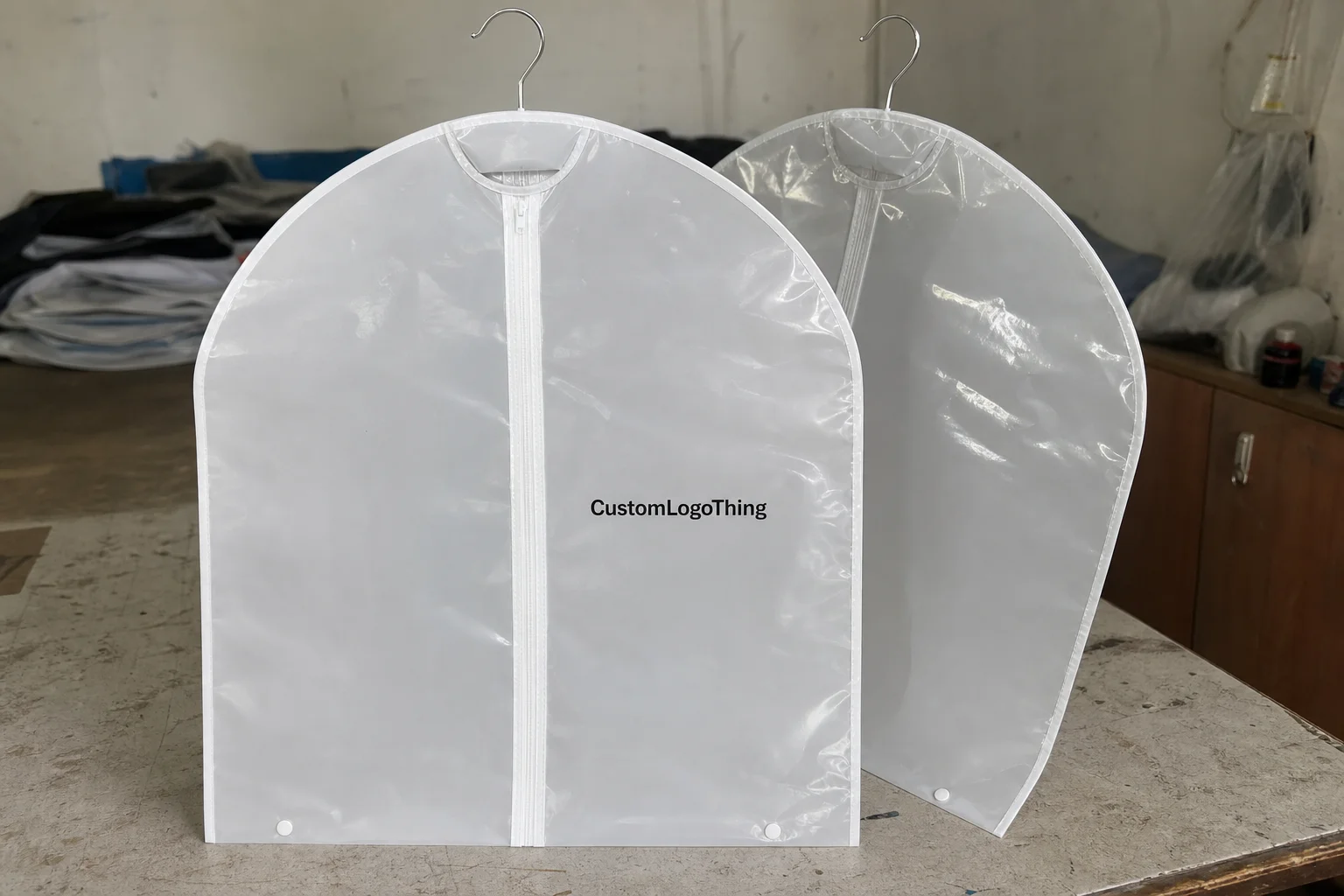
Small runs solve a real operational problem. Apparel teams rarely launch with perfect certainty about final sizing, fabric weight, fold method, or retail presentation, so committing to a large packaging order too early can create dead stock that sits in a warehouse while the product line keeps changing. With Custom Garment Bags plastic low moq, you can test a few dimensions, adjust closure style, and verify how the bag behaves on the actual garment instead of guessing from a spec sheet alone.
That matters for fashion labels, uniform suppliers, bridalwear, workwear, and promotional apparel programs. A short shirt bag and a full-length coat bag are not interchangeable. Add shoulder width, hems, embellishment, and hanger style, and the packaging math changes again. In practice, the bag is part of product packaging, not a throwaway sleeve, so it needs to fit cleanly and support the look of the line. The same logic applies to Custom Packaging Products more broadly: the package should match the product, not fight it.
“A low MOQ is only helpful if the spec is right. Ten thousand poor-fit bags cost more than one thousand well-made ones.”
There is also a branding angle that buyers sometimes underplay. Transparent or lightly printed garment bags can make apparel look more organized and more premium on arrival, which is valuable in retail packaging and during back-of-house handling. If the brand is still evolving, a smaller order lets you test logo placement, opacity, and film feel before scaling up to larger purchase volumes or a companion run of custom printed boxes for folded items.
Good low-MOQ buying starts with four questions: what garment is inside, how will it be stored, how often will it be handled, and what impression should the package create on first contact?
Those questions sound simple, but they prevent the most common sourcing errors. Buyers who skip them often end up fixing problems after production has already started, which is where a small savings disappears fast.
Material choices that affect durability, clarity, and appearance
The most common material choices for garment bags are LDPE, PP, and PVC, and each one brings a different balance of flexibility, clarity, stiffness, and cost. LDPE is usually the most forgiving for low-volume production because it folds well, handles shipping abuse reasonably, and gives a softer hand feel that many buyers prefer for apparel storage. PP tends to be clearer and crisper, which helps when the garment itself should remain visible for presentation or inventory control. PVC can offer a glossy appearance, but it is less favored in many packaging programs because of cost and environmental concerns.
For everyday handling, a softer film often performs better when the bag needs to move through distribution, be folded, or be reused by the customer. A clearer finish can work well when the garment is part of a premium presentation, especially in showroom samples or retail-ready packaging. If the garment is heavier, or if the bag will be reopened many times, thickness and seal quality become just as important as material choice. Dust resistance, scuff reduction, and tear resistance all depend on the combination, not just the resin name.
Thickness is usually discussed in gauge or mil. The useful question is not whether a film sounds “heavy duty,” but whether it matches the garment and the handling route. A lightweight blouse bag used for short-term retail storage does not need the same wall thickness as a coat cover moving through a fulfillment center. In many sourcing conversations, that difference decides both cost and performance.
If you are aligning packaging design with a broader brand system, think of the garment bag as one layer in the full presentation stack. The film color, print style, and closure method should feel consistent with labels, hang tags, tissue, and any outer mailing pack. That consistency is what makes branded packaging feel intentional rather than pieced together.
For buyers who want a sustainability reference point, it helps to review material usage and recovery practices with trusted industry sources. The EPA recycling guidance is a practical starting place, and organizations such as FSC are useful when you are comparing paper-based secondary packaging alongside plastic options.
One caveat: not every “clear” bag performs the same way. Resin blend, film finish, and sealing method all affect the final result. Two suppliers can quote the same material name and still deliver bags that feel noticeably different in use.
How to choose size, thickness, printing, and hanger features
Size is where many first-time buyers get tripped up. A bag that is too short crushes the garment and can distort shoulders or hems, while one that is too long creates excess material, waste, and a sloppier retail look. Start with the finished garment length, then add room for hanger height and bottom clearance. Shirts usually need a shorter profile, dresses need a longer drop, and coats or long uniforms often require more allowance around width and depth so the fabric does not bunch up.
Depth matters as much as length. A tailored jacket with shoulder padding can look fine on a flat measurement sheet and still fail in the actual bag because the front and back panels need more room to breathe. That is why buyers should ask for dimensions that reflect the garment in its folded or hung state, not only its catalog size.
Thickness is usually discussed in gauge or mil, and the real question is how much protection the bag needs during handling. A thinner film can work for short-term storage or light apparel, while a heavier gauge gives better resistance to scuffing and snagging in transit. If you want a practical rule, think in terms of feel and function: does the bag collapse too easily, does it tear near the hanger opening, and does it keep its shape after folding? Those questions matter more than a marketing description.
Printing should stay clean and intentional. One-color logos are often the easiest choice for custom garment bags plastic low moq because they keep setup simpler and help maintain a lower unit cost. Front-only branding is common for retail presentation, though some buyers prefer a second mark on the back panel for warehouse identification. If opacity is part of the design, make sure it supports the garment rather than hiding it completely unless that is the plan.
Then there are the functional details that can make or break usability:
- Hanger holes for quick store or warehouse hanging
- Venting for air movement in longer-term storage
- Zipper closures when repeated reuse is expected
- Bottom sealing for cleaner protection against dust and loose fibers
Some buyers want a zipper because it feels premium, but that is not always the right answer. Zippers add cost, can complicate assembly, and may not be necessary for garments that are handled once and stored. A well-cut hang hole and a solid seal are often enough for day-to-day use.
Buyers get better results when they treat these features as part of the specification, not as afterthoughts. A garment bag that looks fine on a drawing can still be awkward if the hanger opening is too tight, the seal is weak, or the print sits too close to the edge and distorts during production.
Pricing, MOQ, and unit-cost drivers for small-run orders
Low-MOQ pricing follows a simple manufacturing reality: setup costs do not disappear just because the order is smaller. Film selection, print preparation, cutting, sealing, and packing all carry fixed or semi-fixed costs, and those costs get spread across fewer units on a small run. That is why a buyer may see a unit price of roughly $0.18-$0.35 for simple LDPE bags in modest quantities, while thicker films, extra print colors, specialty closures, or custom dimensions can push the range higher.
| Spec choice | Typical effect on unit cost | Why it changes price |
|---|---|---|
| Standard size, no print | Lowest | Minimal setup and simple production flow |
| One-color logo | Moderate | Print screen or plate setup spreads across the run |
| Custom dimensions | Higher | Special cutting and changeover time |
| Heavier gauge film | Higher | More raw material per bag |
| Zipper or reinforced closure | Higher | Extra components and assembly steps |
Where can buyers save? Usually in the spec, not in the visual impact. A cleaner artwork file, fewer print colors, a standard size closest to the garment, and a sensible film thickness can make a meaningful difference. If your team is also buying other branded packaging elements, such as labels or custom printed boxes, bundling the planning stage can help reduce repeat proofing and packaging design churn, even if each item is quoted separately.
Do not confuse unit price with landed cost. Freight, packaging format, sampling, and proof charges can shift the total in a real purchase order. A low unit price with expensive shipping may not be the best value, especially for small-batch programs where the final carton count is limited. For buyers building a controlled rollout, the better question is: what is the true delivered cost per bag, in usable condition, at the warehouse door?
There is also a timing cost that often goes unmentioned. If a packaging delay holds back a product launch, the financial impact can be larger than the bag order itself. That is why experienced buyers often prefer a slightly higher per-unit cost if it comes with fewer revisions and a more predictable approval cycle.
Order process, lead time, and delivery workflow
The order flow should be straightforward: Request a Quote, confirm the spec, review artwork, approve a sample or proof, move into production, then pack and ship. If any one of those steps is unclear, the timeline stretches. That is especially true for custom garment bags plastic low moq orders, because small runs often involve more communication per unit than larger production lots.
Late changes are the biggest risk. Missing artwork files, vague measurements, and shifting requirements around thickness or closure style can turn a simple order into a back-and-forth cycle. On the production side, print setup and scheduling still have to be reserved, even when the quantity is modest. For that reason, lead time is rarely just “production time”; it is a combination of proof turnaround, material availability, machine scheduling, packing, and freight transit.
For a simple run, buyers often see something like 10-18 business days after proof approval, though that depends on the spec, the season, and shipment method. Larger or more complex jobs can take longer. If the bags need to be matched with a broader retail packaging program, the timeline should account for all components, not just the garment bag itself.
Before release, review the proof like a production buyer, not like a casual viewer. Check these points:
- Finished dimensions and tolerance range
- Logo size, placement, and orientation
- Film color, opacity, and surface finish
- Closure type and hanger opening
- Carton packing count and ship-to location
A good sample is more useful than a polished mockup. A mockup can hide issues with stiffness, folding behavior, or seal quality. A physical sample shows whether the bag opens cleanly, sits correctly on a hanger, and protects the garment without making it look overpacked.
For standards-driven buyers, it can also help to compare packaging handling requirements with relevant test expectations from organizations such as ISTA, especially if the bag will travel inside larger distribution packs or e-commerce shipments. That does not mean every bag needs lab testing, but it gives teams a better language for discussing protection and transit risk.
What to check before selecting a low-MOQ supplier
A good supplier makes low-volume buying easier. A weak supplier makes it feel like every question is a special project. The best partners give clear quoting, explain material differences in plain terms, and help you choose the right dimensions without hiding behind vague language. For a packaging buyer, that kind of clarity is often more valuable than a low headline number.
Ask how the supplier handles print registration, film thickness consistency, and seal quality. Those are the details that show up fast in a small order, because there is less margin to absorb mistakes. A bag with uneven sealing or weak edge integrity may still look acceptable in a photo, but it can fail in handling or storage. The same is true when artwork placement is off by a few millimeters; the issue is small on paper and obvious on a retail rack.
You also want help, not confusion, when it comes to terminology. If a supplier can recommend a hanger style, suggest a practical material, or explain whether a zipper closure will interfere with the garment’s hang path, that saves time. The goal is not to turn every project into a custom engineering exercise. The goal is to get the spec right once, then repeat it with confidence.
Here is a simple buyer checklist:
- Clear written quote with all major specs included
- Material guidance that matches garment weight and storage conditions
- Artwork review before production
- Realistic lead time, not a vague promise
- Ability to support repeat orders from the same spec sheet
Ask whether the supplier can explain tolerances in plain language. If they cannot state expected variation in size, thickness, or print position, that is a warning sign. Small runs depend on consistency because there is less volume to absorb a miss.
That kind of process is what buyers should expect from a competent low-MOQ packaging partner, whether they are ordering garment bags, FAQ support on spec questions, or other branded packaging items for a coordinated launch.
How to request a quote and launch the first production run
If you want a clean first run, send complete information the first time. The fastest quote request usually includes the garment type, finished dimensions, preferred material, thickness target, print colors, quantity target, and required delivery date. If the bags will sit on retail displays, be used for showroom samples, or ship directly to customers, say that upfront, because the use case changes the recommended spec.
For many buyers, asking for both a sample and a digital proof is the safest path. The proof confirms layout and measurements, while the sample helps you judge clarity, stiffness, and handling in the real world. That extra step can prevent costly adjustments later, especially when the bag has to sit beside other product packaging elements and still look coordinated.
Compare quotes carefully. A lower unit price is not always the better deal if freight, packing, or revision charges are missing from the first number. Look at the full package: bag spec, print method, carton count, sample policy, and delivered cost. That is how experienced buyers avoid surprises and keep the order aligned with budget.
Once the first run is approved, keep the same spec sheet. That is the easiest way to repeat the order, adjust volume later, and move from test quantity to a steadier production rhythm. If the line grows, you can scale into larger packaging programs with the same artwork and sizing logic, rather than starting over each time.
For brands comparing custom garment bags plastic low moq against other packaging options, the decision usually comes down to fit, handling, and repeatability. Get those three things right, and the bag becomes a practical part of the apparel program instead of just another line item.
What material is best for custom garment bags plastic low MOQ?
LDPE is a common choice when flexibility, reliable protection, and practical cost control matter for smaller runs. PP works well when clarity and presentation are more important than a soft hand feel. The right option depends on garment weight, storage conditions, and whether the bag will be reused by the customer.
Can I order printed plastic garment bags in a low quantity?
Yes, many suppliers support low-MOQ printed orders, especially when artwork is simple. One-color printing, limited placement, and standard sizes usually keep the project easier to approve and produce. Review proofs carefully so logo size and print position are correct before production starts.
How do I choose the right size for a custom garment bag?
Start with the finished garment length, then add room for hanger height and bottom clearance. Account for bulky items like coats, uniforms, or layered apparel so the bag does not stretch or bunch. If needed, ask the supplier for a size recommendation based on the garment type and storage method.
Why does unit price rise when MOQ is lower?
Setup, print preparation, and production changeover costs are spread across fewer pieces. Custom colors, extra print locations, and special dimensions can increase the cost more quickly on small runs. Simplifying the spec is often the best way to control price without hurting performance.
What should I prepare before requesting a quote?
Send the garment type, finished dimensions, quantity, material preference, print details, and target timeline. Include any packaging, sampling, or retail presentation requirements. A complete spec sheet helps the supplier quote faster and reduces revision delays.


