Matte Poly Mailers Bulk Order Planning for Book Brands
Most shipping trouble starts with fit, not print. A mailer can look perfect on a screen and still fail in fulfillment if the packed book is a little thicker than expected, the flap is under strain, or the corners have no room to breathe. That is why book merch Brands Matte Poly Mailers bulk order planning works best when it begins with real packed dimensions instead of a launch mood board.
Matte Poly Mailers have earned a place in book merch for a reason. They are light, opaque, easy to brand, and cheaper to ship than rigid packaging. They suit paperback drops, signed editions, zines, subscription boxes, and modest merch bundles. They are not the answer for everything, though. A hardcover, a boxed set, or a bundle with extra inserts can outgrow a standard bag quickly, and once a packer has to force the product into the opening, labor costs begin rising in ways that do not show up in the first quote.
The practical goal is simple: make the mailer work across hundreds or thousands of orders without slowing the line or creating a damage trail. That means choosing a size around the thickest actual shipment, then checking whether the same spec still behaves well for the smaller orders. Good packaging is usually less glamorous than people want, and much more useful than they expect.
Practical rule: approve the mailer around the thickest shipment you expect to send, not the easiest single-book case.
A smart book merch brands Matte Poly Mailers bulk order planning process answers four questions before anyone asks for pricing: what ships most often, what ships occasionally, how much surface wear is acceptable, and how many units will move before the next reorder. If those stay vague, the result is usually a pile of branded plastic that looks good in a sample photo and awkward in a warehouse.
How matte mailer specs protect books in transit
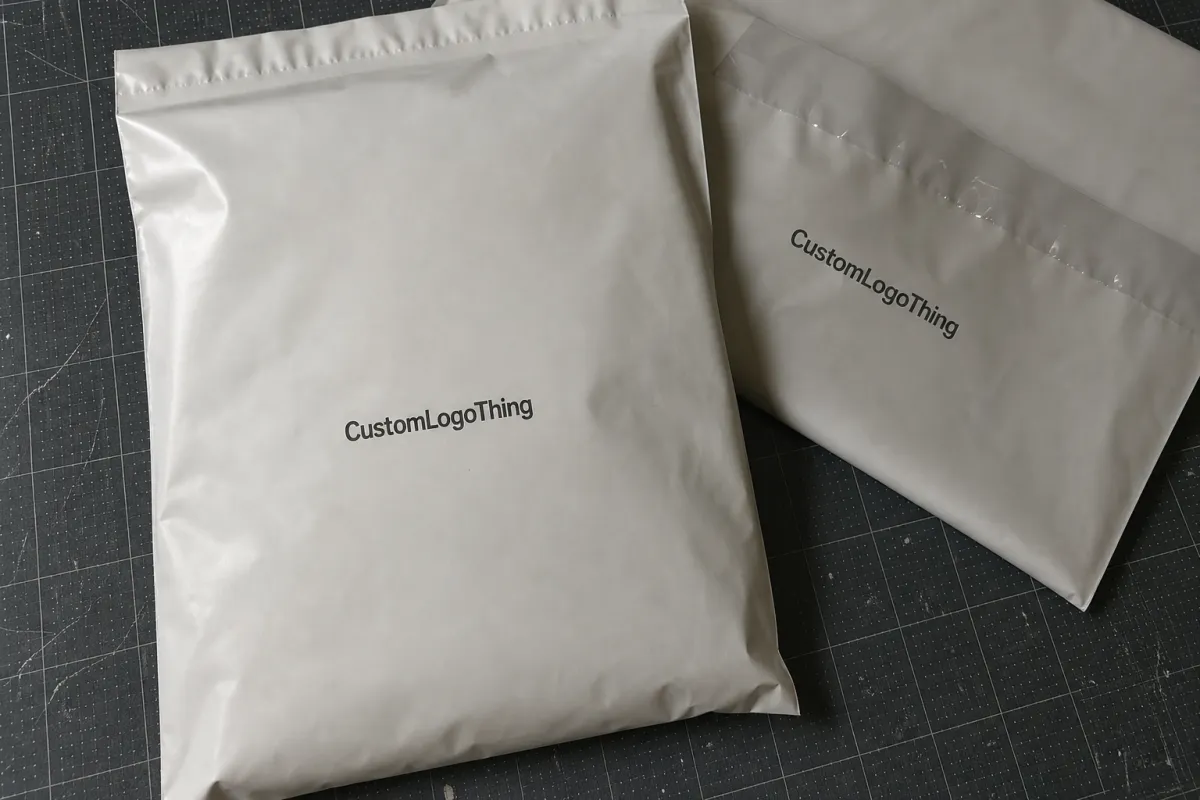
Matte poly mailers protect books through a few plain mechanics: film thickness, seam strength, tear resistance, opacity, and closure performance. The matte surface also hides scuffs better than glossy film, which matters because the outside of the package is the first physical contact a reader has with the brand. If the bag arrives heavily marked up, the rest of the experience starts on a bad note.
For standard book merch, common gauges run around 2.5 mil, 3.0 mil, and 3.5 mil. A 2.5 mil mailer can work for lightweight paperbacks, zines, and flat promotional shipments. A 3.0 mil mailer is often the middle ground for book brands that want decent resistance without pushing cost too far. A 3.5 mil mailer feels sturdier and can help with heavier bundles or higher-value shipments, though it is not always necessary and can be overkill for a simple paperback.
The item itself matters more than the category label. A single 6 x 9 paperback is a different object from a hardcover with a dust jacket, and both are different again from a bundle that includes a book, bookmark, card, sticker sheet, and folded tee. A product page may call them all “book merch,” but the package sees thickness, edges, and weight distribution, not branding language.
- Single paperback: usually needs modest clearance, often 0.5 to 1 inch around the packed item.
- Hardcover book: needs stronger corner protection and more flap depth, especially with a dust jacket.
- Merch bundle: should be sized to the thickest packed stack, not the average order.
- Subscription drop: should favor repeatable packing speed because identical orders expose weak specs fast.
The failure modes are predictable. Corners wear through when the bag is too tight or the item shifts too freely inside. Spines bend when a softcover is shipped without enough support. Adhesive peels when the flap is stretched past its comfort zone. If a mailer only works when it is packed gently and perfectly by a patient person, it is not really ready for bulk use.
If the order value is high or the product is collectible, testing is worth the time. Standards such as ISTA package testing protocols give a useful frame: drop, compress, rub, and handle the package the way a carrier will. Not every book launch needs formal certification, but the thinking behind those tests is sound. A mailer should survive ordinary rough handling, not just a nice day on a packing table.
Sizing, film gauge, and print setup that keep margins intact
Start with the finished packed size. Not the trim size. Not the product listing. Measure the book after any wrap, tissue, insert, postcard, author letter, bubble sleeve, or backing board is included. If the packed item is 9.25 x 12.25 x 0.75 inches, quote around that reality. A package spec should follow the thing that ships, not the thing that sounds convenient in a meeting.
A mailer that is too tight turns every pack into a small struggle. Staff slow down, the closure strip gets stressed, and the bag starts to look tired before it leaves the warehouse. Oversizing goes the other way. The book can slide around, corners can scuff, and some shipping services may charge more because the outer dimensions are needlessly large. A little extra room is healthy; a lot of extra room is a cost.
For many book shipments, a practical allowance is 0.5 to 1.5 inches of width and height clearance, plus enough flap depth to close without pulling the adhesive. Thicker bundles need more room. Flat zines need less. If you are using a rigid insert or corrugated pad, count that as part of the packed size. That detail gets missed often enough to be annoying.
Film gauge choices
For a standard custom poly mailer order, these ranges are sensible starting points:
| Mailer spec | Best use | Typical tradeoff | Estimated unit range at volume |
|---|---|---|---|
| 2.5 mil matte poly | Zines, thin paperbacks, low-weight promo shipments | Lower cost, lighter feel | $0.14-$0.24 at 5,000+ pieces |
| 3.0 mil matte poly | Most paperback books and light bundles | Balanced strength and price | $0.18-$0.32 at 5,000+ pieces |
| 3.5 mil matte poly | Heavier bundles and higher-value shipments | More puncture resistance, higher cost | $0.24-$0.42 at 5,000+ pieces |
| Recycled-content matte poly | Brands with sustainability requirements | May affect minimums, color, and lead time | $0.26-$0.50 at 5,000+ pieces |
These are planning ranges, not a final quote. Size, ink coverage, freight, and resin pricing can all move the number. Any supplier promising one universal price without seeing the spec is either guessing or hoping the buyer does not ask follow-up questions.
Print setup that does not create drama
Cleaner art usually produces cleaner production. A one-color logo on one side is the easiest setup to control. A repeat pattern can look excellent, but it needs proper spacing, bleed, and tolerance for slight movement on flexible film. Heavy flood print across a matte surface can raise cost and sometimes shows more variation than a simple logo mark with good placement.
For book merch brands matte poly mailers bulk order planning, it is usually wiser to begin with one or two sizes and one print version unless the brand already has stable volume across several product lines. Too many SKUs can turn a packaging order into inventory juggling. That sounds organized until it meets a reorder calendar.
Vector artwork is the safest starting point. Pantone references help if color consistency matters. Small type should be handled carefully, because tiny taglines can lose sharpness on flexible film. QR codes and barcodes should be tested at final size before approval. A code that scans only after three tries and a prayer is not useful in the packing line.
You can review size and print options on Custom Poly Mailers if you want a clearer base before requesting pricing.
Pricing, MOQ, and unit cost breakdown
Two matte mailers can look nearly identical and still land at very different prices. That is normal. The quote depends on size, film gauge, print colors, print sides, adhesive style, quantity, packing method, and freight. A 10 x 13 one-color front print is not the same purchase as a 14.5 x 19 full-coverage two-sided print, even if both sit under the same packaging category.
Minimum order quantity varies by production method and supplier setup. For custom matte poly mailers, practical MOQs often start around 1,000 to 2,500 pieces for simpler runs. Better unit pricing usually appears around 5,000, 10,000, and 25,000 pieces because setup cost spreads across more units. That lower number can be attractive, but only if the inventory will actually move.
Buying too deep is a familiar trap. A 25,000-piece order can look brilliant on a spreadsheet until the title sells 3,000 units and the rest sit in storage. Unit cost is only one side of the equation. Shelf life matters too, especially for seasonal campaigns, author launches, and merch tied to a single release window.
| Order quantity | Best fit | Planning advantage | Risk to watch |
|---|---|---|---|
| 1,000-2,500 | New title, author launch, demand test | Lower cash exposure | Higher unit cost and more frequent reorders |
| 5,000-10,000 | Established merch store or repeat campaign | Better pricing and practical inventory depth | Requires a clearer sell-through forecast |
| 25,000+ | Subscription programs and publisher-level drops | Strongest unit economics | Storage, design changes, stale inventory |
For a straightforward 10 x 13 matte poly mailer with one-color printing, buyers may see rough pricing around $0.18-$0.28 per unit at 5,000 pieces, depending on film gauge and print coverage. Larger sizes or two-sided printing can move that into the $0.30-$0.55 range. Small test runs can sit higher, sometimes $0.45-$0.90 per unit after setup and freight. Those numbers are not pleasant, but they are common enough to plan around.
Do not compare piece price by itself. Compare landed cost per packed order. That includes mailer cost, freight to the warehouse, storage, spoilage, packing speed, and returns caused by damage. A mailer that saves six cents but adds 20 seconds to each pack does not save money at scale. It just hides the cost in labor.
If volume is steady, ask about Wholesale Programs so reorder pricing, artwork files, carton quantities, and production notes stay consistent. Reorder discipline is not glamorous. It is the part that keeps the packaging from becoming a recurring surprise.
Process and timeline for a clean bulk rollout
A clean custom mailer order usually moves through the same sequence: quote, artwork review, proof, optional sample, production, packing, freight, delivery. If any of those steps get rushed or blurred, the launch date starts drifting. Packaging orders do not usually fail because one person forgot the whole project. They fail because someone assumed a later approval would be easy to fix.
Typical turnaround depends on complexity and queue position, but simple custom matte poly mailer orders often need 10-18 business days after proof approval for production. Add time for proofing, revisions, sampling, and freight. If physical pre-production samples are required, add another 5-10 business days in many cases. Air freight is faster and expensive. Ocean or consolidated freight can be slower and cheaper. That tradeoff never stops being a tradeoff.
Delays usually come from process, not machinery. Art files arrive in the wrong format. The size changes after the quote. Someone wants to add a tagline after proof approval. A second decision maker enters the conversation with one tiny revision that restarts the clock. None of that is unusual. It is just expensive if the schedule was already tight.
- Confirm packed dimensions: measure the thickest and most common shipment.
- Choose candidate sizes: usually one standard book mailer and one bundle mailer.
- Submit artwork: vector logo, color reference, and print placement notes.
- Review proof carefully: size, seal direction, logo orientation, bleed, and quantity.
- Approve production: only after the final decision maker has signed off.
- Plan delivery: confirm cartons, pallet needs, warehouse address, and receiving window.
Before releasing the order, lock the SKU count. Confirm whether one mailer design will cover all books or whether separate versions are needed for different series, imprints, or campaigns. Separate versions can look polished, but each one changes MOQ, setup cost, and storage. For book merch brands matte poly mailers bulk order planning, fewer versions usually mean fewer surprises.
Color references need realistic expectations. Matte film does not behave exactly like coated paper. If brand color is critical, provide a Pantone target and accept that flexible film printing has tolerances. A supplier should explain whether flexographic, gravure, or digital print is being used and what that means for fine detail, ink density, and registration.
Sustainability claims should stay precise. Recyclable, recycled-content, compostable, and FSC-certified paper components are different things. If paper inserts or labels are involved, standards from FSC may matter. For plastic mailers, check local recycling rules and avoid vague claims that customers can challenge easily.
What a supplier should prove before you place the order
A useful supplier does more than say yes. That answer is cheap. The better sign is whether they can explain the tradeoffs without dressing them up. If you ask for a low MOQ, they should tell you what happens to unit cost. If you want full-coverage two-sided printing, they should flag registration tolerance and ink coverage. If your bundle is thick, they should ask for packed dimensions before naming a size.
Ask for samples. Ask for print examples. Ask how sizing tolerance is handled. Poly mailers are flexible products, so some dimensional variation is normal, but there should still be a stated range and a quality control process. If you are shipping hardcovers, it is reasonable to ask whether corner protection or a paperboard insert is recommended. Sometimes the answer is not a thicker bag. Sometimes the answer is better protection inside the bag.
- Quote clarity: size, gauge, quantity, print colors, print sides, setup, packing, and freight should be visible.
- Proof control: artwork placement, orientation, seal direction, and color notes should be documented.
- Sample support: photos, swatches, or physical samples should be available before large runs.
- Reorder consistency: artwork files and production notes should stay on file for later runs.
- Communication: updates should not disappear after the deposit clears.
Book merch buyers should also ask about carton packing. If 5,000 mailers arrive in cartons of 500, your warehouse handles them differently than cartons of 1,000. Carton size affects receiving, storage, pick-face setup, and reorder timing. That detail seems minor until a launch is already live and there is no easy place to put the boxes.
For broader branded packaging needs, review Custom Packaging Products so mailers, stickers, tissue, inserts, and boxes are planned together instead of as unrelated purchases competing for budget and shelf space.
One glossy sample photo proves very little. A supplier earns trust by delivering the same finish, size, print placement, and closure quality on the second and third run. That consistency matters most for timed drops, subscription programs, and launches that cannot be delayed for a reprint.
Next steps for a lower-risk reprint plan
Start with a tape measure. Measure the finished packed book or bundle in its real shipping state. Include tissue, cards, inserts, protective wrap, dust jacket clearance, and any promo item that ships with the book. Then define the likely order count: launch volume, expected reorder timing, promo shipments, replacement shipments, and a small cushion for packing errors or damage.
Choose one or two candidate sizes. For many book merch programs, that means one standard book mailer and one bundle mailer. If the catalog spans a wide range of books, group them by packed size instead of creating a separate mailer for every title. Title-specific packaging can look polished, but it becomes expensive quickly if sell-through is uneven.
Request quotes against the actual packed item, not a guess. Include these details:
- Mailer width and height, or packed product dimensions for supplier sizing help
- Film gauge preference, such as 2.5 mil, 3.0 mil, or 3.5 mil
- Matte finish requirement and opacity expectations
- Print color count, print side, and logo placement
- Target quantity, reorder expectations, and launch deadline
- Ship-to location for landed cost estimates
Ask for sample photos or swatches. Confirm MOQ. Verify production timing before the launch calendar is locked. If the mailers need to arrive by a specific date, build backward from that date and leave room for proof changes and freight. A schedule that assumes every approval happens instantly is not a schedule. It is a wish with a spreadsheet attached.
Custom Logo Things can help price and spec mailers for book drops, author stores, merch bundles, and subscription-style shipments. The best starting point is still the same: bring the real packed dimensions, the target quantity, and the artwork direction. That is usually enough to turn a vague request into a usable spec.
Book merch brands matte poly mailers bulk order planning works best when the spec, cost, and timeline match the way the books are actually shipped. Not imagined. Not photographed. Actually shipped.
FAQ
How many matte poly mailers should book merch brands order first?
A first run often makes sense at 1,000 to 2,500 pieces if the title is new, the demand curve is uncertain, or reorder timing is still being learned. Go higher only when sell-through is already known. Lower unit cost does not help much if cartons sit in storage for months. Match the first order to expected sales plus a small cushion for damages, returns, promo orders, and packing mistakes.
What size matte poly mailer works for signed books and bundles?
Use the finished packed size, not the cover size alone. Signed books, dust jackets, inserts, backing boards, tissue, and add-on merch all change the fit. A slightly larger mailer is usually better than one that is too tight, but oversizing too much can increase movement inside the bag and make the package look less tidy. For bundles, confirm the thickest possible stack before ordering so staff are not forcing every pack by hand.
How do matte poly mailers affect print quality on book merch orders?
Matte film usually hides handling marks better than gloss, which helps the package look cleaner after transit. Simple artwork with strong contrast tends to print more consistently than tiny details, thin lines, or heavy ink coverage. Ask for a production proof, sample image, or material sample before the run so you can check logo placement, color density, and readability.
What drives unit cost in bulk matte poly mailer pricing?
The biggest cost drivers are size, film thickness, number of print colors, number of print sides, total quantity, and freight. Storage and packing labor should also be counted because a cheaper piece price can still cost more overall if the mailer fits badly. A clear spec with fewer variations usually gets the cleanest quote and the fewest approval surprises.
How long does a custom matte poly mailer order usually take?
Lead time depends on proof approval, order size, print complexity, sampling needs, and the current production queue. Simple orders often move faster when the art file is final and the size is locked before the quote is approved. Build in extra time for sampling, revisions, and freight so the mailers arrive before the launch date, not after it.