Buyer Fit Snapshot
| Best fit | Offset Printed Kraft Mailers projects where brand print, material claims, artwork control, MOQ, and repeat-order consistency need to be specified before quoting. |
|---|---|
| Quote inputs | Share finished size, material target, print colors, finish, packing count, annual reorder estimate, ship-to region, and any compliance wording. |
| Proofing check | Approve dieline scale, logo placement, barcode or warning zones, color tolerance, closure strength, and carton packing before bulk production. |
| Main risk | Vague material claims, crowded artwork, missing packing details, or unclear freight terms can make a low unit price expensive after revisions. |
Fast answer: Offset Printed Kraft Mailers: Costs, Process, and Fit should be specified like a repeatable production item. The safest quote records material, print method, finish, artwork proof, packing count, and reorder notes in one written spec.
Production checks before approval
Compare the actual filled-product size with the drawing, then confirm tolerance on folds, seals, hang holes, label areas, and retail display edges. Reserve space for logos, QR codes, warning copy, and material claims before decorative graphics fill the panel.
Quote comparison points
Review material grade, print process, finish, sampling route, tooling charges, carton quantity, and freight assumptions side by side. A quote is only useful when the supplier can repeat the same color, closure quality, and packing count on the next order.
Offset Printed Kraft Mailers: Costs, Process, and Fit
Offset Printed Kraft mailers earn their place when the outer package has to carry the brand with the same care as the item inside. A premium product tucked into a plain shipper can feel a little unfinished, and that mismatch is usually what pushes teams toward offset Printed Kraft Mailers in the first place. In projects I have reviewed over the years, the packaging decision usually comes down to whether the shipment should disappear in transit or make a calm, confident first impression when it lands on a desk or at a front door. For brands that care about presentation, repeatability, and a controlled unboxing experience, the mailer itself becomes part of the product story rather than just a container.
In plain terms, Offset Printed Kraft mailers are kraft mailers that are printed flat on an offset press before they are converted into finished mailers. That order matters. Offset lithography gives the printer tighter registration, sharper type, and steadier color across larger runs than many faster print methods, which is why it keeps showing up in packaging programs that need the same look from carton one to carton ten thousand. If your shipments include ecommerce subscriptions, retail replenishment, wholesale samples, launch kits, or any other repeat order that has to look polished without feeling flashy, offset is often the method that holds the line between quality and cost.
The tradeoff shows up quickly, and it is worth being honest about it. Offset Printed Kraft mailers make the most sense when the order is large enough to absorb setup costs and the artwork stays fixed through the run. If you need frequent personalization, very small quantities, or weekly artwork changes, offset usually stops being the right tool. I have seen buyers try to make a process-built print method behave like a short-run digital job, and that is where the frustration starts. Different equipment, different economics, different expectations. If you understand that early, you save yourself a lot of backtracking later.
The cheapest quote is not the cheapest mailer if it shows up late, scuffs in transit, or looks off-brand the moment it leaves the shipping table.
Offset Printed Kraft Mailers: What They Are and Why They Matter
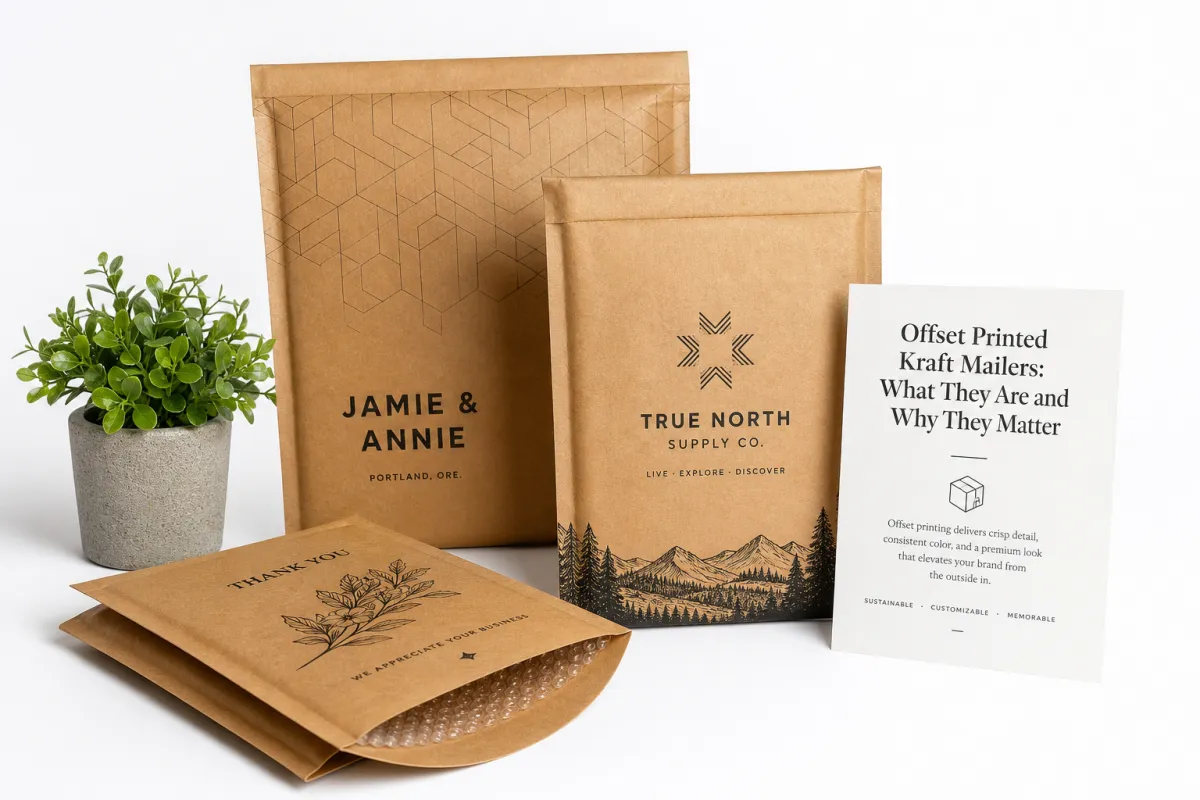
From a packaging buyer's point of view, offset printed kraft mailers are simply kraft mailers that get printed on sheets, then converted into the final mailer shape. Printing flat gives the press a cleaner surface to work with and gives the printer more control over logos, icons, type, and small layout details than a rougher direct-print path usually allows. The finished piece tends to feel deliberate, which matters when the outer package is the first physical touchpoint the customer sees.
That is the appeal. Kraft already brings a sturdy, natural look that feels grounded instead of glossy. Add clean offset printing and the mailer can carry brand identity without turning into a loud billboard. For a lot of ecommerce brands, that balance works better than a shiny package that looks expensive mainly because it reflects more light. Offset printed kraft mailers fit brands that want structure, restraint, and a little visual confidence without extra decoration that does not earn its keep.
They suit a wide range of packaging programs:
- Ecommerce subscriptions where every shipment needs to look consistent from one cycle to the next.
- Retail fulfillment where the outer mailer is the first surface the customer actually sees.
- Wholesale samples that need to look tidy before the product is even opened.
- Promotional kits where print quality matters but the pack still has to ship well.
- Launch programs that need repeatable branding across several thousand units.
From an operations standpoint, offset printed kraft mailers work best when the design is meant to repeat exactly. That means a stable logo, fixed copy, and a quantity high enough to justify prepress work. They are not the right answer for one-off gifts, hyper-local campaigns, or orders where each batch changes anyway. If the art shifts every other week, the print method will fight the schedule and the budget at the same time, and nobody enjoys that kind of tug-of-war.
If you are comparing packaging formats, it helps to look at the broader system too. Some brands use Custom Packaging Products to cover the full shipment mix, while others pair mailers with Custom Poly Mailers for products that need lower weight or better moisture resistance. A printed kraft mailer is one part of a packaging plan, not the whole strategy.
How Offset Printed Kraft Mailers Work in Production
The production flow for offset printed kraft mailers starts well before the press ever starts moving. First comes the brief: size, quantity, board weight, color targets, shipping destination, and any closure requirement. Then the supplier confirms the dieline, checks the art, and makes sure the layout respects folds, seams, and glue zones. That unglamorous work is what keeps expensive mistakes from showing up later. The dramatic part is rarely the part that breaks the job.
Once the artwork is approved, plates are made for the offset press. Ink transfers onto the kraft sheets, the sheets dry, and the printed stock moves into converting, where it gets cut, folded, glued, or sealed into the finished mailer format. That sequence matters because the printed surface and the finished structure depend on each other. If the print lands in the wrong place or the seam area is ignored, offset printed kraft mailers can look perfect while flat and still fail once they are formed. I have seen this happen with otherwise clean artwork, and it usually traces back to someone treating the dieline like a decorative suggestion instead of a production tool.
Why choose offset for this kind of work? Three reasons come up again and again:
- Registration: small type, logos, and line work stay aligned more predictably.
- Color control: brand colors are easier to repeat across larger quantities.
- Surface clarity: the print usually looks cleaner than a rougher direct-print approach.
The substrate matters too. Kraft is not coated art paper. It has texture, absorbency, and a natural shade that changes how ink reads on the finished mailer. A dark logo on kraft can look rich and grounded, though slightly muted. Thin lines may appear crisp on screen and soft on stock if the artwork is too delicate. Reverse knockout type can work, but only when the background and contrast are planned honestly. Offset printed kraft mailers reward simple, well-spaced design far more than they reward fussy detail. That does not mean the artwork has to be plain; it means the design has to respect the material.
Here is the comparison most buyers actually need:
| Print Method | Best Fit | Setup Load | Typical Unit Cost at Scale | What It Means for Buyers |
|---|---|---|---|---|
| Offset | Large, repeat orders with stable art | Higher | $0.18-$0.45 each at 5,000+ units, depending on size and coverage | Best color consistency and print detail once the setup is justified |
| Digital | Small runs, variable art, faster changes | Lower | $0.30-$0.80 each at low to mid volumes | Flexible, but usually pricier per unit on bigger programs |
| Flexographic | Very high volume, simple graphics, repeat SKUs | Moderate to high | $0.15-$0.35 each at very large volumes | Strong economics if the design is simple and the run is long |
That table is a reality check, not a promise. The best print method depends on whether the order is 500 units or 50,000, whether the artwork will change, and whether the mailer has to do more than look attractive. For offset printed kraft mailers, the sweet spot usually sits in the middle-to-larger range where quality matters enough to justify setup, but the quantity still fits the operations plan.
For deeper standards thinking, I often point buyers toward ISTA testing methods for shipment simulation and route evaluation, plus FSC certification guidance when sourcing claims and fiber traceability are part of the decision. Not because every mailer project needs a standards dissertation. Because bad assumptions get expensive fast.
Offset Printed Kraft Mailers Cost and Pricing Factors
Pricing for offset printed kraft mailers starts with quantity, and that is usually where the conversation gets honest. Offset setups are not cheap at small volumes because the prepress work, plate making, press setup, and waste allowance all have to be spread across the run. That is why smaller orders often make offset look expensive. It is expensive if you only want a few hundred pieces. The machine does not care about the reason for the order, and neither does the math.
Several cost drivers show up again and again:
- Quantity: more units usually lower the unit cost once setup is absorbed.
- Mailer size: larger formats use more board and more freight space.
- Board weight: heavier kraft stock raises material cost and shipping weight.
- Ink count: one-color branding costs less than a multi-color layout.
- Coverage: full-bleed art, dark fields, and rich solids need more control.
- Finish: varnish, soft-touch, or special coatings add cost and time.
- Freight: shipping can become a meaningful line item on bulky mailers.
For rough budgeting, buyers often see offset printed kraft mailers land in these zones: a simple, low-coverage run at 5,000 units may sit around $0.18-$0.30 per unit, while a larger or more visually demanding run can move into the $0.35-$0.45 range or higher. At 1,000 units, the same job can look much worse because the setup cost has fewer pieces to share. That is not supplier greed. That is basic production math.
MOQ expectations matter too. If a supplier quotes offset for 300 units, I would ask a second question immediately: what are they actually optimizing for? Sometimes it is a special case. More often, the better answer is to shift the order to digital or another method that fits the run size better. Buyers should compare the right line items, not just the print price. If freight, waste, and setup are ignored, the comparison turns fictional.
Use this quote checklist before asking for pricing on offset printed kraft mailers:
- Final size and internal dimensions
- Exact quantity, not a guess
- Artwork status and file type
- Number of ink colors
- Any coating, varnish, or special finish
- Target ship date and delivery ZIP
- Approval contact and response window
A buyer who can answer those seven items usually gets a cleaner quote faster. A buyer who sends "Need something branded, please advise" usually gets a long chain of follow-up questions. That delay is avoidable, and honestly, it is one of the easiest packaging problems to prevent.
One more practical note: if your program includes other packaging formats, compare the mailer quote against the rest of the system. Sometimes a slightly more expensive outer mailer is worth it if it reduces inserts, damage claims, or rework. Offset printed kraft mailers should be judged on total package performance, not only on print cost.
Process and Timeline for Offset Printed Kraft Mailers
The timeline for offset printed kraft mailers is usually longer than buyers expect, mostly because there are more steps than people count on. Briefing comes first. Then the dieline needs confirmation. Then artwork prep, proofing, plate making, printing, converting, packing, and shipping. If one of those steps disappears in the buyer's head, the launch date usually pays the price.
- Brief and spec confirmation: 1-2 business days if the information is complete.
- Artwork and dieline review: 1-3 business days depending on file quality.
- Proof approval: often 1-3 business days, longer if multiple stakeholders are involved.
- Plate making and press setup: 1-2 business days.
- Printing and drying: 2-5 business days, depending on run size and coverage.
- Converting and packing: 2-4 business days.
- Freight: 2-7 business days for many domestic shipments, sometimes more.
What does that mean in plain language? A clean, standard offset printed kraft mailers order often lands in the 12-20 business day range from proof approval to shipment, with freight on top. Rush projects can compress that window a bit, but only if the art is locked, the size is standard, and the supplier has the capacity. Last-minute edits, special finishes, or color matching requests can add days quickly. Faster than most schedules can comfortably absorb, which is why rushed packaging jobs tend to feel more expensive than they looked on the original quote.
There are a few things that speed up production:
- Locked artwork with final copy
- A clean dieline that matches the actual mailer structure
- Standard sizes already supported by the supplier
- Clear approval ownership on the buyer side
- Simple color builds instead of overly complex graphics
There are also a few things that slow everything down:
- Design teams changing copy after proofing starts
- Color references based on screen images only
- Special coatings or unusual paper requests
- Unclear packaging specs that force multiple quote revisions
- Freight delays caused by remote delivery zones or tight dock windows
From a logistics standpoint, the cleanest way to manage offset printed kraft mailers is to think in inventory windows. Do not order based on the date you want to launch. Order based on the date you need product in house, then add a cushion for proofing, production, and transit. If a campaign starts on the 1st, I would want the mailers on site before the last week of the prior month. Packers notice missing cartons very quickly, and nobody wants to explain a launch delay because the cartons were still on a truck.
Use the spec sheet early. Tie the mailer order to the fulfillment forecast. If monthly volume is stable, print enough to cover the next cycle plus a buffer. If volume moves around, do not assume one giant run is always the smartest choice. Sometimes two planned runs create less risk than one oversized order that sits in storage too long. Offset printed kraft mailers should fit the operations plan, not force the operations plan to bend around them.
Key Factors That Affect Print Quality and Durability
Print quality on offset printed kraft mailers is not just a press question. It starts with the paper. Kraft shade, board weight, and surface smoothness all change the final look. A lighter kraft tone may hold contrast better than a deeper brown. A smoother surface can produce sharper graphics. A heavier board can improve stiffness, though it also adds cost and can change the way the mailer folds and seals.
Ink coverage matters just as much. Large solid blocks look stronger on a screen than they usually do on brown kraft stock. On the actual material, dark colors can absorb differently and appear softer or deeper than expected. Fine text can survive, but it needs breathing room. Thin rules can get muddy if they are pushed too far. The best offset printed kraft mailers usually keep the layout disciplined: bold logo, clear contrast, and not too much tiny information crowded onto a small surface.
Durability matters as much as appearance. A mailer that looks beautiful in a mockup but crushes in transit is a poor buy. Look at seam strength, closure method, scuff resistance, and how the mailer behaves after flexing. If the product inside has edges, corners, or any weight, test the packed sample. Do not approve a flat sample and hope physics will be generous later. It usually is not.
Here is the practical testing checklist I would use for offset printed kraft mailers:
- Fill test: pack the actual product, not a stand-in.
- Drop test: test from realistic handling heights, often 24-36 inches for basic handling checks.
- Scuff test: rub and stack a few samples to see where print wears.
- Seal test: confirm the closure stays shut after pressure and movement.
- Route test: if the mailer travels far, simulate more than one handling cycle.
Brand standards belong in this conversation too. A color that looks right on coated white stock may shift on kraft. That is not the printer being "off"; it is the substrate behaving like kraft. Buyers who care about repeatability should ask for a press proof or a controlled sample on the actual material. It takes time, yes. It also keeps the logo from looking like it had a rough trip before the package ever left the facility.
For sustainability-minded programs, ask for chain-of-custody documentation if it matters to your claims. A mailer made with certified fiber can support the story, but only if the paperwork is real and the claim is phrased carefully. Offset printed kraft mailers often get chosen because they feel more natural and less glossy, but the sourcing details still need to hold up. A nice-looking outer package does not cancel out a sloppy claim.
The most useful advice is boring: test the real packed mailer, not just the art on a flat sheet. That one step catches fit issues, seal issues, and surface wear that a PDF will never reveal.
Common Mistakes When Ordering Offset Printed Kraft Mailers
The biggest rookie mistake with offset printed kraft mailers is assuming they behave like a digital print job. They do not. Offset has setup, plates, and fixed costs that need volume to make sense. If you ask for rapid-fire changes without accepting that reality, the quote gets messy and the schedule gets worse. Different process, different rules. It is strange how often that catches people off guard.
Another common issue is vague spec writing. "Need branded mailers" is not a spec. It is a cry for help. You need final size, quantity, paper weight, color count, finish, and delivery window before the supplier can give a useful quote. Missing one or two details can still be manageable. Missing five means everyone spends time guessing. Offset printed kraft mailers are not the place to improvise your way into clarity.
Artwork errors also cause pain. The ones I see most often are low-resolution logos, text placed too close to folds, seam areas ignored in the layout, and colors chosen from a monitor without proofing on kraft. Small type can look elegant in a design file and weak in print. Reverse knockouts can disappear if the background is too busy. If a supplier asks for a vector file and a proper dieline, they are not being fussy. They are trying to keep your order from turning into an expensive correction.
Freight and MOQ mistakes can wreck budgets just as fast. Buyers sometimes focus only on the per-unit print cost and ignore the rest. If the run is small, freight can swallow the savings. If the unit price looks good but the minimum is far above usage, inventory starts collecting dust. Offset printed kraft mailers should be ordered at a volume that fits both the production economics and the fulfillment forecast.
Before approving a full run, run one sanity check: pack the actual product, seal the mailer, and move it through a normal handling cycle. If the item shifts, the print rubs, or the closure fails, fix it before production. That one sample can save far more money than it costs.
And please, if you are comparing packaging options, compare like with like. A printed kraft mailer, a poly mailer, and a padded mailer are not interchangeable just because they all ship things. If your product needs moisture protection or lower freight weight, another format may be the better fit. If your brand wants a more natural unboxing look, offset printed kraft mailers can be the right answer, but only if the operational side agrees.
Expert Tips and Next Steps for Ordering Offset Printed Kraft Mailers
My rule of thumb is simple: choose offset printed kraft mailers when brand consistency, repeatability, and volume matter more than maximum flexibility. If the artwork is stable and the order is large enough to absorb setup, offset usually gives better-looking results per dollar than people expect. If the art changes constantly or the order is tiny, it is probably the wrong lane. There is no shame in that; it just means the job and the process do not belong to each other.
The fastest way to get a clean quote is to build a one-page spec sheet. Keep it boring and complete:
- Mailer size
- Quantity
- Paper weight or board spec
- Print colors and coverage
- Finish or coating
- Artwork status
- Target ship date
- Delivery location
- Approval contact
Then ask for side-by-side pricing at the same spec. That is the only fair way to compare offset printed kraft mailers against digital or flexo options. A direct comparison forces everyone to price the same material, the same size, and the same quantity. It also keeps the conversation honest, which helps because packaging quotes can look simple right up until freight shows up as its own problem.
I also recommend asking for a sample or pilot run on one SKU before you roll the design across an entire line. That is especially useful if the product varies in weight or shape. A mailer that works beautifully for one item may be too loose, too tight, or too scuff-prone for another. A small pilot tells you more than a room full of opinions, and it gives you a real object to hold before you place the bigger order.
For teams managing multiple packaging formats, it helps to connect the mailer decision to the rest of the system. Manufacturing Capabilities should tell you what is actually feasible on the production side, not just what looks nice in a render. Then the procurement team can align the mailer spec with inserts, labels, and secondary packaging instead of treating every piece as a separate project.
One last thing: do not overcomplicate the artwork. Strong logo placement, clear type, and a practical color plan usually outperform elaborate graphics on kraft. The material already brings texture and character. Let it do some of the work. Offset printed kraft mailers do not need to shout. They need to show up looking like the brand knew what it was doing, which is a lot harder to fake than it sounds.
If you want the shortest possible decision rule, here it is: compare samples, confirm the spec, and place the order only when the timeline and budget actually make sense for offset printed kraft mailers. That is how you buy packaging without creating a second job for yourself.
FAQ
How do offset printed kraft mailers compare to digital-printed kraft mailers?
Offset printed kraft mailers usually win on sharp detail, color consistency, and unit economics once the order gets larger. Digital is better for smaller runs, faster artwork changes, and jobs where setup cost would be hard to justify. If the art is stable and the volume is real, offset printed kraft mailers tend to make more sense.
What is the minimum order quantity for offset printed kraft mailers?
There is no universal MOQ, but offset printed kraft mailers usually start making financial sense once the run is large enough to spread plate and press setup across a meaningful quantity. For some specs that means a few thousand units; for others it may be higher. Ask for quotes at your actual volume range, not a hopeful one.
How long does it take to produce offset printed kraft mailers?
Expect time for artwork approval, plate making, printing, converting, packing, and shipping. Clean files and locked specs can shorten the schedule, while revisions, special finishes, or freight delays add time. In many cases, offset printed kraft mailers take longer than buyers first assume because the non-press steps matter just as much as the press run.
Can offset printed kraft mailers hold up in shipping?
Yes, if the kraft weight, seam construction, and closure method match the product and the route. Always test a packed sample for scuffing, flexing, and seal strength before approving the full run. Offset printed kraft mailers can be very durable, but only when the structure is chosen for the actual shipment conditions.
What artwork do I need for offset printed kraft mailers?
Use a proper dieline, final vector artwork, and clearly specified colors so the printer can separate and register the job cleanly. Avoid last-minute layout changes, tiny type, and color assumptions that were never proofed on kraft stock. Good artwork makes offset printed kraft mailers look premium without turning production into a rescue mission.
If your volume, artwork, and schedule line up, offset printed kraft mailers are one of the cleaner ways to make a shipping package feel premium without overcomplicating the job. If they do not line up, they turn into a slow and expensive lesson in why print methods have different lanes. Match the spec to the reality, test the packed sample, and offset printed kraft mailers will do exactly what they are supposed to do: protect the product, move through fulfillment without drama, and make the brand look like it paid attention.