Most skincare launches do not fail because the formula is weak. They fail because the pack looks provisional, and customers notice that in seconds. A clean, well-sized bag signals that the brand has already solved the small problems: fit, protection, shelf presence, and unit cost. That is why an opp header Bags Wholesale Supplier for skincare launch buyers matters so much. The bag is not just a wrapper. It is the first proof that the launch has been handled with discipline.
OPP Header Bags sit in a useful middle ground. They are simple enough to quote quickly, light enough to keep freight under control, and clear enough to show the product instead of hiding it. That matters for skincare minis, sachets, testers, accessory add-ons, and launch kits. Buyers usually want two things at once: a tidy presentation and a supplier who can repeat the same result without drifting on dimensions or print quality. That combination sounds basic. It is also where many launches get messy.
The practical appeal is easy to understand. A flat bag stores efficiently, packs quickly, and does not force the brand into expensive tooling for a short run. Clear film keeps the product visible; the header creates a branded area; and the format stays flexible enough for a first order that may need a second version later. For launch buyers, that flexibility often matters more than a fancy finish.
Why OPP header bags earn their place in skincare launches
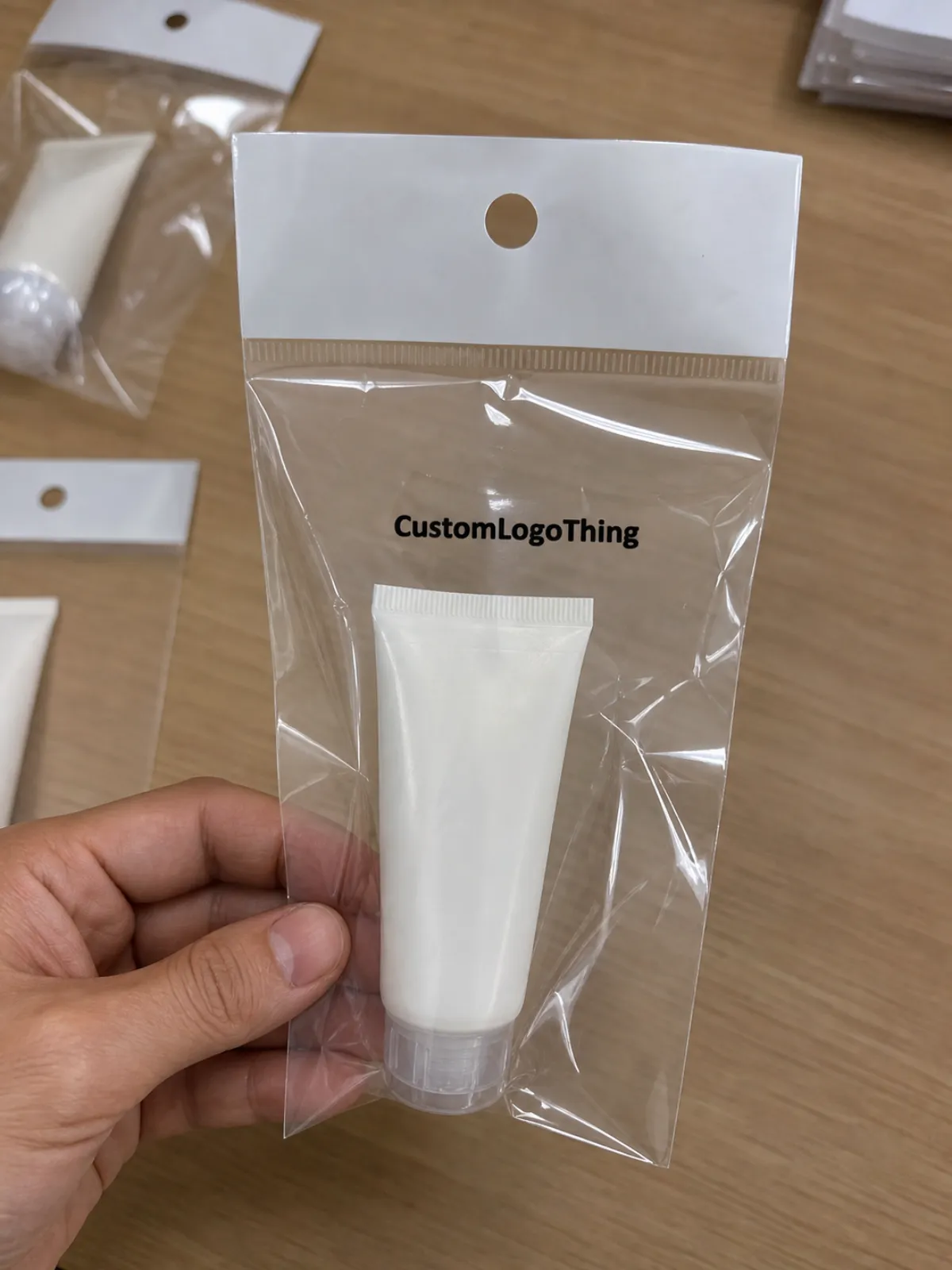
Skincare teams often put most of their energy into the formula, then treat packaging as an afterthought. That is a mistake with a visible cost. A serum vial in a loose sleeve looks improvised. A sample trio in a cloudy pouch looks cheaper than it should. An OPP header bag fixes that quickly because it gives the pack structure without adding much complexity.
There is also a merchandising reason these bags hold up so well. You can place one mini cleanser, several sachets, a rollerball, or a promo bundle in the same family of packaging and still make the set look intentional. That is useful on retail hooks, in display trays, and inside mailers where a bundle can either read as a designed kit or as a pile of parts. Buyers feel the difference immediately. So do retailers.
For launch teams, the repeatability matters as much as the visual effect. A supplier should be able to keep the same bag width, header height, seal finish, and carton count on the reorder. Small changes create large problems later. A bag that was fine for 3,000 units can become awkward at 15,000 if the spec was never locked properly. If the first run is tidy and the second run matches it, the packaging is doing its job.
Best fit for: sample vials, mini jars, sheet mask singles, accessory kits, influencer mailers, and entry-price promo packs that need to look more deliberate than disposable.
There is a second benefit that buyers sometimes underprice: OPP Header Bags are easy to compare across suppliers. That makes sourcing less abstract. You can review film clarity, seal quality, header build, and print registration without needing a long technical briefing. In a launch environment, that directness saves time.
Format choices for samples, bundles, and retail kits
Not every skincare item belongs in the same format. Flat OPP header bags work well for slim samples, folded inserts, and light bundles. Gusseted versions are a better match for mini jars, dropper bottles, and mixed sets that need more depth. If the product has too much volume for a flat bag, the film starts to stretch and wrinkle. The final pack can look pinched even if the contents are fine.
That is why fit should come before decoration. A beautiful header card cannot rescue a bag that is too narrow or too shallow. Buyers who launch multiple SKUs often make the same mistake: they choose one visual format and force every product into it. A better approach is to standardize around one or two sizes and vary the insert or header card. That keeps the brand consistent without turning the bag into a compromise.
Display options matter too. A euro slot is useful if the pack will hang on a pegboard or retail hook. Reinforced headers help when the pack is heavier than a basic sample sleeve. Zippers can improve usability for consumer-facing packs, but they add cost and may not be necessary for launch samples that are meant to be opened once. Each addition solves a real problem, and each one creates a new line item.
Branding choices affect cost in a predictable way. A clear stock bag with a printed label is the least expensive option. A printed header card gives you more room for claims, ingredients, or launch messaging without changing the film itself. Full-color print on the bag or header looks more finished, but setup costs rise because the supplier must manage artwork, registration, and print consistency. Nothing mysterious is happening there. More print means more setup, more checks, and more room for error.
| Format | Typical use | Relative cost | Buyer tradeoff |
|---|---|---|---|
| Flat OPP header bag | Samples, sachets, slim launch packs | Lowest | Best for light items and shallow fills |
| Gusseted header bag | Mini jars, dropper bottles, mixed sets | Medium | More room, slightly higher material use |
| Reinforced or euro-slot pack | Peg display and hang-sell retail | Medium to higher | Better merchandising, extra header build |
| Printed header card pack | Launch kits and branded sample drops | Higher | Stronger brand impact, setup fee usually applies |
For launches with several SKUs, standardizing bag sizes usually beats chasing a custom shape for each item. A practical Wholesale Programs setup can reduce back-and-forth because the supplier can align the bag, card, and carton plan around one repeatable spec instead of reworking every pack separately.
Material specs that affect clarity, strength, and shelf appeal
The spec sheet is where a decent pack becomes a reliable one. For OPP header bags, the most important details are film thickness, clarity, seal strength, anti-static behavior, and wrinkle resistance. The goal is simple: the bag should stay clear, hold its shape, and not cling, haze, or crease the first time it is handled in packing.
Typical OPP film for light retail use often sits around 30 to 40 microns. That range is not a rule; it is a starting point. The right number depends on product weight, the amount of movement inside the pack, and whether the bag needs to survive shipping or just display. Thicker film is not automatically better. A heavy bag can look stiff and less premium. A thin one can tear or distort in transit. The buyer is always balancing appearance, protection, and cost.
Skincare adds some specific risks. Oily residue can haze the film. Alcohol-based formulas can stress weak seals. Sharp caps and pump heads can punch through a loose fit. If the pack includes a metallic closure or a rigid insert, the chance of scuffing rises. That is why a supplier should ask what goes inside the bag, not only what the size is. If they skip that question, they are guessing.
Good suppliers also understand that the filled product is more important than the empty bag. A sample sleeve that looks perfect on a flat table may fail once the actual product is inserted. The real test is pack-out under ordinary handling, not a staged photo. Buyers should ask for a filled sample whenever the product has unusual dimensions, sharp edges, or leak risk.
Practical quality checks are not complicated, but they should be consistent. A credible supplier can talk about seal uniformity, edge finish, print rub resistance, and how the bag behaves under normal carton pressure. For broader packaging standards, reference points like ISTA packaging test procedures help buyers ask better questions, even for relatively small orders.
Compliance is another part of the spec conversation. If the project needs country-of-origin labeling, recycling notes, retail intake marks, or carton identifiers, those details should be confirmed before artwork approval. If the header card is paper-based, ask whether the board can be documented through FSC when that claim is needed. If the pack will be marketed as recyclable, the material claim should match local guidance rather than marketing language. A clean-looking pack with a weak claim still creates rework.
For recycling basics, the EPA’s consumer packaging guidance at EPA recycling resources is a useful baseline. Not glamorous, but useful.
Price, MOQ, and unit cost ranges that shape launch budgets
Pricing for OPP header bags is shaped by more than the bag itself. Size, film grade, print coverage, header card stock, hang-hole style, carton counts, and setup all change the final number. Buyers who ask for a single price without giving those details usually receive a number that cannot be compared to anything. The quote may be real. It still may be useless.
For first runs, a stock-style clear header bag with minimal branding might land around $0.08 to $0.16 per unit at about 5,000 pieces, depending on dimensions and packing details. Printed header cards or heavier construction can move that into the $0.14 to $0.28 per unit range, and sometimes higher if the artwork is dense or the stock is upgraded. Larger orders usually lower the unit rate, but only after the setup cost is spread across more units.
MOQ follows the same logic. A smaller run protects cash flow, but the unit cost is higher. A larger run lowers the per-piece price, but only makes sense if sell-through is likely or a reorder is already planned. For new skincare lines, the safer pattern is often a pilot order with clear trigger points for the second run. That approach keeps packaging spend from outrunning demand.
Launch buyers can reduce cost without weakening the presentation. The biggest savings usually come from simplification, not aggressive negotiation.
- Use one standard bag size across similar SKUs.
- Keep print on the header card instead of full-film coverage.
- Choose a common carton count so pack-out stays predictable.
- Skip specialty finishes unless they add visible shelf value.
Quotes should be compared line by line. Make sure each supplier is quoting the same dimensions, micron thickness, print colors, carton quantity, freight term, and sample cost. Otherwise the lowest number can hide the highest extras. For repeat volume, custom wholesale packaging options often pay off because the first run creates a cleaner spec for the reorder. The second order should be easier than the first, not more confusing.
Timeline and production steps from proof to shipment
The production workflow should be ordinary. That is a good sign. A clean packaging process usually moves from RFQ to artwork check, then digital proof, sample approval, mass production, packing, and shipment. If any one of those steps is vague, delays tend to appear later, and they rarely stay small. Packaging issues usually come from a series of tiny misses rather than one dramatic failure.
Simple stock-style orders can move faster, often within 7 to 12 business days after proof approval if materials are already available. Custom printed runs usually need 12 to 20 business days, sometimes longer if artwork is revised, cards need special finishing, or color confirmation takes a second round. Shipping sits on top of production, so the total calendar should always include transit time. A pack that is finished in the factory is not the same thing as a pack that has reached the warehouse.
The slow points are predictable. Artwork files arrive late. Dimensions are measured without accounting for cap height or fill expansion. Color targets are left vague. And too often, the sample is approved in theory without testing the actual filled product inside the final bag. That last mistake causes more problems than most buyers expect.
Lock these items early:
- Final filled dimensions of the product.
- Artwork format, dieline, and file ownership.
- Print targets, including Pantone or CMYK references.
- Carton counts, master case labels, and ship method.
- Whether the order is a pilot run or full launch volume.
If the project has multiple stakeholders, keep one person responsible for approvals. Packaging moves faster when the supplier is not trying to interpret five different emails. A clear launch-ready wholesale support process helps because it reduces file churn and keeps the production path visible from proof to dispatch.
How to evaluate a wholesale supplier before you order
A decent supplier answers questions. A stronger supplier asks the right ones back. That is the first filter. If a vendor never asks about filled dimensions, product type, display method, or reorder plans, they are probably quoting from a template and filling gaps with hope.
Compare suppliers on consistency, response speed, sampling policy, and whether they explain tradeoffs in plain language. Good vendors do not hide behind buzzwords. They will tell you when thinner film saves cost, when it hurts presentation, and when a slightly bigger bag is safer for pack-out. That kind of honesty matters more than a low quote that collapses on the second order.
“The cheapest sample is usually the one that costs the most later.”
That line keeps showing up in packaging for a reason. The real test is whether the supplier can hold seal quality, color, and dimensions across reorders. If one run looks crisp and the next run looks noticeably different, your team spends time and money correcting something that should have stayed stable.
Here is what stronger service usually looks like:
- Spec sheets with real measurements, not rounded guesses.
- Lead times that are honest rather than optimistic.
- Sample support that reflects the actual product fit.
- One person who owns the file, proof, and follow-up.
That is the practical difference between a quote source and a packaging partner. The right opp header bags Wholesale Supplier for Skincare Launch buyers reduces surprises instead of creating them.
Mistakes that cause cost overruns and launch delays
The most expensive mistake is ordering to the wrong filled size. If the bag is too loose, the product shifts and the presentation looks sloppy. If it is too tight, the item presses against the seal or creases the film. Either problem becomes obvious the moment packing starts, which is usually too late for easy fixes.
Artwork errors come next. Tiny type disappears. Low-contrast logos flatten out. Overcrowded header cards make the pack feel busy instead of controlled. White space is not the enemy; bad white space is. If the layout leaves no breathing room for the logo, product name, and core claim, the pack starts looking cheaper than the formula inside it.
Logistics mistakes are just as expensive, just less glamorous. Buyers forget carton counts, master case labels, or the number of units needed for a pilot test. They forget to ask whether freight is included, whether the supplier will palletize, or whether the sample quantity is separate from production. Then the timeline slips and everyone describes the delay as unexpected. It usually was not unexpected. It was missing information.
Before approval, check these points:
- Actual filled size, not only nominal product size.
- Readability of the print at arm’s length.
- Carton and case label requirements.
- Freight method and delivery window.
- Test quantity for packing before the full release.
Do not assume a nice-looking sample will behave well in volume. A pack can pass a desk review and still fail on the line. That is why real-product sampling matters. It is cheaper than reworking a thousand finished units.
Sampling, approval, and reorder planning
Start with the basics: confirm dimensions, send artwork, request a sample, compare unit-cost tiers, and lock the launch calendar. If there will be follow-up SKUs, tell the supplier early. Leaving that out and expecting a useful recommendation later is a good way to force a second round of quoting.
For new skincare brands, a small pilot run usually makes sense before a larger reorder. It gives the team a chance to check fit, handling, and shelf appearance with real product, not a mock-up. It also exposes smaller issues that tend to hide in the proof stage: header height, hole placement, print contrast, and the way the bag behaves after a carton is opened and resealed during packing.
Once the pilot is complete, the reorder plan should be easy to read. Same file. Same size. Same carton format. Same spec unless a real issue appeared in production. That is how packaging stays useful rather than becoming a recurring emergency. If the bag is stable, the reorder is easier, and the launch team gets to spend time on the product instead of the wrapper.
That is also the right point to compare the first-run data against the quote. If the actual cost landed above target, the reason is usually visible: artwork complexity, setup, tighter tolerances, or freight. If the first run came in clean, the reorder should be even cleaner because the supplier has a better baseline. Good packaging work compounds.
What MOQ should skincare launch buyers expect from an OPP header bags wholesale supplier?
Stock-style packs can start lower, while custom printed runs usually need a bigger first order because setup, materials, and print planning all add cost. Ask for tiered pricing so you can see where the unit cost drops enough to matter. If you have several SKUs, check whether one common bag size or one shared header card can reduce MOQ pressure.
Can OPP header bags handle oils, serums, or sample vials without leaking or clouding?
Yes, if the film thickness and seal quality are right. Cheap bags fail when the product has sharp edges, oily residue, or too much movement inside the pack. For leak-prone items, add an inner wrap or tighter insert so the header bag handles presentation rather than spill containment. Always test with the actual product, not a placeholder.
What artwork files do you need for custom OPP header bags for a skincare launch?
Vector files are safest: PDF, AI, or EPS, with text outlined and a clean dieline from the supplier. Give Pantone references or exact CMYK targets so the color stays close between proof and production. If the header card carries small copy, keep the type large enough to read without squinting. Tiny legal text is a fast way to make a clean pack look careless.
How long does production usually take after proof approval?
Simple stock builds move faster, while custom print adds artwork, proofing, and production time before shipment. Sampling can add a few days if you need to compare materials or check filled fit. Shipping method matters too, so ask for separate timelines for production, packing, and transit instead of one broad estimate that covers nothing.
How do I compare quotes from an OPP header bags wholesale supplier?
Compare the same size, film grade, print coverage, and carton count; otherwise the lowest quote is just a trick with better math. Check whether setup fees, freight, and packaging extras are included, because hidden add-ons can erase the headline savings. Ask for a physical sample or photo proof before approval, especially if the launch depends on shelf presentation.

