A bag can look clean on a screen and still fail on the peg. That gap is why a private label buyer OPP Header Bags production quality checklist matters before a purchase order is released. In retail handling, small defects show up fast: a hang hole that drifts off-center, a seal line that wavers under store lights, a print panel that shifts just enough to make the pack feel careless. None of those issues is dramatic in isolation. Together, they change how the brand is read by the buyer, the merchandiser, and the shopper standing three feet away.
Private Label Buyers usually get better results when they treat the first quote as a risk screen rather than a race to the lowest number. Lock the format, the printed area, the header construction, and the defect limits first. Then compare suppliers on the same spec. It is a duller way to shop, but it prevents the common problem of comparing three different products that all happen to be called “OPP Header Bags.”
A header bag should hang straight, seal cleanly, and keep its shape after shipping and retail handling. If one of those three slips, the package starts looking cheap even when the artwork is strong.
Private label buyer opp header bags production quality checklist
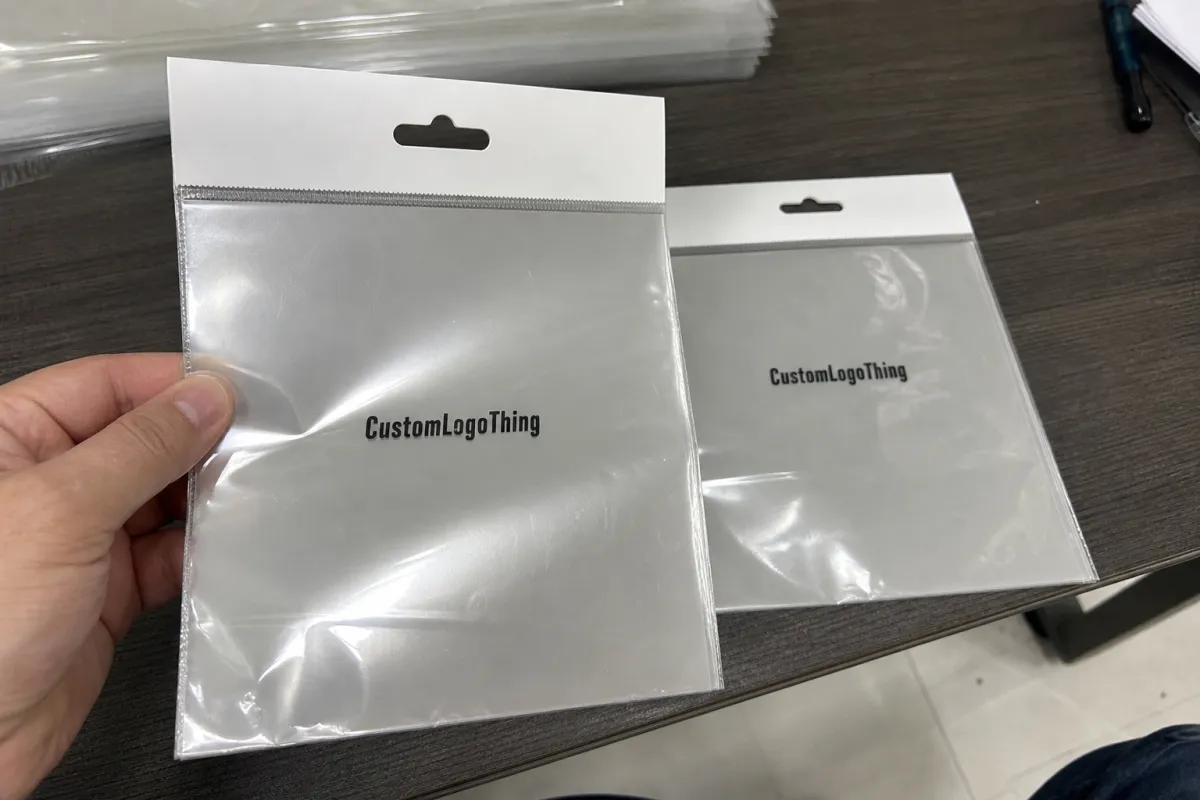
Start with the product definition and do not let the quote drift before that is locked. OPP header bags typically combine a clear or printed body, a reinforced header area, a hang hole or euro slot, and a top seal that keeps the pack intact during packing, shipping, and display. If the supplier cannot describe those parts in plain language, the spec is still too loose.
A useful checklist should answer a simple question: what exactly is being made, and how will it behave on the shelf? Cosmetic consistency matters as much as basic function in private label packaging. One carton that looks slightly different from the next can create a merchandising issue even if the bags are technically usable. The retail test is simple and unforgiving. Does the pack present the same way from first unit to last unit, and does it stay that way after handling, stuffing, and hanging?
That question matters more than it seems. A peg display at checkout magnifies mistakes. If the header punch is crooked by a few millimeters, the error becomes obvious once the bag is on a peg. If the top seal is too light, the header area can curl and the whole pack starts to look uneven. Those are small technical misses, but they are visible misses.
Before quoting, the checklist should cover four basics:
- Product format - clear, printed, or partially printed body; header style; hole type.
- Construction - seal position, film thickness, flap strength, and whether the header is reinforced.
- Artwork placement - print on body only or across header and body; front/back alignment.
- Defect limits - acceptable scuffs, haze, registration drift, and hole-position tolerance.
That is the point of a Private Label Buyer OPP Header bags production quality checklist: it turns a vague packaging request into a controlled manufacturing spec. Once that happens, pricing and timeline discussions become more honest.
Buyer choices that change the outcome
Clear OPP is usually chosen for visibility and a clean retail look. Printed film helps with branding and light protection. The wrong choice is not always obvious until the bag is in a fixture, where gloss, stiffness, and print density change the way light hits the package. If the product inside must stay visible, clarity and low haze matter more than rich coverage. If the shelf story depends on bold branding, then print density, white ink, and precise registration matter more.
Terminology can be confusing here. OPP and BOPP are often used interchangeably in the supply chain, although suppliers may use them a bit differently in conversation. What matters on the finished pack is not the acronym but the film behavior: clarity, stiffness, gloss, noise, seal response, and how the material holds its shape after folding or heat-sealing.
For buyers who need their packaging to survive distribution, testing expectations sometimes follow ISTA methods. If your broader private label line includes sourced or fiber-based components, documentation through FSC can also matter, but only when the material and chain of custody actually support the claim.
Bag construction and print details that affect retail performance
Construction details decide whether good artwork holds up in production. Standard OPP header bags use a film body and a header area that carries the hang hole and much of the load on the peg. If the top seal is uneven, the bag does not sit square. If the hole is punched too close to the edge, the header can tear during handling. A buyer reviewing a production quality checklist should pay close attention to those mechanical points, not just the artwork proof.
Material choice changes the finished pack more than many first-time buyers expect. A slightly stiffer film can present better on the rack, especially in narrow header formats, but it can also raise cost and change opening feel. That is not automatically a drawback. The right choice depends on product weight, display method, and whether the pack is handled by hand or through a semi-automated loading line.
Printing decisions move both appearance and price. One-color print is usually simpler and easier to keep consistent. Multi-color artwork, white ink underlays, and wraparound header graphics require tighter registration control and a more careful proof process. If a logo crosses the header and the body, ask how the supplier handles seam alignment and whether the prepress file accounts for distortion during conversion. Small shifts in print position are one of the most common reasons a bag feels off even when the art itself is correct.
Functional details matter too, even when they never show up in the mockup. Adhesive flap strength, static control, opening ease, and the feel of the top seal all influence how the bag performs on a line and on the shelf. If the retail team needs fast loading, a bag that clings too much slows them down. If the pack moves through automated or semi-automated filling, poor opening performance becomes a production issue, not just a convenience issue.
| Option | Typical use | Quality effect | Approx. unit cost impact at 5,000 pcs |
|---|---|---|---|
| Clear OPP, no print | Simple visibility, low branding need | Best clarity, fastest approval cycle | $0.08-$0.14 |
| Clear OPP with 1-color print | Basic private label presentation | Good balance of cost and branding | $0.10-$0.18 |
| Printed OPP with white ink underlay | Higher shelf impact, richer graphics | Better opacity, tighter registration needed | $0.14-$0.24 |
| Heavier-gauge printed OPP | Premium feel, larger header formats | Improved stiffness and handling, higher material cost | $0.18-$0.30 |
Those ranges are not a promise from any one supplier. They are a practical way to think about how gauge, print coverage, and conversion steps push cost up or down. For private label buyers, the cheapest unit is not always the best value if the bag arrives with curl, scuffing, or weak hole performance.
Specifications that define quality, fit, and consistency
If the spec sheet is incomplete, the production run usually pays for it later. The most important dimensions are finished bag width, finished length, header height, film thickness, hole type, and any flap or reseal feature. Those numbers define how the bag stacks, how it hangs, and how it reads in a planogram. A buyer building a private label buyer opp header bags production quality checklist should require those values in writing before artwork approval.
Tolerance control is where many packaging programs get surprised. A shift of just a few millimeters can change the way a bag looks on a peg or fits into a shipping carton. If the header punch moves too far, the display face looks crooked. If seal width varies too much, the pack can appear warped. That is why quality should be written as a range, not as a vague promise. Ask for cut tolerance, seal width tolerance, and acceptable color drift in plain language.
Print checkpoints should be just as specific. Color matching, line sharpness, barcode legibility, and placement accuracy all need a pass/fail rule. If the packaging carries a scannable code, specify that it must remain machine-readable after print and after packing. If the bag face is gloss-heavy, watch for scuffs and rub marks because they show fast under store lighting. Buyers often focus on color first, but visible scuffs are what shoppers notice when they lift the pack.
Pack-out matters too, especially for distribution. Bundle counts, carton quantities, master carton labels, and pallet pattern preferences should be documented in the spec packet. If the bags will move through a warehouse, ask whether carton labels should include PO number, SKU, lot code, and carton count. That saves time at receiving and reduces confusion if a claim or shortage issue appears later.
A simple way to organize the spec is to split it into four lanes:
- Fit - dimensions, tolerance, hang-hole location, seal width.
- Appearance - print registration, gloss, haze, scuff limits.
- Handling - opening ease, static, stiffness, stacking.
- Distribution - carton count, label format, pallet pattern, transit strength.
Pricing, MOQ, and quote inputs that move unit cost
Pricing usually comes down to a small set of variables, and the quote becomes more accurate when those variables are named clearly. Material gauge, finished size, print count, number of colors, finishing complexity, and any special kitting or packaging all affect unit price. To compare suppliers fairly, every vendor needs to quote the same bag, the same artwork scope, and the same carton expectation. Otherwise, the low quote may only be low because part of the work is missing.
MOQ logic is straightforward once you see where the cost sits. Setup time, plate or prepress work, and conversion time have to be spread across the order, so smaller runs carry a higher unit cost. That is normal, not a warning sign. What matters is whether the supplier can explain the price break between 2,500, 5,000, and 10,000 pieces in a way that helps inventory planning. Private label buyers often save money by ordering into the next tier if the carrying cost is lower than the per-unit premium on the small run.
For an accurate quote, send the following without leaving the supplier to guess:
- Exact finished dimensions, including header height.
- Material preference and target thickness.
- Artwork files, number of print colors, and whether white ink is needed.
- Quantity tiers and the destination ZIP code or port.
- Any sample, test, or compliance requirement.
Hidden cost items can move the final number more than many buyers expect. Freight, import duties, proof charges, custom cartons, and added QC steps are all legitimate line items. If a supplier says the unit price is fixed but refuses to state freight terms, packaging terms, or sample charges, the quote is not complete yet. For private label programs, landed cost matters more than the factory gate price.
A useful mental model is simple:
- More print coverage usually means more setup and tighter registration control.
- Heavier film improves feel and stiffness but raises material cost.
- Smaller MOQ almost always raises unit price.
- Custom cartons or inserts add labor and material.
That is why the checklist should sit beside the price sheet. If the spec is stable, the pricing conversation gets cleaner and the supplier can quote with fewer assumptions.
Production process and timeline from proof to shipment
The normal workflow starts with request for quote, then artwork review, then prepress correction, proof approval, production scheduling, converting, inspection, packing, and shipment. None of those steps is glamorous, but each one can protect or damage the final pack. If the artwork file is messy, the proof takes longer. If the proof is rushed, the production run carries avoidable risk. A buyer who wants stable results should treat every milestone as a sign-off point, not as a formality.
Lead time depends more on complexity and approval speed than on the bag type alone. A clean order with a final artwork file may move in about 12-15 business days after proof approval, while a more complex printed run with multiple colors, custom tooling, or a sample round can stretch longer. That range is realistic, but it is not universal. Capacity, seasonality, and shipping mode all affect the calendar.
Most delays come from a short list of preventable issues:
- Unclear dielines or missing bleed.
- Brand colors that need adjustment after proofing.
- Sample approval sitting too long on the buyer side.
- Late changes to carton labels or ship instructions.
A milestone-based timeline keeps everyone honest. A proof review date, a pre-production sample date if one is needed, a production start confirmation, and a ship-ready date all help avoid confusion. If the supplier cannot provide those checkpoints, the order is being managed informally, and that creates risk when the load date gets close.
For buyers shipping into distribution, transit expectations deserve a look as well. If cartons are crossing long distances or going into a warehouse network, ask whether the supplier uses transit testing aligned with ISTA methods for similar packs. That is not overkill for every job, but it is a sensible question if the bags are sensitive to compression, rubbing, or carton shift.
How to judge a supplier before you place private-label orders
A serious supplier should be able to show more than a low price. Ask for a written spec sheet, material data, production tolerances, QC checkpoints, and a straightforward explanation of how the job will be inspected. If the answer stays vague, the risks stay vague too. The better vendors can explain their process in plain language because they know where the weak points are and how they control them.
Compare suppliers on consistency, not on sales language. Sample quality matters, but response speed matters too, because a prompt answer often signals a better internal workflow. Proof accuracy, willingness to document accept/reject standards, and the ability to explain a defect tolerance are all useful signs. One supplier may be slightly higher on price but stronger on process, and for private label buyers that often saves money downstream.
Supplier-side controls should include inline inspection, seal-strength checks, print registration review, and carton verification before goods leave the facility. If the supplier can describe how they verify hole position, seal width, and carton count, you are probably speaking with someone who works from a real QC system rather than a sales script. The checklist should push the conversation in that direction.
Documentation matters too. If your brand has environmental or sourcing requirements, ask whether the supplier can back up claims instead of just printing them on a quote. That is where supporting documents, chain-of-custody records, and test reports become useful. If the supplier cannot tie claims to real paperwork, treat the claim as unverified until it is proven.
It can help to compare the bag spec with other items in the same retail family. If the line also includes hang tags, labels, or other shelf-facing components, matching print tone and format across the package can make the brand feel more deliberate. For that kind of coordination, Custom Labels & Tags can be a useful companion piece when the bag has to sit beside the rest of the system.
What to send for an accurate quote
If you want a quote without five rounds of corrections, send a complete spec packet. Include bag dimensions, material preference, artwork, quantity, target market, packaging format, and the required delivery window. If you know the end use, say so. A bag for a retail peg display is not the same as a bag for warehouse storage, and the supplier should quote it differently.
Photos help more than many buyers expect. A reference sample or product image lets the supplier compare print placement, header height, gloss level, and presentation expectations. Even when the final product is custom, a visual reference reduces the chance of talking past each other. That is especially useful if the design has a complicated logo lockup or the header area needs to look balanced from a distance.
Before you release the purchase order, ask for three things:
- A production proof.
- A sample plan if a first article is needed.
- A written quality checkpoint list tied to the final spec.
That sequence protects the order and gives both sides a clear record. It also gives you a basis for acceptance if there is ever a dispute about whether the shipment matched the approved sample. In private label packaging, paper trails save time and money.
Use the checklist to confirm the spec, approve the proof, and lock the order only after every production detail is documented. That is the simplest way to keep the bag looking right, hanging straight, and arriving ready for retail.
What should I check first in a private label buyer opp header bags production quality checklist?
Start with finished dimensions, header construction, film material, and print placement before spending time on color tweaks. Confirm the hang hole location and seal strength next, because those are the features most likely to create visible retail failures. Ask for an approved sample or production proof so the checklist matches the actual run, not only the artwork file.
How does film thickness affect private label OPP header bag quality and cost?
Thicker film usually improves stiffness, clarity control, and handling feel, but it also raises material cost and can change converting behavior. Too-thin film can wrinkle more easily and look less premium, especially on larger header bags or hanging displays. The best thickness is the one that meets display and handling needs without paying for unnecessary gauge.
What MOQ should I expect for custom OPP header bags with private label printing?
MOQ depends on size, print complexity, and whether the order needs custom tooling or multiple artwork versions. Smaller runs are possible, but unit cost is usually higher because setup and press time are spread across fewer finished bags. Ask for tiered pricing so you can compare your target quantity against the next cost break.
How long does production usually take after artwork approval?
The timeline depends on proof approval speed, print complexity, order volume, and whether samples must be reviewed before release. A clean, final artwork file usually moves faster than a file that needs dieline correction or color adjustments. Build in time for pre-production confirmation, because rushing that step can create avoidable defects.
What files and details do I need to request an accurate quote?
Provide dimensions, material preference, quantity, print colors, artwork files, packaging requirements, and delivery destination. If possible, include a reference sample or product photo so the supplier understands the finish and presentation you want. The more complete the spec, the more accurate the quote and lead-time estimate will be.

