For jewelry brands, the branded padded mailers for jewelry packaging Unit Cost Breakdown matters because the outer shipper affects both presentation and damage risk. A small parcel can still bend a card, scuff a box corner, or arrive looking less intentional than the product inside deserves.
Padded mailers sit between a plain envelope and a rigid carton. That middle ground is useful for rings in slim boxes, earrings on cards, chain sets in pouches, and gift orders that do not need a full secondary box. The buying decision is simple: choose the lightest structure that still protects the order and supports the brand standard.
Branded padded mailers for jewelry: what buyers notice first
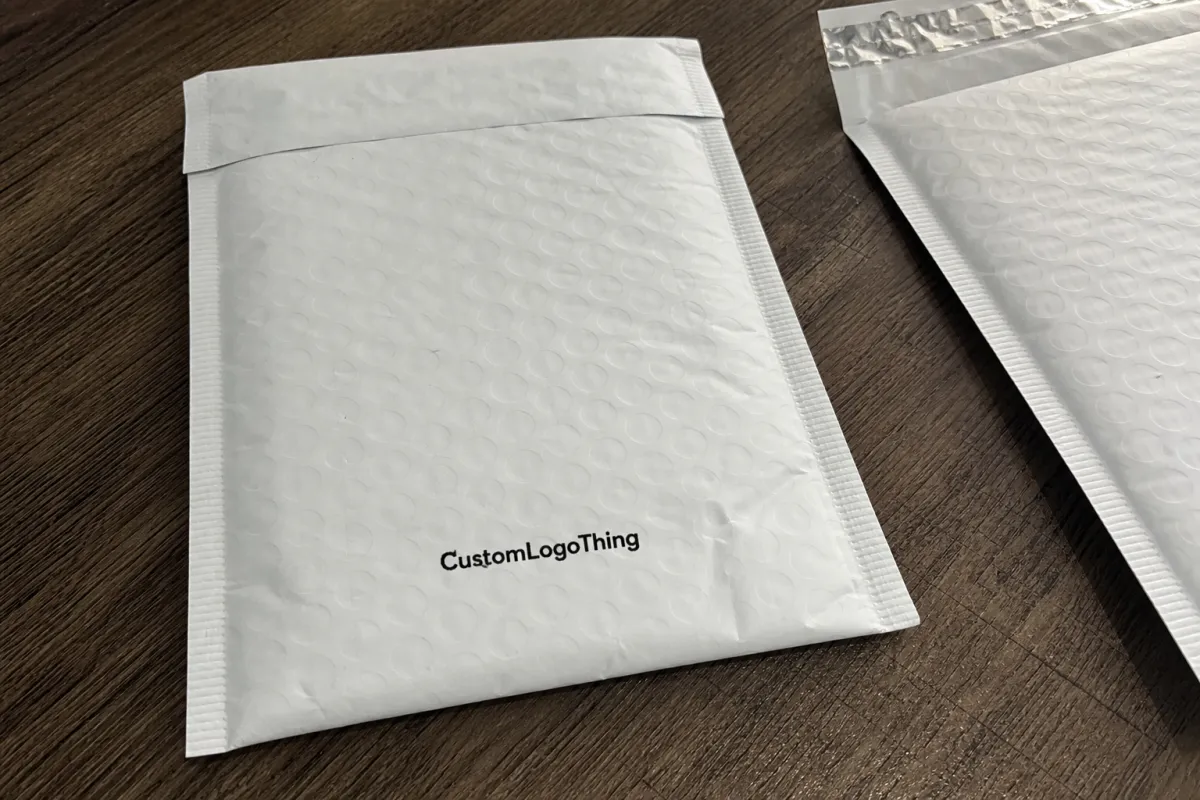
Buyers usually notice the feel of the parcel before the print. Jewelry amplifies that impression because a small change in stiffness or surface finish can make the shipment feel premium or improvised.
That is why the mailer deserves attention as a packaging component, not just a shipping wrapper. A ring box can dent in a soft sleeve, a card can curl, and a necklace tag can mark the inside of a flimsy envelope. The mailer does not need to be elaborate; it needs enough body to keep the contents stable and enough consistency that each order leaves the warehouse the same way.
A small unit saving is not a saving if one damaged return costs more in postage, labor, and replacement handling.
There is also an operational side. Better stiffness can make pack-out faster, improve stackability, and reduce folding mistakes. That matters when a team is shipping at volume and the outer mailer is handled more often than the inner box.
Material build, closure style, and print options that matter
The main cost drivers are the face material, cushioning layer, closure, and print process. In most quotes, the material stack matters more than the artwork.
Common builds include bubble-lined poly, kraft-faced padded mailers, and foam-lined mailers. Bubble gives a balanced mix of shock absorption and stiffness. Kraft creates a paper-led appearance and often fits brands that want a more natural finish. Foam can feel smoother and resist scuffing well, but it often costs more. If paper sourcing or certification matters, ask for documentation rather than relying on a marketing claim; FSC details can be checked at fsc.org.
| Mailer option | Typical build | Typical cost effect | Best use case |
|---|---|---|---|
| Bubble-lined poly | 1.5-2 mil film with bubble cushioning | Baseline to +$0.04 per unit | General jewelry shipping, carded items, slim boxes |
| Kraft padded | Kraft face with paper or fiber cushioning | +0.03-$0.08 per unit | Natural finish, gift orders, paper-led branding |
| Foam-lined | Paper or film face with PE foam liner | +0.06-$0.14 per unit | Higher scuff resistance, smoother hand feel |
| Specialty coated print | Coated exterior with matte or soft-touch finish | +0.08-$0.18 per unit | Premium presentation, higher visual consistency |
Closure style matters more than many buyers expect. A peel-and-seal strip is usually the simplest option, but the adhesive should match the intended use. One-time shipping, return-friendly programs, and repeat opening all put different stress on the flap. If the adhesive is weak, the mailer becomes a handling problem; if it is too aggressive, it can tear or warp the face during sealing.
Print complexity changes pricing quickly. A one-color logo on a solid field is usually the most economical route. Full-coverage art, multiple colors, or tight registration raises setup time and increases the chance of visible mismatch at the seam or flap. Ask for a proof that shows trim, fold, and seal areas together so the layout can be checked where it actually matters.
Size, insert, and thickness specs for rings, earrings, and chains
Mailer sizing gets tricky once the inner packaging is added. A ring box, velvet pouch, and earring card do not occupy space the same way, so the outside dimensions of the jewelry item matter less than the finished packaged size.
The right fit depends on internal clearance, not just flat width and length. A mailer that looks large enough on a spec sheet can still compress a carton corner or create a bulge that stresses the seal. For jewelry, that is more than cosmetic: a stressed seam can split during sorting, and a pinched corner can show through the outer pack.
- Rings: Usually fit best in a compact mailer if the ring box is standardized and the insert stack is minimal.
- Earrings: Often need extra width for backing cards, anti-tarnish sheets, or small gift inserts.
- Chains: Need length that avoids tight folding around clasps and tags.
- Mixed orders: Work better in one format sized for the largest common carton than in several undersized options.
Thickness affects more than protection. It influences how well the mailer survives stacking, belt pressure, and manual handling. Buyers who ship through high-volume parcel systems usually ask for a sample tested under compression and drop conditions rather than relying on appearance alone. ISTA testing language is useful here; the general framework is available at ista.org.
A practical sample review should include the actual jewelry setup, not an empty mockup. Put the real box, card, or pouch inside, close the mailer, and check whether the seams buckle, whether the closure strip is covered cleanly, and whether the outer dimensions still qualify for the intended shipping tier.
Unit cost breakdown, MOQ, and where pricing changes fast
The Branded Padded Mailers for jewelry packaging Unit Cost Breakdown usually falls into five parts: base material, cushioning layer, print method, finish or coating, and setup work. After that come packing format, carton count, sample handling, and freight.
MOQ is a pricing mechanism, not just a supplier threshold. A custom print requires proofing, color control, and packing prep. When the order is small, those fixed steps are spread over fewer mailers, so a run of 1,000 can cost much more per unit than a run of 5,000 even when the material is identical.
A useful way to read a quote is to split it into visible and hidden components. The visible part is the printed unit price. The hidden part is everything needed to make that price real.
| Cost component | What changes it | Typical pricing effect |
|---|---|---|
| Base mailer material | Film gauge, paper grade, liner type | Usually the largest steady cost driver |
| Print setup | Number of colors, plate work, registration | Higher on low MOQs, lower on repeat runs |
| Finish/coating | Matte, soft-touch, gloss, specialty ink | Adds cost and can slow production slightly |
| Packing configuration | Units per carton, inner wrapping, palletizing | Affects labor and freight efficiency |
| Freight and handling | Origin, destination, mode, seasonality | Can move the landed cost more than the print price |
Small runs usually land in the highest band because setup cost is spread thin. At 3,000 to 5,000 pieces, the numbers often become easier to defend if the design is stable. At 10,000 or more, freight planning and storage start to matter as much as print economics.
Buying more units can reduce the unit price, but it also ties up cash and floor space. A brand that saves a few cents per mailer but stores excess inventory is not automatically ahead. For comparison, a 5,000-unit run priced at $0.16 instead of $0.19 saves $150; that is real, but it does not matter if the larger order creates stale stock or forces a rush to match a launch date.
Ask for three quantity tiers every time: a test run, a mid-volume order, and a replenishment price. The spread between them shows whether the quote is setup-heavy, material-heavy, or freight-heavy.
Production steps, proof approval, and timeline from file to ship
A good production flow is predictable: artwork intake, dieline check, proof review, prepress approval, print run, curing or finishing, packing, and final inspection. In practice, the delay usually comes from missing files, unclear color targets, or a proof that waits too long for signoff.
Jewelry mailers are sensitive to registration because the print area is small. A logo near a fold line can distort, and a seal strip that overlaps artwork can affect adhesion. Good suppliers should flag those issues before production starts.
Proof approval is the point where the schedule becomes real. Once the artwork is signed off, the supplier can schedule the press and packout. Slow responses here often create expensive freight choices later because the order has less time to move by standard transit.
Quality control should be specific. A dependable supplier can explain how they check incoming material, confirm print registration, test the closure, and inspect final cartons before shipment. If the answer stays at “we check quality carefully,” there is not enough detail to judge the order risk.
Lead time planning for launch dates, restocks, and peak season
Lead time should be counted backward from the day the packaging must be in the fulfillment area, not from the day the quote arrives. If the outer mailers are late, the inner product may be ready and still cannot ship in the intended format.
There are three separate clocks to watch: sample timing, production timing, and freight timing. A sample may take only a few days or a couple of weeks, depending on the structure. Production begins after approval, and freight can change quickly during peak season, holiday demand, and port congestion.
Restocks are safest when the reorder happens before inventory gets tight. Waiting until the last carton is open creates pressure, and pressure usually shows up as rushed approvals, higher shipping costs, or compromised specs. Brands that treat packaging as a repeatable supply item, not an afterthought, usually avoid those last-minute decisions.
One useful habit is to keep a buffer equal to the next production cycle plus transit slippage. That buffer can feel generous until a holiday rush or weather delay eats through it. The order stays cleaner, and the unit cost stays closer to the quoted number.
What a dependable supplier should document before you place an order
A dependable supplier should document the spec, not just the appearance. The quote should state the finished size, face material, liner type, closure style, print method, color count, packing count, and what the quoted price actually includes. If any of those points are vague, the comparison is incomplete.
Sample consistency matters more than polished sales language. A good sample should match the final structure closely enough to show how the closure behaves, how the print sits on the surface, and whether the mailer survives normal handling. If the sample is only “similar,” treat it cautiously.
Buyers also benefit from asking one practical question: can this mailer cover more than one SKU without forcing overbuying? A standardized size that works for rings, earrings, and slim necklace orders is usually better than splitting volume into several tiny runs. Fewer versions mean fewer setup costs, simpler inventory, and less chance of running out of the wrong size first.
Quality control should be named clearly. Incoming material checks, registration review, adhesion checks, and final carton audits are the checkpoints that reduce shipping surprises. If those steps are part of the process, they should be documented.
What to send for a quote request without losing pricing clarity
To get a useful quote, send the finished dimensions, artwork files, target quantity, preferred material, closure preference, and shipping destination. If the design is still changing, say so. A quote based on unstable artwork is usually a temporary estimate, not a final buying number.
Ask for at least three quantity tiers: a test run, the likely launch volume, and the next pricing break if the order performs well. That structure makes the unit cost easier to interpret because it separates setup expense from material efficiency.
Ask for landed cost, not just factory price. Landed cost includes the unit price, proofing, packing configuration, and freight. A lower print price that leads to more damage, a slower timeline, or awkward storage is not actually the better option. For jewelry, the packaging has to protect the product and keep fulfillment simple.
The most useful packaging decision is often the least dramatic one. A mailer with the right thickness, the right fit, and a clean one-color print can outperform a fancier option that looks good in a mockup but causes problems in transit. That is the practical value behind the Branded Padded Mailers for jewelry packaging unit cost breakdown: it shows where the money goes, where the risk sits, and which details are worth paying for.
How do I estimate branded padded mailers for jewelry packaging unit cost?
Start with material structure, print complexity, MOQ, and closure type, then add proofing, packing, and freight. Compare at least three quantities so you can see how setup cost changes the landed unit price.
What MOQ is typical for branded padded mailers for jewelry packaging?
MOQ depends on size, material, and print method. Lower minimums are possible, but they usually carry a higher unit price because setup and labor are spread across fewer pieces.
Which specs matter most when ordering padded jewelry mailers?
Finished size, liner type, seal strength, and print area are the first details to lock down. If the jewelry ships in a box or pouch, confirm the inside clearance with the real packaged item, not just the outer product dimensions.
How long does production usually take for custom jewelry mailers?
Timing depends on proof approval, print setup, and finishing, so the schedule really starts after artwork is confirmed. Freight should be added separately because transit can change the arrival date more than factory time does.
Can one mailer size work for rings, earrings, and necklaces?
Often yes, if the inner packaging is standardized and the mailer is sized around the largest common carton. The safest way to confirm is to test a real sample with the actual product setup before approving the run.

