Chocolate Unstructured Dad Hats Material Sample Guide
A chocolate cap can look deep and expensive under one light, then turn flat or reddish under another. That is why a chocolate Unstructured Dad Hats Material Sample guide matters before any bulk order moves forward. Brown is a difficult color because the eye reads warmth, depth, and finish all at once. A digital mockup cannot show that. A physical sample can.
The sample is not just a color check. It is the only practical way to see whether the fabric, the soft crown, the curved brim, and the decoration all work as one object. In a category that depends on relaxed shape, a small change in cloth weight or wash can alter the whole impression. What looks like a simple brown hat on paper can become a muddy, flimsy, or overly stiff product in hand.
Buyers often focus on the shade first. That is understandable, but incomplete. The better question is whether the shade still holds up after the fabric is sewn, washed, embroidered, packed, and worn. That is where sample approval earns its keep.
A physical sample should answer one question clearly: does this hat still look deliberate once color, fabric, and fit are in the same room?
Why a sample can reveal a bad brown tone before bulk production
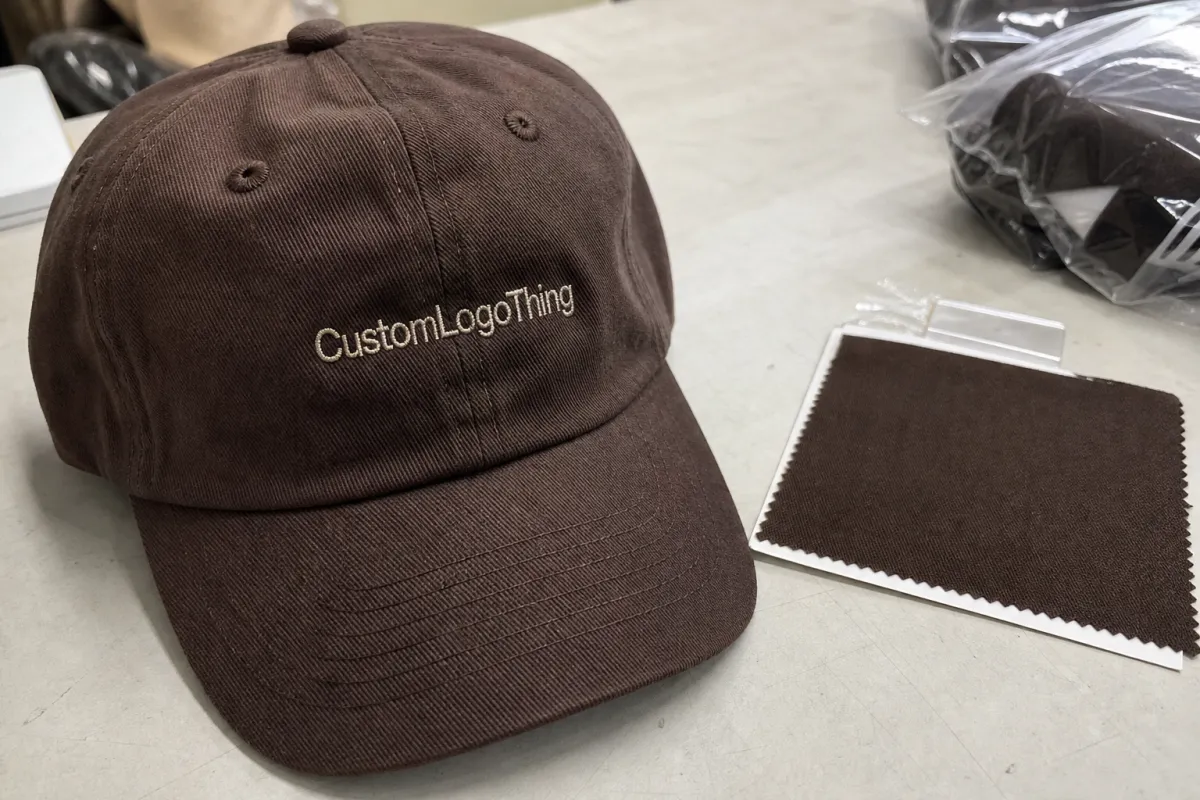
Brown is sensitive to small changes in dye depth and finish. A chocolate tone can drift toward espresso, red clay, taupe, or dull cocoa with only a slight shift in fabric construction. A tighter weave may make the same color read richer. A brushed surface may soften it. A wash can mute it. On a spec sheet those changes seem minor. In person they are not.
That is especially true for Unstructured Dad Hats. The crown collapses differently from a structured cap, so more of the fabric surface is visible and more of the texture influences perception. A heavy, clean chocolate can feel premium. A chalky brown can feel tired. The difference is often not the pigment itself but the way the cloth carries the finish.
Light changes the result again. Warehouse LEDs cool the color. Warm office bulbs push it redder. Daylight exposes undertones that are easy to miss on a screen. If a buyer approves only from a photo set, the order can still fail when the cap lands in retail lighting or on a merch table.
The sample also shows whether the brown supports the decoration. Thread that looks sharp on cream or black may disappear into a darker brown. A woven patch can solve that, but it also changes the drape of the front panel. One decision affects another. That is why approval should be based on the whole cap, not just the fabric swatch.
What a material sample guide should include for soft caps
A useful sample guide separates material testing from construction testing. A swatch answers one set of questions. A sewn cap answers another. If a supplier sends only a finished hat and calls it a material sample, the buyer still does not know how the fabric behaves before sewing, or whether the construction will change the shade and handfeel.
For soft caps, the guide should include the fabric swatch, a sewn sample, a closure sample, and a decoration proof. The swatch should show color, weave, and surface texture. The sewn sample should show crown behavior, seam line placement, sweatband comfort, and brim curve. If the cap is garment washed, pigment dyed, or enzyme washed, that should be written down. Finishing is not a footnote; it is part of the product.
The guide should also list measurable specs. Crown height, front panel depth, brim length, seam count, sweatband width, and closure type all affect how the hat sits. For a typical unstructured dad hat, buyers usually look for a low crown, a pre-curved visor, and a relaxed front panel that still returns to shape after handling. If the cap is too soft, it can slump. If it is too heavy, it stops feeling casual.
- Fabric swatch for tone, weave, handfeel, and finish
- Sewn sample for fit, panel shape, and brim behavior
- Trim sample for buckle, strap, sweatband, and label quality
- Decoration proof for embroidery, patch, or woven label placement
A guide should also say what is not being tested. If the fabric sample is only a color reference, that needs to be clear. If the sewn sample is made in a similar cloth but not the final fabric lot, that also needs to be stated. Buyers lose time when everyone assumes the sample means final approval and the factory thinks it was only a development step.
For brown hats, note the color standard in more than one way. A Pantone reference helps, but a physical lab dip or strike-off is better. Chocolate is one of those colors that can look right on paper and still feel wrong in hand because the warm-cool balance is off by a hair.
Key fabric, finish, and fit factors to compare side by side
Fabric weight is the first practical comparison. A lighter cloth drapes easily and usually feels more laid-back. A heavier one holds the crown shape better and tends to look more substantial in retail photography. For this product type, many buyers compare cotton twill in the 220-260 gsm range against washed cotton or cotton-poly blends in similar or slightly higher weights. The numbers matter, but the handfeel matters more.
Brushed cotton twill is a common choice because it feels soft without becoming limp. Washed cotton gives a more broken-in appearance, though it can mute the chocolate tone and reduce sharpness around the seam lines. Pigment-dyed fabric often produces the richest worn-in look, but the color can vary more from batch to batch. That is fine if the goal is a lived-in aesthetic. It is less fine if the brand needs exact repeatability.
Finish changes the perception of quality. Enzyme wash can make the cap feel softer from day one. Garment wash reduces stiffness and can make the crown collapse in a nicer way. Heavy sanding or aggressive washing may create a desirable vintage effect, but it also increases the risk of uneven shade or premature wear. On a dark brown cap, finish can either add depth or make the product look dusty.
Fit deserves its own review. An unstructured crown should look relaxed, not defeated. The front panel should collapse naturally without folding into a mess. The brim curve needs enough shape to frame the face, but not so much that the hat loses its easy profile. A sample worn on a head will reveal problems that a tabletop review hides immediately.
Decoration adds another layer. A dense embroidery design can pull on a soft front panel and change the way the crown sits. A patch can stiffen the area under it and create an uneven break line. If the logo will be large, test it on the actual fabric rather than assuming the same artwork will behave the same way on all materials. Dark brown is unforgiving here because the eye goes straight to contrast and distortion.
| Fabric option | Typical feel | What to watch |
|---|---|---|
| Brushed cotton twill | Soft, balanced, slightly premium | Can flatten if the weight is too light |
| Washed cotton | Relaxed, vintage, broken-in | May mute the chocolate tone |
| Cotton-poly blend | Stable, often more uniform | Can feel less natural and less breathable |
| Pigment-dyed cotton | Deep, lived-in color | Batch variation and shade drift are more common |
One technical point gets missed often: brown reflects the finish more visibly than the base dye. Two hats can use the same color recipe and still read differently if one has a cleaner surface and the other has a rougher wash. That is why side-by-side comparison matters more than a single sample review.
Sampling process and lead time from request to approval
The cleanest sample process starts with one organized brief. Send the target dimensions, closure style, logo artwork, fabric preference, color direction, and any finishing notes together. If the buyer wants a chocolate tone that leans warm, muted, or almost espresso, say so directly. "Brown" is too vague. "Deep chocolate with low red content" is better.
Once the brief is clear, request the first sample and review it against the written spec. Mark changes on the cap or in one annotated file, not in scattered messages. The goal is to get from the first physical sample to a stable approval with the fewest possible revision loops. Every extra loop adds time and usually adds friction.
Lead times are not uniform. A basic fabric swatch may take 3-7 business days. A sewn cap sample usually needs 7-12 business days. A decorated pre-production sample can take 10-15 business days, longer if the logo requires digitizing or if the trim package is custom. Bulk production often runs 12-20 business days after approval, but custom dye work, special washing, or a tight factory schedule can push that out.
Rush service is possible, but it is rarely free. Buyers should expect a surcharge, often 20%-50% above the standard sample cost, depending on how much schedule pressure is being applied. That is not a penalty so much as a reflection of the extra labor and queue jump. A factory can move faster, but not without tradeoffs.
The most common delay is avoidable. Missing artwork, late closure decisions, and color references that are only described verbally all slow the process. One revision round is normal. Two can still be acceptable. More than that usually means the brief was not tight enough to start with.
Keep one approved physical reference, one written spec, and one sign-off record. Anything looser invites confusion later.
Cost, MOQ, and unit-cost tradeoffs buyers should watch
Sample pricing is higher than bulk pricing because the factory is paying for setup, cutting, stitching, and waste across just one or a few pieces. A fabric swatch often lands around $5-$15 before freight. A sewn sample commonly falls in the $35-$80 range. A decorated pre-production sample can run $60-$150, especially if embroidery, patch tooling, or custom trims are involved. Those numbers are broad, but they are close enough to be useful in planning.
MOQ changes the economics quickly. At 100-300 units, the price per hat is usually much higher than at 1,000 units or more because pattern work and setup are spread across fewer pieces. That can still make sense for a launch test, a niche drop, or a seasonal run. It is less attractive if the brand needs a stable retail margin and expects repeat reorders. Small runs are rarely efficient unless the design is simple.
Unit cost is shaped by more than the fabric. Decoration method, closure type, sweatband quality, inside taping, and wash treatment all move the price. A simple buckle closure costs less than a custom metal clasp. Flat embroidery is usually cheaper than a patch with edge stitching. A garment wash adds labor. A printed inner label may save a little money, but it can compromise the finish if the brand wants a more premium feel.
The hidden costs are often more important than the quoted cap price. Embroidery setup, artwork digitizing, special dye charges, upgraded packaging, and expedited freight all add up. If the supplier offers a presentation-ready sample kit, ask whether it includes the final fabric, not just a similar shade. A sample that looks close but is not truly representative can force another round of approvals and cost more than it saved.
For planning purposes, a rough bulk range on a straightforward chocolate unstructured dad hat might sit around $4.50-$8.00 at higher volumes, $6-$11 at mid-range quantities, and $8-$16 on smaller orders, depending on decoration and materials. Those figures move fast with trim upgrades. They are useful as a budget check, not as a quote.
Common mistakes when approving unstructured dad hat samples
The biggest mistake is judging the brown under only one light source. A chocolate hat that feels rich in daylight can turn lifeless under warm bulbs or slightly gray under cool LEDs. Buyers should check it in at least two settings. If the hat will live in retail, sample it in retail-style lighting as well. That extra step catches more problems than most revision rounds.
Another common error is approving the sample without wearing it. Unstructured hats change shape once they are on a head. What looks balanced on a table may sit too shallow, pinch at the forehead, or collapse too much at the front. The crown should feel relaxed, but still intentional. There is a thin line between casual and unfinished.
Decoration placement deserves close attention. A logo that looks centered on the flat sample can shift once the fabric settles. That is especially noticeable on dark brown because the contrast edge becomes the first thing people see. If embroidery sits too close to a seam or too high on the front panel, the hat can feel slightly off even when the workmanship is clean.
Buyers also assume the sample is a perfect preview of bulk production. Sometimes it is. Often it is only the closest reference the factory can make before final sourcing is locked. If the bulk order will use a different fabric lot, thread source, or wash cycle, the shade can move. Brown is particularly sensitive to that kind of drift because finish and texture influence how the color reads.
One more issue shows up after approval: forgetting to save the sample as a control. If the approved piece disappears into a drawer with no label, the next reorder loses its anchor. That creates unnecessary debate later, especially when multiple teams touch the account.
If the factory cannot confirm the same fabric lot or finishing method for bulk, treat the sample as a direction, not a promise.
Expert tips for sharper approvals and cleaner sample comparisons
Keep the review setup constant. Same table. Same light. Same background. Same camera settings if photos are being taken. That sounds fussy until three brown samples are placed side by side and the background starts doing half the visual work. Neutral gray or white surfaces make comparisons easier, and a color card removes a lot of guesswork from photo records.
Use a simple annotation method. Write down what changed and why the sample passed or failed. "Too red in daylight" is useful. "Not right" is not. Over time, those notes become a practical archive that shortens future approvals. The language can be plain as long as it is specific.
Ask for the sample to be checked after a little handling, not only right out of the box. Soft caps relax once they are worn, unfolded, and set down a few times. That is the shape customers will actually receive. A hat that looks slightly imperfect in the box may be fine on a head. A hat that looks beautiful only when untouched may not hold up in use.
Keep the approved swatch, the approved hat, and the final trim card together. That physical record is worth more than a long email chain. When the next order arrives, the team has a direct comparison instead of a memory of what "better brown" was supposed to mean. That is a small operational habit, but it saves real money.
- Review the sample under daylight and indoor light.
- Wear the hat before approving crown shape and depth.
- Check decoration placement after the fabric settles.
- Label and archive the approved sample immediately.
A final point on comparison: do not stack too many variables into one sample round. If the fabric, closure, logo size, and wash treatment all change at once, the result is hard to evaluate. Good sampling isolates variables. That is slower at first and faster by the second order.
Next steps for a clean quote and production handoff
Start with a brief that can survive a handoff between sourcing, design, and production. Include the exact chocolate direction, fabric type, closure, decoration method, target dimensions, and any wash or finish requirement. If there is a benchmark product already in the market, note what should be matched and what should not. That level of clarity reduces back-and-forth fast.
Then request the sample and review it against the same conditions the final product will face. If the cap is meant for retail, look at it in retail-style light. If it is meant for a relaxed merch drop, check whether the softness still reads premium rather than careless. If the hat is supposed to be a muted brown, make sure the finish does not push it toward red or orange.
Once the sample is approved, confirm the exact reference in writing and attach it to the purchase order. Quantities, size split, packing notes, ship date, and artwork version should all be tied to that approved piece. If the order uses recycled cartons, kraft inserts, or another specific pack-out method, note it before production starts. Rework is more expensive than a careful instruction set.
For buyers managing repeat orders, the approved sample should stay with the account file as the control piece. That way, the next production run starts from a known standard rather than a memory. With a disciplined Chocolate Unstructured Dad Hats material sample guide, the handoff becomes cleaner, the quote becomes more accurate, and the first bulk run is far less likely to drift.
What should I check first in chocolate unstructured dad hat samples?
Start with the color under daylight and indoor light. Chocolate brown can shift surprisingly fast between environments. After that, check the crown softness, the brim curve, and how the hat feels on a real head. A flat sample can hide fit problems that show up immediately once it is worn.
How many sample rounds are normal before approval?
One round is common if the brief is clear and the materials are standard. A second round is normal when the team is refining the shade, changing the logo placement, or comparing finishes. More than two usually means the spec needs tightening before production can move confidently.
Do material samples match the final chocolate color exactly?
Not always. Lighting, dye lot variation, weave density, and finish can all shift how the brown reads in person. Use the sample as the control reference and ask whether bulk production will use the same fabric source, same wash process, and same trim supplier.
What affects sample cost and unit cost on small dad hat orders?
Fabric choice, decoration setup, closure style, and shipping are the biggest cost drivers. Sample costs are higher because the factory absorbs setup labor and waste on a small quantity. Smaller bulk orders usually have higher unit costs because the same setup is spread across fewer hats.
How do I speed up the production timeline after approving samples?
Send the approval in one complete file with artwork, measurements, color reference, quantities, and packing instructions. Do not change the spec after sign-off unless the change is truly necessary. Even a small adjustment can force another sample and push the ship date back.

