A custom poly mailer Bags Bulk Order works best when the bag is treated as part of the shipping system, not just a printed wrapper. Size, film, seal, and artwork all affect labor time, damage risk, and the consistency of the final shipment. If those choices are aligned early, the warehouse moves faster and the packaging looks more deliberate.
From a buyer’s perspective, the mailer does three jobs at once. It protects the product, supports the brand, and keeps fulfillment predictable. The smartest program is usually the one that does all three without adding material cost or handling steps that do not earn their keep.
That is why bulk ordering deserves a practical approach. A mailer that fits the product well can reduce carton use, cut void fill, and simplify labeling. A mailer that is too large, too thin, or awkward to seal often creates hidden costs that do not show up until the first production run is underway.
Why bulk poly mailers reduce shipping mistakes and waste
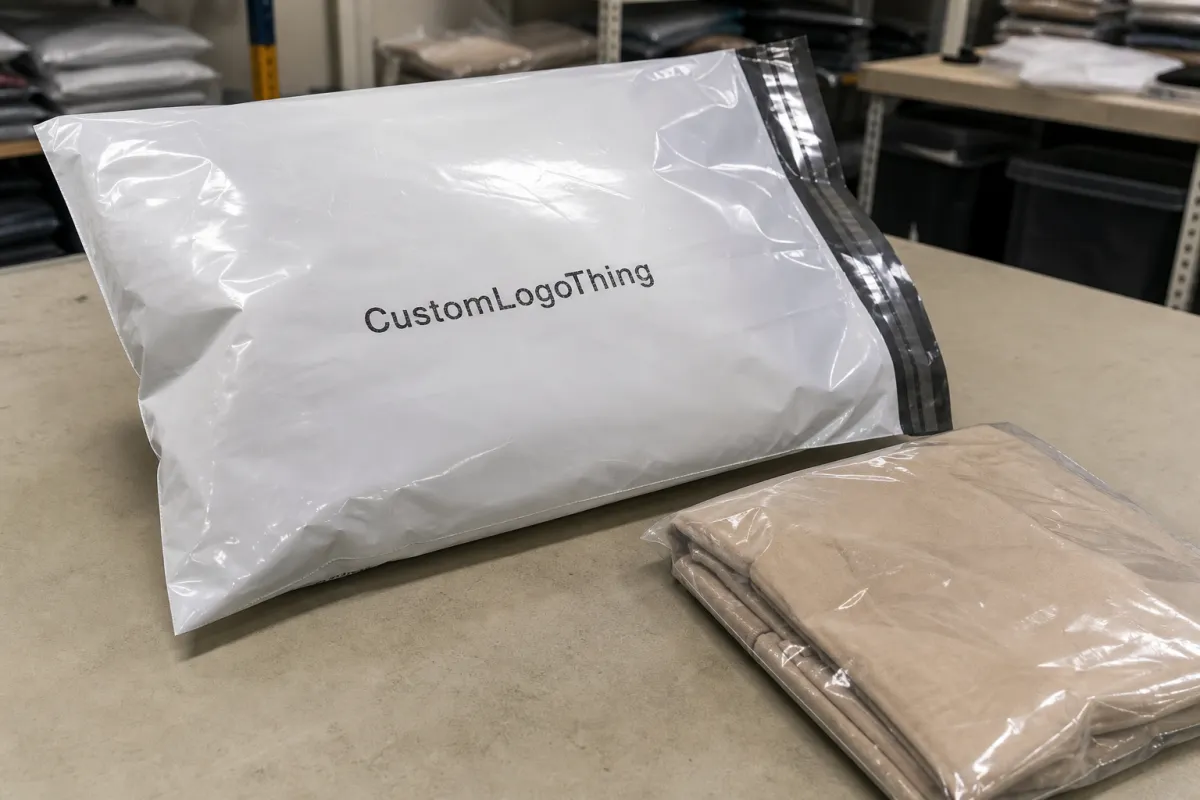
Standardizing on one or two mailer sizes often improves operations more than teams expect. When packers have too many choices, they slow down and start making judgment calls at the bench. That is where mistakes creep in: the wrong size bag, a second pass on labels, or a carton that gets packed too loosely and shifts in transit.
A well-planned bulk mailer program removes much of that friction. The packed item has a known home, the seal location stays consistent, and the label zone can be set once instead of rethought on every order. For apparel, flat accessories, printed inserts, and similar goods, that kind of repeatability matters because the order looks cleaner and moves faster.
It also reduces waste. If the product fits a mailer properly, there is less need for oversized corrugate, fewer filler materials, and fewer “just make it work” decisions at the packing station. Those small efficiencies add up across a week of shipping.
For high-volume teams, the biggest gain is not only material savings. It is labor consistency. A bag that opens easily, folds the same way each time, and seals without extra pressure saves seconds on every packout. Across thousands of units, seconds become real money.
The lowest unit price is not always the lowest landed cost. If a mailer slows packing, causes relabeling, or leads to avoidable damage, the savings disappear quickly.
That is one reason many buyers compare Custom Poly Mailers against boxes too late in the process. Boxes can be the right answer for fragile or rigid products, but they bring more storage demand and more assembly time. For flat products that do not need rigid protection, a poly mailer often does the job with fewer steps and a lighter freight profile.
If your packaging mix already includes Custom Poly Mailers in more than one format, the same discipline applies across the line: fit first, then closure, then print. That order keeps the program focused on the shipping job rather than the decoration alone.
Film, seal, and print choices that shape everyday performance
Most poly mailers use polyethylene film, and many are co-extruded, meaning multiple layers are combined to balance toughness, flexibility, and print quality. That matters because two mailers can look nearly identical on a spec sheet yet behave very differently in real use. One may resist puncture better, another may print more crisply, and a third may seal more cleanly under production heat or pressure.
For light apparel and soft goods, a standard co-extruded film is often enough. For items with zippers, corners, or denser folds, a thicker gauge can help prevent scuffs and split seams. Thicker is not automatically better, though. Overbuilding the film can raise cost without improving day-to-day performance, and it can make the bag stiffer than a packing line wants.
Seal design deserves the same attention. Many mailers use a pressure-sensitive adhesive strip, but the seal geometry and adhesive strength affect how confidently the package closes. Some closures are meant to be permanent, which is useful for tamper evidence and one-way shipping. Others are more forgiving for returns or repack situations. That decision should be made before artwork is approved, not after the bags are already running.
Print changes both appearance and production cost. A one-color logo is often the cleanest answer for a high-volume shipment program because it keeps setup simple and is easier to read at a glance. Full-coverage graphics can look strong, but they add registration demands and raise the chance of visible color variation if the artwork is dense or the file is not prepared carefully.
Finish matters too. Matte films tend to hide fingerprints and reduce glare under warehouse lights. Glossy films usually look brighter and can make color feel more vivid. Neither finish is universally better. The right choice depends on the brand, the product category, and how much handling the mailer will see before it reaches the customer.
Buyers who want a deeper technical frame can use references from packaging.org and ISTA to check packaging terms and transit-testing language before locking in a spec. Those resources are useful when you need to separate marketing language from actual performance requirements.
Size, thickness, and compliance specs to lock in before quoting
Size seems straightforward until someone measures the packed product instead of the loose item. That difference matters. A garment with a hang tag, a folded item with a cardboard insert, or a soft product with one rigid edge can need a larger bag than the flat dimensions suggest. Quotes are more accurate when they are based on finished packed size, not on the product in isolation.
Thickness is usually measured in mils, and the number should reflect the shipping risk. A flat, flexible item may perform well in standard gauge film. A product with edges, hardware, or a more complex fold may need more puncture resistance. The real question is not how thick the bag can be made; it is how much film is needed to protect the product without overpaying for material that adds little value.
Several other specs should be settled early because they affect both performance and production. Seal width changes closure reliability. Gusseting, if used, affects how much depth the bag can take. Label placement matters when the warehouse depends on scan zones or automated sorting. If the mailer must run through equipment, the film has to feed cleanly and close without curling, sticking, or drifting off register.
Compliance deserves attention before the purchase order is issued. If the brand wants to make recyclability claims, the material structure and the wording on the package must support those claims accurately. If the mailers travel through carrier networks with specific packaging expectations, those requirements should be checked against current rules. Environmental language should also be handled carefully; a package that is technically recyclable in one region may not be treated the same way everywhere.
Use this checklist before asking for pricing:
- Finished dimensions of the packed item, including tags, inserts, and any bulk from folds.
- Film gauge based on product weight, stiffness, and puncture risk.
- Seal style for permanent closure, reseal use, or return handling.
- Print area, number of colors, and whether the logo must repeat or stay centered.
- Special features such as opacity, label windows, document pouches, or gussets.
If the same team also manages Custom Packaging Products, it helps to apply the same logic across categories: define fit first, function second, and decoration last. That sequence avoids rework and keeps the spec sheet usable for reorders.
Cost, pricing, and MOQ factors in a custom poly mailer bags bulk order
Pricing for a custom poly mailer Bags Bulk Order usually comes down to a handful of variables: bag size, film weight, print coverage, number of colors, closure style, and volume. Two quotes can look far apart even when they are both reasonable, because one may include heavier film, more setup waste, or more demanding artwork. Comparing only the unit price usually gives a false sense of savings.
MOQ, or minimum order quantity, is typically tied to setup efficiency. More colors mean more setup time. Larger formats use more material. Special film structures or closure features can increase the production floor a supplier needs to run the job efficiently. That is standard in packaging production, not a sign that the supplier is being difficult.
For planning purposes, it helps to think in directional price bands rather than exact numbers. Actual pricing will shift with size, freight, and artwork complexity, but these ranges give a realistic sense of how the market usually behaves:
| Mailer type | Typical use | Typical unit price at bulk volume | Notes |
|---|---|---|---|
| Unprinted stock mailer | Simple fulfillment, low branding needs | $0.08-$0.15 | Lowest setup cost, limited brand presence |
| One-color custom print | Branded shipping for apparel and accessories | $0.11-$0.21 | Often the best balance of cost and presentation |
| Multi-color or full-coverage print | Stronger visual impact, retail packaging programs | $0.16-$0.30+ | Higher ink usage, tighter artwork control, more setup time |
*Directional ranges only. Actual cost depends on size, film gauge, print coverage, and freight.
Bulk buying lowers unit cost only if the spec stays disciplined. It is easy to add thickness, enlarge the bag, or increase the print area because each change seems small on its own. Together, those choices can move the cost up faster than a buyer expects. A simple one-color layout on a standard gauge often makes more business sense than a more elaborate bag that does not improve shipping performance.
Ask for quotes that separate tooling, production, and freight. Landed cost is what matters to finance, not the printed-piece price alone. If the order will repeat across seasons or product drops, Wholesale Programs can help with volume planning and make reorders easier to forecast.
The strongest quotes usually come with a clear explanation of where cost is being spent and where it is not. If a supplier recommends a thinner film that still protects the shipment, or a simpler print layout that stays readable at distance, that is often a sign they understand the job rather than just the decoration.
Process, timeline, and lead time from artwork to shipment
The production path for a custom Poly Mailer Bags bulk order usually follows the same sequence: inquiry, quote review, artwork prep, proof approval, material sourcing, printing, converting, packing, and shipment. The schedule is usually not lost in the middle of that chain; it is lost when one step is only half decided and the next step starts anyway.
Artwork is a common source of delay. So is color approval. If the brand uses a specific shade, the supplier should know whether the goal is to match an existing standard or stay within a reasonable print tolerance. The more detailed the artwork, the more important it is that the right person reviews the proof the first time. A late correction on a large run can move the whole schedule.
Lead time varies by size, print complexity, and season, but a standard custom job often lands in the 12-20 business day range after proof approval. More complex structures, tight color matching, or crowded production calendars can push that longer. Freight time sits on top of production time, so an order that looks fast on paper may still arrive late if transit is not built into the plan.
That is why buffer time matters. Seasonal packaging, launch dates, and promotional shipment windows should not be scheduled right at the edge of production capacity. Packaging is one of those categories where a two-day delay can ripple into warehousing, fulfillment, and marketing all at once.
There is also a practical reason to approve the full system early. A mailer that is supposed to coordinate with inserts, labels, or a retail presentation kit should be reviewed alongside the other pieces. If the mailer design is approved in isolation, the final package can feel mismatched even when every item technically meets spec.
The best-run orders are the ones where the buyer sends complete information up front, the supplier can answer clearly, and no one has to guess at the final size or color. That is what keeps production predictable and avoids last-minute reshuffling.
Supplier checks that protect color, seal strength, and reorders
Price matters, but it should never be the only filter. Before approving a bulk order, ask how the supplier controls print consistency, seal reliability, and dimensional tolerance from run to run. If color drifts, the seal strip fails under normal handling, or the trim size varies too much, the cheapest quote can become expensive very quickly.
Communication is a useful quality signal. A dependable supplier will explain material choices in plain language, point out where artwork limits may affect the result, and say when a simpler build is enough. That kind of advice saves money and avoids overengineering. Good packaging partners do not add features just to make a quote look more complete.
Reorder handling matters as much as first-run approval. Ask how spec sheets, artwork files, and production settings are stored. If the supplier keeps those records cleanly, the next run should move faster and be less likely to drift. That is especially important for brands that ship monthly or have the same package repeat across multiple seasons.
Transit behavior is worth discussing too. Packaging teams often reference ISTA methods because shipping is rougher than a tabletop test. A mailer has to survive conveyor movement, carrier sorting, stacking pressure, and general handling before it reaches the end customer. A bag that looks strong in a proof may still fail if the film is too brittle or the seal margin is too narrow.
It also helps when the supplier is willing to steer buyers away from unnecessary upgrades. If the item is light and flat, heavier film may not improve anything. If a one-color layout solves the branding requirement, extra colors may only add setup cost. Experience shows up in those small decisions.
For buyers comparing formats over time, a useful reference is the FAQ section, especially when the same team is handling fits, print approvals, and reorder timing across multiple packaging components.
Next steps to place an order
To move from planning to quoting, gather the pieces that actually affect production: finished product dimensions, target quantity, artwork files, color goals, seal preference, and the shipping date that truly matters. The more complete the request, the cleaner the quote will be.
Before production starts, confirm the final spec sheet, approve the proof, and lock the schedule. A Custom Poly Mailer Bags bulk order stays on track when the size, film gauge, and print direction are settled before the line is booked. If the order will be repeated later, record the final spec now so the next run does not start from scratch.
A short pre-order checklist usually keeps the process orderly:
- Sample or proof approval so film, print, and layout are confirmed.
- MOQ confirmation so the order fits the production plan.
- Freight estimate so landed cost is visible early.
- Reorder record so the same spec can be used again.
- Final artwork with bleed, placement, and approved colors.
That approach usually leads to a better result because the supplier can quote accurately, the production team has fewer unknowns, and the warehouse receives a mailer that fits the job. The point is not decoration for its own sake. The point is a package that ships cleanly, protects the product, and holds up across repeated runs.
Frequently asked questions
What is the usual MOQ for custom poly mailer bags in bulk?
MOQ depends on bag size, print complexity, and film specification because each setup carries a different production cost. Simpler runs with one-color print and standard film often allow a lower minimum, while larger formats, special closures, or more colors usually raise the threshold.
How do I choose the right thickness for bulk poly mailers?
Match thickness to the product rather than choosing the heaviest film available. Flat, soft items usually do well with standard gauge film, while products with edges, hardware, or more puncture risk may need stronger material to reduce split seams and scuffing.
How long does a custom poly mailer order usually take?
Lead time depends on artwork approval, production setup, volume, and whether the spec is standard or custom. A normal custom run often lands in the 12-20 business day range after proof approval, with freight time added on top.
What files should I send for an accurate poly mailer quote?
Send finished dimensions, estimated quantity, artwork files, number of print colors, and any performance needs such as stronger sealing or higher opacity. A target ship date is also useful because it helps set a realistic production window.
Can I reorder the same mailer specs later without starting over?
Yes, if the supplier keeps the approved spec sheet, artwork files, and production settings on record. Clean records make reorders faster and reduce the chance that size, color, or seal details drift from the original run.

