B2B Pricing Guide for Poly Mailer Bag Unit Costs
Two quotes can look almost identical on paper and still differ by 20% or more once the Poly Mailer Bags unit cost breakdown is unpacked. The usual reason is not mystery pricing; it is a mix of film thickness, print coverage, setup charges, freight, and the quantity tier behind the number. A buyer who sees only the headline rate misses the part that actually matters: landed cost per bag.
That is why a clean quote for Custom Poly Mailers should never be judged by unit price alone. In practice, the cheapest-looking offer can become the most expensive after tooling fees, repackaging, and shipping are added. The tighter move is to compare the full Poly Mailer Bags Unit Cost Breakdown before artwork is approved or a purchase order is signed.
For brands buying branded mailers, this is not academic. A small change in dimensions, a switch from stock to custom size, or an extra print color can alter the economics more than a modest quantity increase. The same logic applies to Custom Packaging Products across the board: the quote is only useful if the specs are aligned, the freight is included, and the supplier has made the cost drivers visible.
Below is the practical version of the pricing story buyers can use before requesting samples, comparing bids, or asking procurement to release an order.
Why Smaller Orders Can Raise Poly Mailer Costs
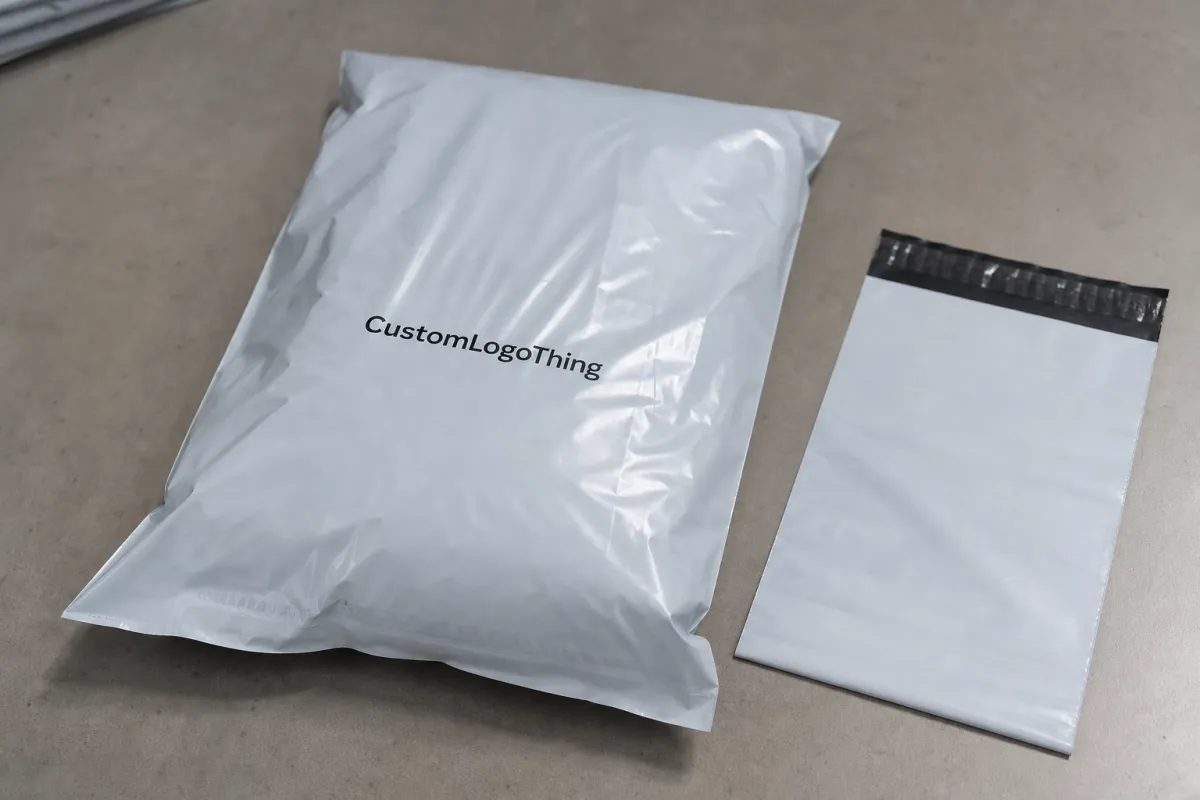
A buyer asks for 2,500 branded mailers. Another buyer asks for 10,000 of the same visible size. On paper, both want a bag that measures the same, carries the same logo, and ships the same product. Yet the smaller order often carries a noticeably higher unit cost because setup and production prep are spread across fewer bags. That is the first thing people miss in a poly mailer bags unit cost breakdown.
Short runs are expensive for a simple reason: a converting line still needs to be set up, the print job still needs to be proofed, and the supplier still needs to cartonize and ship the order. If there are plates, die charges, or pre-press checks, those fixed costs do not shrink just because the order is small. A $120 setup charge feels minor at 20,000 pieces. At 2,000 pieces, it becomes visible immediately.
Film thickness changes the picture as well. A 2.5 mil mailer and a 3.5 mil mailer may look similar to the eye, but the heavier gauge usually consumes more resin and can move the cost faster than buyers expect. So can print coverage. A one-color logo in a compact area is a different job from a full-bleed design that wraps the whole outer surface. The second version needs more ink, more control, and often more waste allowance.
The most useful comparison is not “what is the quote?” but “what is the landed cost per bag at this quantity and spec?” That question exposes whether freight, repacking, and carton counts are hiding a real price swing. It also shows why a quote for 5,000 pieces can sometimes beat a quote for 3,000 pieces by a wider margin than the quantity difference suggests.
A useful quote should tell you what is driving the number. If it does not show film, print coverage, setup charges, and freight separately, the buyer is not seeing the full cost picture.
From a packaging buyer’s point of view, the right starting point is simple: ask for the same size, same thickness, same print coverage, and same shipping term on every bid. If one supplier is quoting stock-style inventory and another is quoting a custom build, those are not competing numbers. They are different products.
There is also a timing effect that gets overlooked. Suppliers with idle capacity sometimes price a small run more aggressively if the job fits into an open production window. That does not happen on every order, and it should never be assumed, but it explains why two quotes from two capable suppliers can still diverge even when the specs are matched. The lesson is to compare complete terms, not just the first number sent over email.
Poly Mailer Bags Unit Cost Breakdown
The poly mailer bags unit cost breakdown usually has six moving parts: film resin, bag dimensions, print method, sealing hardware, packing method, and outbound freight. The unit cost is not one thing. It is the sum of several small decisions that add up fast when the run is short or the artwork is demanding.
1) Film resin and thickness
Polyethylene film is the base material, and it tends to set the floor for pricing. A lighter mailer can be perfectly acceptable for soft goods, while heavier apparel, books, or products with rough corners often need a thicker gauge. Moving from 2.5 mil to 3 mil, or from 3 mil to 4 mil, does not just add durability. It also raises resin usage, which lifts the base rate and may increase waste during conversion.
Opacity matters too. A more opaque film can mean different resin blends or additives. That does not always create a dramatic jump, but it changes the economics enough that a supplier should state the film spec clearly. Buyers should ask for film gauge tolerance, not just a nominal thickness. In production, a tolerance band is often more useful than a single target number because it tells you how much variation is considered acceptable before a lot is held or reworked.
2) Print method and coverage
One-color print is usually the easiest path. Multi-color art adds plate cost, registration control, and more chances for setup waste. Full-bleed coverage is pricier still because the press must hold ink coverage more consistently across the sheet or web. A compact logo in one corner and a full-surface pattern are not the same production job, even if both are “printed mailers.”
For many programs, the biggest surprise is not ink cost. It is the time and waste attached to proofing and alignment. That is why a supplier should quote print area, color count, and proof type separately. Buyers should also ask whether the quoted price assumes standard ink laydown or a heavier coverage requirement, since dense artwork can need more correction during setup.
3) Sealing and functional features
Self-seal adhesive, tear notches, dual adhesive strips, handles, and reinforced seams all move cost. Some features are worth it because they reduce returns or speed fulfillment. Others are cosmetic and do little for actual use. Buyers who ship apparel in high volumes often see the best value in a strong seal and consistent seam quality rather than decorative extras.
A weak seal or uneven seam is not a minor defect. It can create rework at the packing table, damage in transit, or chargebacks if the customer receives an open bag. That kind of failure rarely shows up in the headline quote, but it should absolutely be part of the buying decision. A few tenths of a cent saved on the bag can disappear quickly if a carton is pulled from the line.
4) Packing method and cartonization
How the bags are packed affects both handling cost and freight efficiency. Loose-packed units can be cheaper to produce, but they may take more storage space and create a different carton count. Retail-ready bundles, printed master cartons, or special pallet patterns can add handling steps. Those steps belong in the true unit cost, not buried under a vague “miscellaneous” line.
Packing density also changes freight economics. A bag that nests efficiently may ship far better than one with a bulkier fold or a wider flap. That matters more on larger orders, especially if the product is moving by ocean or cross-country truck where cube is a bigger driver than weight. On smaller orders, the packaging format can matter almost as much as the resin itself.
| Option | Typical price pressure | Common use case | Buyer note |
|---|---|---|---|
| Stock-size, unprinted | Lowest | Generic shipping, internal fulfillment | Good baseline for cost control, limited branding value |
| Custom size, one-color print | Moderate | Apparel, subscription shipments, branded orders | Often the best balance of cost per piece and presentation |
| Custom size, multi-color print | Higher | Brand-led packaging, retail unboxing | Expect plate and setup charges to matter more |
| Full-bleed or premium finish | Highest | Launch programs, high-visibility branding | Compare landed unit price, not just the base quote |
For reference, a simple quote for 5,000 bags might land around $0.12-$0.18 per piece for plain stock-style mailers, $0.18-$0.32 for a custom one-color printed version, and $0.28-$0.45 or more for multi-color or full-coverage work. Those are not promises; they are planning ranges, and they change with size, gauge, freight, and packaging format. The useful move is to ask the supplier to explain each line inside the poly mailer bags unit cost breakdown.
If the supplier also handles recycled-content film or specialty packaging, ask whether the resin blend changes the print yield or the seal strength. Some buyers are targeting lower material impact, and the EPA’s recycling guidance is a useful checkpoint for claims and terminology: EPA recycling guidance. For brands that want to understand transit-test expectations, the ISTA resource center is worth reviewing: ISTA testing standards.
One caution on pricing ranges: if a quote lands far below those bands, check what has been left out. Sometimes the lower number excludes freight, uses a lighter film than requested, or assumes a generic stock format instead of a true custom build. A low number only helps if it describes the same product.
Spec Choices That Move Pricing Up or Down
Before a supplier can quote accurately, it needs the exact specs. Dimensions are obvious, but that is only the start. Ask for width, length, flap style, adhesive strength, thickness, tear notch, print colors, and whether the bag needs matte, gloss, or recycled-content film. The better the brief, the cleaner the poly mailer bags unit cost breakdown.
Custom dimensions can push cost higher because they change film yield and may create more trim waste during production. A stock size often benefits from established tooling and efficient runs. A bespoke size may fit the product better, but that fit comes with setup time and often a higher cost per piece. In other words, “custom” can be smart, but it is rarely free.
Recycled content is another variable. Buyers often want it for brand positioning or procurement goals, and that can be a good decision. It can also change the film feel, opacity, and price. The same is true for specialty finishes. Matte and gloss do not just alter appearance; they can change how the film is handled, printed, and perceived by the end customer. A matte bag may hide scuffs better, while a glossier surface can show graphics more sharply but may be more sensitive to fingerprinting and handling marks.
Durability requirements also matter. Heavy goods, products with sharp edges, or shipments that will pass through dense parcel networks may need stronger seams or a thicker gauge. That does not mean overbuilding every order. It means matching the spec to the use case so the buyer is paying for the right amount of performance, not a guess.
Spec checklist for a quote that compares cleanly:
- Exact bag dimensions and flap length
- Target thickness or film gauge
- Print method, number of colors, and ink coverage
- Adhesive style and seal strength
- Tear notch, handles, or reinforcement requirements
- Packaging format, carton count, and pallet preference
- Delivery ZIP code or destination country for freight
One more point that gets missed: proof type can change the buying experience. A digital proof is fast, but it does not replace a physical sample if color accuracy or seam performance matters. For first-time orders, that sample is cheap insurance. It helps the buyer avoid spending the wrong money on the wrong specification.
Some buyers also forget to specify whether the final count should include overrun or underrun tolerance. That detail can affect both payment and inventory planning. If the buying team expects exactly 10,000 bags and the supplier delivers within a normal production tolerance, the paperwork should already reflect how those small differences are handled. Clear terms prevent awkward surprises at receiving.
MOQ, Quote Tiers, and How to Compare Bids
MOQ is one of the strongest levers in the poly mailer bags unit cost breakdown. Smaller quantities usually carry a higher cost per bag because the same setup work is divided across fewer units. A 1,000-piece run absorbs setup charges very differently from a 10,000-piece run. That is why MOQ should be viewed as a pricing mechanism, not just a supplier policy.
Tiered pricing matters because the jump from one level to the next can be more efficient than buyers expect. Sometimes the step from 3,000 to 5,000 pieces creates a sharper drop in unit cost than the step from 5,000 to 7,500. The reason is simple: once the line is running, incremental units are cheaper than the first units. The setup is already paid for.
That is also why the highest quantity does not always win. If the order sits in storage too long, the carrying cost can erase the discount. A good buyer checks usage rate, warehouse space, and cash flow before choosing the biggest tier. The goal is not to buy the most mailers possible. The goal is to Buy the Right number at the best landed cost.
Here are the common quote traps:
- Rush fees that push the price up after the order is already time-sensitive
- Artwork revisions that trigger new proofs or new plates
- Color changes that look small but create real pre-press work
- Split shipments that add handling and freight complexity
- Carton changes that alter packing efficiency
One simple comparison method works well: ask each supplier for ex-factory price, setup charges, and delivered freight separately. Then calculate the landed unit price yourself. If one quote is cheaper at the dock but materially higher after transport, it is not really the lower-cost option. Buyers who compare only the headline number end up with a false winner.
Quote comparison rules that save money:
- Match the same size, thickness, color count, and finish.
- Confirm whether tooling fees or plates are included.
- Ask for the carton count and pallet count in writing.
- Use the same shipping destination on every bid.
- Check whether the quote assumes one sample proof or multiple revisions.
There is a practical side to quote tiers that procurement teams appreciate. If a supplier can show three or four breakpoints with transparent assumptions, it becomes easier to decide whether a slightly larger run deserves approval. That is far better than negotiating against a single vague number. Clarity reduces internal delay, and delay often costs more than the difference between two production tiers.
Process, Production Steps, and Lead Time Signals
The ordering process matters because every step has a clock attached to it. A supplier may quote a short production time, but that number rarely starts before the proof is approved. For a buyer managing launch dates, the difference between quote date and approval date is not cosmetic. It is the difference between a stocked shelf and a missed ship window.
The typical flow is straightforward: quote request, dieline or artwork review, proof approval, production, quality checks, packing, then shipment. The slowest part is usually not the machine time. It is the back-and-forth before production starts. Artwork revisions, unresolved dimensions, or vague print instructions can add several business days before the press even runs.
A realistic production lead time for a custom printed mailer is often 12-20 business days after proof approval, depending on the factory queue and order size. Transit time is separate. Air and ocean freight behave very differently, and domestic trucking can still add meaningful days if the order is shipping across the country. Buyers who mix production time with transit time end up underestimating the schedule.
In practice, a reorder should carry a buffer. Seasonal programs, promotions, and marketplace launches create demand spikes that do not wait for a late shipment. A smart procurement plan builds in a cushion for proof delays and freight variability. That cushion is often worth more than chasing the absolute lowest unit rate.
Here is the better planning question: “What has to happen before the first bag is ready to ship?” Once that is clear, lead time stops being an abstract promise and becomes a checklist. The checklist should include sample approval, print readiness, carton plan, and the final freight mode. If a supplier cannot explain those steps, the buyer is taking on avoidable risk.
For recurring programs, ask whether the supplier keeps the print spec on file and can repeat the same run without rebuilding the setup from scratch. That can reduce friction on reorders and improve consistency across multiple buying cycles. Consistency is not glamorous, but in packaging it protects margin.
Quality control also belongs in the timeline. A factory that checks seal integrity, print registration, and count accuracy before loading cartons reduces the odds of a costly receiving issue. The best quote in the market is still a weak deal if the shipment arrives short, misprinted, or inconsistent from carton to carton.
What a Reliable Poly Mailer Supplier Should Prove
A dependable supplier does not just offer a low number. It shows the work behind the number. That means a clear spec sheet, stated tolerance ranges, a defined print method, and visible QC checkpoints. If the quote is vague, the risk usually lands on the buyer later, often after the purchase order has already been placed.
The best suppliers answer questions fast and in specifics. They can tell you the film gauge, the adhesive type, the carton count, the pallet pattern, and the likely production window. That kind of communication reduces quote errors, which is one of the most expensive problems in packaging procurement. It is cheaper to fix a spec on the front end than to rework a shipment after the fact.
There is also a useful distinction between suppliers that compete only on rate and suppliers that protect repeat-order consistency. The lowest bid can be tempting, especially when the purchase order is under pressure. But if the color shifts, the seal fails, or the size tolerance drifts on the next run, the real cost shows up in returns, reprints, or brand damage. That is why the poly mailer bags unit cost breakdown should include quality risk, not just print and freight.
Documents worth asking for before approval:
- Spec sheet with size, gauge, print method, and seal details
- Artwork proof with color callouts and placement notes
- Sample photos or a physical sample pack
- Carton count and master carton dimensions
- QC checkpoint summary, especially for print alignment and seal strength
One more practical signal: a supplier that overpromises and under-describes usually creates trouble later. A supplier that states assumptions clearly, including what is not included, usually saves the buyer time. That is a useful filter for anyone trying to source branded mailers at scale.
If you are building a broader packaging program, it helps to keep the supplier conversation inside a wider category view. A partner that can handle multiple formats under one procurement rhythm often reduces the number of moving parts across shipping and presentation.
Consistency matters most on repeat orders. Matching color, maintaining the same seal performance, and holding the same trim dimensions across multiple runs makes the packaging easier to manage inside fulfillment, returns, and inventory planning. A supplier that can describe how it controls those variables is usually the one that will save time later.
Next Steps to Lock the Right Order Spec
Start with the facts a supplier needs to price correctly: exact dimensions, thickness, print colors, quantity, and delivery ZIP code. Without those inputs, the quote is only an estimate, and an estimate is a weak basis for purchase approval. The cleaner the brief, the cleaner the poly mailer bags unit cost breakdown.
Ask for three tiers if possible. For example, 3,000, 5,000, and 10,000 pieces. That shows where the unit cost drops and where the storage trade-off begins. It also helps procurement decide whether a slightly larger order creates a better landed cost or just ties up cash. The best tier is not always the biggest one.
Approve one digital proof and one physical sample before production, especially if the mailer is branded or color-sensitive. A monitor does not tell the full story on ink density, seal feel, or film opacity. A sample does. For first-time orders, that step is cheap compared with a reprint.
Then compare total landed cost and final lead time, not just ex-factory pricing. If the bags are needed for a campaign, a launch, or a seasonal push, schedule matters almost as much as price. A lower number that arrives late is not a savings.
Buyers who treat the order this way get better answers from suppliers and fewer surprises on receipt. That is the real value of understanding the poly mailer bags unit cost breakdown: it turns a vague quote into a procurement decision you can defend.
A solid buying process usually ends with a simple internal record: final spec, approved artwork, agreed freight term, production lead time, and a note on what triggers a re-quote. That record makes the next purchase faster and reduces the chance of drifting into a different product without realizing it.
How do I calculate poly mailer bags unit cost for my order?
Add material, printing, setup, packaging, and freight, then divide by the number of bags shipped. Make sure every quote uses the same size, thickness, and print coverage before comparing the number. If the supplier gives tiered pricing, test two or three volumes to see where the best per-bag rate starts.
What MOQ usually affects poly mailer bags unit cost the most?
MOQ matters because setup costs are spread across fewer bags on smaller runs, which pushes the unit cost up. Custom sizes and multi-color prints often have higher minimums than stock-style mailers. Ask for tiered pricing so you can see whether a slightly larger order creates a better landed cost.
Which specifications raise the unit cost fastest?
Thicker film, larger dimensions, and heavier print coverage usually move the price more than buyers expect. Special finishes, recycled content, and extra features like tear notches or reinforced seals also add cost. Custom artwork revisions can create extra setup charges if the proof changes after approval.
How long is the typical lead time after artwork approval?
Lead time starts after the proof is approved, not when the first quote is requested. Changes to artwork, sample approval, and production queue position can all extend the schedule. Transit time is separate from production time, so buyers should budget for both before committing to a launch date.
What should I send to get an accurate poly mailer quote?
Send the exact size, thickness, quantity, print colors, and delivery destination so the supplier can price the job correctly. If possible, include a sample photo or reference bag so the quote matches the intended use and finish. Ask for a landed-cost quote with freight included so your comparison is based on the real purchase price.


