Choosing event merch Logo Patch Beanies Material guide options sounds narrower than it is. In practice, the beanie body, the patch face, the backing, and the carton all affect how the finished piece feels in hand. A clean logo can look expensive on one knit and oddly rigid on another. That difference is rarely about the artwork alone.
Buyers usually start with the visual, then discover the physical constraints later. A beanie for an outdoor queue, a staff kit for repeated winter wear, and a VIP giveaway all ask for different materials. The right choice is less about chasing the fanciest surface and more about getting warmth, stretch, detail, and lead time to agree with each other.
That is the point of an event merch Logo Patch Beanies material guide: not style advice, but a practical way to compare materials before production starts. The shell fabric controls comfort and fit. The patch controls detail and perceived value. The backing controls whether the decoration sits flat or fights the knit. Change one of those variables and the product changes faster than most mockups suggest.
The same logo can read premium, sporty, or stiff depending on the knit beneath it.
Packaging also matters more than it gets credit for. If the beanies are going into press kits, sponsor boxes, or VIP mailers, the outer carton and insert material can change the buyer’s impression before the hat is even touched. Standard programs often ship in corrugated cardboard master cartons with kraft paper fillers or sleeves. Sustainability claims should be specific: ask whether cartons use FSC certified stock, whether any insert uses post-consumer waste content, and whether “biodegradable packaging” actually matches the disposal stream in the destination market.
Event merch logo patch beanies material guide: why the fabric decision matters first
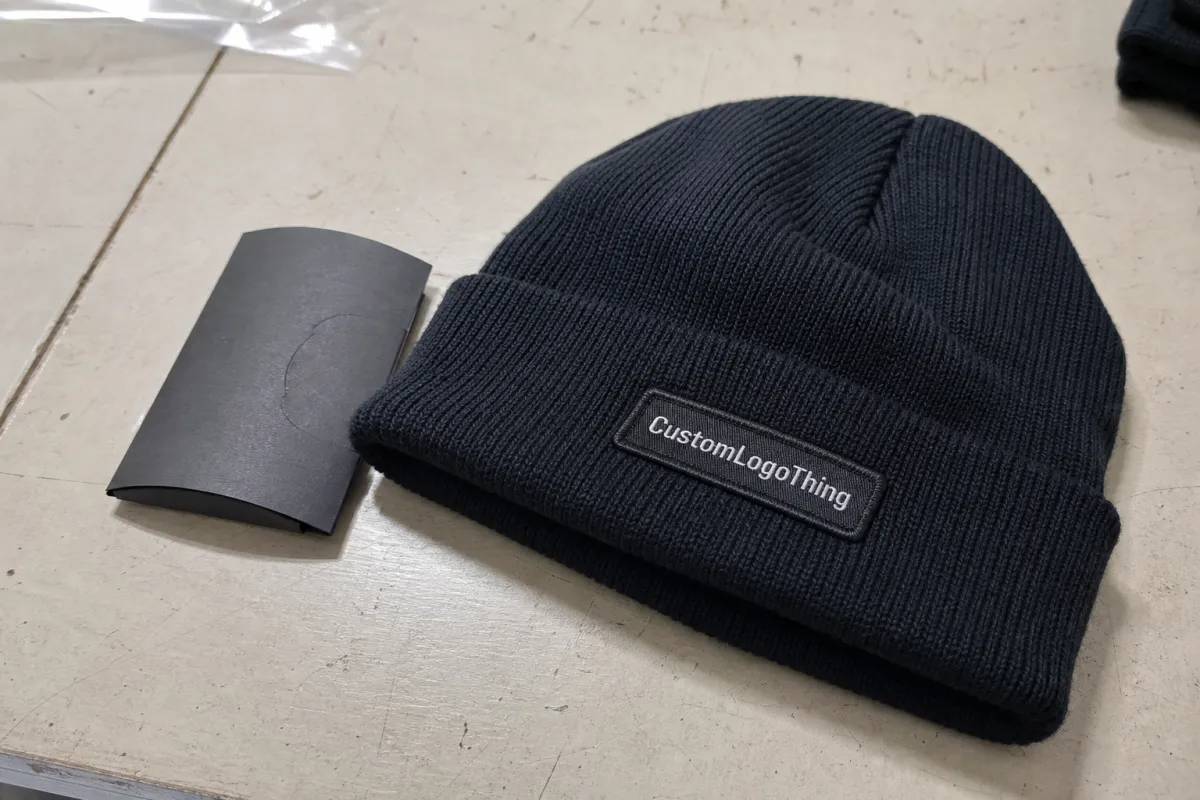
Art files get too much credit. The first useful question is not “How does the logo look?” It is “What has to happen for the hat to be worn comfortably for hours, survive packing, and still show the brand clearly from a distance?” That order matters because knitwear behaves differently from flat goods. A patch that looks balanced on a screen can wrinkle a cuff, pull at the yarn, or sit too high on a slouch style.
Three realities shape the choice. First, visibility: a front patch has to read from several feet away, especially at events with crowds and quick movement. Second, handfeel: if the patch feels scratchy or rigid, people stop wearing the hat after the event. Third, production: a material that needs special tooling, extra temperature control, or repeated approval rounds can push an otherwise simple program off schedule.
Buyers who treat the decoration as a complete product, rather than an add-on, usually make better decisions. The shell fabric determines warmth, stretch recovery, and how premium the beanie feels before the logo is even noticed. The patch determines whether the logo looks crisp, dimensional, or overly bulky. The backing determines whether the decoration is secure on knit, which matters more on beanies than on caps because the fabric moves every time the hat is stretched on and off.
There is a hidden connection here: the more casual the event, the less forgiving the material mismatch. A stadium giveaway may tolerate a basic acrylic body if the patch is centered and the color is right. A retail-style launch piece is judged differently. People touch it, fold it, compare it to items on a table, then decide whether it belongs in a gift bag or a drawer. The logo is only part of that verdict.
Another practical note: small patches are not automatically safer. A patch that is too small can lose legibility, but a patch that is too large can overpower the cuff and flatten the knit visually. On a 1x1 rib cuff, placement tolerance can be tight. If the cuff stretches during wear, a wide patch may bow at the edges unless the backing and stitch line are selected with that movement in mind.
Patch materials and backings that change the final handfeel
Patch material changes the tone of the whole item. Woven, embroidered, leatherette, PVC, felt, and twill all carry the same logo in different ways. Some emphasize detail. Some emphasize texture. Some are designed to survive weather. A buyer who understands that distinction can usually avoid a round of revisions later.
Woven patches are the strongest option for tiny type, linework, and logos with fine interior detail. They sit low on the fabric, which helps on beanies because low-profile decorations tend to stretch and pack more cleanly. Embroidered patches read more traditional and tactile. They work best when the logo is bold enough to survive thread buildup. Leatherette pushes toward a more elevated, retail-style look and can handle debossing well, though it does not always feel as soft as woven. PVC or rubber patches are durable and weather-tolerant, but they read more performance-oriented than cozy. Felt and twill sit in the middle, usually for simple marks or heritage styling.
| Patch type | Detail level | Handfeel | Typical use case | Typical add-on cost |
|---|---|---|---|---|
| Woven | High | Smooth, low-profile | Fine logos, small type, clean brand marks | $0.20-$0.45 per unit |
| Embroidered | Medium | Textured, classic | Bold logos, outdoor merch, school spirit | $0.25-$0.60 per unit |
| Leatherette | Medium-high | Firm, premium | Retail-style gifts, elevated event kits | $0.35-$0.75 per unit |
| PVC / rubber | Medium | Durable, slightly stiff | Weather-resistant promo wear | $0.30-$0.70 per unit |
| Felt or twill | Low-medium | Soft, casual | Simple art, heritage styling | $0.18-$0.40 per unit |
Backing choice deserves equal attention. Sew-on is the most reliable method on knit because it anchors the patch mechanically. That matters when the beanie stretches during wear or sits in a packed shipment. Heat seal can reduce labor and speed production, but the adhesive has to bond cleanly to the right body fabric. If the knit is too open or too stretchy, the patch may lift at the edges later. Adhesive backs are useful for positioning during assembly, but they are rarely the final answer for long-term wear. Velcro has a place in modular programs, though it adds bulk and is not usually the softest option against the forehead.
For beanies, the issue is not just adhesion. It is motion. Knit fabric moves with the head, the weather, and the packing process. A patch that holds well on a flat panel can still ripple on a cuff after two or three wears. That is why a simple woven patch on a stable knit often beats a more elaborate patch on a looser one. A cleaner structure usually produces a cleaner result.
The best quality-control check is also the simplest: put the patch on the actual beanie body and stretch it. Then fold it. Then look at it under real light, not just on a mockup. Edges that seem fine on paper can lift once the cuff is pulled open. That is a common failure point, especially when the patch is oversized or the backing is too rigid for the chosen yarn.
Beanie shell fabrics, gauges, and seasonality
Shell fabric shapes how the hat feels before branding enters the picture. Acrylic remains common because it is warm, economical, and easy to knit consistently. Cotton is softer and more breathable, which helps for milder climates or indoor winter events. Wool blends usually feel more substantial and retain heat well, but they can be scratchier and more expensive. Recycled yarns are increasingly common for brands that need a sustainability story without drifting into vague language. Fleece-lined beanies add warmth, though they change the stretch profile and may make the front patch area slightly less flexible.
Knit gauge is one of the most overlooked specs in event merchandising. A finer gauge creates a smoother surface, which helps patches sit more evenly and allows smaller details to stay legible. A chunkier knit feels cozier and more seasonal, but the texture is less uniform. That can make even a well-made patch look a little uneven because the fabric underneath has more visual movement. In short: the chunkier the knit, the more the patch has to work to stay visually crisp.
Cuff style also matters. A wide cuff gives the logo a stable zone and usually improves front-facing visibility. A slouch beanie feels more fashion-forward, but the decoration area moves more and is harder to control. If the brief is to create a clean staff uniform or a simple giveaway, a cuffed body is easier to manage. If the goal is a streetwear look, slouch can work, but the patch shape and size need a more cautious review.
Stretch recovery is the spec many teams miss until samples arrive. A beanie that stretches out and fails to snap back can distort the patch after only a few wears. That is not a theoretical issue. It shows up in the field when people pull the hat on and off during the same day. For event merch, one-size-fits-most only works if the knit structure recovers well.
Seasonality changes the priority list. Outdoor festivals need warmth, wind resistance, and a patch that can handle rough handling. Campus merch often leans toward comfort and broad appeal. VIP gifts need a denser knit, cleaner decoration, and packaging that feels deliberate without becoming fussy. Retail add-ons live somewhere between those poles: they need to look good on a shelf and still feel practical enough to buy on impulse.
There is also a logistics angle. If the order is traveling a long distance, packaging and carton design matter as much as the decoration. Industry references such as ISTA are useful because they remind teams that a carton failure can ruin an otherwise solid product. A beanie compressed too tightly in transit can arrive with a misshapen cuff, and that makes the patch look worse even when the decoration itself is fine.
Process and turnaround: from art file to delivery
The production path is simple to describe and easy to underestimate. A buyer submits the artwork. The supplier recommends a shell fabric, patch type, and backing. A proof is prepared. If the patch is custom, the run may require digitizing, color matching, shape cutting, or tooling. Then comes approval, sample review if needed, bulk production, finishing, packing, and shipping.
The delays usually come from four places: proof revisions, custom patch construction, color matching, and queueing during peak season. A standard woven patch on an off-the-shelf acrylic body can move quickly. A layered leatherette patch with debossing or special edge treatment needs more setup. If there is a sample revision between proof and production, the calendar stretches again. The work itself may only take a few days, but the approvals around it often decide the real timeline.
For a fixed event date, the safest schedule is built backward from the least forgiving step, not the best-case one. Leave room for at least one internal review, one proof revision, and a shipping window that does not depend on perfect timing. Domestic programs often land in the 12-20 business day range after proof approval, although fully custom patch work or seasonal demand can push that longer. International freight can add substantial variance, especially if customs holds or weather interruptions appear.
Production usually slips at approval, not at the sewing machine.
Packaging affects timing too. Bulk-folded hats can move quickly. Retail-ready packs, hang tags, tissue wrap, and individual inserts add labor. If the order is part of a kit, ask whether the hats can be packed flat and then folded consistently at the final destination. A simple kraft paper wrap can improve presentation without making the line expensive. If the packaging brief includes FSC certified cartons or post-consumer waste inserts, confirm those specs early; sourcing them after the proof stage can slow the job down.
For an event merch Logo Patch Beanies material guide order, the most efficient approval process is usually the one that separates decoration decisions from timeline surprises. A clean proof is useful. A clean proof that can actually be produced on time is better.
Cost, pricing, MOQ, and unit cost: what drives the quote
Price starts with the shell, but it does not end there. The quote reflects the knit body, the patch style, the attachment method, the number of colors, the size of the patch, the packaging format, and the shipping method. Every extra layer of customization adds either setup time or labor, and often both. Even carton dimensions can shift the landed cost because they affect how tightly the shipment stacks and how much freight space it occupies.
MOQ changes the economics in a way that feels unfair until you see the setup work. At lower quantities, the fixed labor is spread across fewer units, so the piece price rises. At higher quantities, the unit cost often drops, but inventory risk rises with it. A 250-piece event order and a 2,500-piece retail run are not just different in size; they are different in strategy. One is about hitting a date with controlled spend. The other is about carrying stock without tying up cash in units that may sit in storage.
For most event programs, small adjustments in material choice move the quote more than a buyer expects. A basic acrylic body with a woven patch is usually the most efficient path. Add a wool blend, a leatherette patch, or gift-ready packaging and the price rises quickly. That does not mean premium choices are wrong. It means the premium should match the use case. Paying more for a finish nobody notices is wasteful. Saving money on a hat that feels scratchy or flimsy is also wasteful because the item stops being worn.
| Option | Approx. unit cost | Best for | Main tradeoff |
|---|---|---|---|
| Standard acrylic beanie + woven patch | $2.75-$4.25 | Large giveaways, sponsor events | Lower luxury feel, but efficient |
| Midweight acrylic/wool blend + embroidered patch | $4.25-$6.50 | Staff kits, campus merch | Better handfeel, slightly higher cost |
| Recycled yarn beanie + woven or leatherette patch | $5.00-$8.25 | Programs with sustainability goals | Higher unit cost, stronger material story |
| Premium knit + specialty patch + gift packaging | $7.50-$12.00+ | VIP gifts, retail add-ons | Looks elevated, but needs tighter planning |
Ask for quantity tiers when comparing quotes. A 100-unit run can look expensive beside a 500-unit run, but the 100-unit option may be the smarter decision if the event is small or the design is still being tested. That is especially true when the patch style is custom. A lower MOQ can reduce the chance of carrying unused inventory after the event ends.
Freight and packing deserve their own line item in the budget. Efficiently packed corrugated cardboard cartons reduce damage and often help with dimensional weight. If the order needs retail-ready presentation, the carton spec can matter as much as the decoration. Sometimes a better carton costs less than a prettier insert because it protects the item and lowers the rate class at the same time. That is one of those small procurement choices that shows up later as a quality win.
Step-by-step material selection for event merch buyers
The cleanest way to buy beanies is to start with the use case, then narrow the material choices from there. A giveaway is not a VIP gift. Staff apparel is not retail. A sponsorship piece with multiple logos needs different spacing and a different patch size than a single-brand hat. When buyers begin with the intended wear pattern, the material choice becomes easier.
- Define the audience - Outdoor attendees, employees, students, and retail customers tolerate different levels of warmth, structure, and decoration.
- Match the climate - Cold, windy events need denser knits and better heat retention; indoor or mild-weather programs can stay lighter.
- Check the artwork - Fine detail favors woven patches; bold icons can go embroidered or rubberized without losing clarity.
- Choose the attachment - Sew-on is the safest default for knit; heat seal is faster but needs the right fabric and temperature control.
- Confirm the packaging - Ask whether the pack is bulk, retail-ready, or gift-ready, and whether materials include kraft wrap, FSC certified cartons, or recycled inserts.
- Set the deadline backward - Count proofing, sample review, production, packing, and shipping before you lock the event date.
There are two quick questions that eliminate a lot of bad options. First: will anyone wear this more than once? If yes, comfort and stretch recovery matter more than a flashy patch. Second: does the logo need to be readable in motion? If yes, the patch must stay simple enough to survive the size reduction that knitwear requires. These questions seem basic. They are also the ones that save the most rework.
If you need a quote, include the details that actually change the numbers: fabric type, knit gauge, patch material, backing choice, patch size, stitch placement, quantity tiers, packaging format, and delivery date. The more precise the brief, the less likely the sample will surprise you. That is especially useful for an event merch Logo Patch Beanies material guide request, where the decoration can look perfect in isolation and still fail once it is sewn onto a real cuff.
One practical limit: if the patch is oversized relative to the cuff, test it before approval. A large patch can crowd the front panel and flatten the texture of the knit. A smaller patch with cleaner edges often looks more expensive because it lets the material beneath it breathe. That is a visual trick, but it is also a production constraint.
Common mistakes, expert tips, and practical checks before you order
The most common mistake is asking the patch to do too much. Buyers see a flat mockup and assume every line will survive at small scale. Knit does not behave like paper. Tiny text, thin borders, and nested shapes can blur or disappear once the patch is reduced to a size that fits the beanie. If the logo needs microscopic detail to remain readable, the format needs to change or the decoration area needs to grow.
The second mistake is ignoring how the backing interacts with stretch fabric. A backing that works on a rigid cap may feel too hard on a beanie, especially across the forehead. Cold weather makes that more noticeable because the wearer feels the structure directly. A softer face with clean edges and a secure sewn perimeter usually performs better than a hard bond that sits slightly proud of the knit.
Quality control should be specific, not vague. Check centering, edge tension, thread color accuracy, patch flatness, and how the cuff behaves after stretching. If the beanies are being boxed, inspect one sample packed the way the final order will ship. A piece can look fine on a table and still arrive with a creased cuff or twisted patch orientation.
These habits reduce rework:
- Request a swatch or sample knit before approving the final body fabric.
- Test the patch on the actual beanie, not only on a digital mockup.
- Check brand-critical colors in daylight, because knit and thread reflect light differently.
- Ask for quantity tiers so you can compare the real price break between runs.
- Confirm how the hats will be folded, packed, and labeled before production starts.
Sustainability-minded orders need their own reality check. A recycled yarn label is useful, but it does not replace packaging specifics. Ask whether the cartons are FSC certified, whether inserts use post-consumer waste, and whether any biodegradable packaging claim matches the actual disposal route. A compostable sleeve is not useful if the destination venue has no compost collection. Procurement is full of those awkward details, and they matter more than the headline wording.
One final practical observation: the best-looking beanies are often the ones with the least drama in production. A stable knit, a legible patch, a backing that suits the fabric, and packing that keeps the shape intact usually outperform a more ambitious build that only looks stronger on paper. If the deadline is real, simplicity is not a compromise. It is often the better specification.
What patch material works best for event merch logo patch beanies?
Woven and embroidered patches cover most event needs because they balance detail, comfort, and brand visibility. Woven is usually better for small type and fine lines, while embroidered works well for bolder logos. PVC and leatherette can be strong choices for specific aesthetics, but they should be matched to the audience and the feel you want on the cuff.
Are sewn-on patches better than heat-applied patches on beanies?
Sewn-on patches are usually the safer choice on knit because they anchor mechanically and handle stretch better. Heat-applied options can speed production, but they depend on the right fabric and careful temperature control. On a loose or highly stretchy knit, weak adhesion tends to show up early.
How long does it usually take to produce custom patch beanies?
Lead time varies by construction, but approvals are often the longest part of the process. A straightforward order can move in roughly 12-20 business days after proof approval, while custom patch details, seasonal demand, or sample revisions can add more time. If the event date is fixed, build the schedule around proofing and shipping, not only manufacturing.
What MOQ should I expect for logo patch beanies?
MOQ depends on whether the beanie is stock or fully custom. Smaller decorated runs may start around 50-100 units, while fully custom knit programs often begin higher, sometimes 300-500 units or more. Ask for tiered pricing so you can compare the cost difference before committing to a larger quantity.
How do I keep beanies from feeling scratchy with a patch?
Choose a softer patch face, keep the edges clean, and avoid backings that make the cuff feel stiff where it touches the forehead. The sample has to be tested on the real beanie body because the same patch can feel fine on one knit and abrasive on another.

