A knit beanie sample can reveal more in half a minute than a spec sheet shows in three pages. That is especially true in a pet treat Cuffed Knit Beanies material sample guide, where buyers are not only judging color and decoration. They are checking whether the cuff holds its fold, whether the knit feels substantial without getting heavy, and whether the piece looks intentional beside a pet treat display instead of reading like a random promo add-on.
For pet treat brands, that first impression has a real commercial effect. These beanies often appear in seasonal bundles, gift-with-purchase programs, or checkout displays where the product has to earn trust through touch. If the sample feels thin, stretches out too quickly, or looks flat under store lighting, the item loses perceived value before the first bulk carton ships.
That is why sample review matters more than many buyers expect. Knit accessories are tactile products. A beanie can look correct on screen and still feel scratchy in hand, limp after a stretch test, or oddly rigid where the cuff should sit close to the head. For pet treat promotions, the stakes are doubled because the beanie is usually judged against packaging, treats, and shelf presentation at the same time.
What Samples Reveal First
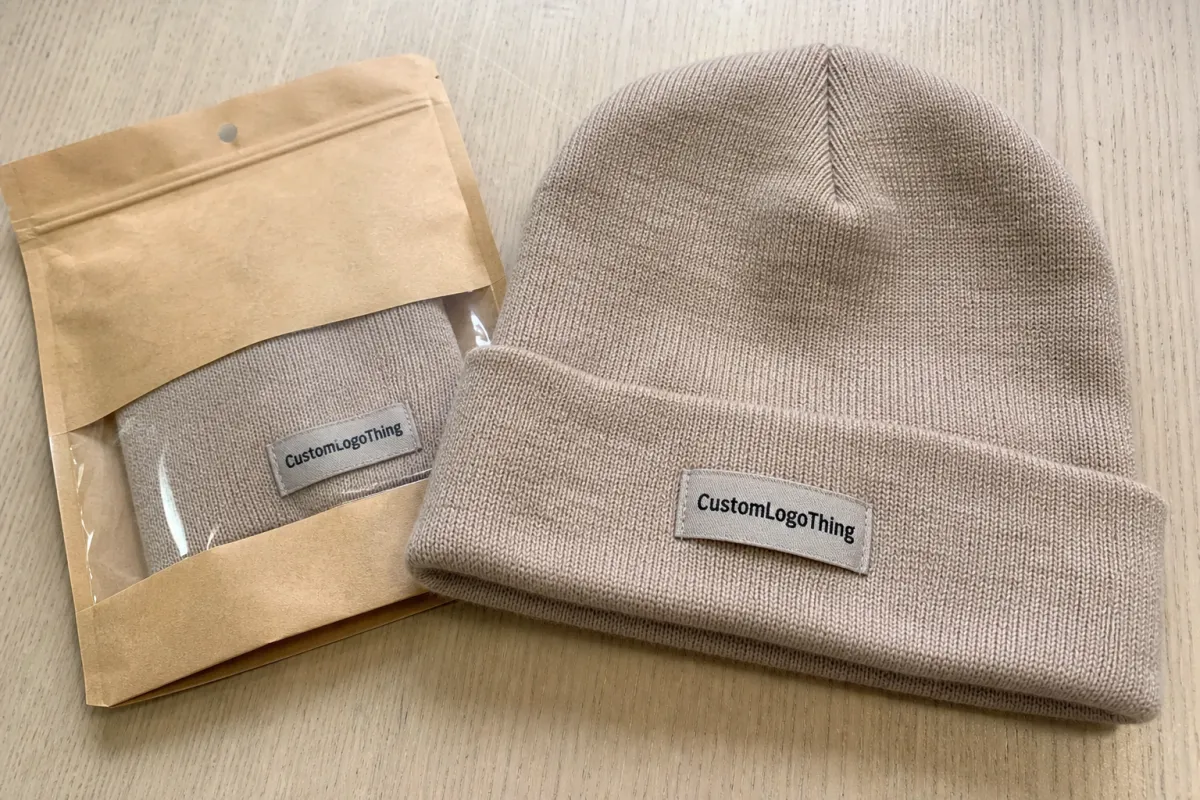
A material sample is the first honest version of the product. In this category, that might be a yarn swatch, a knitted prototype, or a near-finish cap that shows yarn type, cuff structure, stitch density, and decoration behavior before bulk production starts. A good sample does not just answer, “Does it match the art?” It answers, “Will someone want to pick it up, wear it, and keep it?”
That distinction matters because retail knitwear lives or dies on touch. A beanie that looks polished in a rendering can still disappoint if the yarn is coarse, the knit is too loose, or the cuff collapses after a few handling cycles. For pet treat merchandising, where the item may sit beside bags, boxes, and hang-tagged bundles, the tactile result often drives conversion more than the logo does.
In practical buying terms, the sample stage is where teams reduce risk. A single style may need to work across store counters, online product photography, gift sets, and shipping cartons. If the sample shows the wrong drape or a low-end finish, that problem scales across the full run. The cost of a careful sample is small compared with clearing stock that never looked worth its shelf space.
If the cuff does not rebound after a few stretches, the sample is already warning you about production.
For a pet treat Cuffed Knit Beanies Material Sample guide, the first review should answer four practical questions:
- Does the yarn feel soft enough to invite handling without looking flimsy?
- Does the cuff keep a crisp fold and recover after being stretched?
- Does the knit surface support the planned logo method without distortion?
- Does the sample still look premium after folding, unrolling, and retouching?
Buyers should also look at the sample through the lens of shelf behavior. A beanie that feels decent in a hand test may still look weak if the crown slouches in a display tray or the cuff twists after unpacking. These are not minor details. Small changes in structure often decide whether a product reads as a retail accessory or a cheap giveaway.
How Sample Evaluation Works
Good sample evaluation starts before the finished cap arrives. The process usually moves from raw yarn selection to knitting, cuff construction, washing, shaping, and finishing. Each step can improve the result or expose a weak spot. A yarn that looks rich on paper may knit too loosely. A cuff that seems clean on a hanger may buckle after a few wears. Knitted structures amplify small differences.
The most useful reviews combine visual inspection with handling. Check seam consistency, stitch tension, surface smoothness, logo placement, edge finishing, and rebound after folding. If the beanie carries decoration, look closely at whether embroidery sits flat, whether a woven label pulls the knit, or whether a patch makes the front panel feel stiff in one spot. That matters for retail gifts, where the product must look polished from arm’s length and up close.
Hold the sample under different lighting, stretch the cuff, fold the crown, and let it rest for a few minutes. Some samples bounce back cleanly; others relax into a baggy shape that tells you the silhouette will not hold in a warehouse bin or a customer photo. Visual approval and performance approval are not the same thing, and production only respects the latter.
For transit and packout, testing matters too. If the sample will travel in corrugated cardboard cartons or a tighter shipper, ask how it holds shape after compression. The same logic used in packaging tests for harder goods applies here: motion, pressure, and time change the outcome. The transit-testing framework used by ISTA is a useful reference point for thinking about drops, vibration, and compression, even though knit goods behave differently from rigid packages.
One more practical angle: sample presentation matters. If the beanie arrives wrapped in kraft paper or packed in FSC certified corrugated cardboard, the review already benefits from a cleaner sustainability story. That does not fix weak knitting, but it does help the item fit brands that use recycled materials, post-consumer waste claims, or biodegradable packaging in broader merchandising. Packaging and product do not sell separately.
Key Material Factors That Change Handfeel, Stretch, and Durability
Material choice drives almost everything buyers care about: softness, stretch recovery, warmth, price stability, and how the beanie is perceived in a retail setting. The most common options are acrylic, polyester, wool blends, recycled yarns, and mixed constructions. None is automatically best. The right answer depends on target price, expected wear, and how premium the item needs to feel next to the pet treat assortment.
Machine gauge also matters. A looser knit in the 3-gauge to 5-gauge range gives a chunkier, more casual look, while finer constructions in the 7-gauge to 12-gauge range usually feel tidier and can hold decoration more cleanly. That does not make finer gauges universally better. It depends on whether the buyer wants visual weight, warmth, or a smoother surface for branding.
| Material | Handfeel | Stretch Recovery | Durability Notes | Typical Cost Impact |
|---|---|---|---|---|
| Acrylic | Soft, light, familiar | Usually strong if knit density is right | Can pill if the yarn quality is low or the knit is too loose | Often the lowest-cost option |
| Polyester | Smoother, more uniform | Good shape retention | Often performs well in colorfastness and decoration | Mid-range, depending on finish |
| Wool blend | Warmer, more premium, sometimes itchier | Good structure, but blend ratio matters | Higher perceived value, more care sensitivity | Usually above basic synthetics |
| Recycled yarns | Can feel clean and modern, or slightly drier | Depends heavily on fiber quality and spinning consistency | Useful for sustainability messaging if lot control is tight | Often a small premium |
| Mixed yarns | Balanced, but needs close review | Can be strong when the blend is tuned properly | Useful for balancing cost and performance | Varies widely |
The cuff deserves special attention. It carries the logo in many designs, gets the most handling, and reveals whether the yarn has enough memory to hold a crisp fold. A cuff that collapses after a few touches makes the whole beanie look less intentional. A cuff that is too stiff can do the opposite and feel uncomfortable around the forehead. Buyers should ask for the actual cuff depth in centimeters, not just “standard cuff,” because a few millimeters can change both the look and the fit.
Decoration compatibility depends on the material surface. Embroidery sits differently on a tight knit than on a looser one. Woven labels need enough stability to avoid puckering. Rubber patches or stitched badges can create a premium look, but they can also make the front panel feel heavy if the base yarn is too soft. A sample review should never separate material evaluation from decoration evaluation, because the two affect each other.
Other checks belong on the list too:
- Pilling resistance: How quickly does the surface fuzz after handling?
- Colorfastness: Does the shade shift under daylight, store lighting, or friction?
- Wash recovery: Does the knit return to shape after mild laundering?
- Silhouette retention: Does the cap hold its form after warehouse storage?
Some buyers also ask for yarn lot control notes. That is not excessive. If the beanie is likely to be reordered, lot-to-lot drift can show up in color, sheen, or even stretch recovery. A sample that looks right but cannot be repeated cleanly creates trouble later, especially for programs tied to seasonal packaging or coordinated pet gift sets.
Sampling Process, Timeline, and Turnaround Expectations
The sample process should be orderly, not improvised. It usually starts with a brief that covers size, yarn direction, decoration method, target quantity, and packaging. Then comes color selection or digital confirmation, followed by a physical prototype. After buyer review, the supplier may revise the sample once or twice before final approval goes into production.
Simple yarn or color swatches move faster than a fully finished decorated beanie. A bare material sample may arrive in about 5 to 10 business days if the yarn is standard and the brief is clean. A fully decorated sample often takes 10 to 18 business days, and custom dye matching or new artwork placement can extend that window. If multiple departments need sign-off, the calendar stretches again. That is normal, and it is why the best buyers treat sampling as part of the project rather than a warm-up.
A production timeline should also reflect bulk lead time, not just sample lead time. A simple knit program may move from approval to bulk delivery in 20 to 35 days, while custom yarn sourcing, special packaging, or heavier decoration can push that longer. Freight adds another layer. A program can feel fast during sampling and still miss a retail window if shipping is not planned early.
Three things slow turnaround most often:
- Missing reference photos or vague size expectations.
- Pantone targets that are not locked before sampling begins.
- Late changes to the decoration method after the first prototype is already in motion.
There is also a quieter delay: feedback from people who were not in the original approval loop. Marketing may want a more visible logo. Merchandising may want a softer palette. Procurement may push for a lower-cost yarn. Each note can be reasonable on its own, but together they can turn a two-round sample process into four rounds quickly.
Packaging should be part of the timing conversation too. A sample packed in kraft paper with a simple insert may be enough for review, but a retail-ready kit often needs labeled polybags, barcodes, or FSC certified inserts. If the brand wants recycled materials or post-consumer waste claims on the packaging, the supplier may need a separate sourcing step. Those choices are not cosmetic. They affect lead time, and sometimes they affect the quote more than the yarn itself.
Cost, MOQ, and Quote Variables to Review
Pricing for knitted accessories is shaped by a handful of variables that buyers should compare line by line. Yarn composition, stitch complexity, cuff depth, decoration method, packaging, and whether the design uses stock materials or custom-developed options all move the number. If one quote looks far lower than the others, check whether it quietly assumes a thinner yarn, simpler finishing, or less exact color matching.
MOQ matters because it changes how efficiently the factory can plan yarn use and machine time. Smaller runs often carry a higher unit cost and fewer color options. Larger runs usually improve efficiency, but they also increase risk if the sample is not fully correct. In practical terms, a 500-piece test order can look very different from a 5,000-piece production run, not just in price but in how many finish options the supplier is willing to support.
For many knit programs, MOQ starts around 300 to 500 units for simpler stock-yarn projects and rises to 1,000 units or more once custom colors, special patches, or specific packaging are added. That range is not a rule, because factory capacity, yarn availability, and decoration methods all matter. It is still a useful starting point when comparing quotes that look similar on paper but are not similar in production effort.
Sample charges also deserve attention. Prototype work may include setup labor, swatch sourcing, test knitting, or special decoration changes that will not appear in the bulk quote. A sample fee of $35 to $150 is common for simple knit pieces, while a more complex decorated prototype can cost more depending on artwork, yarn sourcing, and revision count. That charge should be viewed as a development cost, not a penalty, if it helps avoid a bad production run.
Here is a useful comparison framework for buyers reviewing quotes:
| Quote Element | What to Confirm | Why It Changes Value |
|---|---|---|
| Yarn type | Acrylic, polyester, blend, or recycled yarn | It changes handfeel, performance, and price stability |
| Decoration method | Embroidery, patch, woven label, or print | It affects setup cost and how the cuff behaves |
| Packaging | Bulk, polybag, kraft paper sleeve, or retail carton | It impacts labor, presentation, and freight efficiency |
| Lead time | Sample lead time and bulk lead time separately | One can be short while the other is not |
| Finishing | Tagging, folding, steaming, labeling | These steps often explain quote differences better than yarn alone |
For sustainability-led brands, packaging can be part of the value equation. A neat sample in FSC certified kraft paper, paired with corrugated cardboard shipping and a recycled insert, may support a cleaner shelf story than a cheaper sample wrapped in mixed film that is hard to sort. That does not make the higher-cost option automatically right, but it does make the comparison more honest. The same holds for post-consumer waste claims: ask for specifics, not slogans. Packaging guidance from the Sustainable Packaging Coalition is a useful reference if the team is balancing appearance, source materials, and end-of-life expectations.
A pet treat Cuffed Knit Beanies material sample guide works best when the quote review is tied to the sample in front of you. If the sample looks and feels better than the quoted spec suggests, ask why. If it looks cheaper than the quote, ask what was added to the sample that will disappear in production. That gap is where budget surprises usually hide.
Common Buyer Mistakes
The biggest mistake is approving on appearance alone. A sample can look polished in a photo and still fail in hand. Thin yarn may expose the crown under bright retail lighting. A loose stitch can stretch out after one handling session. A cuff may hold shape on a table and flatten in a bag. The sample is supposed to expose these issues early, not hide them politely.
Wear testing is another step that gets skipped more often than it should. Even a short try-on tells you a lot: does the yarn feel itchy, does the cuff recover, does the silhouette sit correctly on different head sizes, and does the logo stay legible when the fabric moves? For a product that competes on tactile trust, one-minute handling is better than a long debate over photos.
Inconsistent feedback is also expensive. If merchandising wants a softer handfeel, marketing wants stronger contrast, and procurement wants a lower unit price, the supplier can end up revising the wrong feature. A clean approval path keeps everyone aligned. One decision owner, one spec sheet, one revision log. That is the difference between a manageable sample cycle and a drawn-out back-and-forth that eats the calendar.
Color approval needs discipline too. Without a reference system, tiny shade drift can make a coordinated pet gift assortment look mismatched across SKUs. A cream cuff beside a slightly warm oatmeal body may read intentional in a spreadsheet and accidental on the shelf. Use the same reference card, the same lighting, and the same approval notes every time. If the supplier references a Pantone match, confirm the tolerance and ask how it behaves in yarn, not only in ink.
The last mistake is underestimating the packout. A good knit can be weakened by bad folding, tight overpacking, or low-grade inserts that bend the cuff out of shape. That is why sample approval should include the product, the fold, and the carton together. A strong sample in weak packaging is still a weak retail result.
Expert Tips and Next Steps Before Approval
Create a simple approval checklist before the sample lands. Score softness, stretch recovery, cuff shape, logo clarity, and perceived value on the same sheet. That keeps the review objective and makes cross-team feedback easier to reconcile. If the sample gets a 4 out of 5 on every point, you know exactly what needs one more round. If it gets a 2 on cuff shape and a 5 on everything else, the fix is obvious.
Ask for at least one wear-and-pack test. Fold the sample, stretch it, display it, and inspect it again after handling. Then see how it looks after a few minutes of rest. That is a better proxy for retail presentation than a static photo. If the beanie is meant to ship with pet treat gift bundles, ask for a packout mock-up in the same way you would review a label proof or a carton proof.
Where possible, compare two yarn or cuff options side by side. A small material change can shift both price and sell-through potential. A tighter knit may cost slightly more, but it may also read more premium and hold a logo better. A recycled yarn may support the brand story, but only if the finish is clean enough to hold up in person. The point is not to choose the cheapest sample; it is to choose the one that fits the intended shelf role.
Before moving to bulk, lock down the details that cause the most trouble later:
- Final yarn composition and color reference.
- Exact cuff depth and overall size.
- Decoration method and placement.
- Packaging format, including kraft paper, FSC certified inserts, or corrugated cardboard shippers.
- Target MOQ, unit price, and sample approval date.
If any spec still feels off, request one revised sample before production starts. That is cheaper than fixing hundreds or thousands of units after the fact. Used well, this pet treat Cuffed Knit Beanies material sample guide helps buyers choose fewer surprises, not just a prettier prototype. That is the difference between a decent knit accessory purchase and one that earns a repeat order.
FAQ
What should I check first in a pet treat cuffed knit beanie material sample?
Start with handfeel, cuff recovery, and stitch density. Those three cues usually predict how the beanie will wear in real use. Then confirm the decoration area stays flat enough for branding and does not distort when the cuff is stretched.
How long does a cuffed knit beanie sample usually take to approve?
Simple material or color samples are usually faster than fully finished decorated samples, which often need more setup and review time. Build extra time for revisions if the project needs custom yarn matching, new artwork placement, or multiple internal approvers.
What affects the unit cost of knit beanie samples and production?
Yarn type, stitch complexity, cuff depth, and decoration method are the biggest cost drivers. MOQ, finishing, and packaging can also move pricing, especially when the order uses custom materials or special handling.
Can I compare different materials using the same sample request?
Yes, and it is often the smartest way to choose between acrylic, blends, and recycled options. Ask for the same size, cuff structure, and decoration method so the comparison reflects the material rather than the construction.
What is the best next step after I approve a sample?
Confirm the final spec sheet, including yarn, color, decoration, quantity, and packaging details. Then verify the production timeline and request a pre-production reference if any detail still needs one last check.


