The premium cuffed beanies Unit Cost Breakdown often looks tidy right up until the sample phase exposes the real work. A price that seemed straightforward on a spreadsheet starts carrying setup charges, yarn matching, knit programming, decoration, finishing, and packaging decisions that were never actually fixed. That is not a surprise in production. It is the production.
Buyers usually feel the price shift most sharply on smaller runs. A 300-piece order can look expensive because the fixed work is sitting on top of a short stack of units. At 1,000 pieces, the same fixed costs spread out, and the unit price finally starts behaving the way people expected from the beginning. Comparing only the blank hat price misses the point. Compare the beanie, the branding, the packaging, and the freight as one system, or the quote will mislead you.
Premium Cuffed Beanies are a good example of how a simple product can still carry a layered cost structure. The silhouette is familiar, but small changes in cuff depth, knit gauge, logo method, or yarn blend can move the number faster than many buyers expect. That is why the smartest quotes are not the shortest ones. They are the ones that show how the number was built.
Why cuffed beanie unit cost drops after the first sample
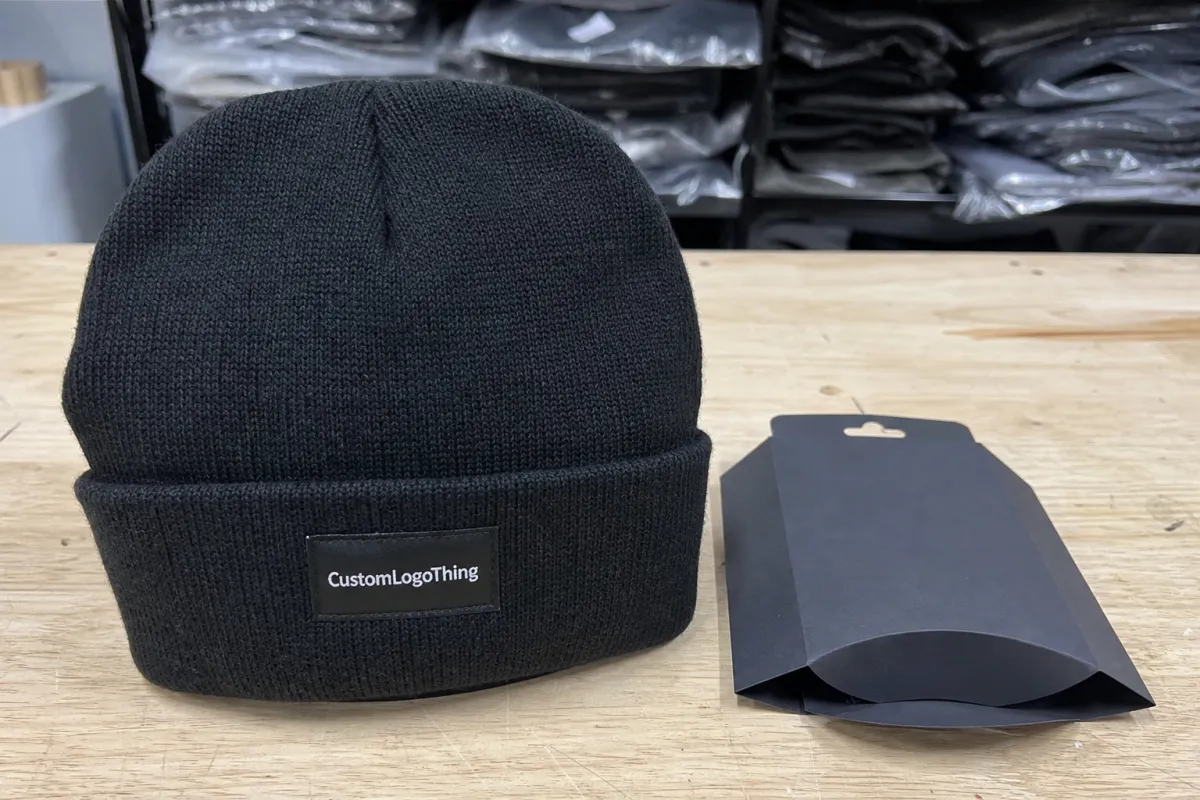
The first sample does more than show the product. It settles arguments. Fit, cuff height, logo placement, crown shape, knit density, and color accuracy all get resolved in one piece, sometimes two if the buyer is particular about texture or trim. Before that approval, the factory is making choices on your behalf. After approval, production becomes repeatable, and repeatability lowers cost.
That drop is mostly about fixed work. Embroidery digitizing, knit file setup, shade matching, patch prep, and sample labor usually happen before bulk production begins. Those costs do not disappear just because the order got larger. They simply matter less per unit. On a small order, they are loud. On a larger order, they are background noise.
For a typical double-layer acrylic cuffed beanie with one-color embroidery, a smaller run might land around $4.80-$7.20 per piece. At 1,000 units, the same spec often moves closer to $2.70-$4.10, depending on the yarn, decoration, and packaging choices. That spread is normal. A quote that barely changes across those quantities deserves a second look.
The practical levers are not glamorous, but they matter:
- Cuff height changes both the logo zone and the amount of knit fabric used.
- Yarn blend affects handfeel, warmth, shrink behavior, and raw material cost.
- Knit density changes labor time and the finished appearance.
- Decoration method can add sewing, digitizing, or extra programming.
The first sample should make the quote more accurate, not less. If the number is still vague after the spec is locked, the supplier is either guessing or hiding something in the margins.
Cuffed beanie construction details buyers should lock first
“Premium cuffed beanie” is a broad brief. It can mean a soft retail-style hat with a clean embroidered logo, or a heavier winter piece with a structured cuff and a woven patch. Those are not the same product, and they should not be priced as though they are. The fastest way to get a real quote is to define the build before anyone starts talking about unit cost.
The body construction is the first choice. A single-layer beanie uses less yarn and usually feels lighter. A double-layer beanie is warmer, more substantial, and the better fit for most premium programs because it holds shape better and gives the decoration a cleaner surface. The cuff matters just as much. A 2.5-inch cuff leaves a different brand window than a 3.5-inch cuff, and the taller cuff can alter how the hat sits once it is worn.
Fit is another detail that gets overlooked until the first wear test. A cuffed beanie can look excellent on a flat lay and still fail on head shape if the knit tension is too loose or the crown decreases are clumsy. Buyers often focus on the front logo first. That is understandable. But if the beanie slouches badly, twists after a few wears, or pinches at the forehead, the logo will not save it.
Lock these points before quoting:
- Yarn type and blend
- Knit structure and body thickness
- Cuff depth and overall height
- Logo method and approximate size
- Label style, if any
- Packaging format and carton requirements
That list is not busywork. It is the minimum information needed to build a reliable price. Without it, the supplier is filling in blanks, and blanks usually become change orders later.
Yarn, gauge, cuff height, and decoration specs that move the price
Material choice affects far more than color. It determines how the beanie feels in hand, how quickly it can be made, and how much room there is for error. Acrylic remains the workhorse for most cuffed beanies because it is consistent, easy to dye, and generally cheaper than natural fiber blends. Recycled polyester is useful when the buyer wants a cleaner sustainability story without moving too far up the price ladder. Wool and wool blends usually feel richer and hold warmth better, but they can complicate color matching and push the unit cost up faster than buyers expect.
Gauge matters in a very direct way. A tighter knit in the 9-12 gauge range generally looks cleaner, reads more premium, and gives a smoother base for branding. A chunkier 5-8 gauge knit has a more casual feel and can look more tactile, but it uses more yarn and usually requires more time on the machine. Texture is not free. The better the fabric appears, the more likely someone had to slow down to make it happen.
Decoration method is often the biggest swing factor after quantity. A small embroidered logo is usually the simplest choice and works well for understated branding. A woven patch creates a more retail-forward look, but it adds a sew-on or heat-apply step. Knit-in graphics feel integrated, and they can look excellent, but they require more programming and more careful color planning. A woven label is clean and cost-conscious, though it will not carry the same presence as a front logo if the brand needs visibility from across a room.
Cost also creeps in through the packaging list. Hangtags, insert cards, size stickers, barcode labels, individual polybags, and master carton markings all sound minor until the final invoice arrives. Each one is a small increment. Together, they alter the quote enough to matter.
If the logo is simple, the sample should be simple. If the price looks unusually low, something is probably missing.
One more point that deserves clarity: some suppliers use the phrase tooling fee loosely. On knit beanies, that can mean embroidery digitizing, knit programming, patch setup, or even a charge that is really just sample labor under another name. Ask what the fee covers. A precise answer is a good sign. A fuzzy answer usually means the quote is incomplete.
Premium cuffed beanies unit cost breakdown: what drives the quote
A serious premium cuffed Beanies Unit Cost Breakdown should read like an accounting note, not a sales sheet. The important parts are the blank body, decoration, sample or setup charges, packaging, freight, and any destination handling or duty. If the supplier hides those pieces inside one line, comparison gets harder on purpose. That is not efficiency. That is opacity.
There is no single correct price, but there are predictable ranges when the spec is clean. A double-layer acrylic cuffed beanie with one-color embroidery, a woven label, and standard polybag packaging often sits in the following bands:
| Run size | Typical spec | Unit cost range | Setup / sample burden | What usually happens |
|---|---|---|---|---|
| 200 units | Double-layer acrylic, one-color embroidery, woven label, polybag | $5.25-$7.90 | Highest per piece | Useful for pilot orders, but fixed costs weigh heavily |
| 500 units | Same spec, standard cuff, stock yarn colors | $3.60-$5.30 | Moderate | Often the most practical first commercial run |
| 1,000 units | Same spec, simple packaging, one production batch | $2.85-$4.40 | Lower per piece | Cleaner economics and easier scheduling |
| 3,000+ units | Custom yarn matching, more complex branding | $2.20-$3.70 | Best spread | Better unit pricing, but QC and lead time need attention |
Those ranges assume a sane spec. They are less useful if the artwork is unclear, the yarn is exotic, or the decoration requires multiple steps. To make the quote readable, ask the supplier to split the response into five parts:
- Blank hat cost - the beanie before any branding.
- Decoration cost - embroidery, patch, knit-in pattern, or label work.
- Setup charges - digitizing, programming, shade matching, sample prep.
- Packaging - polybags, inserts, hangtags, barcode labels, cartons.
- Freight and handling - origin shipping, customs support, and delivery.
The cleanest comparison method is to request the same spec at 200, 500, and 1,000 units. If the price hardly moves, the supplier may be padding the smaller tier or hiding cost somewhere else. If the quote drops sharply at 1,000, that usually means the production line can run efficiently and the setup cost is being absorbed properly.
For buyers who care about how products arrive, packaging is not a footnote. Cartons need to survive the real trip, not just a short walk across a warehouse. If the brand uses paper hangtags or insert cards, FSC-certified stock is a sensible upgrade. The same applies to transit testing: even a well-made beanie can arrive looking tired if the outer packaging was treated as decoration instead of protection.
Production steps, lead time, and delivery checkpoints
A trustworthy supplier should be able to explain the production sequence without drifting into sales language. The usual flow is artwork review, digital proof, sample or pre-production approval, bulk knitting, finishing, packing, and shipment. That is the baseline. Problems usually start when one of those stages is skipped or rushed.
Sampling commonly takes around 5-10 business days, depending on whether the artwork is ready and the yarn is already in stock. Bulk production often runs 15-30 business days after approval for standard programs. Larger orders, special yarns, or more complex branding can extend that timeline. Freight sits outside that schedule. Ocean transit, customs processing, and local delivery deserve their own planning window.
Most delays come from a familiar set of mistakes:
- Vector artwork is missing or incomplete.
- Pantone targets are vague or changed late.
- Yarn stock is unavailable in the requested shade.
- Sample feedback arrives slowly.
- Packaging changes after bulk production has begun.
A simple checkpoint list helps keep both sides aligned.
- Checkpoint 1: spec confirmation before sample work starts.
- Checkpoint 2: proof approval for logo size, placement, and colors.
- Checkpoint 3: sample sign-off with fit and finish notes.
- Checkpoint 4: pre-pack inspection or production photos before carton close.
- Checkpoint 5: carton count, label check, and ship date confirmation.
If a supplier cannot describe these steps clearly, their process is probably loose. If they can describe them but cannot tell you where approval is needed, the schedule will drift. Cuffed beanies are not difficult products. They only become messy when communication is thin and assumptions are doing the heavy lifting.
How to compare suppliers without paying for fluff
A quote is only useful if it can be compared against another quote. That means the response needs to show the same variables every time. Unit price, sample cost, setup charges, packaging, and shipping should all be visible. If those elements are buried inside one number, the supplier is asking for trust before they have earned it.
Ask about defect tolerance and rework policy. If 3% of the batch has uneven stitching, what happens? Which defects trigger replacement, and who pays the freight on the replacement units? Does the factory inspect knit consistency before packing, or do they simply count cartons and move on? These are not theoretical questions. They determine how painful a small production issue becomes.
Quality also shows up in repetitive tasks that buyers rarely see. Proof accuracy, color stability across reorders, label alignment, carton labeling, and packaging count discipline all reveal how serious the factory is. A beautiful sample means little if the second run drifts from the first one. Consistency is the real test.
Use these comparison points:
- Proof clarity - can they show exact logo placement and cuff dimensions?
- Repeatability - can they re-run the same spec without shade drift?
- QC detail - do they check stitch consistency and label alignment?
- Packaging discipline - do cartons match the promised count and marks?
- Lead time honesty - do they give a range or an unrealistic promise?
A lower price may be real. It may also reflect lighter yarn, weaker inspection, or missing packaging charges. If the supplier cannot explain why they are cheaper, assume one of the line items is either absent or understated. Buyers who ask that question once usually avoid paying for the answer later.
What to send for an accurate bulk quote today
If the brief is clean, the quote will usually be cleaner too. The fastest way to get a reliable number is to send the essential details in one pass instead of trading five rounds of partial clarification. Quantity, logo file, yarn color target, cuff dimensions, decoration method, packaging, destination, and deadline are the core inputs. Leave one out and the supplier starts guessing.
Use this checklist before requesting pricing:
- Target quantity and backup quantity
- Logo file in vector format
- Preferred yarn type and color
- Cuff depth and overall beanie height
- Decoration method and approximate logo size
- Packaging needs, including hangtags or inserts
- Delivery location or port
- Sample requirement and approval deadline
Then ask for two quantity tiers and one alternate spec. A 500-unit quote and a 1,000-unit quote on the same design shows the real unit-cost curve. Add a second version with a simpler logo or standard yarn color, and the savings become visible instead of abstract. That comparison is more useful than arguing over a single number.
For procurement teams, the most valuable quote is the one that separates landed cost from factory cost and exposes the setup burden clearly. That is the only way to understand a Premium Cuffed Beanies unit cost breakdown without overpaying for assumptions. If the response is precise, the buying decision gets easier. If it is vague, the price is probably doing too much hiding.
What drives a premium cuffed beanies unit cost the most?
Order quantity is usually the biggest lever because setup and handling spread out as volume rises. Decoration method matters almost as much. Embroidery, woven patches, knit-in graphics, and label applications all cost differently. Yarn choice, knit density, and packaging can also move the quote more than buyers expect.
What MOQ makes custom cuffed beanies cost efficient?
Small runs can work, but the unit price usually improves once the order reaches the mid-hundreds. Comparing 200, 500, and 1,000 units on the same spec is the most useful way to see the break point. Below that, setup and sampling carry more weight on each beanie.
How long is the usual turnaround for cuffed beanies?
Sampling often takes about a week, depending on artwork readiness and yarn availability. Bulk production commonly takes several weeks after sample approval. Transit adds its own timeline, so a production date and a delivery date should never be treated as the same thing.
Can I lower the quote without changing the look too much?
Yes. Standard yarn colors, a simpler logo method, and fewer packaging extras usually reduce cost. Keeping the same silhouette while reducing thread colors is a common way to save money. Ask for two specs side by side so you can see where the savings come from before you cut anything important.
What should I ask for in a unit cost breakdown quote?
Ask for unit price, sample cost, setup charges, freight, and any carton or labeling fees. Request the MOQ tiers so you can compare 200, 500, and 1,000 units. Have the supplier confirm lead time, defect handling, and whether packaging is included or separate.

