Buyer Fit Snapshot
| Best fit | Price Sustainable Foam Replacement Inserts projects where brand print, material claims, artwork control, MOQ, and repeat-order consistency need to be specified before quoting. |
|---|---|
| Quote inputs | Share finished size, material target, print colors, finish, packing count, annual reorder estimate, ship-to region, and any compliance wording. |
| Proofing check | Approve dieline scale, logo placement, barcode or warning zones, color tolerance, closure strength, and carton packing before bulk production. |
| Main risk | Vague material claims, crowded artwork, missing packing details, or unclear freight terms can make a low unit price expensive after revisions. |
Fast answer: Price Sustainable Foam Replacement Inserts: Costs & Specs should be specified like a repeatable production item. The safest quote records material, print method, finish, artwork proof, packing count, and reorder notes in one written spec.
Production checks before approval
Compare the actual filled-product size with the drawing, then confirm tolerance on folds, seals, hang holes, label areas, and retail display edges. Reserve space for logos, QR codes, warning copy, and material claims before decorative graphics fill the panel.
Quote comparison points
Review material grade, print process, finish, sampling route, tooling charges, carton quantity, and freight assumptions side by side. A quote is only useful when the supplier can repeat the same color, closure quality, and packing count on the next order.
If you are trying to price sustainable foam replacement inserts, the first number that lands in your inbox rarely tells the whole story. A tray or cutout can look inexpensive right up until the product starts shifting in transit, rubbing against a carton wall, or taking a corner hit that turns into a return. Once that happens, the cheaper insert stops looking cheap pretty fast.
That is why price sustainable foam replacement inserts has become such a regular phrase in sourcing meetings. Buyers are not only weighing cleaner materials. They are checking whether the insert can lower damage claims, reduce repack labor, and make the landed cost easier to defend. The best decisions usually sit at the point where protection, waste reduction, and procurement math all line up.
I have sat through enough packaging reviews to know how often this gets missed on the first pass. The sample looks fine on the bench, the quote looks tidy in the spreadsheet, and then the product starts moving around in transit. That is usually the moment the real conversation begins.
Price Sustainable Foam Replacement Inserts: Why Buyers Switch
Most teams begin comparing price sustainable foam replacement inserts after a shipment arrives with a problem they cannot ignore. The product may still be intact, yet the current insert cracked, compressed, or let the item move around inside the box. That kind of failure is not subtle. A low-cost insert that causes a higher damage rate ends up taxing the warehouse, the returns team, and the customer service queue.
The piece price often hides the real expense. A difference of $0.15 to $0.30 per unit can look like a clean savings on a quote sheet, then fade fast once one damaged unit, one repack, and one replacement shipment are counted. Ship 10,000 units and even a half-percent increase in damage means 50 more failures. At that point, price sustainable foam replacement inserts are no longer a packaging preference. They are part of a risk-control strategy.
Packaging buyers also look at presentation. Sustainable replacement inserts can reduce dependence on conventional polyurethane or EPS when those materials no longer fit retail policy, brand direction, or recycling expectations. A cleaner insert structure can also sharpen the unboxing experience, which matters in cosmetics, electronics, subscription kits, and gift packaging where the interior finish speaks for the brand before the product is even touched.
The disposal side matters too. Conventional foam can be awkward for end users to separate or sort, and some retailers are pushing suppliers toward simpler, lower-waste components. In those cases, price sustainable foam replacement inserts are judged not only on cushioning performance, but on how easily they fit into the rest of the packaging system. The goal is not a perfect end-of-life outcome every time. The goal is fewer complications than the old format created.
The lowest insert price can become the highest total cost if it drives damage, repack labor, and replacement shipments. Those hidden costs pile up faster than many sourcing teams expect.
That is the real reason price sustainable foam replacement inserts keep getting more attention. They sit at the junction of operations, brand presentation, and procurement discipline. A well-fitted insert protects the product. A well-documented insert moves through internal approvals faster. A material choice that also cuts waste makes the case even stronger.
There is also a timing issue that buyers feel in a very practical way. If an insert requires constant hand fitting or extra void fill, the line slows down and nobody is happy about it. A design that holds the product in place with minimal fuss tends to earn its keep, even if the unit price is not the absolute lowest on paper.
Product Details: What Sustainable Foam Replacement Inserts Include
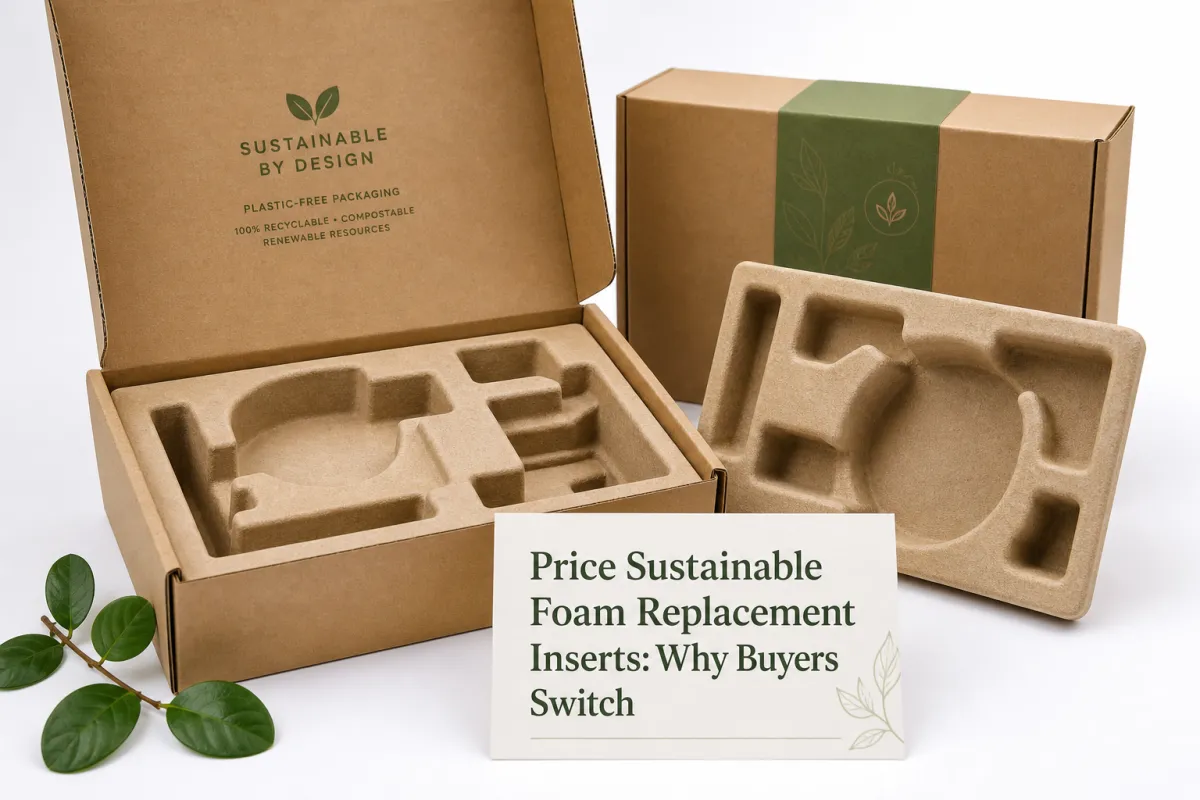
Sustainable inserts are not all built the same way, and that is where quote comparisons often go sideways. Price sustainable foam replacement inserts can refer to recycled-content foam, plant-based foam blends, or foam-alternative constructions such as molded fiber when the product does not need a traditional foam feel. The right choice depends on fragility, brand presentation, and how much compression the pack-out can handle before the product starts to move.
Common build options include recycled polyethylene foam, bio-based or plant-based blends, and hybrid layouts that pair a cushioning layer with a paperboard or fiber support structure. Some programs need a precision-cut insert with tight cavities around each component. Others work better with a simpler block-style insert that wraps the product with fewer cutouts. Price sustainable foam replacement inserts should be matched to the item itself, not to a generic sustainability brief.
The structure usually changes with the product category:
- Electronics: tighter cavities, corner support, and anti-shift control for screens, housings, and accessories.
- Cosmetics: smooth surfaces, premium presentation, and pack-out that keeps bottles or jars centered.
- Glassware: higher crush resistance, impact isolation, and more space around fragile edges.
- Tools: denser foam or hybrid layouts that prevent rattling and protect metal finishes.
- Subscription packaging: lighter constructions that still stop movement during parcel shipping.
There is a real difference between a basic block protector and a precision-cut insert. Block-style designs are usually easier to produce and often cheaper at low volume, but they may leave more empty space or call for extra void fill. Precision-cut inserts ask for more setup, yet they tend to hold the product more securely and deliver a cleaner presentation. For premium programs, that added control can justify the difference in price sustainable foam replacement inserts.
Buyers should also ask exactly what the quote includes. One supplier may be pricing material and cutting only. Another may be pricing design support, tooling, sample development, assembly, and pack-out into outer cartons. Those are not small differences. A bare insert and a ready-to-pack solution do not belong in the same comparison until the scope is clear.
The first question to answer is whether the insert serves protective function, presentation, or both. Some applications need a product to survive drop testing. Others need the insert to look sharp under a lid or inside a retail box. Plenty of programs need both, and that is usually where price sustainable foam replacement inserts start to separate by more than buyers expect. A more polished finish often means tighter tolerances and more controlled fabrication.
Specifications Buyers Need Before They Price Sustainable Foam Replacement Inserts
An accurate quote starts with the spec sheet, not the subject line of the email. Before a supplier can price sustainable foam replacement inserts, they need enough detail to understand the item, the carton, and the type of abuse the package will face on its way to the customer. A vague request usually returns a vague number. A complete request tends to produce a tighter range and fewer revisions.
Begin with the product itself. Provide exact dimensions, weight, and any sensitive surfaces that must not touch the insert. Handles, protrusions, buttons, valves, and glass edges should be called out clearly. The more irregular the shape, the more important it becomes to mark contact points and no-contact zones. That information affects price sustainable foam replacement inserts directly because it changes cavity complexity and material usage.
Measurements that matter
Buyers often underestimate how much the measuring method changes the result. A product measured with calipers may call for a different cavity than one estimated loosely by hand. For better pricing accuracy, include product dimensions in millimeters or inches, the carton’s internal dimensions, and the intended orientation inside the box. If the product can ship upright or flat, state that clearly. A pack-out change can alter the amount of material needed, and that shifts price sustainable foam replacement inserts with it.
Useful inputs usually include:
- Product length, width, and height.
- Product weight and any heavy-side imbalance.
- Carton internal dimensions.
- Shipping method: parcel, courier, pallet, or mixed channels.
- Drop-risk profile: retail shelf, direct-to-consumer, or warehouse transfer.
Clearance deserves attention too. Tight cavities can look elegant, but they may slow packing or put stress on a delicate finish. A looser fit can speed assembly, yet it may reduce retention. Many programs settle somewhere between the two, often using about 1 to 3 mm of clearance per side depending on material recovery and product shape. That balance has a direct effect on price sustainable foam replacement inserts because tighter tolerances usually mean more setup work and more sample adjustments.
Density, firmness, and recovery
Three terms get mixed up constantly: density, firmness, and compression resistance. They are related, but they are not the same thing. Density affects material weight and often cost. Firmness affects how the insert feels when compressed. Compression resistance affects how well the insert protects the product under load. If the insert is too soft, it can bottom out. If it is too firm, it can add bulk or transmit shock. For many flexible foam applications, ASTM D3574 testing is a useful reference for physical properties.
That is often where price sustainable foam replacement inserts begin to move. A denser or more engineered material usually costs more, but it can also lower transit failures. Buyers should ask for the property that matters most to the product: shock absorption, crush recovery, surface protection, or presentation quality. Not every pack needs the same foam style, and not every foam style belongs in the same product category.
In practical terms, the right material also has to recover after compression. If an insert takes a set too quickly, the pack-out can loosen after a few cycles or after sitting in a hot trailer. That is the kind of detail that does not show up in a glossy mockup, but it absolutely shows up in the field.
Finish and assembly details
Finish matters more than many sourcing teams expect. Retail-ready packaging may require crisp edges, consistent color, low dust, and a surface that does not shed fibers or crumbs. Subscription kits may care more about speed and repeatability. If the insert needs adhesive, print marks, a top layer, or secondary assembly, that should be spelled out early. Every one of those details alters price sustainable foam replacement inserts, and every one affects how smoothly production runs.
To keep quoting fast, send the supplier a complete package:
- Product photos from multiple angles.
- CAD files or a dimensioned drawing.
- Target annual usage and first order quantity.
- Shipping conditions and drop-test expectations.
- Any branding, color, or presentation requirements.
The strongest quote requests are not long. They are complete. A complete spec sheet can cut quote revisions from three rounds to one, which saves time for everyone involved. It also makes price sustainable foam replacement inserts easier to compare because each supplier is pricing the same job instead of filling in missing details differently.
If you want to move faster, send the carton drawing too. A lot of friction disappears once the insert designer can see the available depth, the lid clearance, and the way the product sits in relation to the box walls. That one file often saves a week of back-and-forth, which is no small thing.
Price Sustainable Foam Replacement Inserts: Pricing, MOQ, and Cost Drivers
Here is the number buyers ask for first: how much does it cost? The honest answer is that price sustainable foam replacement inserts change with material, geometry, quantity, and the production method behind the part. A simple insert at volume can look very different from a multi-cavity premium layout. The piece price is only one line in the spreadsheet. Tooling, samples, freight, and rejection rates matter just as much.
Below is an illustrative comparison for common custom programs. These are not universal prices. They are the kind of bands buyers often see when they ask for price sustainable foam replacement inserts with realistic specs and modest production runs.
| Insert Type | Typical MOQ | Indicative Unit Price | Best Fit | Main Tradeoff |
|---|---|---|---|---|
| Simple recycled foam block insert | 200-500 units | $0.35-$0.95 at 5,000; $0.70-$1.50 at 1,000 | Basic protection, low-complexity products | Less precise fit |
| Precision contoured foam insert | 500-1,500 units | $0.90-$2.50 at 5,000; $1.60-$3.80 at 1,000 | Electronics, cosmetics, premium kits | More setup and sampling time |
| Molded fiber or pulp hybrid | 1,000-5,000 units | $0.80-$2.20 at 5,000; $1.40-$3.50 at 1,000 | Retail-focused, lower-plastic programs | May need more carton depth |
| High-spec presentation insert | 1,000+ units | $1.50-$4.50+ depending on finish | Luxury, gift, and brand-forward packaging | Highest setup cost |
The table gives one part of the picture. Volume gives another. Setup cost spreads out over more units as quantity rises, so price sustainable foam replacement inserts often drop sharply between pilot and production orders. A sample run can cost more per piece than the final order because machine time, cut-path programming, and operator setup are not yet spread across thousands of units.
That is why the quote should separate sample cost, tooling cost, and production unit cost. A low pilot price with a large setup charge can look attractive until the full number is assembled. A slightly higher sample price may save money if it proves the fit and avoids several rounds of revisions. For many buyers, the real question is not, “What is the cheapest insert?” It is, “What is the lowest landed cost over the whole program?”
MOQ logic usually comes from one of three places: material yield, cutting efficiency, or tooling type. Sheet-cut inserts may run in a few hundred units because the setup is lighter. Die-cut or routed inserts often ask for a higher quantity to justify the tooling. Molded programs can require a larger minimum because the mold or forming tool has to be amortized. Asking for one universal MOQ is less useful than asking for the MOQ by construction method. Price sustainable foam replacement inserts are much easier to evaluate when the minimum is explained plainly.
A simple way to pressure-test the quote is to ask for three prices: a pilot tier, a target-volume tier, and the next break above that. Then request a landed-cost comparison against the current insert. If the sustainable option costs $0.22 more but prevents even a small number of returns per thousand units, it can still win. That kind of math is easier to defend internally than a pure piece-price argument.
Prototype pricing deserves its own attention. Sampling is not wasted money if it protects the production run. A sample can show whether the cavity is too tight, whether a corner needs more support, or whether vibration is causing the product to rebound out of the insert. Fixing those issues before full production is usually cheaper than discovering them after launch. In many programs, price sustainable foam replacement inserts improve on the second quote because the sample round removes the unknowns.
There is also a hidden cost in overengineering. A prettier insert is not always a better insert if it requires extra manual trimming or slows pack-out. The cleanest solution is the one that meets the protection target with the least friction in production. That sounds simple, but it is where a lot of programs get tangled up.
Ordering Process and Timeline for Sustainable Foam Replacement Inserts
The ordering path is straightforward once the inputs are ready. When buyers price sustainable foam replacement inserts, the process usually moves from brief to quote, then from sample to approval, and finally into production and shipment. Each step carries its own risk. The fastest route is the one that removes uncertainty early.
- Brief: Send the product dimensions, target quantity, photos, and shipping conditions.
- Quote review: Confirm the material, cut style, MOQ, and any one-time setup charges.
- Sample development: Review a physical or digital sample and check fit, hold, and finish.
- Approval: Sign off on the sample, artwork, and pack-out direction.
- Production: Release the order and complete the run.
- Packing and dispatch: Verify counts, carton labels, and shipping method.
Timing depends on complexity. A simple quote may come back in 1 to 3 business days if the brief is complete. Sampling often takes 5 to 12 business days. More complex tooling can stretch that window. Production is commonly 10 to 20 business days after approval, although larger or more intricate jobs can run longer. If the design needs multiple revisions, the schedule grows quickly. That is normal, and it is also avoidable.
Delays usually show up in the same places. Missing dimensions. Unclear product photos. A sample approved too early. Late feedback from a brand team that wants a cleaner finish after the prototype is already made. Every extra round adds days, and sometimes weeks, to the schedule. Buyers who prepare early can price sustainable foam replacement inserts more accurately and receive them faster.
If launch timing is tight, prioritize the information that changes the cavity and the cushioning performance. Exact size. Weight. Fragility. Transit method. If those are clear, a supplier can often get close on the first sample. Faster approvals matter too. A three-day delay in sign-off may sound small, yet it can push a production slot and create a much longer wait later.
A complete brief also helps the supplier recommend the right construction method from the beginning. A molded approach may be better in one case. CNC-cut foam may be smarter in another. A hybrid insert may reduce both cost and bulk in a third. Buyers who provide enough detail usually see fewer surprises, which is exactly what you want when you price sustainable foam replacement inserts for a launch or a replenishment order.
For teams juggling several SKUs, it also helps to compare not just the insert itself but the labor around it. If one design takes an extra 20 seconds to pack and another drops straight in, that difference adds up over a long run. I have seen that small operational gap matter more than the material choice in some programs.
Why Choose Us for Sustainable Foam Replacement Inserts
Custom Logo Things is built for buyers who want a practical answer, not a vague sustainability pitch. If you are trying to price sustainable foam replacement inserts, you need clear specs, responsive quoting, and technical support that gets the job from concept to order without unnecessary churn. That is the standard we aim to keep.
Three things matter most in a real packaging program: fit, consistency, and communication. If the insert changes too much from sample to production, the pack-out stops working. If the quote shifts every time a dimension gets clarified, procurement loses confidence. If the lead time changes without warning, launch planning gets harder. Our approach is built to reduce those problems.
We also look at validation the same way a buyer does. For transport testing, many teams align their samples with methods from ISTA. For fiber-based outer components or mixed-material programs, certification references from FSC can support sourcing documentation. Those references do not replace package testing, but they give teams a cleaner way to compare options and document their choices.
What does that look like in practice?
- Consistent tolerances: enough control to keep the product centered and protected.
- Material clarity: recycled-content and alternative-material options presented with plain specs.
- Responsive quoting: fewer back-and-forth rounds when the brief is complete.
- Reorder stability: predictable production notes for future runs.
- QC checkpoints: practical checks that reduce transit damage and unexpected rework.
Procurement concerns get a lot of attention here. Buyers Need to Know whether the MOQ comes from tooling or yield, whether samples are charged separately, and whether revisions affect the schedule. That level of clarity helps price sustainable foam replacement inserts without a lot of guesswork. It also makes internal approval easier, because the cost logic is visible from the start.
Another point matters just as much: a sustainable option is not automatically the right option. Sometimes the best answer is a material that uses less plastic and still protects the product through parcel shipping. Sometimes the best answer is a geometry change that trims waste before the material choice even enters the conversation. Good packaging buying is less about slogans and more about the fit between item, carton, and channel.
And honestly, that is where the work gets interesting. The best packaging teams are not chasing a label; they are building a system that ships well, looks right, and does not create extra cleanup for the warehouse.
Next Steps: Get a Quote and Validate Fit Fast
If you want a fast, credible response, send a complete spec package. Include the product dimensions, product photos, target quantity, carton size, shipping conditions, and any branding or color requirements. If you already know the transit risk, say so. If the item is fragile, high-value, or display-facing, mention that too. Those details help price sustainable foam replacement inserts with far fewer revisions later.
It also helps to ask for two numbers instead of one. Request a pilot quote and a production quote. That gives you a view of setup cost, volume breakpoints, and the point where the economics improve. If you can approve a sample before the full order, take that step. It catches tight cavities, weak corners, and finish issues before they become expensive problems.
For buyers comparing current packaging options, the real question is not whether the insert is “green enough.” The real question is whether it protects the product, fits the budget, and supports the shipping path. If the answer is yes, then price sustainable foam replacement inserts become easier to justify, easier to approve, and easier to reorder.
A practical takeaway: start with the carton, not the foam. Measure the internal box space, note the product’s fragile points, and ask for a sample tied to those dimensions before you commit to a full run. That sequence usually gives the clearest read on whether the insert is truly doing its job.
What does the price of sustainable foam replacement inserts usually include?
A quote usually covers the insert material, cutting or molding, and basic production labor, while tooling and setup may be separate. Ask whether the price includes samples, design support, assembly, and any outer packaging so you can compare quotes accurately.
How do sustainable foam replacement inserts compare to EPS on price?
Unit price can be higher or lower depending on material choice and design complexity, so the total landed cost matters more than the sticker price. Better fit, fewer damages, and cleaner disposal can offset a higher per-unit cost in many shipping programs.
What minimum order quantity applies to sustainable foam replacement inserts?
MOQ is usually tied to tooling efficiency, sheet yield, or production setup requirements rather than a single universal number. Smaller pilot runs may be available, but the per-unit cost will usually be higher until volume increases.
How long does it take to make sustainable foam replacement inserts?
Sampling often takes days to a couple of weeks, while full production usually depends on approval speed and order size. A complete spec sheet and fast sample sign-off are the biggest factors in shortening lead time.
Can you quote sustainable foam replacement inserts from CAD or dimensions only?
Yes, a CAD file or precise dimensions is often enough to start an accurate quote and feasibility review. Photos of the product, shipping carton size, and fragility notes help refine the price and reduce sample revisions.
If you send a complete spec package, the first quote is usually much more useful than a rough ballpark because the material, cavity depth, and pack-out can be priced against the same assumptions from the start.
Related packaging resources
Use these related guides to compare specs, costs, quality checks, and buyer decisions before making the final call.