Apparel brands usually request a printed Frosted Zipper Bags quote for apparel when standard clear poly bags no longer match the product, price point, or customer experience. The goal is not decoration alone. The right bag protects the garment, shows brand information, supports returns, and creates a cleaner presentation without the cost or storage burden of rigid boxes.
A useful quote should connect size, material, print method, quantity, closure, compliance marks, packing method, and delivery timeline. If a supplier quotes without asking about the folded garment, artwork, destination, and deadline, the number may be fast but not reliable.
When to Request a Printed Frosted Zipper Bags Quote for Apparel
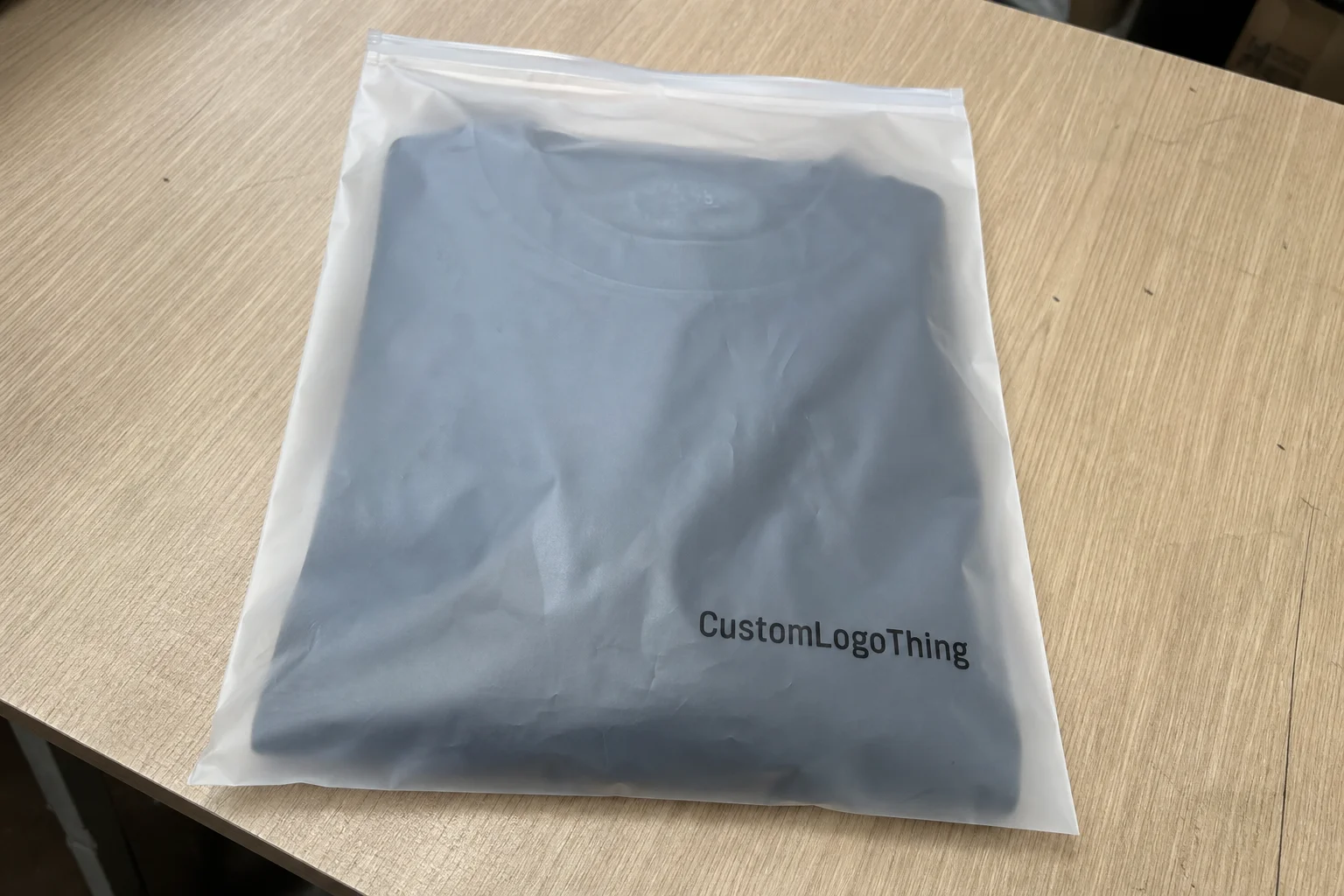
Frosted Zipper Bags make sense when the garment deserves more than a commodity sleeve but does not justify a box. Standard clear poly bags are often chosen for the lowest landed cost. Printed frosted zipper bags are chosen when brand presentation, resealability, and shelf-readiness matter.
The frosted finish hides wrinkles and minor handling marks better than clear plastic while still giving customers a hint of the garment color, texture, or print. That balance works well for T-shirts, leggings, underwear, scarves, socks, swimwear, activewear, uniforms, baby apparel, and merch drops.
The zipper closure also changes the bag’s use after delivery. A tear-open sleeve is usually discarded immediately. A resealable zipper bag can be used for returns, travel, storage, event merchandise, inventory organization, or sample kits. That gives the printed logo a longer useful life.
Common buyers include fashion startups, streetwear labels, boutique retailers, subscription apparel companies, uniform suppliers, ecommerce brands, and merch sellers preparing for higher-volume fulfillment. Many start with stock bags, then upgrade when order volume grows and packaging begins to affect perceived value.
A useful quote is not just a per-bag number. It should make size, Material, Print, MOQ, production timing, and freight clear enough for comparison.
Product Details That Affect Apparel Presentation
A frosted plastic zipper bag for apparel is typically built for folded garments such as T-shirts, hoodies, leggings, underwear, socks, scarves, swimwear, baby clothes, uniforms, and promotional merchandise. The format looks simple, but the specification affects cost, packing speed, and presentation.
The frost level changes the look. A light frost shows more product color and print through the film. A heavier frost creates a softer, more subdued retail effect. Compared with glossy plastic, frosted film reduces glare in product photos and at packing stations, making the logo easier to read.
The zipper is usually a press-to-close track. It allows customers or warehouse teams to open the package, inspect the garment, and close it again without destroying the bag. For ecommerce returns, this is useful because size and fit returns are common in apparel.
Common film structures include LDPE, CPE, EVA, or blended plastic films. LDPE is widely used and cost-efficient. CPE can feel softer and more premium. EVA blends may improve flexibility or handfeel depending on formulation. A softer film may feel upscale, but if it stretches too much during packing, barcode positioning and stackability can suffer.
Logo placement should be planned around the folded product, not just the empty bag. A centered logo on a flat bag may sit too low once a hoodie fills the lower section. Pants may create a taller packed shape. Socks may need smaller formats with tighter print margins. The fold affects the final presentation as much as the graphic design does.
Functional add-ons can include suffocation warnings, vent holes, hang holes, recycling marks, barcode stickers, size labels, matte writing panels, or white ink under colored artwork. If the bags support retailer shipments, marketplace fulfillment, or warehouse scanning, these details can prevent relabeling and sorting problems later.
Apparel Bag Specifications to Confirm Before Ordering
Before requesting a quote, prepare the core specifications. Suppliers can estimate from rough information, but accurate pricing depends on accurate inputs.
- Bag width and height: measured in the orientation the garment will be inserted.
- Bottom gusset: useful for thicker garments or multi-piece sets.
- Film thickness: usually discussed in mil, micron, or gauge.
- Material type: LDPE, CPE, EVA, or blended plastic film.
- Zipper style: standard press-to-close, slider-style if available, or specialty track.
- Print colors: one-color, two-color, CMYK process, or spot-color Pantone matching.
- Finish and opacity: light frost, medium frost, heavy frost, matte effect, or custom opacity.
- Quantity: launch order, reorder quantity, or annual forecast.
- Delivery location: ZIP code or country for freight calculation.
Sizing should start with the folded garment, not the flat garment. Hoodies, fleece, denim, and multi-piece sets need more room and may benefit from thicker film. A bag that is too tight slows packing and looks strained. A bag that is too large lets the garment slide around and can make the product look cheaper.
Film thickness affects both cost and feel. Thinner bags reduce material usage, carton weight, and unit cost. Thicker bags feel more substantial and tolerate repeated opening better. Many apparel buyers compare an economical film against a thicker premium-feel option before deciding.
Artwork should be supplied as vector files when possible. Pantone references help with spot colors, while CMYK references help set process-print expectations. Safe margins protect artwork from zipper tracks, side seals, and cut tolerance. White ink may be needed under colored artwork if the frost level or garment color affects logo visibility.
Compliance should be confirmed before approval. Suffocation warnings may be required depending on bag opening size, material thickness, and selling region. Retailer or marketplace rules may also specify warning text, font size, barcode position, or label zones. For broader packaging guidance, buyers can review resources from the U.S. Environmental Protection Agency and align decisions with applicable local rules.
Ask for a dieline or digital proof before production. Zipper placement, logo scale, warning copy, and label zones should not be left to assumption.
Cost, Pricing, MOQ, and Unit Cost Drivers
The unit cost of printed Frosted Zipper Bags depends on material, size, thickness, print complexity, order quantity, finishing requirements, and freight. The quote is a calculation, not a fixed shelf price.
Minimum order quantity, or MOQ, is driven by film production, machine setup, printing plates or screens, zipper setup, and packing labor. The first 1,000 bags carry a heavier share of setup cost than the next 10,000, so per-bag cost often drops between a test run and a bulk reorder.
A one-color logo on a standard-size frosted zipper bag usually quotes more efficiently than a multi-color, edge-to-edge pattern on custom thick film. Custom size, heavy film, special zipper colors, high opacity, oversized ink coverage, and rush production all increase cost pressure.
| Specification Choice | Typical Cost Impact | Buyer Consideration |
|---|---|---|
| Standard size with one-color logo | Lower setup burden and faster quoting | Good for launch orders, merch drops, and common T-shirt formats |
| Custom size with thicker film | Higher material and setup cost | Useful for hoodies, fleece, denim, or multi-piece apparel sets |
| Multi-color or full-pattern print | Higher print setup and possible longer proofing | Best when the bag acts as a visible brand surface |
| Rush production with express freight | Can raise landed cost sharply | Only sensible when missed launch dates would cost more |
| Compliance marks and barcode zones | Modest artwork planning cost, possible label coordination | Reduces warehouse friction and retailer rejection risk |
Freight is often underestimated. Packaging is lightweight, but it occupies carton space. Air freight for a rush launch can raise landed unit cost more than the bag material. Ground or sea freight usually supports better economics for planned replenishment, but requires earlier ordering.
Ask for tiered pricing at three quantities: a launch quantity, a likely reorder quantity, and an annual forecast quantity. For example, compare 2,000, 5,000, and 10,000 pieces. The pricing curve helps show whether it is smarter to start small or consolidate volume.
For cleaner supplier comparisons, request separate line items for tooling, print setup, sampling, production, packing, and shipping. A low unit price can become expensive if zipper failure causes repacking, if bags arrive late, if warnings require relabeling, or if the film feels wrong for the garment price point.
Process, Timeline, and Lead Time from Artwork to Delivery
The production path usually follows a sequence: requirement intake, size recommendation, material selection, artwork review, quote, proofing, sample approval if needed, mass production, quality inspection, packing, and shipping. Skipping a step moves the risk downstream.
The clock starts when usable specs and artwork are supplied, not when a buyer first asks for a price. “I need apparel bags with my logo” is not enough for a production-ready quote. Dimensions, quantity, artwork, destination, and deadline make the request easier to price accurately.
The fastest quoting requests usually include:
- Bag width and height, or folded garment dimensions
- Garment type, such as T-shirt, hoodie, leggings, socks, or uniform set
- Target quantity and possible reorder quantity
- Logo file, preferably AI, EPS, PDF, or SVG
- Print color count and Pantone or CMYK references
- Destination ZIP code or country
- Required in-hand date
- Whether samples are needed before mass production
Proofing checks artwork position, logo scale, color references, zipper orientation, suffocation warning placement, and label zones. A digital proof is useful for layout mistakes. Existing material samples help buyers judge feel and opacity. Pre-production custom samples add confidence, but also add cost and time.
Lead time depends on production queue, material availability, print method, order size, custom film requirements, inspection steps, and shipping method. A repeat order from approved artwork is generally faster than a first run with new sizing, new print plates, custom opacity, and sample approvals.
Express shipping can rescue an urgent launch, but it can also damage the freight budget. If bags are needed for a product drop, photo shoot, retailer appointment, subscription box packing date, or influencer seeding campaign, build in buffer time. Work backward from the date your fulfillment team needs bags in hand, not the public launch date.
Quality Checks That Prevent Packaging Problems
Quality control prevents problems that often appear only after garments have been packed, photographed, shipped, or returned. The main checks are zipper closure strength, side seal integrity, print adhesion, film thickness, finished bag dimensions, opacity consistency, logo placement, color match, warning text, and carton count accuracy.
Zipper testing should confirm that the bag opens and closes smoothly without splitting at the side seams or pulling away from the film. A zipper that feels tight during one test can slow packing after thousands of units. A zipper that opens too easily can spill garments during handling.
Print durability matters because bags are stacked, slid across packing tables, inserted into mailers, and handled by customers. Logos should resist casual rubbing under normal packing and transport conditions. ASTM test methods are commonly used across packaging and materials evaluation; for transit concerns, buyers can also reference distribution testing frameworks from ISTA.
Sizing inspections are just as important. Bags that are slightly too tight slow workers down and make apparel look squeezed. Bags that are too large create movement inside the package. Neither supports a premium presentation.
Clear size labels, scannable barcodes, and resealable closures can improve return handling. A customer may be able to place the garment back into the same bag, and warehouse staff can scan, sort, and restock with less friction. The benefit depends on the return condition and internal process, but the packaging can help or hinder.
Approval samples are especially useful for first-time orders. They show frost level, film feel, logo contrast, zipper behavior, and folded garment fit better than a screen proof. Before mass production begins, define acceptable tolerances for dimensions, print position, and color.
Next Steps to Get an Accurate Custom Bag Quote
A strong quote starts with a clear request. Gather the details before contacting a supplier to get better pricing, fewer revisions, and a more realistic timeline.
- Identify the garment type: T-shirt, hoodie, leggings, underwear, socks, uniform, scarf, or multi-piece set.
- Measure the folded product: include width, height, and thickness after folding.
- Choose the preferred finish: light frost, medium frost, heavy frost, matte feel, or a sample-based match.
- Estimate order quantity: include launch quantity and expected reorder quantity if available.
- Gather logo files: vector artwork is best, with Pantone or CMYK color references.
- List required add-ons: suffocation warning, hang hole, barcode zone, size sticker, vent holes, or recycling mark.
- Confirm use case: ecommerce fulfillment, retail display, warehouse storage, subscription boxes, event merchandise, or sample kits.
- Provide deadline and destination: production and freight should be calculated together.
Send a photo of the folded garment and any current packaging if available. Visual context helps prevent wrong-size assumptions and supports better logo placement. A design that looks balanced on an empty bag can shift once the garment is inside.
If you are comparing a pilot run against a replenishment order, ask for tiered pricing. Two or three quantity levels can show whether the cost break is meaningful.
For a more accurate printed Frosted Zipper Bags quote for apparel, include unit quantity, folded garment dimensions, artwork, delivery destination, required date, and any compliance or barcode requirements through Contact Us. The quote should show unit cost, MOQ, proofing steps, lead time, and shipping options clearly enough for a real purchasing decision.
FAQs
What details do I need for a printed frosted zipper bag quote for clothing?
Provide bag size, garment type, quantity, film thickness preference, print colors, logo file, delivery location, and deadline. If sizing is uncertain, send folded garment dimensions or a photo of your current packaging. Mention any required add-ons, including suffocation warnings, hang holes, barcode panels, size labels, vent holes, or retailer-specific marks.
What is the typical MOQ for custom printed frosted zipper bags?
MOQ depends on size, material, print method, and whether the bag uses a standard or custom specification. Higher quantities usually reduce unit cost because setup and production costs are spread across more bags. Ask for tiered pricing so you can compare a launch quantity against a larger replenishment run.
How long does production take for frosted zipper bags for apparel?
Timeline depends on artwork readiness, proof approval, material availability, order size, print complexity, inspection steps, and shipping method. The clock usually starts after specs, artwork, quote approval, and deposit or purchase order are confirmed. For launch deadlines, work backward from the date your fulfillment team needs bags in hand, not the public sale date.
Can I print a logo, warning text, and size information on the same frosted zipper bag?
Yes. Most designs can include a logo, suffocation warning, size indicator, barcode zone, or product information panel on the same frosted zipper bag. Placement should be planned around the zipper, garment fold, side seals, and scanning requirements. A digital proof helps confirm that all elements remain readable after the apparel is packed.
Are printed frosted zipper bags better than clear poly bags for apparel packaging?
Printed frosted zipper bags create a softer, more branded presentation while still showing some product color or shape. The resealable zipper adds value for returns, storage, travel, and repeated customer use. Clear poly bags may cost less, but frosted zipper bags often perform better when presentation, reuse, and organized fulfillment matter.


