Get a Printed Frosted Zipper Bags Quote for Boutique Products
A customer can decide whether a necklace, hair clip set, skincare sample, folded scarf, or small gift bundle feels worth picking up before they ever touch the product itself. The bag has already done part of the selling. Asking for a printed Frosted Zipper Bags quote for boutique products is therefore more than asking for a unit price; it means defining the film, size, zipper, print, packing method, order quantity, and delivery needs clearly enough that the finished bags match the product and the quote does not hide avoidable surprises.
What a Boutique Frosted Zipper Bag Quote Should Clarify
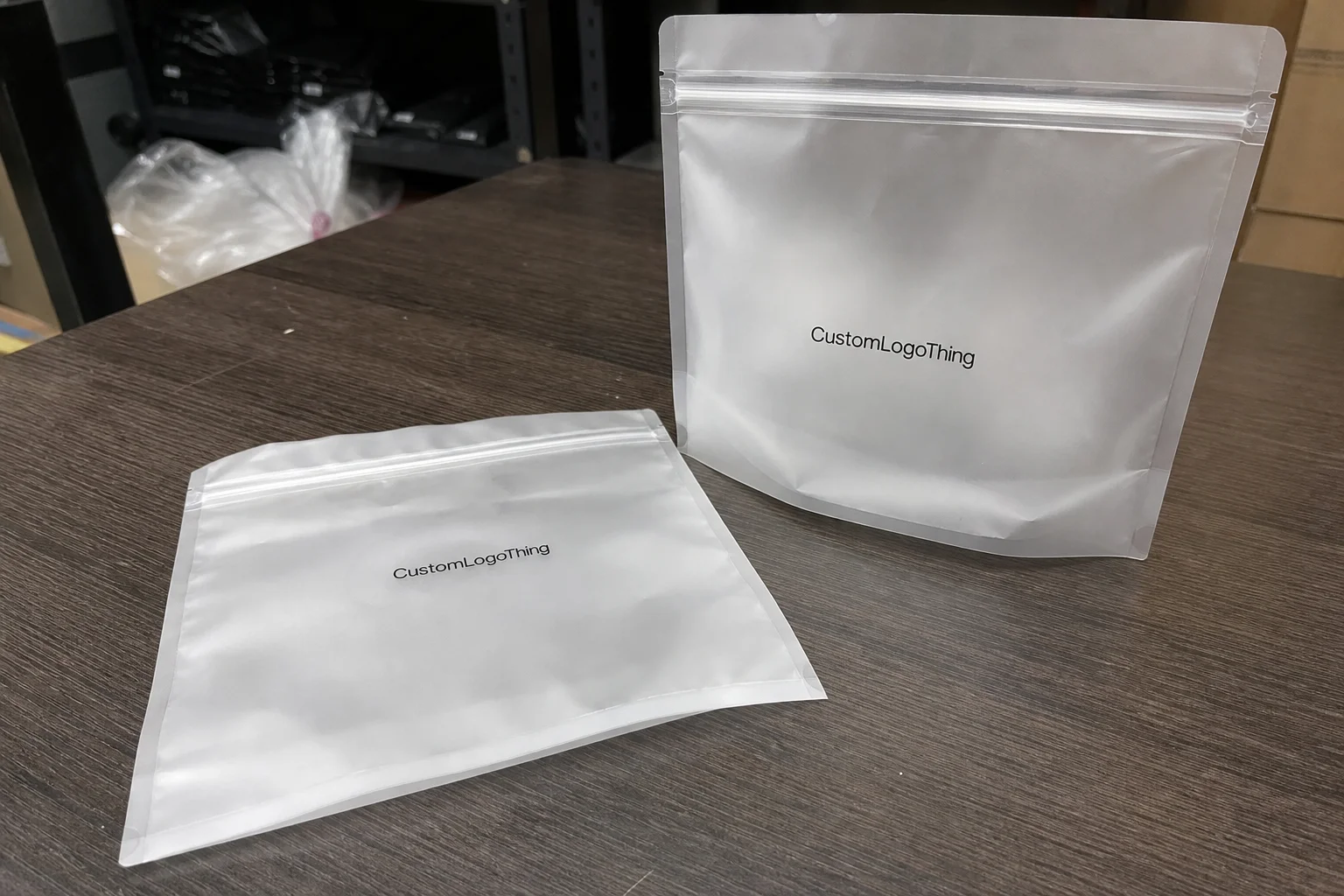
Frosted zipper bags sit in a useful space between plain poly packaging and higher-cost rigid boxes, molded trays, or custom paperboard cartons. They give small retail goods a cleaner presentation without forcing the packaging budget out of proportion to the product inside. For boutique items, that balance matters: the package has to protect, display, and carry the brand while still leaving room for healthy margin.
A useful quote should identify the actual bag construction, not just describe it as a “custom plastic zipper bag.” Zipper placement, film thickness, bottom gusset, hang hole, print method, artwork coverage, carton pack count, and freight terms can all change the final cost. Two quotes may look close on the first line and still represent very different bags once the specifications are compared.
These pouches are often a strong fit for apparel accessories, jewelry cards, skincare samples, stationery sets, hair accessories, travel-size goods, pop-up shop merchandise, and branded product bundles. The frosted surface softens the view of the item, reduces glare under retail lighting, and gives a printed logo a calm background while leaving enough visibility for customers to understand what they are buying.
Practical buyer note: The lowest quote is not always the best quote. The stronger quote is the one that matches the product, display method, filling process, and reorder plan closely enough that the packaging does not need to be rebuilt after the first delivery.
From a packaging buyer’s point of view, the aim is simple: compare options clearly, approve artwork with confidence, and move from sample review to production with fewer revisions. That starts with giving the packaging team enough detail before the estimate is built.
Frosted Zipper Bag Materials, Finish, and Retail Use Cases
Most frosted zipper pouches for boutique retail are made from PE-based films, often LDPE or similar polyethylene blends. These films offer a soft hand feel, good flexibility, and reliable converting performance for lightweight and medium retail items. The frosted or matte-like finish diffuses light rather than reflecting it like glossy clear plastic, which can make even a simple flat pouch feel more deliberate on a shelf, hook, or countertop display.
The frosted effect gives partial product visibility. Fine details are muted, but the contents are not fully hidden. That works well for boutiques that want shoppers to recognize a pair of socks, a carded bracelet, a folded mask, a small accessory set, or a travel item while still keeping the presentation tidy and branded.
Zipper choice deserves careful attention. A standard press-to-close zipper track is common for lightweight and medium goods because it allows repeated opening and closing without adding much bulk. Slider-style zipper options may be available for some structures, but they typically affect cost, lead time, and minimum order quantity. A pouch opened once at checkout has different requirements than a pouch used repeatedly in a handbag, toiletry kit, or travel organizer.
- Flat zipper bags: Good for jewelry cards, face masks, stationery, stickers, socks, folded fabric goods, and small accessories.
- Bottom-gusset bags: Better for items that need extra volume or a pouch that can stand more easily when filled.
- Header or hang-hole bags: Useful for peg displays, retail walls, trade show racks, and compact store fixtures.
- Rounded-corner formats: Helpful when bags will be handled often or placed near delicate fabrics.
Optional features should be part of the quote request whenever possible. Common additions include hang holes, tear notches, vent holes, rounded corners, suffocation warnings where applicable, barcode placement, recycle marks, SKU label windows, and product information panels. For general recycling and material-claim reference points, buyers can review resources from the U.S. Environmental Protection Agency, especially if internal brand guidelines include sustainability language.
Frosted zipper bags are not the right answer for every product. Sharp-edged, oily, greasy, heavy, or abrasive items may need thicker film, an inner wrap, a coated insert, or a different structure. Thicker film can solve some handling issues, but it cannot compensate for a product that punctures, stains, or stresses the pouch during normal use. Real product testing matters.
Print Specifications That Keep Boutique Branding Sharp
Printing on frosted plastic works well when the artwork is planned for the material. A one-color logo is usually the most economical custom option, especially for a boutique ordering its first branded run. Multi-color artwork, gradients, fine lines, full-panel ink coverage, or front-and-back designs can look excellent, but each choice can affect setup, print method, registration control, waste allowance, and unit cost.
Contrast is one of the first things to check. Frosted film is semi-translucent, so pale beige, light gray, soft blush, or thin metallic-look artwork may not read clearly unless the ink system and background are considered together. White ink, black ink, navy, forest green, deep burgundy, and other stronger spot colors often perform better because they hold contrast against the diffused surface.
For clean production, start with the right files. Vector logos in AI, EPS, or editable PDF format are preferred. Fonts should be outlined, fine lines should be thick enough to print consistently, and brand colors should be identified with Pantone or spot color references when color accuracy matters. A low-resolution PNG pulled from a website may be useful for early discussion, but it is not ideal for production artwork.
Print location affects the finished feel more than many buyers expect. A centered logo gives the pouch a gift-ready look. A lower-corner mark feels quieter and more premium. An all-over pattern can be memorable, though it uses more ink and requires closer attention to repeat, coverage, and rub resistance. Front-and-back printing can carry product details, care instructions, or barcode information, but leaving enough frosted material visible usually keeps boutique packaging from feeling crowded.
| Print Option | Best Use | Typical Cost Impact | Buyer Watchpoint |
|---|---|---|---|
| One-color front logo | Launches, pop-up packaging, simple brand presentation | Lowest custom print setup in many cases | Confirm logo size and position before proof approval |
| Two-color logo | Brands with a defined accent color or icon system | Moderate increase due to color setup and registration | Ask about registration tolerance for fine details |
| Front and back print | Product information, barcode, warnings, care instructions | Higher than one-side printing | Check barcode orientation and readable text size |
| Dense or full-panel coverage | Bold campaigns, seasonal drops, patterned packaging | Higher due to ink use and production control | Large ink areas may affect feel, stacking, and scuff resistance |
Large solid ink areas can change the tactile and visual character of the pouch. Depending on the ink system and drying conditions, heavy coverage may require more production control to reduce blocking, scuffing, odor, or uneven appearance. That does not make heavy coverage wrong; it simply means the quote should reflect the artwork honestly.
Plan compliance information before proof approval. If the bag needs SKU labels, barcode windows, material marks, care instructions, warning text, or suffocation warnings, include those details early. For larger retail programs, standards from organizations such as ISTA can also help teams think through handling, shipping, and packaging performance.
A digital proof should always be reviewed before production. For color-sensitive launches or a full brand packaging refresh, a physical pre-production sample or production sample may be worth the added time and cost. A screen proof confirms layout; a real sample confirms feel, opacity, zipper performance, print contrast, and shelf appearance.
Size, Thickness, and Specification Details to Confirm
Size mistakes are common because many people measure only the outside flat width and height. That is a start, not the full specification. A serious Printed Frosted Zipper Bags Quote for boutique packaging should account for usable inside width, usable height below the zipper, lip or header area, bottom gusset depth if needed, and extra allowance for product thickness.
If the product has depth, the bag behaves differently. Folded fabric, blister cards, stacked bracelets, small boxes, cosmetic sample sets, and bundled hair accessories can make a pouch bow outward or stress near the side seals. A bag that looks right on a ruler can feel tight, wrinkled, or overfilled once the actual product goes inside.
Thickness should match the product and use case. Lighter films can work for samples, stickers, paper goods, and flat small items. Medium films are often appropriate for boutique accessories, folded textiles, masks, and small retail bundles. Heavier films may help when the pouch needs a firmer hand, better puncture resistance, or repeated customer handling.
Heavier is not automatically better. A thicker gauge can feel stiff on small items, raise unit cost, reduce carton packing efficiency, and use more plastic than the product requires. In practice, the right film is the lightest structure that still protects the product, feels appropriate in the customer’s hand, and survives the expected packing and selling conditions.
- Material type: LDPE, PE-based film, or another approved structure.
- Finish: Frosted, matte-like, semi-translucent, or a custom surface treatment if available.
- Film thickness: Confirm gauge or micron range rather than relying on “standard.”
- Bag dimensions: Usable width, usable height, zipper position, and header area.
- Zipper type: Press-to-close, slider-style if available, or specialty closure.
- Gusset style: Flat, bottom gusset, or another pouch format.
- Print details: Number of colors, print sides, print area, and artwork coverage.
- Packing method: Inner pack count, master carton count, carton labeling, and pallet requirements if applicable.
- Shipping destination: Full delivery address or at least ZIP/postal code for freight estimating.
Plastic film converting has normal production tolerances for size, thickness, print position, seal width, and color. If the pouch must fit a rigid insert, shelf tray, mailer, peg hook, or store fixture, say so before production. A tolerance that is harmless for a soft scarf can matter a lot for a rigid backing card.
Sampling is the safest route when the fit is close. Test with the real product, not only a measurement. Product corners, fabric compression, label placement, zipper clearance, and the way staff fill the bag all affect the final result.
Cost, Pricing, MOQ, and Unit Cost Factors
Pricing is driven by more than quantity. Material thickness, bag size, zipper construction, gusseting, print colors, print area, plate or setup requirements, inner packing, carton packing, freight, and delivery timing all influence the final number. A compact flat pouch with a one-color front logo will price very differently from a large gusseted pouch with two-sided printing and dense coverage.
Minimum order quantity exists because custom packaging requires setup. Film has to be sourced or allocated, presses need to be prepared, artwork must be proofed, converting equipment must be scheduled, and quality checks must be completed. Higher quantities often reduce the unit cost because setup is spread across more bags. That does not mean every boutique should buy the largest quantity; it means price breaks are worth reviewing before you commit.
For planning only, a small Custom Frosted Zipper pouch with one-color printing may be quoted in a much different range than a larger retail pouch using heavier film and two-side artwork. Real pricing depends on the specification, supplier capabilities, freight, and market material costs. Buyers often see a meaningful unit-cost difference between a minimum run, a practical reorder quantity, and a larger stock-up quantity. The spread between 2,500 pieces and 10,000 pieces can be substantial when setup costs are distributed across the run.
| Quote Driver | Lower-Cost Direction | Higher-Cost Direction | Why It Matters |
|---|---|---|---|
| Bag size | Small flat pouch | Large pouch or wide gusset | More film per unit and different machine setup can raise cost |
| Film thickness | Lighter gauge for flat items | Heavier gauge for handling or puncture resistance | Material weight affects both price and freight |
| Print colors | One-color spot logo | Multi-color or tight registration art | More setup, more control, and more make-ready waste may be required |
| Print coverage | Small centered logo | All-over pattern or large solids | Ink use, drying, handling, and quality checks increase |
| Quantity | Higher run quantity | Minimum custom run | Setup cost spreads more efficiently across larger orders |
| Freight | Consolidated carton shipment | Rush shipping, split shipments, or bulky cartons | Carton volume and destination can materially affect landed cost |
Ask whether freight is included or estimated separately. Cartons, inner packs, palletizing, and destination all matter. A quote that includes delivery may appear higher than one that excludes freight, but the delivered cost is often more useful for budgeting.
For an apples-to-apples comparison, ask each supplier to specify material, thickness, finished size, print colors, print sides, MOQ, setup charges, sample charges if any, carton count, and freight terms. One quote may include artwork proofing and delivery while another does not. One may use a heavier film. Another may assume a simpler zipper. The numbers only tell the truth if the specifications match.
If you are gathering pricing for boutique inventory planning, request at least three price breaks: the minimum order, a realistic reorder quantity, and a larger stock-up quantity. That gives you a clearer view of cash outlay versus unit cost before you choose the run size.
Process, Timeline, and Production Steps from Artwork to Delivery
The normal custom packaging process follows a sequence, and skipping details early usually costs time later. Start with product details and target quantity. Confirm bag size. Review artwork. Prepare the quote. Approve the proof. Place the order and deposit if required. From there, the job moves into material planning, print setup, production, quality checks, packing, and shipment.
Timeline depends heavily on how complete the buyer’s information is at the start. Missing dimensions, low-resolution artwork, unclear color instructions, unknown delivery address, or late changes can slow down quoting and proof approval. A complete request can usually be reviewed much faster because fewer assumptions need to be checked.
The proof stage is not a formality. The supplier should show the bag size, zipper position, print location, color references, and required text before production starts. Review spelling, logo orientation, barcode direction, warning language, and product fit assumptions carefully. If the logo should sit 1 inch below the zipper or the barcode needs a clear quiet zone, that detail belongs in proofing, not after production begins.
Physical samples can add time, but they can also prevent an expensive mismatch. For a boutique launch where hand feel, opacity, zipper strength, and shelf appearance carry real brand value, a pre-production sample or production sample may be a sensible step. Not every reorder needs it. New structures, tight fit projects, and color-critical designs often do.
Custom production lead time varies based on material availability, print complexity, order quantity, current production load, and whether tooling or special components are needed. A simple one-color run on a common size and film is usually easier to schedule than a new gusseted structure with heavy coverage and specialty packing. Be cautious with any universal timeline that ignores those variables.
Buyers can keep turnaround more predictable by approving artwork promptly, consolidating feedback, avoiding specification changes after proof approval, and providing a complete ship-to address early. Small changes can have larger consequences than expected. A late logo revision or changed barcode panel may require corrected plates, updated proofs, or new production instructions.
Build cushion into launch planning. Delivery day is not the same as ready-for-sale day. Boutique teams may still need to receive cartons, count inventory, fill product, apply SKU labels, repack for store locations, prepare displays, or split stock between online fulfillment and retail sales. A few extra business days in the plan can protect the launch from rushed packing and avoidable handling mistakes.
Before You Request a Custom Bag Quote
Before asking for a printed frosted zipper bags quote for boutique packaging, gather the details that affect fit and cost. Measure the product. Decide whether the pouch should be flat or gusseted. Choose the target hand feel. Identify the zipper style. Select print colors. Estimate both the first order quantity and the likely reorder quantity.
Artwork should be ready before pricing moves too far. Send vector files such as AI, EPS, or editable PDF whenever possible. Include brand color references, notes on front or back printing, and any required product text. If the logo must match other retail packaging, share that detail early so the proofing conversation is based on the full brand system rather than one isolated file.
A product photo or sketch with dimensions helps more than many buyers expect. Soft, irregular, bundled, or carded products can be difficult to size from numbers alone. A quick photo showing the product, thickness, display orientation, and label placement can help the packaging team spot fit issues before samples or production.
Ask for two or three quoted options instead of one vague price. A standard economical version may use a practical gauge and one-color logo. A heavier retail-feel version may cost more but improve hand feel. A higher-quantity price break may make sense for reorder planning if the product is a proven seller. Custom Logo Things can help clarify material selection, print setup, size adjustments, MOQ planning, artwork preparation, and packaging choices that align with boutique presentation and budget.
If you are ready to compare options, send your project details through Contact Us. Include product dimensions, desired quantity, logo file, print color count, delivery location, display method, and packing requirements so the quote can be specific instead of padded with assumptions.
FAQs
What information do I need for a printed frosted zipper bag quote for a boutique order?
Provide bag width and height, product dimensions, desired quantity, preferred film thickness or hand feel, zipper style, print colors, print location, artwork file, and delivery address. If you are unsure of size, send a product photo with measurements so the bag can be sized around real packing conditions rather than a rough flat measurement.
What MOQ should I expect for custom frosted zipper bags?
MOQ depends on bag size, material, printing method, and production setup, so it should be confirmed during quoting. Ask for multiple quantity breaks because the unit cost often improves when setup is spread across a larger run.
Can frosted zipper bags be printed with full-color boutique branding?
Yes, full-color branding may be possible, but artwork complexity, color count, ink coverage, and registration requirements can affect pricing and lead time. Simple one-color or two-color logos are usually the most cost-effective choice for boutique retail packaging.
How do I choose the right thickness for printed frosted zipper pouches?
Match thickness to product weight, sharpness, handling, and desired hand feel rather than choosing the heaviest film by default. Light flat items may use a lighter film, while accessories, garments, or products handled repeatedly may benefit from a stronger gauge.
How long does production take after I approve my frosted zipper bag proof?
Lead time varies based on material availability, print complexity, order quantity, and current production schedule. Approving artwork quickly, avoiding late specification changes, and confirming shipping details early will help keep the project moving.


