Buyer Fit Snapshot
| Best fit | Printed Kraft Boxes Wholesale projects where brand print, material claims, artwork control, MOQ, and repeat-order consistency need to be specified before quoting. |
|---|---|
| Quote inputs | Share finished size, material target, print colors, finish, packing count, annual reorder estimate, ship-to region, and any compliance wording. |
| Proofing check | Approve dieline scale, logo placement, barcode or warning zones, color tolerance, closure strength, and carton packing before bulk production. |
| Main risk | Vague material claims, crowded artwork, missing packing details, or unclear freight terms can make a low unit price expensive after revisions. |
Fast answer: Printed Kraft Boxes Wholesale: Costs, Specs, Orders should be specified like a repeatable production item. The safest quote records material, print method, finish, artwork proof, packing count, and reorder notes in one written spec.
Production checks before approval
Compare the actual filled-product size with the drawing, then confirm tolerance on folds, seals, hang holes, label areas, and retail display edges. Reserve space for logos, QR codes, warning copy, and material claims before decorative graphics fill the panel.
Quote comparison points
Review material grade, print process, finish, sampling route, tooling charges, carton quantity, and freight assumptions side by side. A quote is only useful when the supplier can repeat the same color, closure quality, and packing count on the next order.
Printed Kraft Boxes Wholesale sounds simple until the spreadsheet starts telling the truth. A plain kraft box looks inexpensive right up until you add labels, sleeves, inserts, tape, and hand labor. Then the “easy” option stops being easy. That is why Printed Kraft Boxes wholesale matters for brands that want control instead of surprise invoices.
For ecommerce launches, retail rollouts, subscription programs, and kit assembly, wholesale packaging gives you three things buyers actually need: a fixed spec, a predictable unit cost, and a box that does more than sit there looking brown. In practice, printed Kraft Boxes Wholesale can replace several separate finishing steps with one production run. Fewer touchpoints. Fewer mistakes. Less chaos at pack-out. That is usually where the hidden value shows up.
If you are buying for cosmetics, candles, coffee, apparel, supplements, or mixed product sets, the real question is not whether kraft looks good. It usually does. The real question is whether the structure, print method, and board strength match the product, the shipping path, and the labor you actually have. That is the difference between a packaging purchase and a small operational mess.
I have watched brands overthink the logo and underthink the box. Bad move. The logo is the easy part. The box has to survive shipping, fit the product, and not turn your packing table into a crime scene. That is where printed kraft boxes wholesale earns its keep. If you are comparing programs, it also helps to look at structured buying options like our Wholesale Programs and the broader range of Custom Packaging Products that can fit different product categories and budgets.
Why printed kraft boxes wholesale make budgets behave
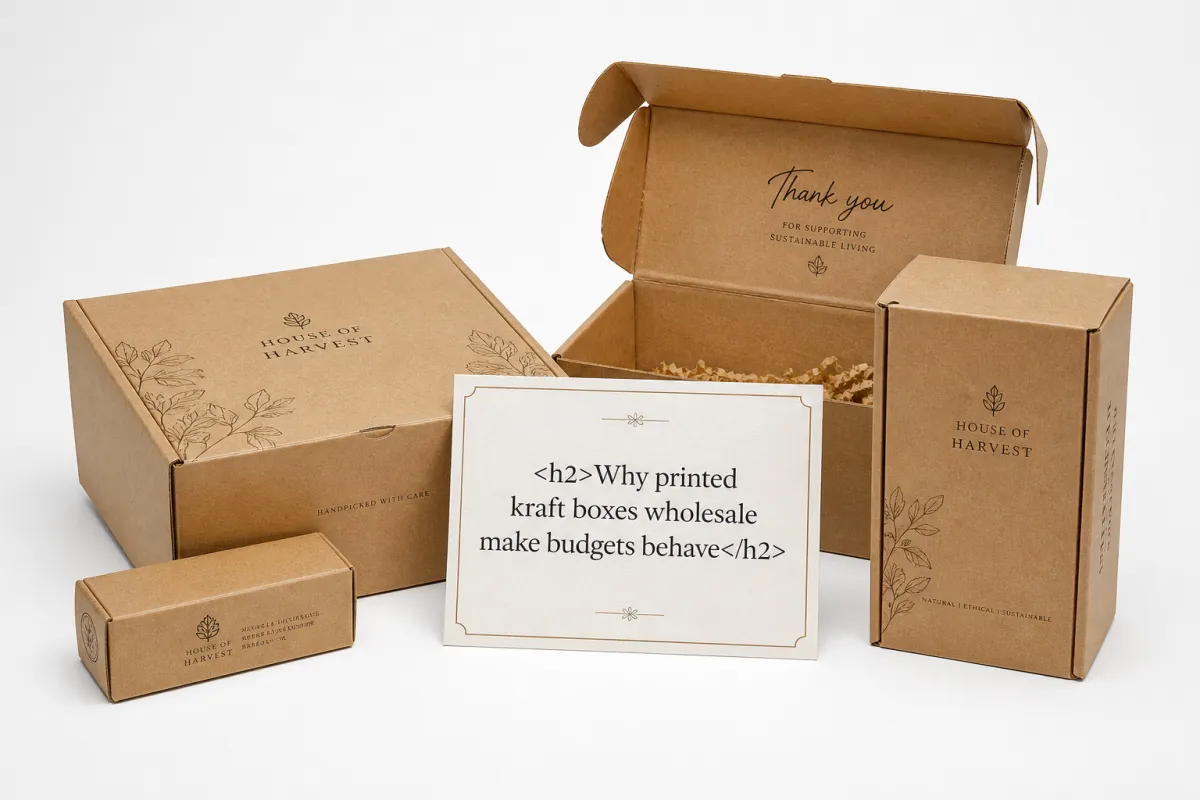
Printed kraft boxes wholesale works because it turns packaging into a known input instead of a moving target. If you are launching a new product, the last thing you need is a carton spec that keeps changing every time someone edits the label, swaps an insert, or changes the fulfillment method. Lock the structure early. Protect the margin before the first shipment leaves the dock.
A “cheaper” plain kraft box often becomes a more expensive choice once you add adhesive labels, belly bands, stickers, insert cards, or a separate hand-applied sleeve. That extra handling costs money at the box line and again at fulfillment. A well-planned printed kraft boxes wholesale order can fold those visual and functional needs into one production run, and that is where the savings usually show up.
From a buyer’s point of view, the value is blunt. Better shelf presence. Faster pack-out. Fewer line items on the invoice. More consistent reorders. If you sell through retail, wholesale packaging also gives you a cleaner presentation on shelf without pretending the box is luxury theater. Kraft has a natural, honest look. That is the point. It signals practical quality without asking for excessive finishing.
Printed kraft boxes wholesale is also a strong fit when you need packaging that feels recyclable, earthy, or minimal but still branded enough to do its job. The material reads as functional. The print can stay restrained. You do not need a pile of gloss and foil to look professional. Sometimes a strong logo, the right board weight, and clean dielines are enough.
A plain kraft box is only cheap if you count the carton and ignore the labor. Once you add handwork, that bargain gets familiar fast.
For brands that reorder regularly, the biggest win is predictability. A wholesale run lets you hold the same dimensions, print setup, and production method over multiple cycles. That helps with inventory planning and keeps the packaging from drifting every time someone changes vendors. If you want a stable packaging program, printed kraft boxes wholesale is usually the cleaner route.
It also matters for cash flow. Packaging is one of those line items that gets ignored until the launch date gets close. A wholesale quote, once the spec is right, gives you a realistic per-unit number you can build into margins. That is how smart brands avoid the “we’ll fix packaging later” routine. Later is expensive. Even small savings matter when the order volume grows, because a three-cent difference can become a meaningful budget swing when multiplied across thousands of units.
Another advantage is consistency across channels. A box that works for shipping can often be adapted for retail display, subscription fulfillment, or promotional kits with only modest changes. That kind of flexibility is useful when a product line spans direct-to-consumer, wholesale accounts, and seasonal bundles. Printed kraft boxes wholesale lets you keep the branding unified while adjusting only the structure or insert style as needed.
What printed kraft boxes wholesale actually include
Not every printed kraft boxes wholesale order means the same thing. Buyers use the phrase for everything from simple mailer boxes to premium Rigid Gift Boxes wrapped in kraft paper. Those are not the same product, not the same materials, and not the same price band. A good quote starts with the right box style.
The main structures you will see are mailer boxes, tuck-end cartons, shipping cartons, rigid gift boxes with kraft wraps, sleeves, and insert-ready formats. Mailers are common for ecommerce because they ship flat and stack well. Tuck-end cartons work well for retail shelves and lighter products. Shipping cartons are built for transit strength, often with corrugated board and more conservative tolerances. Rigid boxes are usually chosen when the unboxing moment matters more and the product needs a premium presentation without heavy decoration.
Depending on the product, the kraft surface can be used as the main exterior or as a wrap over a different substrate. Common applications include natural brown kraft, bleached kraft, recycled kraft, and printed kraft-laminate wraps. The finish is often kept matte because it supports the material story, but some jobs use spot varnish or soft-touch coating if the brand wants a more polished feel. The right choice usually depends on budget, shelf environment, and how much surface protection the box needs.
One reason people like printed kraft boxes wholesale is that it can cover both practical and visual goals at once. A box for a candle set may need a snug insert, a simple one-color logo, and enough board strength to avoid crushing. A box for apparel may need a lighter structure with less internal support. A box for supplements may need clear panel copy, tamper-aware packing logic, and enough room for regulatory labels. The format changes, but the buying logic stays the same.
Here is the practical difference between common box types:
- Mailer boxes: Usually used for ecommerce and subscription kits; often arrive flat and fold into a self-locking shape.
- Tuck-end cartons: Common for retail and lightweight products; often chosen when shelf visibility matters.
- Corrugated shipper boxes: Best for transit protection; often used when the package needs to travel alone.
- Rigid kraft boxes: Common for gifts and higher perceived value; usually cost more because of the assembly and wrapped structure.
- Sleeves and wraps: Useful when you want branding without fully printing every panel or when the base box is shared across SKUs.
Printed content also varies. Some orders only need a logo, a web address, and one or two product identifiers. Others need full-panel art, usage text, QR codes, compliance statements, or shipping marks. Each added panel increases design time and can affect print setup, especially if the box uses multiple colors or tight alignment. With printed kraft boxes wholesale, keeping the artwork clean often leads to better results than trying to squeeze too much information onto every side.
It is also common to pair the box with inserts. Paperboard inserts, corrugated dividers, and molded supports each solve a different problem. Paperboard inserts usually help with presentation and light positioning. Corrugated dividers are often better for multi-item kits or products that need cushioning. Inserts can raise the packaging budget a bit, but they often reduce damage rates and improve the packing experience. That tradeoff is usually worth considering early.
Specifications that matter before you request a quote
The fastest way to make a packaging quote useful is to give the supplier the details that actually affect production. For printed kraft boxes wholesale, that usually means the structure, material, dimensions, print coverage, finish, quantity, and end use. Without those basics, the quote is mostly a guess dressed up as a number.
Start with dimensions. Internal size matters more than the box drawing on a mood board. Product length, width, and height should be measured with enough room for inserts, labels, or protective wrap. If the item is fragile or irregular, common practice is to allow extra clearance for the insert and cushioning rather than forcing a tight fit. A few millimeters may not sound like much, but it can change the way the product sits, ships, and opens.
Material choice is the next big one. Kraft boxes can be made from folding carton board or corrugated board, depending on the job. Folding cartons are often measured in points or calipers, while corrugated stock is usually discussed by flute type and wall construction. Typical options include single-wall corrugated for lightweight shipping, E-flute for a cleaner print surface and slimmer profile, and heavier structures when compression resistance matters more. The right board usually depends on how far the box travels and how much weight it needs to hold.
Printing is another place where small decisions create big cost swings. One-color black, one-color white, or simple spot-color printing is often the most economical. Full-bleed art, multiple colors, or fine registration usually increases setup time and scrap risk. Digital printing can work well for shorter runs or frequent design changes. Flexographic printing is often used for larger runs and simpler graphics. Offset printing can give crisp detail on certain carton styles, especially when the box needs richer artwork. The best method depends on the run size, the surface, and the visual goal.
Finishing options should be chosen with care. Gloss, matte, aqueous coating, and selective varnish each affect both appearance and performance. Many kraft boxes stay uncoated to preserve the natural texture, but some projects need coating for rub resistance or moisture resistance. That can be useful when boxes are handled a lot in fulfillment or displayed under lights. If the box will be stored in a humid environment, it is usually wise to confirm whether the material and finish can tolerate that condition without warping or scuffing.
Do not forget the production details that reduce surprises later:
- Quantity: Higher quantities often lower the unit price, but storage and cash flow still matter.
- Turnaround: Rush jobs are possible in some cases, but they often narrow the available material and print choices.
- Artwork format: Vector files are usually easier for print setup than low-resolution images.
- Proofing: Digital proofs are common, and physical samples are often wise when fit or print accuracy matters.
- Assembly: Flat-packed boxes reduce freight and storage pressure, while pre-assembled boxes save labor.
Accurate specifications also reduce back-and-forth. When a buyer says “same as last time” but the product has changed by half an inch, the result is usually a bad fit. For repeat orders, keep a record of the approved dieline, final artwork, and packing notes. That simple habit saves time on future printed kraft boxes wholesale runs and helps keep the spec stable across seasons.
If you are comparing packaging across product lines, it helps to look at the full set of options in Custom Packaging Products. That way you can match one box style to one SKU and use a different format for another instead of forcing every product into the same structure.
Printed kraft boxes wholesale pricing and MOQ basics
Pricing for printed kraft boxes wholesale usually follows the same pattern as most custom packaging: unit cost depends on quantity, structure, print complexity, material grade, and finishing. The bigger the order, the lower the unit price tends to be, but that does not mean the largest run is always the smartest buy. Storage, forecast accuracy, and design stability all matter.
Minimum order quantities, or MOQs, vary widely by box style and production method. A simple digitally printed mailer may support a lower MOQ than a rigid box with multiple components. A standard wholesale run might start in the low hundreds, but many programs become more economical at larger quantities, often in the 500 to 5,000 range or above depending on the spec. The exact threshold depends on the factory setup and the box structure.
A useful way to think about pricing is by cost layer. There is the base board cost, the print setup, the die-cutting or cutting form, the finishing step, the assembly labor, and the freight or packing cost. Each layer can be modest on its own, but together they determine the final quote. That is why two boxes with the same size can still have very different prices if one uses simple one-color print and the other uses multiple panels, inserts, and coating.
As a rough market pattern, simpler printed kraft boxes wholesale orders generally price better than highly decorated cartons. Mailers and folding cartons are often the most cost-efficient when the artwork is straightforward. Rigid boxes and multi-piece sets usually land higher because they take more labor and more careful construction. If your goal is to keep the unit price under control, reduce complexity first before trying to shave board thickness in a way that hurts performance.
Freight also matters. Flat-packed boxes usually ship more efficiently than assembled boxes, and that can change the landed cost meaningfully. For large orders, it is common to compare the unit box price against the total landed cost, including freight and any handling at receiving. Sometimes the slightly higher box price wins because it saves space and reduces damage in transit.
Here are a few practical pricing habits that usually help:
- Keep the print layout simple unless the artwork truly needs more coverage.
- Use one standard box size across as many SKUs as realistically possible.
- Choose inserts only where the product actually needs stabilization.
- Confirm whether the quote includes tooling, plates, sampling, and freight.
- Plan reorders before inventory gets critical so the spec does not need rushed changes.
Buyers sometimes ask whether a lower MOQ is automatically better. Not always. If the run is too small, setup costs can dominate the unit price and the order may lose efficiency. If the run is too large, storage and obsolescence become a problem when artwork or product dimensions change. The sweet spot usually depends on sales velocity and how stable the product line is. For businesses with predictable demand, a larger wholesale run can make sense. For seasonal or test products, a smaller order may be the safer move.
This is also where a structured supplier relationship helps. Programs like our Wholesale Programs are often designed to support reorder consistency, which is useful when packaging needs to stay aligned with a stable product mix. If the goal is long-term packaging control rather than a one-time purchase, that setup is usually more efficient.
How the process and timeline usually work
The production path for printed kraft boxes wholesale is usually straightforward, but each step matters. A typical project starts with the spec, moves to artwork, then proofing, then sampling if needed, and then production. If any one of those steps is rushed or skipped, the risk of a fit issue or print mistake goes up quickly.
The first step is brief but important: define the box. That means dimensions, product weight, structure, print areas, and whether the box needs inserts or special closures. When the spec is clear, the supplier can usually guide material options and advise whether the box should be made in corrugated or folding carton stock. That guidance is especially useful if you are balancing presentation against shipping durability.
After the spec comes artwork review. The print file should be checked for bleed, safe zones, panel alignment, and any copy that needs to stay on a certain face of the box. For kraft materials, it is usually smart to expect a slightly different visual result than on coated white board. Natural kraft can mute colors and slightly shift contrast, so artwork may need adjustments to keep text readable and logos crisp.
Sampling is often worth the time when fit or customer experience matters. A digital mockup can help confirm layout, but a physical sample gives a better sense of closing behavior, product clearance, and how the box feels in the hand. For multi-item kits, sample approval can prevent expensive mistakes later. A small delay for sampling is usually cheaper than correcting an entire production run.
Production timelines depend on quantity and complexity. A simple order may move relatively quickly, while a complex box with multiple print colors, special coating, or custom inserts takes longer. In many packaging projects, the realistic schedule includes file preparation, proof approval, manufacturing, packing, and transit. When a buyer asks for a faster turnaround, the usual tradeoff is reduced flexibility or higher cost. That is normal. The important thing is knowing which tradeoff you are making.
Quality checks should happen before shipping whenever possible. Common checks include size tolerance, print alignment, crease accuracy, glue consistency, and fold performance. For printed kraft boxes wholesale, those checks are not cosmetic details. They determine whether the packaging closes cleanly, stacks well, and performs the way the packing team expects.
The packing team should also know how the box is intended to be used. If the product must sit inside a specific insert orientation, or if the closure should tuck a certain way, those notes should be documented. Good packaging is not just about the printed shell. It is about how the whole system works when real people assemble it at speed.
When the project is part of a broader packaging rollout, it often helps to coordinate box style with labels, mailers, tissue, and filler materials. That way the brand has a consistent story and fewer mismatched parts. If everything is ordered separately with no shared spec, the result can look accidental even when each item is technically fine.
Why choose us for printed kraft boxes wholesale
Choosing a supplier for printed kraft boxes wholesale is mostly about reducing risk. The best partner is not the one that says yes to everything. It is the one that helps you Choose the Right structure, avoid unnecessary decoration, and keep the box aligned with your budget and fulfillment process.
What matters most is practical packaging knowledge. You want someone who understands that a nice-looking box is not enough if it buckles in transit, slows down assembly, or wastes space on the shelf. A good packaging partner should be able to explain tradeoffs clearly: when to choose corrugated over folding carton, when to keep the print simple, when inserts are worth the cost, and when a standard size can save real money.
Another reason brands value a wholesale-focused partner is reorder stability. If your packaging changes every time you reorder, inventory planning gets messy and customer experience can drift. A reliable production spec makes repeat orders easier to manage. That stability matters if you run promotions, seasonal bundles, or product refreshes, because it keeps your packaging from becoming a moving target.
We also pay attention to the details that matter at pack-out. That includes flat-pack efficiency, folding behavior, easy opening, and clean finishing. A box can look good on a proof and still behave badly on a production line. We try to catch those issues early rather than after cartons arrive.
For buyers comparing packaging categories, it can be useful to review broader product options in our Custom Packaging Products lineup. Sometimes the best solution is a slightly different structure than the one you first had in mind. A more suitable carton style can improve the shipping result and lower total cost at the same time.
If your order is part of a repeat buy, a launch sequence, or a multi-SKU rollout, the wholesale model usually provides the most control. That is especially true when the packaging needs to support both presentation and practicality. Printed kraft boxes wholesale is not about making the box fancy for its own sake. It is about making the box work well enough that it stops being a problem.
Next steps for ordering printed kraft boxes wholesale
If you are ready to move forward, the best next step is to gather the essentials in one place. That usually means product dimensions, estimated quantity, target shipping method, artwork files, and a short note about the box’s job. Is it for retail display, ecommerce shipping, gifting, or subscription fulfillment? The answer changes the recommendation.
It also helps to note what is already fixed and what is flexible. If the product size cannot change, the box can be built around it. If the box style must stay the same, then the product insert or packing method may need to adapt. That kind of clear decision-making speeds up the quote and reduces revisions.
Here is a simple way to prepare:
- Measure the product and confirm the final packed size.
- Decide whether you need mailer, tuck-end, rigid, or shipper construction.
- Share the preferred print style, from simple logo print to full-panel art.
- Estimate your reorder volume so the quantity plan is realistic.
- Ask whether samples, inserts, and freight are included in the quote.
If you are still deciding between options, use your customer experience goal as the filter. A box for a premium gift set may justify a more elaborate build. A box for fast-moving ecommerce replenishment often performs better when it stays simple and efficient. The most successful printed kraft boxes wholesale orders are the ones that match the product and the workflow instead of trying to do everything at once.
Once the spec is clear, quoting gets much easier. Once the proof is approved, production becomes far less stressful. Once the packaging lands, the box should disappear into the process and do its job without drama. That is the goal.
If you want to explore a broader set of options while keeping procurement organized, start with our Wholesale Programs and compare them with the available Custom Packaging Products. From there, it is easier to narrow the box style, finish, and volume to what your operation actually needs.
Printed Kraft Boxes Wholesale: decision table
| Decision area | Best fit | What to verify | Risk if skipped |
|---|---|---|---|
| Board or flute choice | Product protection, stacking strength, and shipping distance | Caliper/flute, crush resistance, and sample fit | Weak structure or oversized cartons increase damage and freight cost |
| Print and finish | Retail presentation, unboxing, and shelf recognition | Color proof, coating, scuff resistance, and logo placement | A good dieline can still look cheap if finish and color drift |
| Packing method | Hand packing, ecommerce fulfillment, or retail-ready cartons | Inner count, master carton, label position, and warehouse handling | Good packaging slows operations if pack-out is ignored |
FAQ
What products work best with printed kraft boxes wholesale?
Kraft boxes work well for many categories, including cosmetics, candles, apparel, coffee, supplements, gift sets, and ecommerce kits. The best fit depends on weight, fragility, and how the box will be handled in transit or on shelf.
Are printed kraft boxes wholesale always recyclable?
Often they are, but recyclability depends on the exact board, coating, ink coverage, and any added components. A simple kraft carton is usually easier to recycle than a heavily laminated or multi-material package. Local recycling rules can also differ.
Which print method is most common?
It depends on the run size and artwork. Digital printing is often used for shorter runs or frequent changes. Flexographic printing is common for larger runs with simpler graphics. Offset printing can work well when detail and color control matter more.
How do I know if I need inserts?
If the product shifts, scratches, tips over, or arrives damaged during testing, inserts are usually worth considering. Corrugated dividers, paperboard supports, and custom fitted inserts each solve different problems, so the right choice depends on the product.
Can I keep the design minimal and still look branded?
Yes. Many strong kraft box designs use a simple logo, one accent color, and clean typography. Minimal packaging often performs well because it feels intentional and avoids clutter.
What should I send when requesting a quote?
Send product dimensions, quantity, box style, print expectations, desired finish, and any insert needs. If you have artwork, include that too. The more complete the information, the more accurate the quote usually is.
Is a larger order always the better deal?
Not always. Larger quantities often lower the unit price, but they also increase storage needs and the risk of obsolete packaging if the product changes. The best order size usually depends on how stable your product line is and how quickly you use inventory.
How can I keep costs under control?
Use a standard size when possible, keep the print layout efficient, avoid unnecessary finishing, and confirm the box structure early. Those choices often have a bigger impact than trying to trim small amounts from the board spec.


