Buyer Fit Snapshot
| Best fit | Printed Kraft Product Sleeves with Logo projects where brand print, material claims, artwork control, MOQ, and repeat-order consistency need to be specified before quoting. |
|---|---|
| Quote inputs | Share finished size, material target, print colors, finish, packing count, annual reorder estimate, ship-to region, and any compliance wording. |
| Proofing check | Approve dieline scale, logo placement, barcode or warning zones, color tolerance, closure strength, and carton packing before bulk production. |
| Main risk | Vague material claims, crowded artwork, missing packing details, or unclear freight terms can make a low unit price expensive after revisions. |
Fast answer: Printed Kraft Product Sleeves with Logo: Material, Print, Proofing, and Reorder Risk should be specified like a repeatable production item. The safest quote records material, print method, finish, artwork proof, packing count, and reorder notes in one written spec.
Production checks before approval
Compare the actual filled-product size with the drawing, then confirm tolerance on folds, seals, hang holes, label areas, and retail display edges. Reserve space for logos, QR codes, warning copy, and material claims before decorative graphics fill the panel.
Quote comparison points
Review material grade, print process, finish, sampling route, tooling charges, carton quantity, and freight assumptions side by side. A quote is only useful when the supplier can repeat the same color, closure quality, and packing count on the next order.
Printed Kraft Product Sleeves With Logo: Practical Brand Guide
One of the quickest ways to change how a product reads on shelf is not a full carton redesign. It is a sleeve. Printed kraft product sleeves with logo can shift the first impression in seconds because the sleeve changes the part buyers notice first: the outer face, the message band, the brand mark, and the quality cues around the pack. For many brands, that is a lighter lift than rebuilding every primary package component, yet it still creates a clear visual change that shoppers register almost immediately.
From a packaging buyer's point of view, that matters. Printed kraft product sleeves with logo give you a way to refresh one SKU, launch a seasonal run, label a limited edition, or create a consistent look across multiple variants without changing the base container. They can carry branding, ingredients, promotions, barcodes, and compliance details while keeping material use relatively restrained. If the goal is to balance shelf appeal, cost, and speed, that mix is exactly why these sleeves keep showing up in packaging conversations. I've seen a lot of projects get unstuck right here, just by choosing a sleeve instead of a heavier redesign.
What Printed Kraft Product Sleeves With Logo Actually Do
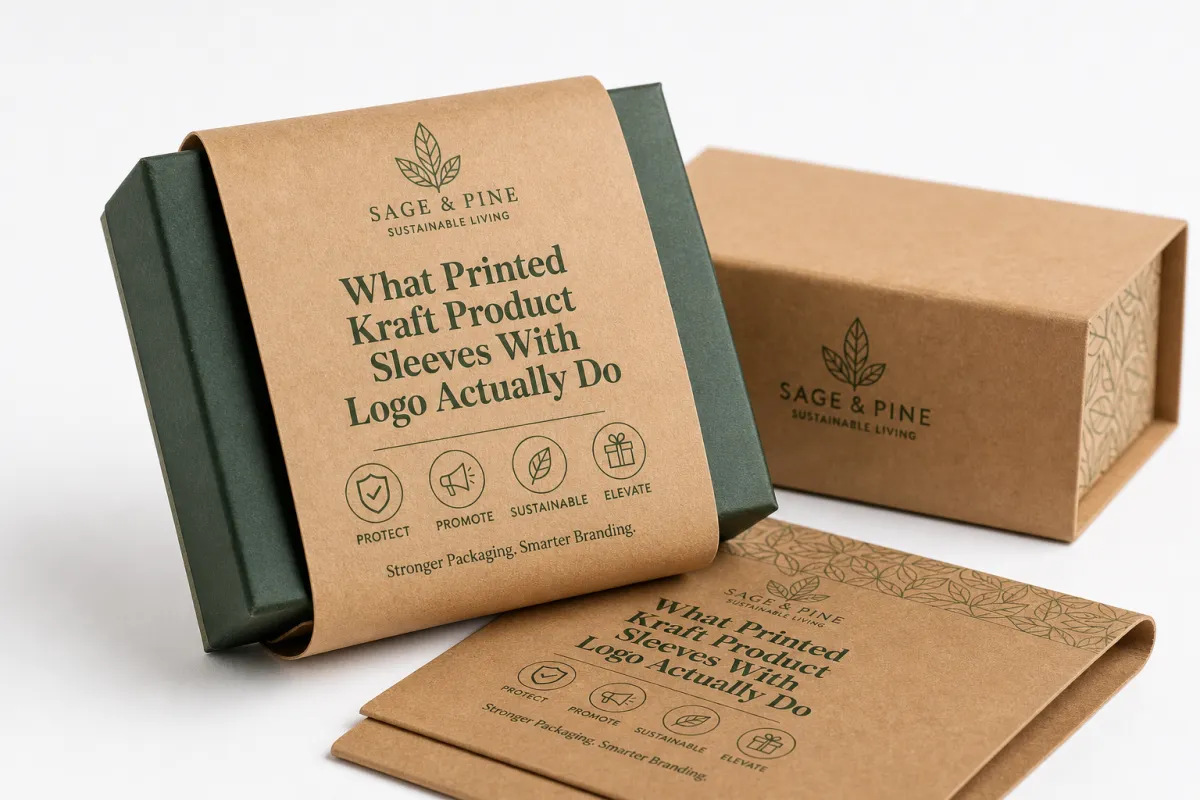
Printed kraft product sleeves with logo are simple in structure and strong in effect. They are paper wraps, bands, or shell-style overlays that slip over a box, pouch, jar, tray, bundle, or another primary pack. Their job is to add branding, messaging, and visual structure without forcing a full packaging redesign. That sounds modest, but in practice a sleeve can change how premium, natural, giftable, or organized a product feels the moment a shopper sees it.
The reason is visual hierarchy. A sleeve gives the brand a fresh outer face while leaving the base package in place. That helps brands that need a lower-commitment refresh, since the sleeve can update market presentation without scrapping existing inventory or retooling the full package system. It is also a useful move for seasonal packaging, test launches, and multi-SKU assortments where the base pack stays stable but the story changes by flavor, scent, color, or formulation.
There is a functional side as well. Printed kraft product sleeves with logo can carry information that does not fit cleanly on the primary pack. Think ingredients, usage notes, QR codes, barcodes, callouts, promotional copy, or a short origin story. If a jar label is already crowded, a sleeve can absorb the overflow. If a carton needs a limited-edition message, the sleeve can handle that without disturbing the rest of the line.
That is one reason sleeves are often chosen before a bigger packaging move. They let brands test visual direction, manage smaller runs, and preserve flexibility. A full carton redesign can cost more in prepress, inventory, and operational disruption. A sleeve can still feel intentional, but it is easier to swap, update, and scale. For packaging teams trying to improve shelf appeal while holding the line on material use, printed kraft product sleeves with logo are a practical middle ground.
Common uses include:
- Seasonal editions and gift sets
- Short-run product launches
- Multi-variety SKUs that need distinct branding
- Retail bundles and sampler packs
- Secondary messaging for promotions or compliance details
A sleeve earns its place by doing three jobs at once: identify the product, support the brand, and keep the pack readable in a crowded aisle.
How Printed Kraft Product Sleeves With Logo Work in Production
Printed kraft product sleeves with logo are usually printed flat, then converted into a finished shape by die-cutting, slitting, scoring, folding, or gluing. That sequence matters because the final fit is not determined by artwork alone. It depends on the dieline, the fold placement, the overlap, and the way the sleeve closes around the package. A design that looks excellent on a flat proof can feel loose, bulky, or misaligned if the structural work is weak.
Material choice is the next major decision. Uncoated kraft stocks are common because they preserve the natural fiber look that many brands want. Recycled-content papers are also widely used, especially when the brand story leans into lower material intensity or paper sourcing. Some sleeves use smoother, print-friendly surfaces that still read as kraft, but offer cleaner logo edges and better small-text legibility. The tradeoff is tactile. Rougher kraft feels more rustic. Smoother kraft usually prints more crisply.
Print method depends on run size and the color requirements. Digital printing is often the fastest route for short runs, frequent updates, and multiple artwork versions. Offset printing tends to make sense at larger quantities because color control improves and unit cost usually falls as volume rises. Flexographic printing can fit certain volumes and repeat jobs, especially when the artwork is simpler and the production line is built for it. Each method has its own sweet spot, and the right one depends on how often the design changes and how much coverage the sleeve needs.
Printed kraft product sleeves with logo also need structural choices that affect how the final package behaves. Wider sleeves can feel more prominent on shelf, but they also require more accurate fit. Locking tabs can improve retention. A tighter friction fit may be enough for cartons that move gently through retail, but a band that travels through e-commerce fulfillment may need more hold. If the sleeve is intended to be opened and reseated, the lock line matters more than if it is only decorative.
The workflow usually looks like this:
- Define product dimensions and target fit.
- Request a dieline matched to the exact container or bundle.
- Place artwork with correct bleed, safe zones, and fold awareness.
- Approve proofs, then move into print.
- Finish, convert, inspect, and pack out.
The last step is easy to underestimate. If sleeves are delivered flat and inserted later, the pack-out team needs clear instructions. If they arrive preformed, the conversion tolerances matter. In either case, printed kraft product sleeves with logo are not just decoration. They are part of the production system, and the production system decides whether the sleeve feels premium or fussy.
Cost, MOQ, and Pricing for Printed Kraft Product Sleeves With Logo
The economics are straightforward: printed kraft product sleeves with logo are usually priced more by size, print coverage, structure, and finishing than by kraft paper itself. A simple one-color sleeve on a standard stock can be very different from a full-color sleeve with custom die-cuts, variable copy, or specialty finishing. If a supplier quotes only the paper grade, the quote is incomplete. The setup and conversion work often drive the real cost.
Typical cost ranges vary widely, but there are useful anchors. For a straightforward sleeve at moderate quantity, you may see pricing around $0.12-$0.30 per unit once you are in the low-thousands, depending on the print method and the amount of ink coverage. Full-color work, tighter tolerances, and added finishing can push that to $0.25-$0.60 or more. At smaller volumes, the unit price rises because prepress, make-ready, and conversion costs are spread across fewer pieces. That is normal. The question is whether the sleeve still beats a larger packaging overhaul.
Minimum order quantities also matter. Many custom sleeve jobs have MOQs in the 500-5,000 range, with digital programs sitting lower and offset or converted jobs sitting higher. The reason is not arbitrary. Setup, tooling, proofing, and color calibration take time whether you print 500 sleeves or 5,000. Once that work is done, the economics improve as volume rises. For that reason, printed kraft product sleeves with logo often make the most sense when you can group a few variants into a single production plan or when you have a launch calendar that supports several months of demand.
There is a useful way to compare print approaches before you request quotes. The table below is not a universal price sheet, but it helps brands think through tradeoffs before they commit.
| Print Option | Best For | Typical Volume | Relative Unit Cost | Strengths |
|---|---|---|---|---|
| Digital | Short runs, versioning, fast turnarounds | 250-2,000 units | Higher at scale, lower setup burden | Quick proofing, easy artwork changes, good for tests |
| Offset | Larger commercial runs, tighter brand color control | 2,500-25,000+ units | Lower at higher volume | Consistent color, efficient for repeat lines |
| Flexographic | Repeat jobs, simpler graphics, certain line-based formats | Mid to high volume | Competitive on repeat production | Efficient for steady demand and simpler artwork |
For buyers, the smartest quote request is not just "price per thousand." Ask for multiple quantities, because the break point can be meaningful. Ask for a plain-stock option as well, because a simpler construction may be enough if the artwork is doing most of the work. Compare landed cost, not just print cost. Shipping, assembly, insertion, and pack-out labor can change the real number faster than people expect. Printed kraft product sleeves with logo are often a budget-efficient choice precisely because they let you preserve the primary pack and update only the outer layer.
If sustainability reporting matters, ask whether the paper carries FSC chain-of-custody documentation or similar sourcing proof. The FSC site is a useful reference point for understanding what that certification covers. A supplier who can explain sourcing clearly is usually easier to work with than one who stays vague.
Production Steps, Process, and Lead Time for Printed Kraft Product Sleeves With Logo
Lead time is where sleeve projects are won or lost. Printed kraft product sleeves with logo can move quickly, but only if the dimensions, artwork, and proofing cycle are disciplined. The process usually starts with a brief that defines the product, the target fit, the message hierarchy, and any compliance content that must be present. That sounds basic, yet many delays begin here because the supplier receives incomplete measurements or a vague description of how the sleeve should close.
Next comes the dieline. This is the map. It shows the fold lines, the bleed, the trim area, the glue zone or tuck zone, and the safety margins that keep logos and copy out of danger. If the dieline is wrong, the artwork is wrong too. That is why proofing matters so much. A digital proof can catch positioning mistakes, while a hard proof can reveal how the stock behaves in hand. On a sleeve job, a few millimeters can decide whether the package looks custom-fit or loosely adapted.
Then the job moves into print and conversion. The printed sheets are checked for color, line weight, registration, and surface behavior. After that, they are cut, scored, folded, and assembled according to the chosen structure. Some jobs use a simple band style. Others use a locking wrap or a sleeve with tabs that help it stay in place during transit. If the final package has to survive distribution, testing should not stop at a flat sample. Put the sleeve on the actual filled product and see how it behaves after handling, stacking, and vibration.
That is where standards can help. Distribution testing based on ISTA protocols is often a sensible reference point for packaged goods that need to travel without scuffing, shifting, or opening unexpectedly. Not every sleeve needs full lab testing, but the more the package moves, the more useful that discipline becomes.
Typical turnaround times depend on complexity. Simple digital sleeve programs can often move in roughly 10-15 business days after proof approval. Offset jobs, custom finishing, or complex conversion can move closer to 15-25 business days, sometimes longer if there is a queue or a revision cycle. Build in extra time if the artwork still needs legal review, barcode testing, or final copy signoff. One artwork change can ripple through the entire schedule. That is the part teams often forget.
A realistic lead-time checklist looks like this:
- Measurement confirmation on the live product
- Dieline review and artwork placement
- Proof approval, including color expectations
- Print, cure, finish, and convert
- Pack-out or shipment planning
Well-run printed kraft product sleeves with logo jobs do not feel rushed. They feel orderly. That happens because the work is front-loaded: good measurements, good proofing, and a clear handoff from prepress to production. The more precise the front end, the less expensive the back end.
Key Factors That Make Sleeves Work Better
Size is the first factor, and it is more important than most people expect. A sleeve that is too loose slides. One that is too tight buckles at the fold or scuffs the printed surface. The best-looking printed kraft product sleeves with logo are usually the ones that disappear structurally while still making the branding sharper. That means the sleeve should fit the package, not fight it. A measured fit is especially important when the sleeve has to cover a jar, carton, or tray with slightly rounded edges or variable dimensions.
Stock choice changes both appearance and performance. Rougher kraft can reinforce an earthy, handmade, or ingredient-forward brand story. Smoother kraft usually improves small text and logo sharpness. Recycled-content stock can support a sustainability position, but only if the rest of the material spec supports that claim. If you are planning to say the sleeve is recyclable, check the coating, ink system, and local recycling rules first. A claim that sounds clean but is not supported by the actual spec creates avoidable risk.
Color strategy matters too. On kraft, colors shift. Black usually performs well. Deep greens, warm neutrals, and restrained white space can look elegant. Bright, high-chroma colors may need more testing because the brown tone of the substrate changes the final result. If a brand wants a premium look without overprinting the paper, one-color artwork can be more striking than a crowded full-color layout. Printed kraft product sleeves with logo do not need to shout to be effective.
Finishing is the other quiet quality cue. A plain matte surface often feels natural and credible. Selective varnish can highlight the logo. Embossing adds tactile depth, although it also increases setup complexity and cost. A brand does not need all three. Sometimes the strongest sleeve is the one that keeps the finish simple and lets the typography carry the message. That is especially true for products that want to signal authenticity rather than luxury.
Practical details deserve attention:
- Barcode placement should stay scan-friendly after wrapping.
- Nutrition panels and legal copy should remain readable.
- Score lines should not cut through the logo mark.
- Adhesive zones should be kept clear of critical text.
One more factor: test the sleeve with the actual filled product. An empty carton, an empty jar, or an unfilled tray can mislead you because weight, surface finish, and internal tension all affect fit. Printed kraft product sleeves with logo should be judged in real conditions, not just on a flat proof sheet.
Common Mistakes Brands Make With Sleeves
The most common mistake is crowding the sleeve. Because the format feels like extra space, teams sometimes treat it as a mini billboard and load it with claims, icons, badges, and paragraphs of copy. That usually backfires. The eye needs hierarchy. If every inch is trying to speak, nothing stands out. The better move is to use the sleeve to frame one or two strong messages and let the rest of the information sit where it belongs.
Measurement errors are another frequent problem. A few millimeters off can change everything. The sleeve may slip, hide a closure point, or land awkwardly over a label seam. For printed kraft product sleeves with logo, the live package matters more than the nominal dimensions on a spec sheet. Measure the actual product, with the final fill level, final label, and final closure method in place. That sounds tedious, but it saves a lot of rework later.
Vague sustainability language is a third issue. Saying "eco-friendly" or "recyclable" without a material spec is risky. The paper grade, coating, adhesive, and print method all affect the disposal story. If the sleeve is made from recycled kraft, say that. If it uses FSC-certified fiber, say that accurately. If it is designed to be recyclable in paper streams, confirm that with the supplier and keep the language specific. General claims attract scrutiny. Specific claims build trust.
Color mismatch can also trip teams up, especially when mockups are approved on coated paper and final production runs on uncoated kraft. The same brand color can read darker, flatter, or warmer once it hits the brown substrate. That is not a defect. It is how the material behaves. The solution is to approve color on the actual stock, or at least on a proof that simulates it closely. Printed kraft product sleeves with logo need material-aware color expectations, not generic assumptions.
Order planning errors are equally costly. Brands sometimes underestimate MOQ, forget to budget for hand assembly, or approve artwork too late for a launch date already locked into retail. A sleeve project may look small, but the schedule can still break if one step slips. That is where a launch checklist helps.
- Confirm dimensions on the live product.
- Check dieline and artwork alignment.
- Verify claims, barcodes, and legal copy.
- Approve proof on the correct stock.
- Plan insertion and pack-out labor.
The final mistake is skipping real-world testing. A sleeve that looks perfect in a PDF may perform poorly on a shelf, in shipping, or in a consumer's hand. That is why careful brands treat printed kraft product sleeves with logo as a prototype-first decision. The sleeve has to survive both the camera and the supply chain.
Expert Tips and Next Steps for Printed Kraft Product Sleeves With Logo
If the goal is to move fast without losing control, start with one hero SKU. A pilot run reveals more than a stack of renderings ever will. You will learn whether the sleeve feels secure, whether the logo reads clearly, and whether the structure suits the product better than a full box change. From there, you can roll the format across the line with fewer surprises. That is usually a smarter path than approving a broad family of printed kraft product sleeves with logo before the first physical sample is tested.
Compare at least two stock weights and two print methods if your schedule allows it. A slightly heavier sheet may improve stiffness and shelf presence. A lighter sheet may reduce cost and still perform well if the sleeve is only decorative. The same logic applies to printing. Digital can be ideal for versioning and small lots. Offset can win on consistency and cost once volume climbs. There is no universal winner. The right choice depends on run length, artwork complexity, and how stable the design will be over time.
Ask for a quote that breaks out printing, finishing, conversion, shipping, and any hand assembly. That makes the true unit cost visible. A cheap print quote can become an expensive landed price once assembly is added. A more expensive print run can still be the better business decision if it eliminates a separate label, a box redesign, or a higher-cost packaging component. Printed kraft product sleeves with logo often look like a small decision, but they usually sit at the intersection of branding, operations, and cost control.
If the package will compete on shelf, do a shelf test. Place it beside the nearest competitor products and step back. Give yourself five seconds. That is often enough. Does the sleeve sharpen the product story, or does it disappear into the category noise? Does it signal natural, premium, efficient, or cheap? Those snap judgments are what shoppers make, whether the brand likes it or not. A sleeve that performs in that short window is doing real work.
Before scaling, build a launch checklist:
- Dieline approved and measured on live product
- Copy checked for regulatory accuracy
- Barcode scan tested after sleeve application
- Material and disposal language confirmed
- Pack-out method assigned and timed
If you want a practical starting point, order a sample, fit it on the actual product, test the message hierarchy, and compare it with the current pack under real lighting. Then decide whether to scale. That measured approach is why printed kraft product sleeves with logo work so well for brands that want a better-looking pack without taking on a full packaging rebuild. It is a controlled change, and controlled changes tend to age well.
What size artwork do I need for printed kraft product sleeves with logo?
Start from an accurate dieline, not a guessed flat size, because sleeve dimensions change once folds, overlaps, and locking areas are added. Leave safe margins for logos and copy so nothing important lands on a score line or trim edge. Ask your printer for a template based on the exact container or carton you plan to use, then place artwork against that file before you sign off.
Are printed kraft product sleeves with logo recyclable?
They can be recyclable if the paper stock, inks, and any coatings are compatible with local recycling rules. Avoid plastic laminates or heavy mixed materials if recyclability is a priority. Use clear disposal language only after confirming the actual material spec with your supplier, because what looks paper-based on a mockup is not always paper-friendly in the waste stream.
How do I keep printed kraft product sleeves with logo from slipping?
Use the right sleeve width and friction fit for the container shape. Consider tuck tabs, tighter tolerances, or a small amount of adhesive if the pack will move in transit. Test the sleeve on a filled product, not an empty sample, because weight and surface finish affect fit more than many teams expect.
What affects the price of printed kraft product sleeves with logo the most?
Quantity, print coverage, stock choice, and finishing usually drive the biggest price swings. Custom die-cuts and short-run setup costs can also raise the unit price. Request quotes at several volumes so you can see where the price break becomes meaningful and whether the sleeve still makes sense versus a broader packaging change.
How long does the process take for printed kraft product sleeves with logo?
Timelines depend on artwork readiness, proof approvals, print method, and whether the sleeves need special finishing. Simple digital runs can move quickly, while larger offset jobs or complex conversions take longer. Build in time for revisions, because one artwork change can affect the whole schedule. For that reason, printed kraft product sleeves with logo are best handled with a clear prepress calendar and a realistic launch buffer.
Related packaging resources
Use these related guides to compare specs, costs, quality checks, and buyer decisions before making the final call.


