Buyer Fit Snapshot
| Best fit | Printed Mailers with Water Based Inks projects where brand print, material claims, artwork control, MOQ, and repeat-order consistency need to be specified before quoting. |
|---|---|
| Quote inputs | Share finished size, material target, print colors, finish, packing count, annual reorder estimate, ship-to region, and any compliance wording. |
| Proofing check | Approve dieline scale, logo placement, barcode or warning zones, color tolerance, closure strength, and carton packing before bulk production. |
| Main risk | Vague material claims, crowded artwork, missing packing details, or unclear freight terms can make a low unit price expensive after revisions. |
Fast answer: Printed Mailers with Water Based Inks: Film, Print, MOQ, and Carton Packing should be specified like a repeatable production item. The safest quote records material, print method, finish, artwork proof, packing count, and reorder notes in one written spec.
Production checks before approval
Compare the actual filled-product size with the drawing, then confirm tolerance on folds, seals, hang holes, label areas, and retail display edges. Reserve space for logos, QR codes, warning copy, and material claims before decorative graphics fill the panel.
Quote comparison points
Review material grade, print process, finish, sampling route, tooling charges, carton quantity, and freight assumptions side by side. A quote is only useful when the supplier can repeat the same color, closure quality, and packing count on the next order.
Printed Mailers With Water Based Inks: Sustainable Guide
Most brands start with a practical question: can the mailer look premium, protect the product in transit, and avoid the sharper odor, cleanup, and shop-floor fuss that often come with solvent-heavy print systems? That is the space where printed mailers with Water Based Inks tend to make the most sense. They do not solve every packaging problem, but they can reduce solvent exposure, support a cleaner pressroom environment, and still give the shipment a polished first impression without turning the job into a production headache.
From a packaging buyer’s perspective, the value is concrete. You are not only paying for ink on film or paper. You are paying for how the mailer runs on press, how it behaves in a carton, how it stacks in storage, and whether the finished piece still lines up with your disposal and sustainability goals. I have seen jobs look inexpensive on paper and then get expensive because someone ignored drying time or gloss level. A better question than “Can we print it?” is “What happens after the run, after pack-out, and after the carrier has handled it a few times?”
That is why printed mailers with Water Based Inks deserve a close look. They sit right between branding, operations, and materials management. A label can cover part of that job. A direct-printed mailer can do more when the outer package needs to carry the brand message instead of hiding it behind the product inside.
What Are Printed Mailers With Water Based Inks?
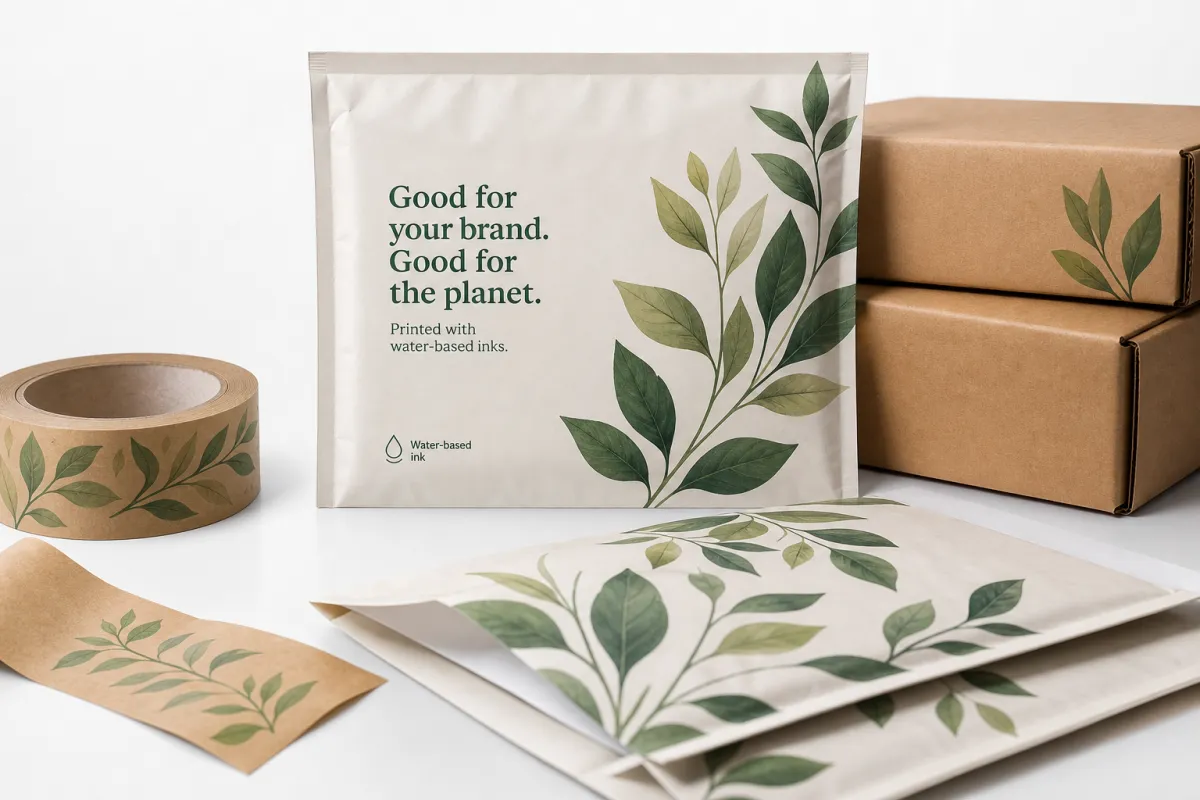
Printed mailers with water based inks are shipping mailers printed with inks that use water as the main carrier for pigments and binders rather than relying on heavier solvent-based formulas. In everyday terms, that often means less odor, easier cleanup, and a printing process that can be friendlier to operators and facilities that pay close attention to emissions. The details still matter, though. “Water based” is not a blanket guarantee of recyclability, compostability, or lower impact across the board.
Most brands choose printed mailers with water based inks for e-commerce shipments, Branded Poly Mailers, kraft mailers, recycled-content mailers, and promotional programs where the outer bag becomes part of the customer experience. A fashion label may want a clean logo on a poly mailer. A subscription brand may need repeatable graphics across recurring shipments. A direct-to-consumer company may want the shipping material to feel intentional rather than generic. In each of those cases, the mailer becomes a visible piece of the brand story the moment the customer sees it.
Substrate choice does most of the heavy lifting. A water-based system can look excellent on one material and underperform on another. Glossy poly, recycled-content film, and paper-based mailers each accept, hold, or resist ink in their own way. So when someone asks whether printed mailers with water based inks are sustainable, the honest answer depends on the full package structure, not just the ink category printed on the spec sheet.
The environmental profile comes from several choices working together: the mailer material, the drying method, the ink formulation, and the end-of-life path. A multi-layer structure that local recycling systems cannot process will not become recyclable because the ink changed. A paper-based mailer with responsible fiber sourcing can tell a stronger recovery story, but only if coatings, adhesives, and print coverage still fit the intended stream. Water based inks can help, but they are not magic.
For brands that want a cleaner-looking package without stepping into a more complicated print method, printed mailers with water based inks are often a sensible middle ground. They are not the lowest-cost option in every situation, and they are not the right fit for every substrate. They are, though, one of the more practical ways to align branding, production, and sustainability without overcomplicating the buying decision.
How Printed Mailers With Water Based Inks Are Made
The production path for printed mailers with water based inks usually begins before the press ever starts moving. Artwork comes first: file checks, logo cleanup, color separation, dieline confirmation, and a review of safe zones so nothing important lands too close to an edge, seal, or fold. After that comes press setup, which may involve plates for flexographic printing or digital setup for shorter runs and versioned artwork. Ink is then applied, dried or cured, inspected, and packed for shipment.
Water-based inks behave differently from older solvent-heavy systems. Water carries the pigment and binder, then evaporates or is removed during drying. That sounds tidy on paper, but the real work is in the balance. If drying is too light, the print can scuff. If the line speed is too fast, adhesion can suffer. If the substrate does not respond well to the ink chemistry, the surface can look uneven even when the color formula is correct. The ink matters, but the press setup matters just as much.
For higher volumes, flexographic printing is often the practical choice because it handles repeatable runs efficiently and keeps unit cost under control once setup is complete. Shorter runs, test launches, or mailers with several artwork versions may be better suited to digital methods. That is one reason printed mailers with water based inks are not a one-size-fits-all category. The best method depends on run length, artwork complexity, substrate type, and how much variation the brand needs.
Drying deserves more attention than it usually gets. It is not just the final step after printing. Drying affects rub resistance, stackability, carton packing, and how soon the mailers can move through the warehouse without transfer marks or blocking. A rushed dry-down can create a problem that only shows up after the mailers sit in a humid staging area for a day or two. If the drying curve is wrong, you are gonna see it later, not right away.
The ink chemistry also needs to match the substrate. A water-based system can perform beautifully on one recycled-content film and poorly on another. Two printed mailers with water based inks may look similar on the press floor and behave very differently after a week in transit. Sample testing matters more than many buyers expect.
“A mailer is not just an ink decision. It is a system decision: material, press, drying, handling, and end use all have to agree.”
If you want a broader packaging baseline, the technical guidance from industry groups such as ISTA transport testing standards is useful for thinking about distribution stress, while the EPA’s sustainable materials management guidance is helpful when you are evaluating disposal, waste reduction, and recovery logic. Those references do not choose the mailer for you, but they keep the conversation grounded in real performance and material recovery.
Key Factors That Affect Print Quality and Performance
If you are comparing printed mailers with water based inks, begin with the substrate. Virgin polyethylene, recycled-content films, kraft paper, and coated composites all respond differently to ink adhesion, color saturation, and rub resistance. A glossy film may preserve sharp graphics but show scuffing more easily. A kraft surface may support a more natural look, yet it can mute certain colors and soften fine detail. Recycled content brings a sustainability story, but it can also add visual variation that buyers should accept before production starts.
Design decisions matter more than many teams expect. Large solid areas can reveal streaking or banding if the press is not tuned well. Tiny reversed text can disappear if the contrast is too weak. Gradients may look smooth in a digital proof and less forgiving on the finished run. Metallic accents, heavy flood coverage, and dark backgrounds each bring a different set of risks. With printed mailers with water based inks, the strongest designs usually work with the material instead of fighting it.
Compliance belongs in the same conversation. Water-based ink does not remove the need to meet food-contact rules, retailer packaging requirements, or recycling claims that need evidence. If a brand wants to say the mailer is recyclable, the full structure should support that statement. If a paper mailer needs FSC sourcing to satisfy a sustainability policy, ask for it early. If the package will be tested for distribution durability, make sure the supplier understands the target standard and not only the artwork.
That is where printed mailers with water based inks become a systems topic rather than a decoration topic. A buyer who only asks for color can end up with a package that looks fine on a desk but struggles in a humid sorting center. A buyer who asks how the mailer will move through the supply chain usually gets a better answer because the supplier has to think beyond the press sheet.
Storage and shipping conditions can expose weak choices quickly. Humidity, compression in stacked cartons, repeated handling, and longer transit times all raise the chance that a marginal ink bond shows problems. If you know the mailers will sit in a warehouse for several weeks before use, or if they will be packed in hot conditions, say so. That information can change the recommended ink load, dry time, or substrate choice.
In practice, the best results come from matching four things at once: artwork, substrate, print method, and logistics. Chasing the lowest ink spec in isolation can be misleading. The real question is not whether printed mailers with water based inks are “good” in the abstract. The real question is whether the whole package system can maintain appearance and performance from press to doorstep.
Printed Mailers With Water Based Inks: Cost and Pricing Factors
Price is where the conversation gets real. The cost of printed mailers with water based inks depends on material choice, number of colors, print coverage, run length, setup charges, finishing, packaging format, and freight. A simple one-color logo on a standard poly mailer can sit in a very different range from a full-bleed branded mailer with custom sizing and recycled-content film. If a supplier gives you a number without explaining those variables, ask for the assumptions in writing.
For buyers trying to budget, a useful way to think about it is this: setup costs are spread across volume, so larger runs usually lower the unit price, while short runs carry more overhead per piece. In many programs, a repeat order with existing artwork can be materially cheaper than a first-time custom job because the proofing and press preparation are already done. That is one reason printed mailers with water based inks can look more expensive at the quote stage than they do after a brand settles into a stable reorder rhythm.
There is also the unit-cost trap. A lower per-piece quote can still cost more in the end if it creates higher waste, slower production, or a package that needs extra protection because the print is delicate. A mailer that scuffs easily may force reprints. A mailer that tears in transit can generate customer service costs that never appear in the original quote. Buying on price alone tends to hide the real risk.
Some buyers want a direct comparison, so it helps to lay the options side by side. The ranges below are planning numbers, not promises. Order volume, artwork complexity, and substrate availability can move them up or down.
| Mailer Option | Typical Use | Planning Range per Unit | Notes |
|---|---|---|---|
| Stock poly mailer with label | Low-cost shipping with minimal branding | $0.12-$0.22 at 5,000 units | Fast to deploy, but branding is limited and the visual impact is lower. |
| Printed mailers with water based inks | Branded e-commerce shipments | $0.18-$0.35 at 5,000 units | Stronger presentation and a cleaner press-room profile, with pricing influenced by coverage and colors. |
| Kraft mailer with water-based print | Natural look and paper-forward branding | $0.30-$0.60 at 5,000 units | Often stronger on brand story, but substrate and finish selection matter for durability. |
| Short-run custom mailer | Launches, seasonal drops, tests | $0.35-$0.80+ | Setup costs are spread across fewer pieces, so unit pricing rises quickly. |
That table leaves out an important truth: total landed cost is more useful than unit price. If the supplier is shipping from farther away, freight may erase the savings of a cheaper press run. If samples are needed, proofing and test shipping may add weeks and dollars. If the mailer needs a higher grade of film because the artwork is dense, the print cost may rise while the damage rate falls. The cheapest quote for printed mailers with water based inks is not always the smartest purchase.
There is also brand value to account for, even if it is harder to model. A well-printed mailer can reduce the need for extra inserts, improve first-touch perception, and make a small DTC brand look more established. For some programs, that is worth more than a few cents per piece. For others, the money is better spent on stronger inserts or better corrugate. The point is to compare options through both operational and customer-facing outcomes, not just print cost.
When you talk to suppliers, ask for a quote that separates material, print setup, ink coverage, packing format, and freight. That makes it much easier to compare printed mailers with water based inks against Custom Poly Mailers or other packaging formats without guessing where the money is going.
Step-by-Step Process and Timeline
A smooth order for printed mailers with water based inks usually follows a predictable path. First, define the mailer size and closure style. Then confirm the substrate, upload artwork, check color targets, and review the proof. If the project is new or the color needs close control, a sample run can be worth the extra time. After approval, production begins, the finished mailers are inspected, packed, and shipped. Straightforward on paper. In real operations, delays usually show up between those steps, not inside them.
Turnaround time depends on order complexity. A repeat order with no artwork changes can move relatively quickly, while a first-time custom program may require multiple proof rounds and sample checks. For many projects, a realistic planning window is often 12-15 business days from proof approval, though that can stretch if the substrate is special, the artwork uses several colors, or a compliance statement needs review. With printed mailers with water based inks, timeline planning is less about optimism and more about removing avoidable back-and-forth.
The most common delays are not mysterious. Artwork corrections take time. Color matching takes time. Supplier queue time takes time. Ink or film sourcing can also create a bottleneck if the requested material is not already in stock. If your brand wants a specific Pantone target, note it early. If a barcode must scan in a fulfillment center, say so before the proof is signed. If a sustainability claim needs exact wording, get that text approved internally first so it does not stop production later.
One of the easiest ways to keep momentum is to reduce the number of decision-makers late in the process. One person should approve the proof. One person should own the deadline. One person should verify that the pack spec still matches the order quantity. That may sound basic, but scattered sign-off often stretches printed mailers with water based inks from a two-week job into a month-long one simply because each correction restarts the clock.
From a planning perspective, the cleanest workflow looks like this:
- Define the order volume and mailing use case.
- Choose the substrate and print method.
- Send print-ready artwork and brand color references.
- Review digital or physical proofs.
- Approve samples if the design is new.
- Release production and confirm ship timing.
- Inspect the first cartons against the approved reference.
That process is not glamorous, but it is reliable. Buyers who treat printed mailers with water based inks like a controlled production project tend to see fewer surprises than buyers who treat them like a standard stock purchase with a logo on top.
Common Mistakes When Ordering Sustainable Mailers
The biggest mistake is assuming ink choice equals sustainability. It does not. You can specify printed mailers with water based inks and still end up with a structure that is difficult to recycle, hard to sort, or too resource-heavy for your brand goals. The ink system is only one piece. Substrate selection, adhesives, coatings, print coverage, and disposal guidance all shape the outcome.
The second mistake is under-specifying the artwork. Too much solid coverage can make the print look heavy or uneven. Tiny type can break up, especially on textured or recycled surfaces. Poor contrast can turn a sharp logo into a blurry block after production. Buyers sometimes approve a beautiful screen mockup and then act surprised when the finished printed mailers with water based inks look more muted. That is usually a proofing issue, not a printer failure.
The third mistake is approving color on screen only. A monitor is not a substrate. A physical proof is the better reference because it shows real ink behavior, not RGB optimism. If the mailer is going to travel through a rough distribution network, ask for rub-resistance or transit-style testing. Standards-based thinking helps here, whether you are using internal methods or relying on guidance such as ISTA transport testing standards for distribution simulation and handling.
The fourth mistake is ignoring freight, damage, and reprint risk. A cheap quote can become an expensive program if the mailers arrive late, fail in transit, or need to be reworked because the ink did not anchor properly. That is where many buyers miss the real cost of printed mailers with water based inks: the package is not just a line item, it is part of the customer journey and the fulfillment system.
The fifth mistake is rushing the order and expecting perfect results. If you compress the timeline, the supplier may have less room to fine-tune drying, evaluate samples, or source a better substrate. That can force trade-offs in color, appearance, or durability. A rushed order may still be usable, but it is less likely to be the version your brand actually wanted.
Another issue is failing to align sustainability claims with documentation. If the mailer is paper-based, ask about FSC-certified stock when that matters to your organization. If the mailer is intended to be recyclable, confirm the actual recovery pathway. If the brand wants to mention lower odor or less solvent exposure from printed mailers with water based inks, make sure the claim is supported by the process and not only by the headline.
And one more practical point: do not forget warehouse conditions. A mailer that looks great in a climate-controlled sample room can behave differently after two weeks of stacking in a humid facility. The strongest programs test for real handling, not ideal handling.
Expert Tips and Next Steps for Better Results
If you are evaluating printed mailers with water based inks, ask suppliers for three things before you compare quotes: substrate specs, print method details, and sample images or physical samples from comparable jobs. Those three items reveal more than a polished sales sheet ever will. They show whether the supplier understands the material, whether the print system fits the job, and whether the finished mailer is likely to match the promise.
It also helps to compare packaging options side by side instead of in isolation. A standard poly mailer may win on cost. A kraft mailer may win on feel. Printed mailers with water based inks may win on the balance of branding, production cleanliness, and supply-chain fit. If you already offer multiple formats, compare them through the lens of cost, durability, and brand impact. For some products, a custom outer mailer will outperform a label on a plain bag. For others, plain stock plus a better insert is the smarter spend. That tradeoff should be made deliberately, not by habit.
A proofing checklist is another smart move. Ask for color targets, barcode readability, bleed requirements, safe zones, and shipping durability expectations. If the mailer will carry compliance text, include that text in the checklist. If the design uses fine reversed type, ask the supplier how they plan to handle it on the chosen substrate. A checklist makes printed mailers with water based inks less dependent on memory and more dependent on process.
For new designs or large-volume launches, a pilot order is often worth the effort. A smaller test run can reveal adhesion issues, scuffing, blocking, or timing problems before you commit to a larger buy. It can also tell you whether the finished package feels right in hand. That matters more than many teams expect. The customer does not experience a spec sheet. The customer experiences a bag, a seal, a tear strip, and the first glance at the outer package.
Here are a few practical next steps that usually move the project forward:
- Gather vector artwork, logo files, and brand color references.
- Decide whether your sustainability goal is lower odor, better recoverability, FSC sourcing, or a stronger recycled-content story.
- Request a quote that spells out setup, material, print coverage, and freight separately.
- Ask for a sample or proof before final approval.
- Set a realistic approval deadline so production does not stall.
If you are still deciding between formats, it can help to review broader options in Custom Packaging Products before locking in the mailer spec. That broader view often clarifies whether printed mailers with water based inks are the right fit for the shipment, or whether another format will do the job with fewer trade-offs.
Used well, printed mailers with water based inks are not just a sustainability talking point. They are a practical packaging decision that can improve the customer’s first impression, reduce some of the messier parts of production, and support a more disciplined materials strategy. The clearest takeaway is simple: lock the substrate, approve a real proof under warehouse lighting, and test the mailer against the handling conditions it will actually face before you place the full order.
FAQs
Are printed mailers with water based inks recyclable?
Sometimes, but recyclability depends on the full mailer structure, not the ink alone. Check the substrate, coatings, adhesives, and local recycling rules before making a claim. If the mailer is multi-layered or heavily coated, it may need a different disposal path even if the print system is water based.
Do printed mailers with water based inks hold up in shipping?
They can, if the ink is matched to the substrate and properly dried. Ask for rub-resistance and transit-style sample testing, especially for glossy or recycled films. Long warehouse storage, humidity, and rough handling are the usual stress points, so it helps to test against real conditions rather than ideal ones.
How much do printed mailers with water based inks cost?
Cost depends on order volume, number of colors, material type, and print setup method. Short runs usually cost more per unit; larger runs spread setup costs more efficiently. Freight, sampling, and waste from proofing should be included in the total quote so the budget reflects the real program cost.
What artwork works best for printed mailers with water based inks?
Simple, high-contrast artwork usually prints more cleanly than intricate gradients or tiny reversed text. Large flat color areas may need careful approval because they can show banding or scuffing more easily. Vector logos and print-ready files reduce setup issues and help color matching.
How long does production usually take?
Turnaround depends on proof approval speed, substrate availability, and the print method. Existing repeat jobs are faster than first-time custom orders with new artwork or new colors. Build in time for samples if brand color, scuff resistance, or sustainability claims need validation, because that step often protects the schedule later.
What should I do before placing the order?
Ask for a sample on the exact substrate you plan to use, then check it under the same lighting and handling conditions your warehouse will create. If the print still looks good after a quick rub test and a day of rest, you have a much clearer answer than a spec sheet alone can give you.


