Buyer Fit Snapshot
| Best fit | Custom Printed Tissue Paper for Boutiques projects where brand print, material claims, artwork control, MOQ, and repeat-order consistency need to be specified before quoting. |
|---|---|
| Quote inputs | Share finished size, material target, print colors, finish, packing count, annual reorder estimate, ship-to region, and any compliance wording. |
| Proofing check | Approve dieline scale, logo placement, barcode or warning zones, color tolerance, closure strength, and carton packing before bulk production. |
| Main risk | Vague material claims, crowded artwork, missing packing details, or unclear freight terms can make a low unit price expensive after revisions. |
Fast answer: Custom Printed Tissue Paper for Boutiques: What Works should be specified like a repeatable production item. The safest quote records material, print method, finish, artwork proof, packing count, and reorder notes in one written spec.
Production checks before approval
Compare the actual filled-product size with the drawing, then confirm tolerance on folds, seals, hang holes, label areas, and retail display edges. Reserve space for logos, QR codes, warning copy, and material claims before decorative graphics fill the panel.
Quote comparison points
Review material grade, print process, finish, sampling route, tooling charges, carton quantity, and freight assumptions side by side. A quote is only useful when the supplier can repeat the same color, closure quality, and packing count on the next order.
Custom Printed Tissue Paper for Boutiques: What Works
When a customer buys a $28 candle, the candle is not always the first thing they notice. The tissue wrap is. That is the quiet power of custom Printed Tissue Paper for boutiques: it gives a small purchase a clear sense of care, and it does it before the product is even handled. A plain box can feel intentional once the inside is lined with branded paper. A modest order can feel more expensive. A hurried packing job can suddenly look considered. The paper does a kind of visual whispering that a logo sticker alone usually cannot manage.
I have seen this play out on a packing table more times than I can count. A boutique owner will test two versions of the same order, one wrapped in plain white tissue and one wrapped in branded sheets, and the second one always gets the nod from customers standing at the counter. Not because the product changed. Because the package told a better story. That story matters, even if the brand is only shipping a few hundred orders a month.
The move only works if the paper earns its place. A logo printed on tissue is not enough. Boutique owners usually need three things at once: a cleaner unboxing, a little product protection, and a finish that matches the rest of the retail packaging. When those pieces line up, custom printed tissue paper for boutiques becomes part of the selling environment. When they do not, the result is just decorative paper that wrinkles, prints poorly, or disappears into the box like an afterthought.
Custom Printed Tissue Paper for Boutiques: Why It Sells the Package Before the Product
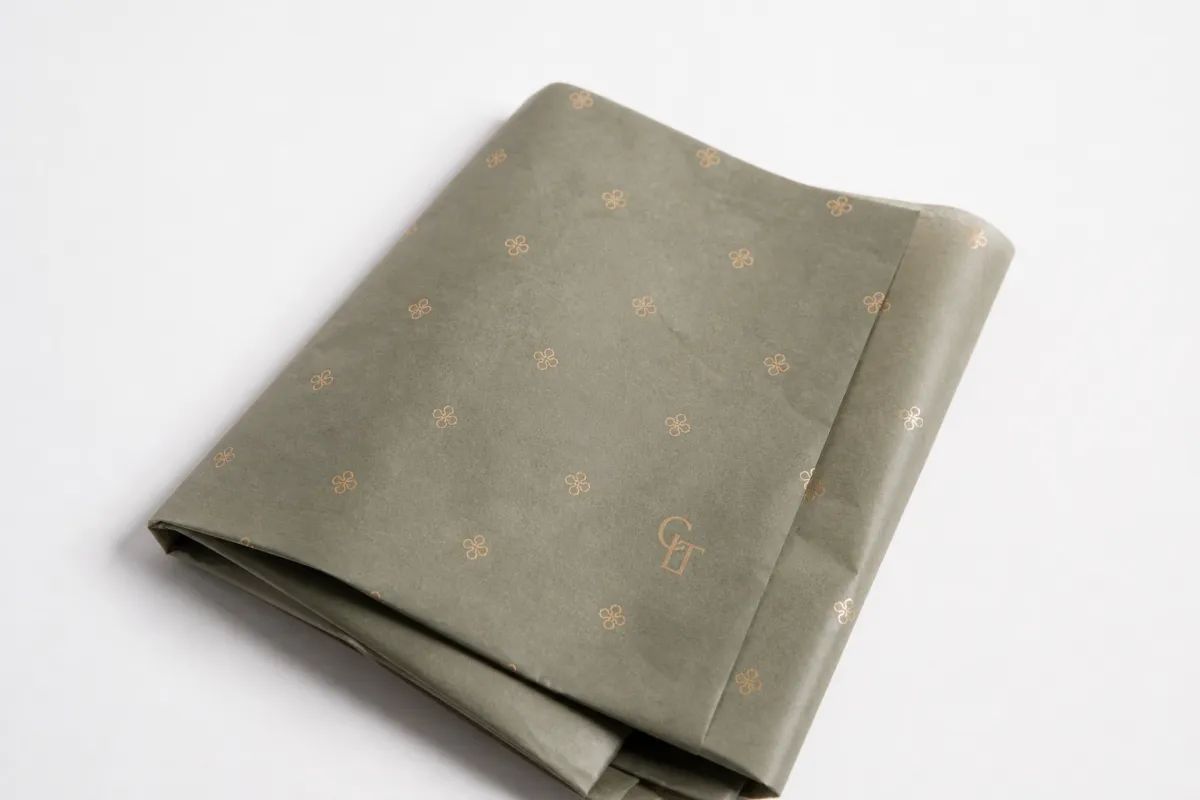
custom printed tissue paper for boutiques matters because it enters the customer experience early. Before a lid lifts or a ribbon is untied, the tissue already signals whether the brand feels polished. The first five seconds of touch and sight are doing more work than most owners realize. A crisp repeat, a clean monogram, or a restrained border can make even a simple mailer feel curated.
For buyers who watch margin closely, tissue is one of the least expensive ways to add branded packaging without moving to rigid boxes or elaborate inserts. A boutique can keep a basic folding carton, a mailer, or a gift bag and still make the presentation feel designed. That is useful for apparel, jewelry, beauty products, candles, and gift sets, especially when the outer shipping box is plain and the inside has to carry the brand story.
The overlooked benefit is visual order. Tissue is not only decoration. It organizes the package. A repeat print makes a stack of folded shirts look planned. A subtle logo pattern makes a jewelry order feel finished. A soft branded wrap inside a candle shipment can make the whole purchase feel less like inventory and more like a gift. That kind of order matters because customers often read quality through presentation before they read it through the product itself.
"A boutique buyer does not need tissue paper to shout. It needs to fold cleanly, print cleanly, and make the order feel cared for."
That is why custom printed tissue paper for boutiques tends to outperform packaging that tries too hard. The paper adds style without forcing the brand into a rigid, costly structure. It also plays well with stickers, ribbon, inserts, and Custom Packaging Products that create a more complete package branding system.
In a sample room, the nicest packaging usually is not the flashiest one. It is the one that still looks good after it has been handled three times, folded, refolded, and pressed into a bag by someone in a hurry. Tissue that holds up to that kind of real use is doing its job. Pretty is nice. Practical is what keeps the brand from looking fussy.
In practice, the strongest uses are straightforward:
- Apparel tissue that keeps folded items crisp and makes the stack look orderly.
- Jewelry tissue that adds a soft branded layer before the box opens.
- Beauty and candle tissue that helps gift orders feel more finished.
- Seasonal gift set tissue that changes the mood without replacing the full package.
If the boutique sells gifts, the tissue is part of the gift. If the boutique sells essentials, the tissue helps raise perceived value. Either way, custom printed tissue paper for boutiques lets a small brand look more organized than its budget might suggest.
There is another reason owners keep coming back to it: the cost usually sits far below the cost of Custom Printed Boxes. Rigid setups climb quickly. Even mailers become expensive once print, structure, and finishes stack up. Tissue gives you a branded layer That Feels Premium while staying flexible enough for several product lines. That flexibility is one reason it stays popular in retail packaging, and honestly, it is one of the few packaging upgrades that can make sense before the business is fully scaled.
How Custom Printed Tissue Paper for Boutiques Works
custom printed tissue paper for boutiques starts with a file, not a press run. The supplier usually asks for logo artwork, color targets, sheet size, and the repeat style. Once those are set, the job moves into proofing and print setup. A single monogram repeat is usually simple. A pattern with gradients, tiny type, or a more detailed illustration demands more prepress attention. That is not a flaw in the process. It is the nature of printing on a thin, absorbent substrate.
The most common print method is flexographic printing. The short version: the artwork is transferred through plates in a repeat pattern across the sheet. Flexo is efficient for spot colors and repeated branding, which is exactly why it fits custom printed tissue paper for boutiques so well. Digital printing can work for smaller runs or more complex art, but it often changes the cost structure and may not deliver the same economy at scale.
Pattern mechanics matter more than most first-time buyers expect. Tissue is large, light, and soft. The design has to repeat cleanly so the logo does not look clipped or awkward when the sheet is folded. Border spacing, repeat distance, and sheet dimensions affect how the tissue reads once it is in the box, not just how it looks flat on a screen. A design that looks tidy in a mockup can fall apart once the paper bends around the product.
That is also why tiny text usually disappoints. Tissue paper is not a poster board or a coated label stock. The sheet is soft, translucent, and often uncoated. Fine details can fill in or vanish. Dark inks sometimes read heavier than expected. Pale inks can disappear after folding and handling. Bold shapes, clear marks, and high-contrast elements usually survive better. custom printed tissue paper for boutiques rewards clarity more than delicacy.
A normal approval flow looks like this:
- Send logo files, brand colors, and sheet size.
- Review a digital layout or strike-off for repeat placement.
- Check color expectations against a physical sample if available.
- Approve the final proof before the full run starts.
- Confirm packing, carton counts, and shipping details before dispatch.
If the supplier offers a sample or proof sheet, use it. A screen mockup cannot show how the paper folds around a candle box or how the repeat reads after the tissue is crumpled into a gift bag. A good approval process saves money and time, especially for custom printed tissue paper for boutiques that has to match other branded packaging already in circulation. A five-minute review on a monitor is just not enough.
For sourcing and performance references, the FSC is useful for paper responsibility questions, and the ISTA guidance helps when packaging has to survive real shipping abuse instead of a neat spreadsheet. Those are better anchors than vague supplier promises.
Design Choices That Affect the Look and Performance
The design choices behind custom printed tissue paper for boutiques are not cosmetic details. They decide whether the paper feels soft, whether it wraps cleanly, and whether the print reads clearly once it has been folded into a parcel. Paper weight, finish, color count, and artwork complexity all matter. Ignore one of them and the whole sheet can feel off.
Paper weight is the first tradeoff. Lightweight tissue usually folds better and feels more elegant in the hand. Heavier tissue resists tearing and can tolerate rougher packing, but it often costs more and takes up more storage space. A common range is around 17gsm to 30gsm, depending on the use. Delicate apparel and jewelry often work well with lighter tissue. Gift sets or products that get packed and repacked more aggressively may benefit from a slightly heavier sheet. custom printed tissue paper for boutiques should support the product, not fight it.
Finish matters too. Uncoated tissue keeps the surface soft and pliable, which is one reason many boutiques prefer it. A coated or slick surface can look less natural and may not wrap as nicely. Most boutique teams are not chasing lab-grade precision. They want a paper that feels like it belongs in a real retail packaging system, not one that looks borrowed from a completely different category.
Color strategy is where budgets become very visible. One-color or two-color printing usually keeps setup simpler and produces a clean branded look. Multi-color art can look richer, but the added setup can increase cost and complicate proofing. If the brand already uses strong colors on labels, boxes, or bags, the tissue does not need to do every job. Trying to make custom printed tissue paper for boutiques carry too many colors often creates a louder, messier package instead of a better one.
What Usually Prints Best
- Bold logos with clear spacing.
- Simple repeat monograms.
- Thin borders with enough contrast to survive folding.
- Seasonal motifs that stay recognizable in one or two colors.
What usually prints poorly? Tiny taglines, hairline artwork, and low-contrast details that look lovely on a monitor and vanish on tissue. A boutique owner may love a detailed logo, but the paper does not care about sentiment. It prints what the press can hold, not what the brand deck imagines. That is why strong logo repeat work remains the safest path for custom printed tissue paper for boutiques.
Color matching deserves a sober note. Tissue often reads differently from a coated box or a laminated label because the substrate is thinner and more absorbent. A warm black can tilt brown. A pale pink can arrive weaker than expected. If the boutique is matching tissue to boxes, bags, stickers, or ribbon, compare the pieces together instead of judging each sample in isolation. The strongest packaging design is usually the one that looks coherent across all touchpoints, not the one item with the loudest render.
That is also why many brands use tissue to reinforce an existing package branding system rather than invent a second identity. If the boutique already has strong custom printed boxes, the tissue can echo the logo, mirror a border, or repeat a pattern without competing for attention. The result feels cleaner and more expensive than a stack of unrelated pieces.
One more practical point: keep enough margin in the design for folds and wrap edges. A pattern that runs too close to the edge can look chopped once the sheet is tucked around the product. On tissue, white space is not wasted space. It gives the brand room to breathe, and it stops the print from feeling crowded once the paper is handled in a real store.
Cost, Pricing, and MOQ: What Boutiques Actually Pay
custom printed tissue paper for boutiques is attractive because it gives a branded look without the price of more structural product packaging. Still, the bill is not random. Pricing usually depends on sheet size, paper weight, color count, quantity, and how the paper is packed for shipping. Two quotes can look similar and still land far apart once freight and setup enter the picture.
The biggest driver is quantity. Lower minimums usually raise the per-sheet cost because the setup work gets spread across fewer pieces. Larger runs lower the unit price, but they also tie up more cash and storage. That is the real tradeoff. A small boutique can absolutely order a modest run, but custom printed tissue paper for boutiques at low quantities is never as cheap per sheet as a deeper run. That is just arithmetic, not a supplier trick.
Typical pricing for boutique tissue can land around $0.07 to $0.25 per sheet, depending on spec and volume. A small branded run with simple one-color art may sit closer to the upper end. A deeper order with fewer setup complications can fall lower. Freight, proofs, and setup charges can swing the final total more than owners expect, especially when the order crosses a warehouse or customs boundary.
| Order Type | Typical MOQ | Typical Price Per Sheet | Best For | Main Tradeoff |
|---|---|---|---|---|
| Light branding run | 1,000-3,000 sheets | $0.14-$0.25 | New boutiques, seasonal tests, limited drops | Higher unit cost |
| Standard boutique run | 3,000-5,000 sheets | $0.09-$0.18 | Core branded packaging programs | Moderate storage need |
| Deeper production run | 5,000-10,000 sheets | $0.07-$0.14 | Stable designs, larger order volume | More inventory risk |
The hidden costs are where people get surprised. Artwork cleanup can add time. Proof shipping can add money. Rush fees can erase the savings from a larger run. Split shipments may look convenient and then become expensive. If you are comparing quotes for custom printed tissue paper for boutiques, make sure every quote includes the same sheet size, same print count, same paper weight, and same delivery location. Otherwise you are comparing apples to packaging noise.
Here is a practical buying rule: spend on what the customer actually sees. If the tissue will be used inside gift orders, every sheet matters. If it is mostly a back-of-house wrap layer, go lighter on print complexity and put the saved money into something more visible, like a better box, ribbon, or insert card. That is how smart retail packaging budgets usually work.
Another honest point: do not overbuy a seasonal design unless the artwork can survive a later season. A winter motif can look excellent for six weeks and then become dead inventory. custom printed tissue paper for boutiques should fit real sales volume, not hopeful sales volume. That kind of overordering is where a lot of small brands quietly burn cash.
If you are building a broader packaging line, compare tissue quotes against other Custom Packaging Products so the paper fits the rest of the program instead of eating budget that should have gone to boxes or bags.
Process and Timeline: From Artwork to Delivery
custom printed tissue paper for boutiques usually follows a simple sequence, but the timeline is only simple if the artwork and approvals are clean. A typical workflow starts with the brief, then moves to file prep, proofing, approval, print production, finishing, packing, and shipment. Miss one approval step and the whole schedule starts to wobble.
For a plain repeat logo design, production can move fairly quickly once the proof is approved. A more detailed design, special color requirement, or complicated freight route adds time. A normal custom run often lands in the 12 to 15 business day range after proof approval, but that is not a promise. Complex jobs, rush periods, and shipping distance can stretch it longer. custom printed tissue paper for boutiques rewards planners and punishes last-minute buyers.
The biggest delay is usually not the press. It is the human side. Slow logo approvals, unclear artwork, late color changes, and holiday backlogs all add friction. If the boutique is launching a new product line or opening a store, tissue should not be the emergency item that ruins the schedule. Order it early enough that freight has room to breathe.
Here is a sensible planning window:
- 2-3 weeks before launch: approve artwork and samples.
- 3-5 weeks before launch: place the production order for a standard run.
- 5-7 weeks before launch: order if freight, customs, or multiple locations are involved.
If the tissue is part of a seasonal packaging set, allow more buffer. Stores get busy, carriers get messy, and everyone suddenly discovers that a small tissue order can hold up a larger product launch. That sounds absurd until it happens to the same team twice.
Sample approval matters because tissue behaves differently in real use than it does in a file preview. Check the repeat, the fold, the ink weight, and the overall feel. A design can look polished flat and then fall apart visually once it is crumpled around a product. Testing one sheet in a real package is a cheap way to catch problems before a full run. For custom printed tissue paper for boutiques, that step is usually worth it.
If a supplier offers split packing or multiple shipping destinations, confirm carton counts and address details early. Boutiques with several stores often discover that logistics matter as much as print quality. A good product arriving late is still late. That part never feels fair, but it is true.
One more practical tip: avoid changing the artwork after proof approval unless the change is truly necessary. Every revision can reopen production and shipping timing. On a tight launch schedule, that drift is painful. The cleaner the file process, the smoother the order.
Common Mistakes Boutiques Make With Custom Printed Tissue Paper
The most common mistake with custom printed tissue paper for boutiques is choosing artwork that looks good on a screen and prints badly on paper. Tissue is thin, slightly translucent, and less forgiving than people expect. If the art relies on tiny lines, soft gradients, or low contrast, it can turn muddy fast. Designers love detail. Tissue likes clarity.
Another mistake is underordering. A shop may plan a launch, sell faster than expected, and then discover that the last 200 sheets are sitting in the back while the best-selling product is gone. That is backward. If the tissue is tied to a successful product line, order enough to cover the actual demand window. Running out of packaging while the product is still selling is exactly the sort of avoidable headache boutiques swear they will not have, right until they do.
Oversized logos create their own problems. A huge mark can dominate the wrap and make folding awkward. Thin lines can disappear. Light gray on white can vanish. Very dark colors may look heavy or bleed visually on the sheet. custom printed tissue paper for boutiques usually performs better with a strong repeat than with one giant hero graphic.
Storage gets overlooked too. Tissue wrinkles, absorbs moisture, and gets damaged if a boutique handles it like cardboard. It should be stored dry, flat, and away from the kind of backroom chaos that ruins good print. If the paper is stored badly, the first sheets out of the carton will tell on you.
There is also a branding mistake that shows up a lot: trying to make the tissue do every branding job at once. It does not need to carry the logo, the tagline, the seasonal message, the social handle, and the pattern of the month. That turns the package into visual noise. Better packaging design usually means giving each item one job. Tissue wraps. Stickers seal. Boxes protect. Inserts explain. That split is cleaner and looks more expensive.
For boutiques that use a broader branded packaging system, tissue should support the rest of the story, not compete with it. If the store already has strong bags, labels, or Custom Packaging Products, the tissue can be quieter and still do its job. Quiet is not boring. Quiet is often what makes the whole package feel intentional.
A few simple mistakes to avoid:
- Using a design file that is not vector-based.
- Choosing colors without checking how they read on translucent paper.
- Ordering a quantity that only covers one short sale window.
- Ignoring how the tissue folds inside the actual product box.
- Making the print so busy that the brand message gets lost.
Good custom printed tissue paper for boutiques should make the package cleaner, not louder. If the paper becomes the star and the product gets lost, the design missed the point.
Expert Tips and Next Steps for Better Ordering Decisions
If you want custom printed tissue paper for boutiques to work well, start with a sample-first mindset. Approve one proof sheet, then fold it around a real product or box. That single test usually tells you more than ten render files. It shows how the logo repeats, whether the sheet tears too easily, and how the design reads once the paper is bent and layered.
Keep the message simple. One clear mark is usually enough: a logo repeat, a monogram, or a seasonal pattern that fits the brand voice. The more focused the artwork, the more likely the print will look sharp in production. If the boutique wants to refresh the look later, tissue is easier to update than full custom printed boxes, which is another reason it is such a useful part of retail packaging.
Compare quotes on identical specs. Same sheet size. Same gsm. Same number of print colors. Same packing format. Otherwise the lowest quote may simply be the quote with less paper, less ink, or less service. That is not a better deal. That is smaller print disguised as savings.
Before the next order, use this checklist:
- Artwork is in vector format.
- Pantone or color targets are confirmed.
- Sheet size matches the product or gift bag.
- Quantity fits the actual sales forecast.
- Deadline includes proof time and freight time.
- Shipping address and receiving hours are correct.
There is no magic number that works for every boutique. A small jewelry label and a larger apparel shop will not use custom printed tissue paper for boutiques the same way. The right order size depends on product volume, seasonal swings, storage space, and how often the brand changes its look. That is why careful buyers start with a controlled run instead of guessing big.
For sourcing discipline, the better references are concrete ones: FSC for responsible paper sourcing and ISTA for shipping performance thinking. Those are much more useful than a glossy sales sheet with no actual numbers behind it.
If you are lining up tissue with the rest of the packaging system, compare it alongside Custom Packaging Products so the whole set works together instead of feeling pieced together from three different eras of branding.
Custom Printed Tissue Paper for Boutiques: The Practical Bottom Line
custom printed tissue paper for boutiques is worth it when the paper supports the brand, fits the product, and lands inside a realistic budget. It is not a cure-all. It will not save a weak product, and it will not rescue a messy brand system. Still, it can make a small boutique look sharper, more organized, and more premium without forcing a huge packaging overhaul.
The best orders are usually the simple ones: clear repeat artwork, sensible sheet size, enough quantity to cover the selling season, and a color choice that matches the rest of the package. If you treat custom printed tissue paper for boutiques like a strategic part of the packaging stack rather than a decorative afterthought, the return is usually solid. Not flashy. Solid. That is what good packaging does most of the time.
So the practical move is straightforward: request samples, compare quotes on the same spec, confirm the timeline, and place a run that fits real sales volume. Pick a design that folds well, not just one that looks pretty on a screen. Then test it in the actual box or bag, because that is where it lives. That is the cleanest path for custom printed tissue paper for boutiques, and it is usually the difference between Packaging That Sells the package before the product and packaging that just adds another box in the storeroom.
How much does custom printed tissue paper for boutiques usually cost?
Price depends on sheet size, paper weight, number of colors, and quantity. Lower MOQs usually cost more per sheet, while larger runs drop the unit cost faster. Add freight, proofing, and setup fees when comparing quotes so custom printed tissue paper for boutiques does not look cheaper than it really is.
What is the usual MOQ for custom printed tissue paper for boutiques?
MOQs vary by supplier and print method, but small runs are usually possible at a higher per-sheet cost. If you need seasonal designs or limited drops, ask for a lower MOQ option before committing to a large inventory. For stable evergreen branding, a larger MOQ often makes more sense financially for custom printed tissue paper for boutiques.
How long does the turnaround usually take for custom printed tissue paper?
Simple repeat designs can move faster than multi-color or highly customized jobs. Proof approval, artwork fixes, and freight distance can add days or weeks. Build buffer time before launches, holidays, or store openings so custom printed tissue paper for boutiques does not become the bottleneck.
What artwork works best for boutique tissue paper printing?
Bold logos, clean monograms, and simple repeat patterns usually print most clearly. Tiny text and hairline details can disappear on thin tissue, especially with light inks. Vector files are usually the safest starting point for crisp production work on custom printed tissue paper for boutiques.
Is custom printed tissue paper worth it for small boutiques?
Yes, if your packaging is part of the brand experience and you want a more polished first impression. It is one of the lower-cost ways to make an order feel premium without changing the product itself. The key is choosing a design, quantity, and timeline that match real sales volume for custom printed tissue paper for boutiques.

