Buyer Fit Snapshot
| Best fit | Printed Void Fill for Brand Packaging projects where brand print, material claims, artwork control, MOQ, and repeat-order consistency need to be specified before quoting. |
|---|---|
| Quote inputs | Share finished size, material target, print colors, finish, packing count, annual reorder estimate, ship-to region, and any compliance wording. |
| Proofing check | Approve dieline scale, logo placement, barcode or warning zones, color tolerance, closure strength, and carton packing before bulk production. |
| Main risk | Vague material claims, crowded artwork, missing packing details, or unclear freight terms can make a low unit price expensive after revisions. |
Fast answer: Printed Void Fill for Brand Packaging: Design, Cost, Fit should be specified like a repeatable production item. The safest quote records material, print method, finish, artwork proof, packing count, and reorder notes in one written spec.
Production checks before approval
Compare the actual filled-product size with the drawing, then confirm tolerance on folds, seals, hang holes, label areas, and retail display edges. Reserve space for logos, QR codes, warning copy, and material claims before decorative graphics fill the panel.
Quote comparison points
Review material grade, print process, finish, sampling route, tooling charges, carton quantity, and freight assumptions side by side. A quote is only useful when the supplier can repeat the same color, closure quality, and packing count on the next order.
Printed Void Fill for Brand Packaging: Design, Cost, Fit
Printed Void Fill for brand packaging is one of those quiet details that can reshape a shipment the moment the lid comes off. The empty space inside a carton is never really empty. It affects how the product sits, how the box opens, and how finished the whole presentation feels before the customer has even touched the item. In packaging work, printed void fill for brand packaging sits right at the point where protection and presentation overlap, and that makes it worth a careful look rather than a passing glance.
For brands selling through e-commerce, gift sets, or premium retail channels, the material inside the box often acts like a second voice for the brand. It keeps the item from sliding around, cushions vulnerable edges, and carries color, pattern, or texture that supports the overall story. Printed Void Fill for brand packaging is not there to hide air just for the sake of it. It makes that air useful, and it does so in a way customers notice almost immediately.
The best packaging teams treat it as both a design decision and a production decision. They look at carton size, product fragility, print method, sustainability claims, folding behavior, and packing speed in the same conversation. Printed Void Fill for brand packaging can protect a shipment and reinforce the brand at the same time, but only when the spec matches the product and the line that has to run it. If the fit is off, the filler becomes another source of friction instead of a support system.
What printed void fill for brand packaging really is
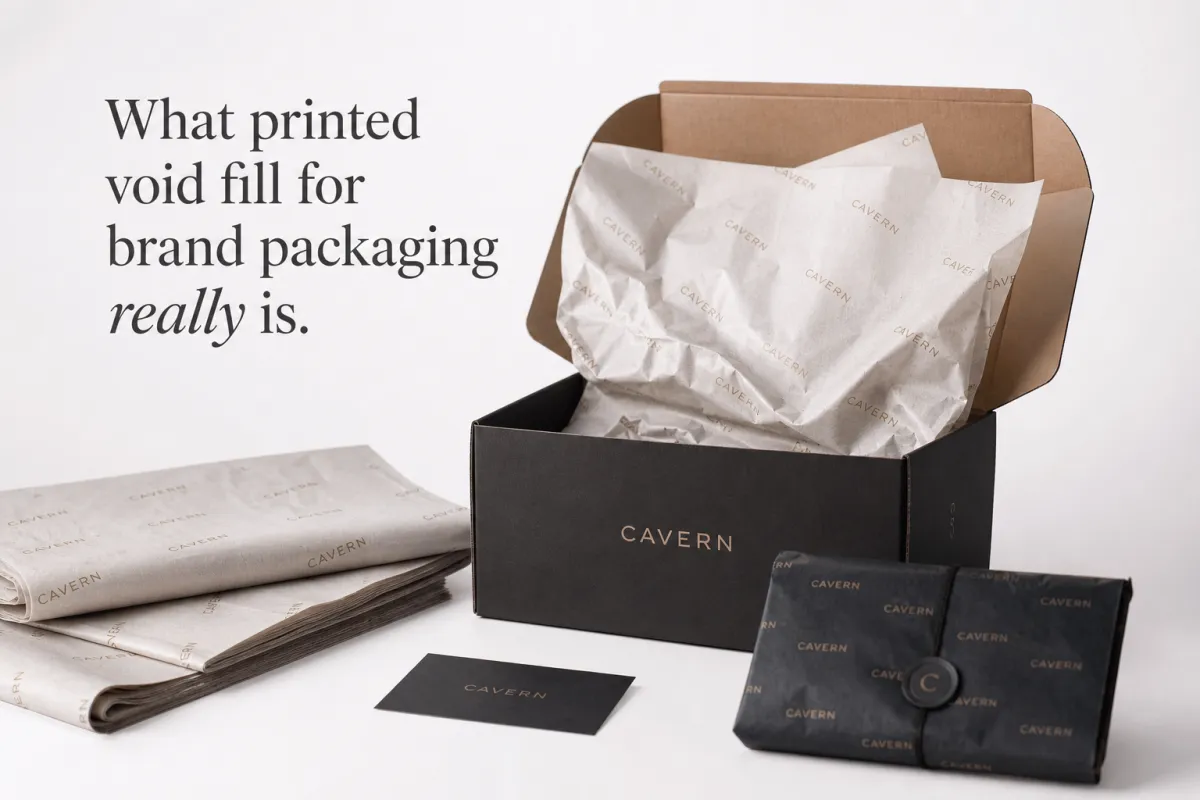
Printed void fill for brand packaging is protective material designed to occupy unused volume inside a shipping carton or gift box. That unused volume matters more than it looks. If a product can tilt, rattle, or settle during transit, the odds of scuffing, corner damage, or breakage climb fast. A filler that performs well cuts down that movement. A branded filler does the same thing while also carrying graphics, color, messaging, or pattern that supports the identity of the package.
The difference between ordinary filler and branded filler is bigger than a cosmetic upgrade. Ordinary filler answers one question: does the product stay in place? Branded filler answers that question and adds another: does the opening experience feel intentional? Printed void fill for brand packaging belongs in that second category. It shapes the first few seconds after the carton opens, and those seconds often carry more weight than the rest of the unboxing.
That matters most for products judged visually before they are used. Cosmetics, candles, apparel accessories, premium food gifts, electronics, and subscription kits all benefit from printed void fill for brand packaging because the inside of the box is part of the product story. If the carton looks unfinished or improvised, the item can feel less considered. If the void fill is printed, sized correctly, and aligned with the outer packaging, the entire presentation feels more deliberate and more premium.
There is a practical side too. E-commerce shipments rarely get a second chance. The customer does not compare the inside of your box against a shelf display or a sales counter. The unboxing moment is the storefront. Printed void fill for brand packaging helps turn shipping volume into a branded experience without asking the product to carry every visual cue on its own.
"A box that opens into empty, unplanned space sends a message faster than any marketing copy. Customers read carelessness at a glance."
That is why printed void fill for brand packaging belongs in the wider packaging system. It is not separate from custom printed boxes, tissue, inserts, or labels. Each piece has a role, and the effect gets stronger when those roles are coordinated. The best pack-outs feel calm, cohesive, and easy to understand, even when the structure underneath is doing a lot of work.
How printed void fill for brand packaging works in the box
The mechanics are simple enough. Printed void fill for brand packaging fills empty volume so the product does not move during handling, shipping, or final delivery. The details are where the spec either holds together or falls apart. A filler that looks full on a flat sample can compress too much once it goes into a carton. A material that looks elegant on a bench can flatten under the weight of a heavier product. I have seen that happen more than once, and it is usually the result of approving from a mockup instead of a packed sample.
Common formats include kraft paper, tissue, crinkle paper, molded inserts, die-cut paper forms, and layered wraps. Some are printed after conversion. Some use pre-printed stock. Some are better suited to light items, while others provide more compression resistance for heavier products. Printed void fill for brand packaging does not always require bold graphics. A single-color repeat pattern can be enough to create structure, rhythm, and brand recognition without crowding the box.
The print method changes the outcome. Flexographic printing often makes sense for larger runs where repeat artwork and consistent coverage matter. Digital printing can work well for shorter runs, launch seasons, or artwork that changes often. Pre-printed stock can lower per-unit cost, though it also reduces flexibility. In practice, printed void fill for brand packaging works best when the printed surface matches the part of the filler the customer actually sees. Printing a hidden fold or buried panel adds cost without adding value.
The reveal matters as much as the material. Good printed void fill for brand packaging guides the eye from the outer carton to the product in a way that feels controlled and thoughtful. A layer of branded tissue, a printed paper nest, or a patterned crinkle bed can slow the reveal by a second or two, and that tiny pause creates a sense of ceremony. It also sharpens the visual hierarchy inside the box, which helps the customer understand what to look at first.
That balance of protection and presentation is where the value sits. The filler should not behave like decoration only, and it should not act like industrial cushioning only. Printed void fill for brand packaging needs to protect the product, support packing speed, and reinforce the brand story without becoming a distraction. When one of those jobs is ignored, the whole system feels weaker.
For brands building a complete packaging stack, this is where Custom Packaging Products become useful as a coordinated group instead of a pile of separate purchases. The outer carton, the insert, the tissue, and the printed void fill for brand packaging should behave like one planned pack-out. Customers notice that coordination even if they never have a name for it.
Printed void fill for brand packaging: cost, pricing, and MOQ
Cost is where interest turns into a real buying decision. Printed void fill for brand packaging can be economical, but the final unit price depends on a few moving parts: substrate, print process, number of colors, coverage area, custom cutting, order volume, and how much handling the material requires. A two-color run on simple kraft paper will not price the same way as a custom die-cut insert with a textured finish and tight registration.
At smaller volumes, setup costs can dominate the quote. At larger volumes, material use and press efficiency start to matter more. That is why digital printed void fill for brand packaging can look expensive at high quantities while flexo or sheet-fed production starts to make more sense once the order grows. The better choice depends on where the brand sits today and how often the artwork is likely to change.
| Format | Typical MOQ | Directional Unit Cost | Best Fit | Watch-Out |
|---|---|---|---|---|
| Printed tissue wrap | 500-1,000 sheets | $0.05-$0.14 | Light products, apparel, giftable retail packaging | Thin stock may show fold marks or ink rub |
| Printed kraft crinkle paper | 1,000-2,500 units | $0.12-$0.28 | E-commerce shipments, subscription kits, mixed SKU packs | Bulk can change pack-out density from carton to carton |
| Flexo-printed paper void fill | 5,000+ units | $0.08-$0.18 | Repeat designs, steady replenishment, branded packaging | Less flexible for frequent artwork changes |
| Die-cut branded insert | 2,000-5,000 units | $0.22-$0.65 | Fragile products, cosmetics, premium product packaging | Tooling and folding labor can raise total landed cost |
| Molded pulp with branding | 3,000+ units | $0.20-$0.55 | Protection-heavy applications, recyclable brand systems | Logos and fine detail are limited compared with printed sheet goods |
Those numbers are directional rather than exact quotes, yet the pattern is clear enough. Printed void fill for brand packaging usually becomes cheaper per unit as volume rises, provided the spec stays stable. If the artwork changes every month or the carton footprint shifts from one SKU to the next, any savings can disappear into setup time, proofing, and waste.
There are hidden costs too. Artwork prep can take longer when the design has to fit folds, edges, or a dieline that does not behave like a simple rectangle. Proofing may need a physical sample if color accuracy matters. Storage can become an issue if the filler arrives in bulk and needs a dry, organized area. Packing labor matters as well. A filler that looks beautiful but adds six extra seconds to each pack-out carries a cost that grows quietly across the life of the program. That part gets overlooked a lot, and then everyone wonders why the quote did not match the real spend.
That is why buyers should compare price against brand value, not only against unit cost. If printed void fill for brand packaging adds a few cents and prevents a damage claim, the return may be obvious. If it makes the package feel more intentional and more memorable, the value is harder to chart but still real. A modest increase in spend can make sense when it supports both damage reduction and stronger brand recall.
MOQ is another place where overcommitment happens fast. A large minimum can look efficient on paper, but it can lock a new design into inventory before the team has seen how the spec performs. Flexible substrates, standardized sizes, and limited color counts reduce that risk. For smaller brands, printed void fill for brand packaging often works best as a pilot run tied to one SKU or one seasonal launch. That keeps the budget connected to learning instead of excess stock.
From a packaging buyer's point of view, the useful question is not whether printed void fill for brand packaging is worth it in the abstract. The better question is whether the packaging system earns its place through lower damage, faster packing, stronger presentation, and repeat purchase behavior. That is a sharper test, and it usually leads to better decisions.
Process and timeline: printed void fill for brand packaging production steps
The production path is usually more structured than buyers expect. Printed void fill for brand packaging moves through briefing, sizing, artwork, proofing, production, and delivery. Each step seems small. Put together, those steps decide whether the final piece looks polished or improvised.
The first step is defining the pack-out. That means measuring the carton internal dimensions, the product dimensions, the weight, and the amount of open space that needs to be filled. A good spec does more than list the outer box size. It also notes whether the item can tolerate movement, whether it needs corner protection, and whether the filler is decorative, load-bearing, or both. Printed void fill for brand packaging needs that information before the artwork conversation begins.
Artwork comes next. This is where dieline checks matter. Graphics that look centered on a screen can drift once they are folded, tucked, or compressed in the box. Color expectations should be set early too, especially if the design needs to match an outer carton, label, or tissue wrap. A proof should show how the print behaves on the actual format, not only on a flat mockup. Printed void fill for brand packaging usually looks best when the team reviews a folded sample rather than relying on a render alone.
A realistic timeline for a straightforward job can look like this:
- Brief and measurement review: 1-2 business days
- Artwork setup and dieline confirmation: 2-4 business days
- Proofing and revision cycle: 3-7 business days
- Production after approval: 7-15 business days
- Delivery, depending on location and freight method: 2-5 business days
Custom tooling, specialty finishes, or unusual materials can extend the schedule. If the filler needs a new cutter, embossing die, or a less common paper grade, the timeline can stretch by a week or more. Printed void fill for brand packaging also slows down when artwork review drifts. That happens often during launch season, when more people want to weigh in after the proof arrives than before the brief is written.
It helps to lock milestones in a sensible order. Dimensions should be final before the art is finalized. The art should be final before a proof is approved. The proof should be approved before the sales team promises a production slot. Printed void fill for brand packaging is easier to manage when the decision chain is clear. Without that clarity, the project turns into a series of quiet delays, each one blamed on the next person in line.
Key factors that decide performance and appearance
Protection comes first. If the filler collapses, sheds, tears, or fails to hold the product in place, the brand message loses credibility quickly. Printed void fill for brand packaging should resist compression enough to keep the item stable during handling and transit. Heavier products may call for a denser paper structure or a die-cut insert rather than loose-fill material. Lighter items can use a simpler spec, but only when the carton size is tight enough to support it.
Fit is the next variable. One of the most common mistakes is assuming the void is larger or more regular than it really is. Cartons rarely pack out perfectly. Tolerances, product shape, accessory bundles, and closure pressure all change the result. Printed void fill for brand packaging works best when the team measures actual packed volume rather than relying on outer dimensions alone. A filler that seems right in a sample box can become too thin once the real product, paperwork, and protective wrap are added.
Print quality affects perception. Legibility matters more than people expect. Fine lines can break up on crinkle paper, soft stock can blur if ink density is too heavy, and folded surfaces can hide important parts of the design. If the graphics are meant to be seen after the customer opens the box, test them in the actual orientation. Printed void fill for brand packaging needs to read from the customer's angle, not from the designer's desktop view.
Sustainability choices shape the spec too. Recycled content, FSC-certified paper, and recyclability all matter, but each claim should match the actual material and the local collection system. For teams comparing recyclability claims or forest sourcing standards, two useful references are the ISTA testing resources and FSC certification guidance. Printed void fill for brand packaging can support a greener story, but only when the substrate, inks, and carton all line up with that claim.
Product category changes the spec as well. Cosmetics often need a refined appearance with a tight fit and very little dust. Apparel can tolerate lighter fill but still needs a clean visual presentation. Electronics need stronger immobilization and a more restrained look. Food-adjacent goods can bring separate compliance questions, especially if the filler touches a primary container or sits close to sensitive items. Printed void fill for brand packaging is not one fixed solution. It is a group of decisions shaped by the product in the box.
Hand-feel matters more than many teams expect. A filler that scratches, sheds, or feels flimsy can lower perceived value even when the graphics are attractive. If the customer sees a polished brand and feels cheap paper, the mismatch stands out immediately. Printed void fill for brand packaging should feel like it belongs with the outer carton, the tissue, and the insert card, not like a separate item added at the last minute.
Common mistakes with printed void fill for brand packaging
The first mistake is treating printed void fill for brand packaging like decoration only. If the material does not protect the product, the prettier version becomes the more expensive failure. A damaged item can trigger a replacement, and that cost can wipe out any savings from a cheaper filler. The box may look premium on opening day and still miss the business test.
The second mistake is sizing graphics too boldly for the real fold pattern. Artwork that looks full-bleed on a flat proof can disappear once the material is crumpled, tucked, or compressed inside the carton. Logos can land on hidden surfaces. Text can get buried. Repeated graphics can turn into visual noise. Printed void fill for brand packaging should be designed with the final shape in mind, not with the press sheet alone.
The third mistake is ignoring tactile quality. A material that feels dusty, stiff, or overly synthetic can pull down the perceived value of the package. That matters most in giftable packaging, where the customer opens the box with expectation rather than urgency. If the filler sheds or catches on the product, the flaw is obvious right away. Printed void fill for brand packaging should open cleanly and behave predictably in the hand.
The fourth mistake is under-testing the pack-out. Brands often approve a sample from the bench and only discover the weak point after real shipping conditions shake the system loose. Drop tests, vibration exposure, carton compression, and route-based transit testing catch issues earlier. A spec that passes a quick lift test may still fail after a longer carrier route. Printed void fill for brand packaging should be validated in context, not only in a quiet room.
The fifth mistake is forgetting fulfillment labor. A filler that looks elegant but arrives in awkward stacks, needs repeated unfolding, or slows the pack line can create hidden cost. Multiply a few extra seconds by thousands of units and the labor number becomes meaningful. Printed void fill for brand packaging should help the people packing the orders, not just the art direction deck.
Brands also misjudge how closely the filler needs to match the rest of the system. If the outer carton is refined but the inner fill feels generic, the contrast is abrupt. If the tissue pattern fights the void fill pattern, the package starts to feel crowded. The strongest systems are coordinated, not loud. Printed void fill for brand packaging should support the broader packaging language, including custom printed boxes and the retail packaging palette, rather than competing with them.
Finally, teams sometimes assume a premium look automatically produces a premium result. It does not. A visually strong piece that arrives at the wrong bulk, wrong opacity, or wrong fold memory may still miss the brief. Printed void fill for brand packaging rewards careful spec writing more than decorative enthusiasm.
Expert tips and next steps for printed void fill for brand packaging
Start with one pilot SKU. That keeps the learning contained while still showing how printed void fill for brand packaging performs in the real world. A pilot also reveals whether the material slows the line, whether the print reads properly after folding, and whether the carton closes with the right tension. One good test is worth far more than a dozen opinions from a screen.
Ask for three proof types if the project has any complexity: a flat artwork proof, a folded or packed sample, and a transit-tested sample if the product is fragile. Printed void fill for brand packaging can look perfect in a render and still feel wrong in the box. Physical samples expose the difference quickly. They also help teams agree on what "premium" actually means for the customer.
Coordinate the filler with the rest of the system. If the outer carton uses a strong graphic grid, the void fill should not introduce a different visual language without a reason. If the pack includes tissue, stickers, or inserts, those pieces should speak to each other. Printed void fill for brand packaging should feel like a continuation of the brand identity, not a separate project with a different design team.
Before you commit to volume, review cost, lead time, storage, and reorder frequency together. A design that looks efficient on a quote can become less attractive if it requires a large MOQ or a long replenishment cycle. A short spec sheet helps here. List the carton size, product weight, desired appearance, target unit cost, approval date, and expected launch window. With that in hand, printed void fill for brand packaging becomes easier to compare across suppliers.
If you are building a broader system, pair the filler conversation with the rest of the pack architecture. Our Custom Packaging Products page is a useful place to compare companion components, and our Case Studies show how different packaging choices hold up in real use. That context matters because printed void fill for brand packaging rarely works as a standalone decision; it works best as part of a complete pack-out.
My practical advice is straightforward: request quotes on two or three material options, compare them against the same product and carton dimensions, and do not approve the design from a digital mockup alone. Printed void fill for brand packaging earns its place when the numbers and the unboxing experience line up. If both are strong, you have something worth rolling out.
Printed void fill for brand packaging is small in size and large in impact. It protects the product, shapes the first impression, and can make an ordinary shipment feel intentional. Done well, printed void fill for brand packaging supports brand identity, reduces avoidable damage, and turns empty space into part of the story. The clearest next step is to test one real pack-out with one real product, then judge the result by damage rate, packing speed, and how the box feels in the hand.
What is printed void fill for brand packaging used for?
It fills empty space so products do not shift in transit. It also adds a branded layer to the unboxing experience, which can make the package feel more premium. In many setups, printed void fill for brand packaging does both jobs at once.
How do I choose the right material for printed void fill packaging?
Match the material to the product weight, fragility, and carton size. Then check whether the finish supports your brand look without hurting protection. It also helps to confirm whether the material is recyclable or aligned with your sustainability goals.
What affects the price of printed void fill for brand packaging the most?
Material type, print method, and order volume usually drive the biggest swings. More colors, custom shapes, and specialty finishes raise unit cost. Packaging labor and storage can matter as much as the material itself, especially for printed void fill for brand packaging that is awkward to load.
How long does printed void fill production usually take?
Simple stock-based jobs can move quickly once artwork is approved. Custom sizes, proofs, and specialized print setups extend lead time. Planning for revisions early helps keep printed void fill for brand packaging on schedule and reduces the risk of a launch delay.
Can printed void fill work for small brands with low MOQ needs?
Yes, especially if you choose digital printing or standardized formats. Small brands should compare setup fees against unit cost before ordering, because the economics can change fast. A pilot run is often the safest way to prove printed void fill for brand packaging before a larger commitment.


