A folded tee can leave the warehouse looking flawless and still arrive with a scuffed corner, a split seal, or a print that looks flatter than the proof if the bag spec was chosen casually. That is why the retail launch custom poly mailer Bags Material Spec guide matters before artwork polish or presentation tweaks. The mailer is not just branded packaging; it is a working part of the shipment, and it has to survive pack-out, parcel handling, and the customer’s first touch.
In practical terms, a Custom Poly Mailer bag is a polyethylene shipping bag built for apparel, accessories, and slim boxed goods that do not need the rigidity of corrugated cardboard. For a launch team, the job is to balance product packaging, print quality, and cost so the mailer looks deliberate without becoming expensive, bulky, or hard to pack. That sounds simple until the first sample is loaded with tissue, a tag, and an insert card.
Most problems start with assumptions. A bag that seems large enough on a flat drawing may fail once a product is folded in its final retail state. A bright print can hide a weak film. A low quote can conceal a thinner gauge, extra freight, or a production minimum that complicates the launch schedule. The right spec reduces all of that noise.
Retail launch custom poly mailer bags material spec guide: what buyers miss first
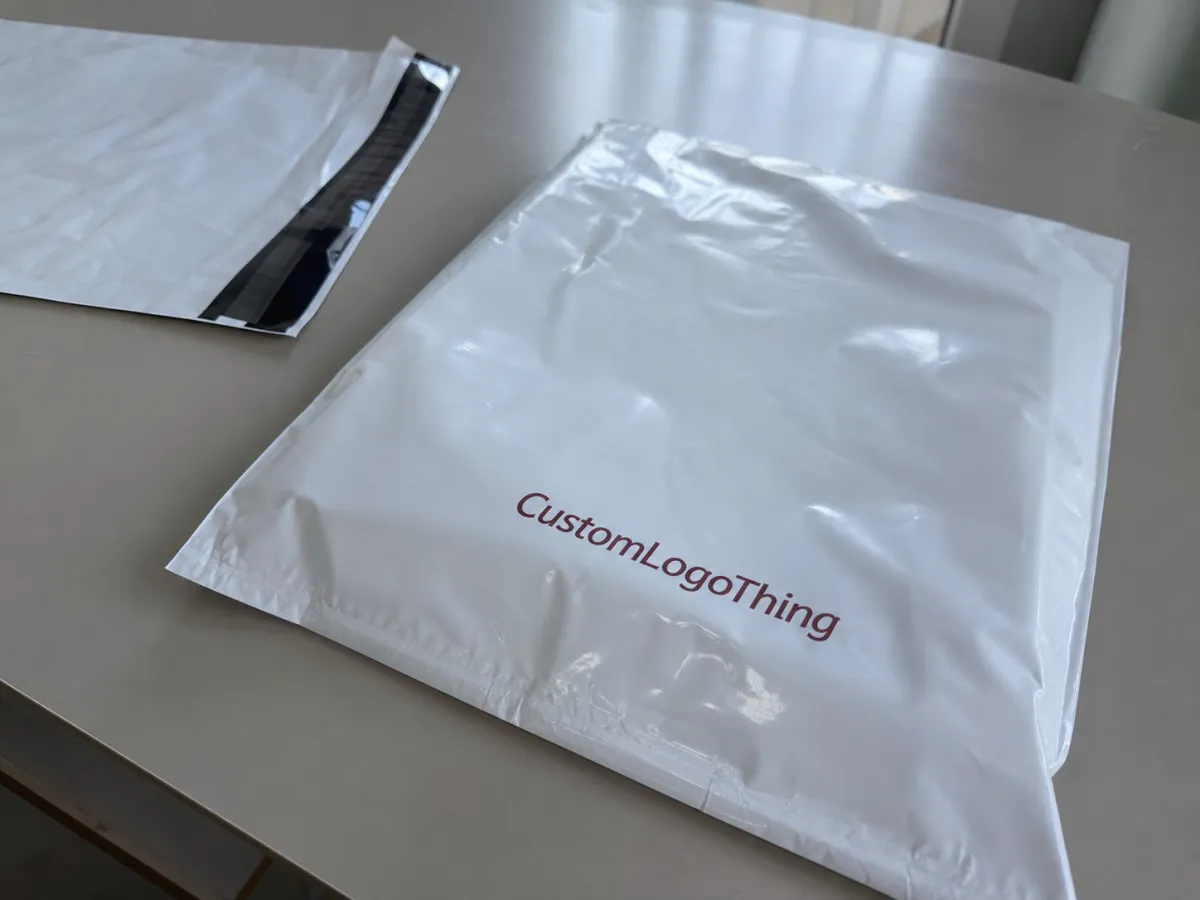
The first miss is usually sizing. Buyers measure the bare product, not the packed product. That difference sounds minor until tissue, a hang tag, a barcode sticker, or an inner sleeve adds just enough bulk to stress the seal. A second miss is treating the print as the main event. On a production line, the real experience starts with film feel, seal quality, and how quickly a packer can close the bag without fighting it.
From a packaging buyer’s point of view, the mailer has to fit into the larger retail packaging system too. If the line already uses custom printed boxes, corrugated cardboard shipper cartons, or kraft wraps, the poly mailer should not feel like a random add-on. A clean size, crisp logo placement, and a closure that holds after compression all help the launch feel intentional.
Here is the plain-English version: a custom poly mailer is a lightweight polyethylene bag with a printed exterior, usually used for soft goods and compact orders. It protects against moisture, dirt, scuffing, and casual tampering. It does not replace the structural protection of a box, so the spec should match the item. A soft tee and a rigid accessory kit should never be treated as equivalent packouts.
One useful way to judge the bag is to compare it to the other parts of the shipment. The mailer sits in motion, rubbing against cartons, pallet wrap, and neighboring parcels. The spec needs enough backbone to survive that environment while still folding flat, shipping efficiently, and fitting the packing workflow. That is the part many teams miss when they focus only on the mockup.
How custom poly mailers perform in retail shipping
A mailer earns its keep through the whole path from pack table to doorstep. The product is folded, inserted, sealed, bulk packed, stacked, and then knocked around by courier handling, conveyor vibration, and last-mile abrasion. If a seam opens or the film stretches too much, the package branding never gets a fair chance to do its job.
For retail launches, the spec should start with the abuse the bag will actually see. The warehouse side matters as much as the customer side. A packer needs enough room to load quickly, the seal must close in one clean motion, and the bag should hold shape after being stacked with other outgoing orders. Those details reduce labor friction and cut down on damage claims later.
Film structure matters here. Coextruded films can improve puncture resistance and give a cleaner print surface than simple single-layer bags, especially when the outer layer is tuned for ink adhesion and the inner layer for toughness. Opacity matters too. A bag with uneven opacity can show the garment outline, which some brands want to avoid for privacy and presentation reasons.
Finish affects perception more than many buyers expect. Satin-gloss film usually looks cleaner under retail lighting, while matte finishes can hide fingerprints and minor scuffs better. Stretch behavior matters as well. If the film is too soft, the bag can feel slack and unstructured. If it is too stiff, packers may fight it during sealing, and that slows the line down. A material can be technically strong and still be wrong for the operation.
Best-fit uses are usually soft goods, slim boxed items, and multi-item bundles that remain compact after folding. That includes tees, socks, small accessories, and some beauty or lifestyle items that ship well without a corrugated box. For heavier or sharp-edged contents, move up in gauge or reconsider whether a box is the better retail packaging choice. The cheapest failure is the one caught on paper, not in transit.
"The best mailer is the one a packing associate can grab, load, seal, and ship without thinking twice."
If you are comparing formats, our Custom Poly Mailers page shows common sizes and closure options, while Custom Packaging Products gives a wider view of how packaging choices can support the launch as a whole.
For teams that want a more formal handling benchmark, parcel transit methods from ISTA are worth reviewing. You do not need a lab for every launch, but it helps to think in terms of drops, vibration, and compression instead of assuming the artwork proof tells the whole story.
Material, print, and seal specs that shape the bag
Material choice sets the tone for the order. LDPE is still common because it is flexible, economical, and easy to fold. Coex film is often the better choice when the launch needs stronger tear resistance and a cleaner print face. Recycled-content blends can work too, as long as the team accepts some variation in clarity or surface feel. For a retail launch Custom Poly Mailer Bags material spec guide, this is where the tradeoffs become visible.
Gauge deserves real attention. A 2.5 to 3.0 mil bag is often enough for standard apparel, while heavier or sharper contents may call for 3.5 to 4.0 mil. Thicker is not automatically better. Extra thickness adds freight weight, can make folding harder, and may cost more than the launch budget wants. The right gauge is the one that survives the route without creating waste or slowing the pack line.
Print method should match the artwork and the budget. Simple spot-color work can keep cost controlled, while full-bleed graphics create stronger shelf-to-door branding if the design has enough contrast. If the bag will slide against other cartons or be packed into bins with rigid pieces, ask how well the ink stands up to scuffing. A beautiful proof on paper does not always predict how ink behaves on film.
Common spec choices and what they tend to do
| Spec choice | Best use | Typical feel | Rough unit cost at 5,000 pcs |
|---|---|---|---|
| LDPE, 2.5-3.0 mil | Light apparel and low-risk soft goods | Flexible, lightweight, easy to pack | $0.16-$0.24 |
| Coex film, 3.0-3.5 mil | Most retail apparel launches | Balanced strength and print clarity | $0.20-$0.32 |
| Recycled-content coex, 3.0-4.0 mil | Brands with recycled-content targets | Similar handling, sometimes slightly less glossy | $0.24-$0.38 |
| Heavier gauge custom bag, 4.0 mil+ | Multi-item packs or contents with sharper edges | More body, higher freight and material cost | $0.28-$0.42 |
Seal style deserves as much respect as film choice. A peel-and-seal adhesive should close cleanly without lifting at the corners, and the tack level needs to work in your packing environment, not just in a sample room. Some programs add a tear strip for easier opening, which can improve the customer experience if the bag is meant to be opened and discarded without scissors. Others prefer a permanent seal because it reduces the chance of tampering during transit.
Finish is the last part of the spec, but it is not minor. Matte can soften the look and hide handling marks. Gloss can make color pop and give a brighter first impression. Die-cut handles are useful in some retail packaging programs, though they are less common for mailers than for in-store carryout formats. The choice depends on how the bag travels and how the brand wants the customer to feel when it is opened.
For recycled-content or end-of-life questions, the EPA recycling guidance is a good reference point, especially if your team is trying to match materials with a broader sustainability claim. The caveat is simple: recyclability claims are only as useful as the local collection stream that can actually handle the film.
Cost, pricing, and MOQ: what changes unit cost
Unit cost moves for a few clear reasons: bag size, film gauge, print coverage, color count, closure upgrades, and order volume. Bigger bags use more material. Heavier film costs more. Full-coverage printing uses more press time and more setup. A retail launch that wants stronger brand presence usually pays more than a simple one-color logo bag, and that is normal.
A retail launch Custom Poly Mailer Bags material spec guide also has to account for MOQ, because the minimum order can shape the entire launch plan. Some buyers want a small pilot run before a broader rollout. Others need a larger quantity to cover multiple store drops and e-commerce channels. MOQ often changes with print complexity and bag size, so it pays to ask early whether a slightly different spec could lower the minimum without hurting the launch.
Hidden costs are where quote comparisons get messy. Ask whether the price includes plates, setup, samples, overages, palletization, and freight. If one quote seems much lower, check whether it is based on a lighter gauge, a smaller size, or a shorter print area. A clean comparison should line up size, material, print method, closure, and delivery terms before anyone compares the bottom line.
Typical launch pricing for printed poly mailers often lands somewhere around $0.18-$0.28 per unit at 5,000 pieces for standard specs, rising as the print gets heavier, the gauge gets thicker, or the closure gets upgraded. That range moves with market conditions, film choice, and freight, so treat it as a planning band rather than a promise. One-color bags on simple film can come in lower; a fully printed, heavier-gauge bag can move well above it.
Another cost item that gets overlooked is overrun and under-run tolerance. A small quantity variance is common in print manufacturing, but no one wants a launch delayed because the production count was not written down clearly. If the program depends on exact allocation across warehouse, retail, and sample inventory, state the acceptable range in writing before production starts.
Process and timeline: from artwork to production steps
The workflow is straightforward when the information is complete. It starts with spec intake, then size confirmation, then artwork setup, proofing, sample approval, production, and shipping. The spots where projects slip are usually the first two and the last two: incomplete measurements, late artwork changes, sample revisions, and freight timing.
For a retail launch custom Poly Mailer Bags Material spec guide, the key is to lock the decisions that affect tooling and print early. Size, film type, print method, and quantity should be fixed before the proof goes out. If those shift after approval, the schedule stretches fast. Even a small change to the seal area or print boundary can mean a new layout, a new sample, or both.
Lead time depends on the spec, but a practical planning window is often 12-15 business days from proof approval for standard jobs, with longer timing for more complex prints or recycled-content sourcing. Add freight time on top of that. If the launch date is tied to a store reset or influencer drop, plan backward and leave room for rework. That buffer is cheaper than air-freighting a rushed order.
The most common delay is simple: artwork arrives late or in the wrong format. Another is measurement guesswork. A bag spec built from “close enough” dimensions may look fine on a screen and fail on the line. Exact product dimensions, packed weight, and closure position save time and money because they reduce the chance of a second round of proofs. Packaging teams often underestimate how long a one-day delay in artwork can ripple into freight and warehouse scheduling.
Custom packaging teams that manage both custom printed boxes and mailers usually know this already, but it is still worth repeating: production schedules do not forgive vague instructions. A clean brief turns into a clean proof. A vague one turns into rework, which is far more expensive than a few extra minutes spent measuring the actual packed item.
Step-by-step spec checklist before you approve samples
Start with the product in its final packed form, not the bare item. Measure the folded tee, the accessory bundle, or the boxed set exactly as it will ship, including tissue, insert card, or inner wrap. That is the number the bag has to fit. A perfect fit on an empty product can still fail once the full pack-out is inside.
Then check the closure. The seal should land where the operator can close it cleanly without forcing the film or folding the bag awkwardly. If the seal is too close to the contents, the adhesive takes stress. If it is too far, you waste material and create a loose look. A good fit should feel easy, not tight. In production, easy usually means repeatable.
Review the artwork file with the same care you would use for any branded packaging proof. Confirm bleed, safe area, logo contrast, and barcode placement if the mailer will be scanned in a fulfillment environment. On film, small text disappears faster than on paperboard, so thin fonts and low-contrast type need extra scrutiny. Dark type on dark film is a common trap.
- Measure the packed product, not just the product alone.
- Confirm the bag size, seal area, and closure style together.
- Check artwork bleed, safe margins, and barcode readability.
- Ask for one physical sample or a digital proof against the same checklist.
- Verify the film, gauge, finish, and print coverage before release.
If the sample is physical, test it with the exact folding method your packers will use. A good sample run usually reveals small issues that are easy to fix early, like a logo sitting too low, a seal that grabs too aggressively, or a gauge that feels too soft once the product is inside. Small changes made now are far cheaper than reprinting a launch lot.
One more check matters more than buyers expect: carton fit. If mailers are packed into shipper cartons before they reach the fulfillment line, the carton size and stack pattern can affect scuffing and curl. A bag that looks perfect loose on a table may behave differently once it has been compressed in bulk.
Common mistakes that derail retail launch mailers
The first mistake is choosing a film that feels premium but punctures too easily in the warehouse. That often happens when buyers focus on touch and forget transit. The second is ordering a size that fits one folded unit but fails once tags, inserts, or protective sleeves are added. Both mistakes are avoidable if the spec starts with the worst-case packout instead of the prettiest mockup.
A third mistake is trusting the proof too much. A digital image can make a color look richer than it will print on film, and a paper sample can hide how the bag behaves when bent, stacked, or rubbed inside a carton. That gap between proof and production is exactly where many launch surprises come from. The smart move is to ask how print registration, ink coverage, and seal strength will be controlled, not just how the proof looks on screen.
Another trap is ignoring shipping conditions. Humidity, carton compression, and line handling can expose weak seals or thin gauges quickly. If the bag is packed in hot conditions or stored under heavy cartons, an adhesive that looked fine in testing may not hold up as well in real use. Good retail packaging design assumes the shipment will meet less-than-ideal conditions somewhere along the path.
Some teams also forget that a mailer lives inside a broader system. If the launch includes corrugated cardboard master cartons, inserts, and retail display materials, the outer mailer should not conflict with the rest of the presentation. A bright, glossy bag can still work, but it should feel intentional alongside the other components rather than pasted on as a separate idea. The same is true for recycled-content claims: if the bag says one thing and the rest of the system says another, buyers notice.
In practice, the cheapest way to avoid these issues is to ask for a spec review before anything is approved. That one conversation usually catches more problems than a second round of artwork tweaks ever will. It also exposes where a small spec change can save money without weakening the package.
Expert tips and next steps to lock the order
Start with the product’s worst-case packout, then spec the mailer around that size. If the bag can handle the fattest fold, the thickest insert, and the real seal area, it is much less likely to fail once the launch goes live. That is the simplest way to protect timing and customer experience at the same time.
Ask for one quote on the target spec and one on a modest upgrade. A small bump in gauge or a better closure can tell you a lot about how much protection costs. Sometimes the better spec is only a few cents more per bag, and that difference is easier to justify before the launch than after the first damaged order comes back.
Then build the action list in order. Confirm dimensions. Approve artwork. Request a sample. Check lead time. Align freight with the ship date. If the launch has store and e-commerce components, make sure the bag quantity covers both channels with room for spoilage and rework. Good package branding is not accidental; it is managed.
If the bag is part of a broader packaging design refresh, this is also a good moment to check whether other items in the line need updates. A mailer that matches the new tone may point to changes in inserts, labels, or even adjacent product packaging pieces. The point is not to redesign everything. The point is to make sure the launch feels like one system, with the same visual and functional logic across every touchpoint.
That is why the retail launch custom poly mailer bags material spec guide is worth keeping close: it gives you the language to compare material, print, seal, and cost before the order is locked. Gather your measurements, artwork, quantity, and delivery window, and you will be in a much stronger position to place the right order the first time.
What material works best for retail launch custom poly mailer bags?
For most apparel launches, coex LDPE or a recycled-content coex blend gives a good balance of strength, print clarity, and flexibility. Move up in gauge if the product has sharp corners, heavier contents, or multiple items inside one bag.
How do I know what thickness to specify for a custom poly mailer?
Use the packed weight and the sharpest edge as the starting point, not the empty product weight. Ask for sample testing with the exact folded item and closure method so you can see how the film behaves in real use.
What should I compare in custom poly mailer bag quotes?
Match size, gauge, print coverage, closure type, MOQ, freight, and overrun terms before comparing unit prices. A lower number can hide setup charges, plates, shipping, or a smaller spec than the one you actually need.
How long does a retail launch custom poly mailer order usually take?
Proofing and sample approval can add several days before production begins, especially if artwork needs corrections. Build in extra time for freight, seasonal backlog, and any late changes to size, print, or closure details.
What information should I send for an accurate spec quote?
Send product dimensions, packed weight, artwork file, quantity, and delivery location so the quote is built on real numbers. Add the launch date, target feel, and any must-have features like tear strips, matte finish, or tamper-evident sealing.
Can a poly mailer replace a box for every retail order?
No. A mailer works best for soft goods and compact items that can tolerate flex and compression. If the product has fragile corners, sharp edges, or a high chance of crushing, a box is usually the safer choice.

