Private Label Buyers usually do not lose margin because the poly bag costs too much. They lose it because the wrong bag creates a chain reaction: rework at packing, wrinkled garments on receipt, chargebacks from missed specs, and cartons that look fine until transit damage exposes weak film or poor seals. That is why a private label buyer Apparel Poly Bags packing requirement guide needs to stay close to production reality. The bag is not a side item. It affects labor, presentation, and compliance.
From the buyer side, a poly bag has four jobs. It protects the garment, presents the brand clearly, moves quickly through the packing line, and meets retailer or shipping requirements. If one of those fails, the “cheap” option turns expensive in a hurry. Unit price matters, but unit price without context is how buyers end up paying twice.
There is also a timing issue that is easy to overlook. Packaging that slows hand-packing by only a few seconds per piece can create a visible labor cost once the order volume climbs. A 2,000-piece run is inconvenient. A 40,000-piece run becomes real money.
Buyer rule of thumb: start with the folded garment, the packing method, and the channel requirement. Then choose the bag. Reversing that order usually produces the wrong spec.
If you are building a broader packaging program, it helps to keep apparel bags aligned with related components in Custom Packaging Products and Custom Labels & Tags so the insert, hang tag, and inner bag do not contradict one another.
Why Apparel Poly Bag Specs Make or Break Private Label Packing
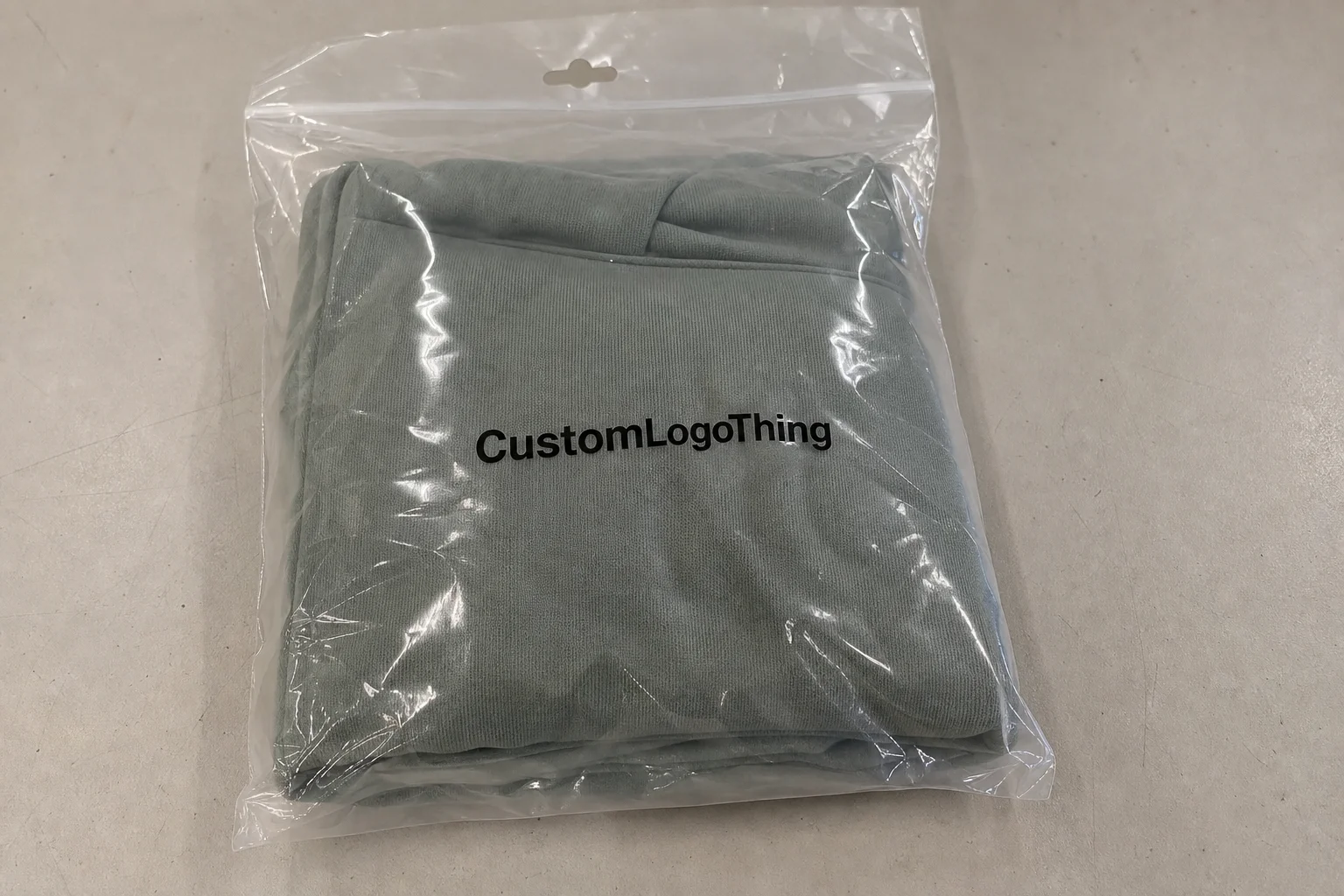
Apparel Poly Bags are part of the product system, not a disposable extra. A folded tee in a bag that is too loose will shift in transit and come out looking tired. A hoodie packed into a tight bag can compress the fold, stress seams, and create a lumpy shelf appearance. Neither problem sounds dramatic, yet both create avoidable cost.
Private label programs are especially sensitive because the packaging often carries brand expectations without much room for inconsistency. Buyers usually have to balance five things at once: fit, visual presentation, protection, warehouse handling, and compliance. A bag that works for a basic DTC insert pack may fail in retail receiving. A retail-ready bag may be overbuilt for an inner pack and waste material.
What catches buyers off guard is how often the “slightly cheaper” bag costs more after labor and rejects are counted. If 6% to 10% of a run needs to be reopened, re-folded, or rebagged, the savings disappear fast. That is not theoretical. It shows up in packing time, line interruptions, and the extra carton volume caused by sloppy packing.
The practical takeaway is simple. A bag spec should reflect the garment, the pack method, and the channel. If those three do not match, the order may still ship, but it will not ship efficiently.
Poly Bag Types, Materials, and Closure Options for Apparel
Most Apparel Poly Bags are made from LDPE or PP. LDPE is softer, more flexible, and usually easier to work with on a hand-packing line. It folds without fighting the operator and is common for basic garment packing. PP is stiffer and often clearer, which helps presentation, but it can feel less forgiving during insertion. Recycled-content film is also more common now, especially where buyers want to reduce virgin resin use. The tradeoff is usually in cost, clarity, or both, depending on the blend.
Plain English version: if the order needs easy handling and a forgiving bag, LDPE usually makes sense. If the garment needs a sharper visual finish, PP may be the better fit. If a brand wants recycled content, the buyer should ask for the actual percentage and confirm whether the retailer accepts the claim. That last part matters. A recycled-content bag that fails a retailer standard is still a failed bag.
Common apparel bag styles include flat bags, header bags, suffocation-warning bags, resealable bags, and self-adhesive flap bags. Flat bags are the workhorse for folded tees, socks, and underwear. Header bags fit hanging presentation or retail display cards. Suffocation-warning bags are common because many programs require printed safety text. Resealable bags and flap-seal bags are useful when the item may be opened for inspection and returned to the package without damage.
In practice, buyers usually match the style to the garment and the channel:
- Tees and basic tops: flat LDPE bags with a clean print zone and standard warning text.
- Folded shirts and polos: clearer film, tighter dimensional control, and neat seal placement.
- Intimates and socks: lighter-gauge bags with compact footprints and barcode-friendly panels.
- Hoodies and sweatshirts: wider bags and stronger film to handle bulk without tearing.
- Lightweight outerwear: thicker film or a gusseted format to reduce stress on the bag.
Print and finish change the story more than many buyers expect. Clear bags show the garment, but they also show wrinkles, dust, and poor folding. Frosted film hides minor handling marks and can look cleaner under mixed warehouse lighting. Printed warnings and logo marks can improve shelf presence, but every extra color adds setup, proofing, and cost. If the item is a basic replenishment style, simpler usually wins. If the packaging is part of the retail display, presentation deserves more attention.
Compliance should never be handled by memory. Many buyers rely on retailer or distributor standards for warning text, perforation, film strength, or seal style. Transit testing guidance from groups such as the ISTA can be relevant for shipping performance, while material stewardship issues may connect to guidance from the EPA depending on the program and destination market.
One practical distinction is worth making: a bag for inward product protection is not automatically the right bag for direct ship. If the poly bag is only an inner pack inside a master carton, the spec can usually be lighter. If the same bag has to survive carton drops, sorting, and repeated handling, it needs more film strength and better seal integrity.
| Option | Best for | Typical cost impact | Main tradeoff |
|---|---|---|---|
| LDPE flat bag | Tees, socks, basic apparel | Lowest | Less shelf polish than premium film |
| PP clear bag | Retail presentation, crisp visuals | Medium | Can feel stiffer during packing |
| Resealable flap bag | Returns, inspection, repeat opening | Medium to higher | Slower pack speed |
| Suffocation-warning bag | Retail and shipping compliance | Medium | Requires correct text and placement |
Size, Thickness, and Packing Compliance Specs Buyers Should Lock In
Bag size should be based on the folded garment, not the raw cut size. Measure the folded width, length, and thickness after the folding method is fixed. Then add enough room for easy insertion without leaving so much slack that the product shifts around. A bag can be technically large enough and still be wrong if the garment is bulky, stretchy, or springy.
For width and length, buyers normally work from the folded dimensions plus a modest allowance. Slim tees need less room. Hoodies, sweatshirts, and layered garments need more because stack thickness changes the fit. If the bag is too tight, the fold compresses and the garment looks crushed. If it is too large, the product moves around and the presentation goes sloppy. The middle ground is not a guess; it comes from the fold size and the line method.
Thickness is usually discussed in microns or mils, depending on the market. For light retail or inner packing, lower gauges can work. For heavier garments or rougher handling, thicker film is safer. A practical range for many apparel applications is around 30 to 60 microns, but that is a starting point, not a universal rule. The right thickness depends on the item weight, the amount of warehouse handling, and whether the bag is going into a simple carton or a more demanding shipping path.
Compliance items should be written into the spec, not left to interpretation. Suffocation warnings, vent holes, closure type, and print placement may all be required. Some retailers want the warning text in a specific size and location. Some want the bag perforated or vented. Some want a barcode on a clear panel so scanning is reliable. Those details sound minor until they cause receiving delays.
Carton pack count and overage allowance belong in the same spec. Do not assume the factory will default to your preferred format. State how many bags per carton, how many cartons per style, whether master cartons need special labels, and whether a small overrun is acceptable for inspection loss or packing waste. One clear paragraph can prevent several rounds of clarification later.
Good spec sheet rule: if two people can read it differently, the factory will probably choose the cheaper interpretation.
For programs that also include paper inserts or certified cartons, some buyers compare sourcing standards with groups like FSC so the overall packaging claim stays consistent across components.
Private Label Buyer Apparel Poly Bags Packing Requirement Guide: Cost, MOQ, and Quote Factors
This is where many buyers lose time. They ask for “poly bag pricing” before the spec is stable, which produces quotes that are not really comparable. The better approach is to define the bag first, then request pricing. Otherwise the quote includes assumptions, and assumptions are where hidden cost lives.
Unit cost is driven by resin type, thickness, dimensions, print colors, seal or closure style, and volume. Bigger bags use more material. Heavier film costs more. More print colors mean more setup. Custom warning language can be inexpensive if it is standard, but special wording, multi-language copy, or exact placement requirements can add artwork work and line setup time.
MOQ usually rises with customization. Stock bags can often be ordered in lower quantities because they do not need new tooling or a dedicated print run. Custom printed bags usually need higher minimums because the factory has to justify setup, plates, and changeover time. If you need three sizes and each one is small, the economics get worse quickly. That is not a negotiation trick; it is production math.
Hidden costs are often where the budget drifts. Typical extras include plate or setup charges, proof revisions, sample runs, split shipments, special carton labeling, and repacking if the initial spec was wrong. Buyers who focus only on unit price can end up 12% to 25% over the expected total once all the little pieces are added together. The quote still looked fine on paper. The total did not.
For budgeting, these ranges are a better mental model than a single headline price:
- Stock plain poly bags: usually the lowest unit cost, especially at higher quantities.
- Simple one-color printed bags: typically a modest premium over stock bags.
- Multi-color branding or special warning layouts: higher setup and higher unit cost.
- Custom size plus custom print: the most expensive route, but sometimes the only correct one.
Volume changes the math quickly. A 5,000-piece order often sits in a much higher unit-cost band than a 20,000-piece run with the same artwork, because setup gets spread across fewer units. That is why useful buyers ask for at least two quote options: a budget-safe version and a preferred spec. The gap between them tells you more than one quote ever will.
If the packaging has to coordinate with hang tags, inserts, or shipping mailers, the whole program should be reviewed together. Pairing the inner bag with Custom Labels & Tags and, where relevant, Custom Poly Mailers helps prevent mismatched branding or duplicated compliance text across different package layers.
Production Steps, Lead Time, and Sample Approval Process
The production flow should be boring. That usually means it is under control. First comes spec confirmation. Then artwork proof. If the order is custom enough, a sample or pre-production approval follows. After that comes mass production, inspection, carton packing, and shipment. If any of those steps is fuzzy, the order slows down.
Lead time depends on complexity. Stock bags can move fast because there is no custom setup. Simple printed bags take longer because artwork and production approval have to be locked before the run starts. Fully custom size plus print plus compliance text takes the longest. In practice, a straightforward custom order often runs around 12 to 15 business days from proof approval. More complex jobs, larger quantities, special materials, or multiple proof revisions can push that out further.
The most common delays are not technical. They are administrative. Buyers send incomplete artwork, missing measurements, or late compliance edits. The factory waits. The schedule slips. Then someone asks for a rush. Rush orders happen, but they are not cheap and they are not magic.
Samples are worth the time when color, logo position, warning wording, or bag feel matters. A digital proof may be enough for a basic clear film bag with standard text. If the brand needs exact placement, a barcode zone, or retailer-specific wording, a physical sample or at least a carefully checked proof is safer. A few millimeters off can matter if the bag has to look uniform across a private label line.
Plan against your launch date, receiving window, and freight mode. Do not build the bag schedule around wishful thinking. Build it around the warehouse calendar, the factory schedule, and transit time. Buyers who do that tend to avoid the most painful kind of delay: cartons arriving after the receiving window has already closed.
How We Match Apparel Poly Bags to Your Packing Line and Brand Standard
A useful supplier should ask how the bag will actually be used. Manual packing needs different bag behavior than automatic or semi-automatic equipment. If workers are hand-inserting folded garments, a softer film and a wider opening can cut packing time. If the line uses machinery, dimensional tolerance and seal consistency matter more. In that setting, even small drift can create jams or inconsistent closure quality.
Brand consistency matters on repeat orders, and buyers usually notice the problem before anyone else does. A slightly darker warning print, a shifted logo panel, or inconsistent clarity may pass basic inspection, but it still weakens the visual standard. Packaging quality tends to get exposed on the second or third reorder, not the first.
Private label programs often need multiple sizes, seasonal restocks, or split colorways. That means the packing spec should be organized by SKU, not by a vague product family. One hoodie SKU may need a different bag than another hoodie SKU if the fold size shifts by even an inch. A clean spec file reduces those errors. Long email chains with conflicting measurements usually create them.
In practice, the buyer-side win is fewer holds, fewer rejects, and fewer cartons reopened at receiving. The bag should support the pack line instead of slowing it down. If the supplier understands line speed, fold standard, and channel requirement, the order usually moves more predictably.
Next Steps to Place a Better Poly Bag Order
Before asking for quotes, prepare the basics: garment type, folded dimensions, target quantity, closure style, print file, warning text, carton pack count, and shipping destination. If the folded dimensions are not known yet, get them first. Asking a supplier to guess is a good way to end up paying for rework later.
Useful buyers ask for two spec options when they need a real comparison. One should be the minimum acceptable version. The other should be the preferred version with better presentation or stronger protection. That makes the cost difference visible instead of vague.
For anything custom or compliance-sensitive, request a proof or sample before production. Confirm the MOQ. Lock the lead time. Write the carton labeling instructions clearly. If split shipments are needed, say that early. If the order supports a launch, say that early too. Silence is not a planning method.
A practical checklist helps:
- Approve the garment folded dimensions.
- Confirm bag material and thickness.
- Lock print copy and warning text.
- Verify MOQ and unit pricing bands.
- Set the production lead time and transit window.
- Confirm carton pack and labeling rules.
That is the practical version of a private label buyer apparel poly bags packing requirement guide. Tight specs. Clear approvals. Fewer surprises. Better packing. A poly bag may be small, but in private label operations, small mistakes tend to scale very efficiently.
What information do I need for a private label apparel poly bag quote?
Provide the garment type, folded dimensions, bag width, length, and gusset if needed, along with thickness, closure style, print requirements, total quantity, warning text, carton pack count, and delivery destination. Without those details, pricing is only an estimate.
How do I choose the right poly bag size for folded apparel?
Measure the folded garment after the folding method is set, then add enough room for easy insertion and a little movement without excess slack. Knits, hoodies, and layered items usually need more allowance than flat tees because the fold is bulkier and less compressed.
What is the usual MOQ for custom apparel poly bags?
MOQ depends on size, film, and print complexity. Stock bags are usually easier to source in smaller quantities. Custom printed bags often need higher minimums because setup and production efficiency have to work for the factory.
How long does production usually take for printed poly bags?
Stock bags move faster. Custom printed bags usually need time for proofing, setup, and production. Straightforward orders may run in about 12 to 15 business days after proof approval, while more complex jobs take longer.
Do apparel poly bags need suffocation warnings?
Many retail and shipping programs require them, depending on the market and distribution channel. Check your buyer standard, retailer requirement, and local compliance expectations before placing the order. Do not assume the warning is optional.


