Apparel poly Bags with Logo low moq do something deceptively simple: they make a small apparel run look planned. Not improvised. Not like a sample batch that got packed in whatever was available. A logo on the bag gives the garment a finished frame before anyone touches the fabric.
That matters for launch drops, creator merch, seasonal capsules, and test programs where the buyer wants presentation without tying up cash in packaging inventory. You do not want 10,000 empty bags sitting in a warehouse just to qualify for a print run. You want enough branded sleeves to support the product, keep storage manageable, and avoid paying for packaging you may never use again.
The practical appeal is straightforward: low risk, a retail-ready look, and a minimum order level that matches how small apparel businesses actually buy.
Why apparel poly bags with logo low moq make small runs look retail-ready
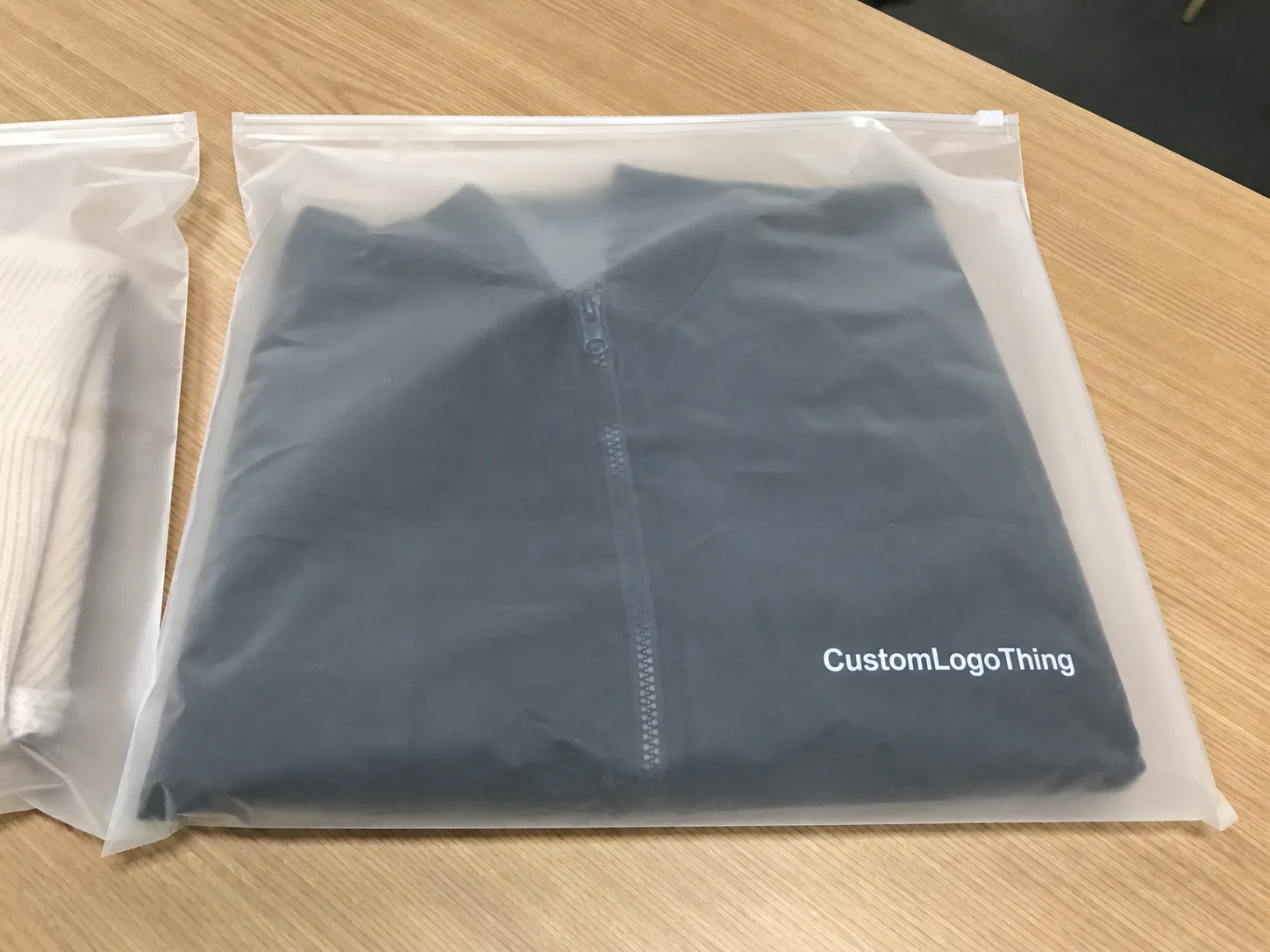
A printed poly bag changes the first impression quickly. A 200-unit tee run in plain bags looks like production overflow. Put the same shirts in branded sleeves and it reads like a product line. That shift is bigger than many buyers expect, especially when the product is sold in person, displayed on a shelf, or photographed for fulfillment.
For smaller brands, packaging has to carry more weight than it does for a mature label. One clean logo, even in a single color, can create recognition before the customer ever handles the garment. A good bag also helps at the back end. Warehouse teams can identify sizes and styles faster, and retail staff see a package that looks intentional rather than temporary.
Low-MOQ packaging is also a sensible response to demand uncertainty. If the style is new, the colorway is unproven, or the drop is limited, the money should go to inventory and sales activity first. That is why Apparel Poly Bags with logo low moq keep showing up in buying decisions: they let brands improve presentation without committing to a full packaging program too early.
“The strongest low-MOQ packaging does not try to be flashy. It just looks like it belongs there.”
That usually means a clear bag, a readable logo, and a fit that does not leave the garment swimming in excess air. The package should support the product, not compete with it.
If you are comparing packaging choices, start with the sales channel. Retail display, e-commerce fulfillment, and warehouse storage all ask different things from the bag. For broader packaging options, see Custom Packaging Products and our FAQ for ordering basics.
Film, seal, and print details that affect garment fit
Most buyers narrow the options to a few common formats: clear poly sleeves, self-seal bags, wicketed bags, and header bags. Each one serves a different pace of packing and a different presentation need. Clear sleeves are the simplest and usually the least expensive. Self-seal bags speed up small pack-out operations. Wicketed bags make sense when the packing table needs throughput. Header bags matter more when hanging display or prominent presentation is part of the job.
The film itself affects how the garment looks under light. Clear, crisp stock usually reads cleaner than cloudy film. Too much haze can flatten fabric color. Heavy gloss can make the package feel more like generic commodity packaging than branded apparel. Buyers do not always ask for clarity specs, but they should.
Print choices are usually driven by MOQ. One-color logo printing is the easiest place to start. Spot-color branding is still manageable. Once artwork becomes multi-color, full coverage, or layered with gradients, setup becomes more involved. That raises the odds of plate charges, proof revisions, and longer lead times. For small runs, simple art usually wins because it keeps production predictable.
There is a practical rule that tends to hold up: a good bag fits the folded garment with a little room for insertion and sealing, but not so much room that it looks loose. Too large feels careless. Too tight slows pack-out and can distort the seal or press a garment fold awkwardly.
| Bag type | Best for | Typical setup | Pack-out speed |
|---|---|---|---|
| Clear poly sleeve | Tees, basics, folded sets | Simple logo print, low MOQ | Medium |
| Self-seal bag | E-commerce, smaller teams | Adhesive strip, clean closure | Fast |
| Wicketed bag | Higher-volume folding stations | Stacked on wicket for quick packing | Very fast |
| Header bag | Retail display, hanging presentation | Printed header area, hang hole options | Medium |
For broader packaging context, the Packaging Machinery Manufacturers Institute publishes useful material on packaging systems and equipment. Bag choice is not just a print question; it is also a handling question. If a product will be folded, sleeved, stacked, shipped, and touched several times, the film and closure need to match that path.
Sizes, gauges, and finishing specs buyers should confirm
A clean quote starts with the right measurements. That means bag width, gusset depth, length, film thickness, seal type, and print area. If one of those is missing, the supplier either has to guess or come back with follow-up questions. Both slow the process.
Buyers should measure the folded garment, not just the flat garment size. A neatly folded tee needs less room than a hoodie. Thick fleece, heavyweight sweatshirts, and multi-piece bundles need extra depth and width to avoid crushing the garment or making the bag difficult to close. Smaller accessories such as socks can use narrower formats, while folded sets require enough room to keep everything orderly.
Gauge matters because the bag’s job changes from one use case to another. Lighter film is usually acceptable for dust protection, visual merchandising, and basic retail handling. Thicker film makes more sense when the package will move through warehouses, be repacked, or be handled multiple times before the customer sees it. A thin sample sleeve is not the right spec for a product that will take a few knocks.
Finishing details are useful only when they solve a real problem. Vent holes can help certain garments. Hang holes support display. Resealable strips are useful for customer-facing packaging and return workflows. Recycling marks or warning text may be necessary for some programs. The common mistake is adding features because they sound premium. In practice, every extra feature affects cost, production complexity, or both.
Common apparel fit guidance
- Tees: Usually work well in narrower sleeves with modest length and limited excess air.
- Hoodies: Need more width and gusset room, especially if the fleece is thick.
- Sweaters: Often need a softer fit and more careful folding to avoid wrinkling inside the bag.
- Socks and accessories: Can use smaller formats, often with simpler print coverage.
The best suppliers usually ask for actual folded dimensions rather than a generic garment size. That is a good sign. It means they are quoting the bag for the finished pack, not estimating from memory. If they skip that question, the quote may be based on assumptions that will need correcting later.
Pricing, MOQ, and quote math for small custom runs
Pricing for Apparel Poly Bags with logo low moq depends on several variables: bag size, film thickness, print colors, artwork coverage, and whether the bag is stock or fully custom. Small runs cost more per unit. That is not a penalty so much as the reality of setup. Plates, proofing, and press preparation still have to happen, even when the order is small.
For simple printed work, buyers often see rough pricing in the $0.08 to $0.25 per bag range. The actual number depends on quantity and spec. Larger bags, thicker film, more print colors, and special finishing can push the price higher. Once an order drops below about 1,000 pieces, freight and setup can matter as much as the unit price itself, which is why landed cost gives a much truer picture than the quoted per-bag number.
The MOQ tradeoff is easy to understand. Smaller quantities reduce inventory risk and free up cash, but the unit cost rises. If the product is still being tested, that tradeoff usually makes sense. If the style is already proven and likely to repeat, stepping up to a larger quantity can improve the economics quickly. In many cases, the jump from 500 to 2,500 pieces moves the unit price enough to change the decision. A jump from 2,500 to 5,000 can create another meaningful drop if the artwork is still simple.
The useful part of a quote is not the headline number. It is the math behind it.
- Quantity: MOQ versus scale pricing.
- Dimensions: Width, length, gusset, and seal style.
- Artwork count: One color, two colors, or more.
- Delivery location: Freight changes the landed total.
- Samples: Preproduction approval can add time and small charges.
For sustainability context, the EPA’s packaging-related materials guidance is useful when brands are trying to reduce unnecessary packaging or waste. See EPA recycling and materials guidance. Not every brand needs a formal sustainability program to benefit from using the right amount of packaging rather than more packaging than necessary.
Ask for tiered pricing whenever possible. A supplier should be able to show how the price changes at 500, 1,000, 2,500, and 5,000 pieces if the project is real. If the quote only includes one number, it may not reflect the actual production economics.
Order process, proofing, and lead time for production steps
The basic sequence is predictable: request specs, confirm artwork, approve the proof, start production, then pack and ship. The hard part is usually not the factory schedule. It is the back-and-forth before the job is ready to run. Missing dimensions, uncorrected artwork, and unclear color references are the usual culprits.
Lead time depends on quantity, print complexity, and whether the supplier already has the right film in place. Simple printed sleeves can move fairly quickly after proof approval. More complex work, custom sizes, or multi-color art usually takes longer. A realistic range is often 7-15 business days for straightforward runs, with longer timelines for larger orders or jobs that need several proof revisions.
Most delays happen before production begins. Low-resolution logos force redraws. Missing Pantone references create color questions. No dieline or no folded dimensions means the supplier has to estimate, and estimates are where rework starts. Clean information at the start is the fastest route to an accurate first order.
“Fast orders are usually not fast because anyone rushed the press. They are fast because the buyer sent complete information and approved the proof without dragging it out.”
For brands that also ship products in mailers, it helps to separate the job of the garment bag from the job of the outer parcel. A printed poly sleeve protects and presents the product; the mailer handles transit. If you need to compare the two, our Custom Poly Mailers page shows how those packaging layers serve different purposes.
Some programs also have tighter handling expectations. In those cases, it is worth understanding transport testing standards such as those from ISTA. Poly bags are not usually engineered like heavy shipping cartons, but they still need to survive the handling pattern they will actually face.
What separates a reliable supplier from a cheap quote
A low quote only matters if the bag arrives the way it was approved. If the print is off-center, the seal is weak, or the film warps after packing, the savings disappear fast. Buyers who have ordered packaging more than once usually stop asking for the lowest number and start asking better questions.
A reliable supplier should be able to confirm the material, print tolerance, bag construction, and packing method before payment. If they cannot tell you the film thickness or how the bags are packed for shipment, that is not flexibility. It is a lack of process control. A dependable quote should explain what is included, what is extra, and where setup charges come from.
Communication is part of quality control. Good suppliers respond quickly enough to keep the job moving, but they also give answers that are specific enough to trust. Proof accuracy matters. Revision handling matters. So does the ability to explain why a particular print method or bag construction fits the order. The best quotes are not the shortest ones; they are the ones that make the production path visible.
Consistency is where value shows up over repeat orders. The same logo bag ordered twice should look like the same product twice: same film, same seal, same print position, same feel. That kind of repeatability is what makes a packaging program dependable. Without it, the brand ends up spending time checking random variation instead of packing product.
| Quote type | What you get | Risk level |
|---|---|---|
| Lowest bid only | Small upfront number, limited detail | High |
| Spec-backed quote | Material, size, print method, and MOQ spelled out | Lower |
| Sample-first quote | Proof or sample approval before full run | Lowest |
One practical caution: a low bag price can hide cost elsewhere, especially in setup, artwork changes, freight, or repeat revisions. That does not make the quote dishonest by default, but it does mean the buyer needs to compare the full landed cost, not just the line item on the bag itself.
What to send for a fast quote and first-order approval
A fast Quote for Apparel poly bags with logo low moq usually depends on whether the buyer sends enough information in one pass. The most useful items are the garment type, folded dimensions, target quantity, and intended use. A bag for retail display is not the same as a bag for warehouse storage or e-commerce fulfillment, so the use case matters.
Artwork should be sent in vector format whenever possible: AI, EPS, or editable PDF. If color matching matters, include Pantone references. Add placement notes so the supplier knows where the logo should sit relative to the edge, seal, or hang hole. If there is an existing package to match, send photos. Reference photos shorten the proof cycle more than most buyers realize.
If the spec is still being decided, ask for two versions: a lower-cost baseline and a more polished option. That comparison usually makes the tradeoff obvious. It is easier to choose between two real packages than to imagine what a small price difference might buy.
Here is the shortest useful checklist:
- Garment type and folded size.
- Quantity needed and any repeat volume.
- Logo file in vector format.
- Print color references and placement notes.
- Sample photos or current packaging reference.
That is enough for a serious first quote. If the supplier still cannot answer clearly after that, the process is likely to stay messy. There is no advantage to spending time untangling confusion that should have been resolved before pricing started.
For a wider look at product categories and ordering basics, our internal Custom Packaging Products page and FAQ are useful starting points before requesting pricing.
Most buyers looking for Apparel Poly Bags with Logo low moq want three things: a clean presentation, a fair landed cost, and a supplier that can handle revision work without making every change feel like a crisis. That is a reasonable standard. Send complete specs, compare the full production math, and choose the bag that fits the product and the sales channel rather than forcing the product to fit the cheapest quote.
FAQ
What is the usual MOQ for apparel poly bags with logo low MOQ orders?
It depends on size, print method, and film type, but low-MOQ custom runs often start around 500 to 1,000 bags. One-color prints and standard sizes are easier to keep low. More complex art, special finishes, or unusual dimensions usually push the minimum higher. If repeat volume is likely, ask for tiered pricing so you can see the cost at 2,500 or 5,000 pieces as well.
Can I print a logo on clear poly bags for apparel without a large order?
Yes. Simple logo printing on clear bags is one of the most common low-MOQ requests. One or two ink colors usually keeps setup cleaner and pricing easier to predict. Full coverage artwork, gradient effects, or full-color jobs tend to require more setup and may raise the minimum.
How do I choose the right bag size for folded tees or hoodies?
Measure the folded garment, not the flat one, then allow a little room for insertion and sealing. Tees usually fit narrower sleeves than hoodies, while thick fleece needs more width or gusset depth. If the bag will be displayed retail-side, a snug fit usually looks better than a loose package with excess air.
What artwork do you need for a logo quote on apparel poly bags?
Send a vector file such as AI, EPS, or editable PDF whenever possible. Include Pantone or CMYK color references, logo placement notes, and any text that must appear on the bag. If the artwork is not final, send the closest version available so the supplier can confirm print limits before quoting.
How long does a low MOQ custom poly bag order usually take?
Simple orders can move quickly after proof approval, while more complex print jobs take longer. Lead time depends on quantity, number of colors, and whether the supplier has to create new plates or source a different film. The fastest path is complete specs, clean artwork, and prompt proof approval rather than a scattered email thread.


