If you are comparing packaging formats for a private label line, the Private Label Buyer Drawstring Plastic Bags bulk pricing guide usually starts with one simple question: can one bag replace several packaging steps without inflating labor or material spend? In practice, a drawstring bag often takes the place of twist ties, loose ribbons, or separate closure parts. That simplifies packing and keeps the final presentation consistent.
For customlogothing.com buyers, the real value is not just the closure style. It is the mix of unit cost, usable size, print coverage, and how the bag supports retail display, kitting, or fulfillment. Get those pieces aligned and a polished drawstring package can stay economical, especially in bulk.
Why Drawstring Bags Can Lower Packaging Cost While Improving Shelf Appeal
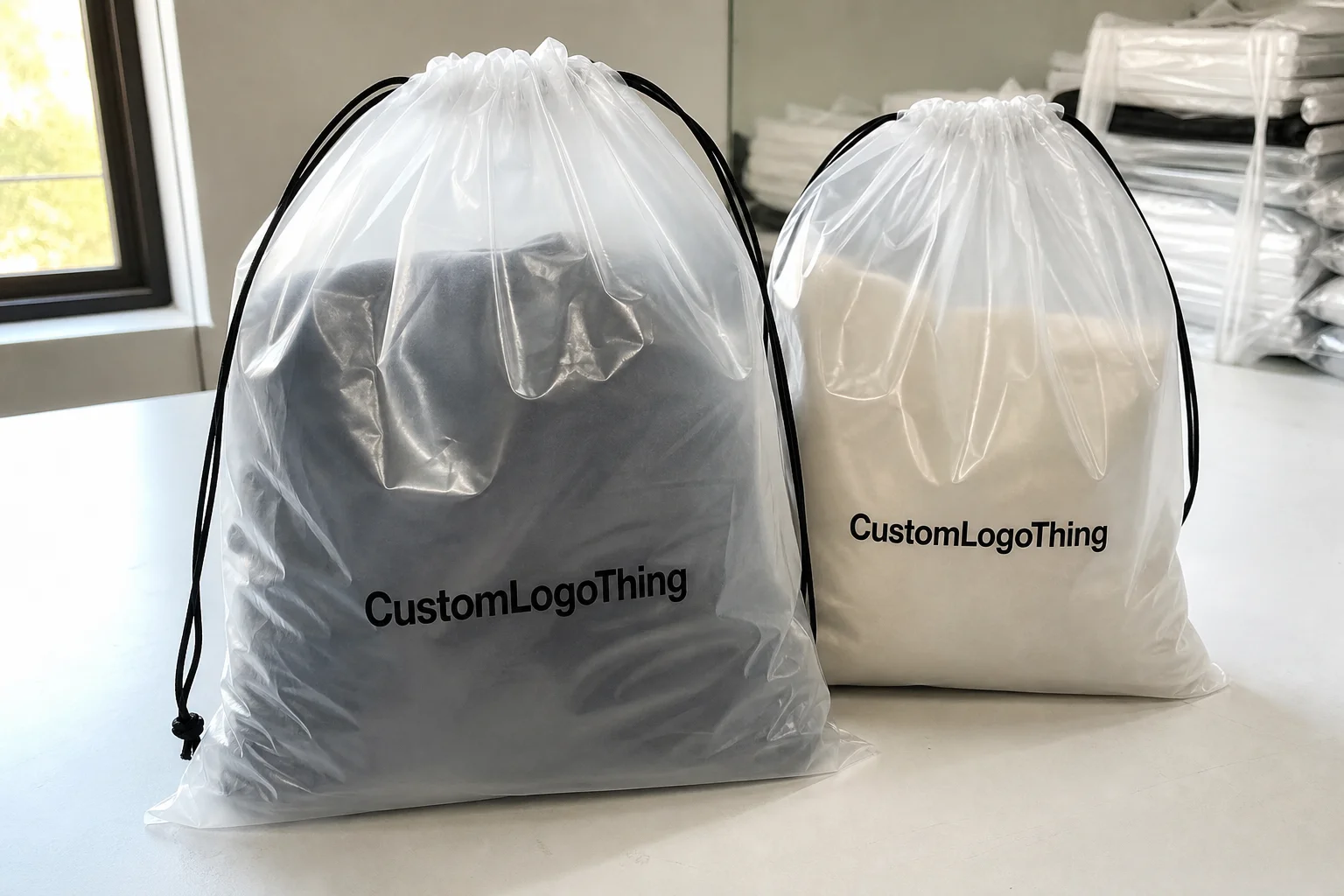
A drawstring plastic bag is often a practical fit when a private label brand wants a more finished look without adding multiple packaging components. One closure. One bag. One repeatable presentation. That matters on a packing table where every extra touch costs time, especially across multi-SKU orders or seasonal assortments.
From a buyer’s point of view, the value shows up in two places. First, the line runs cleaner because workers are not sorting through ties, seals, or extra finishing materials. Second, the product reaches retail or the customer in a package that feels intentional. That is useful for apparel, gift sets, accessories, sample packs, promotional kits, and private label retail assortments.
The surprise for many teams is that the closure itself does not have to make the bag expensive. The bigger drivers are film gauge, dimensions, print coverage, and quantity. A well-matched bag spec can keep the cost per piece under control while still giving you a package that looks more premium than a plain open-top poly bag.
“Most packaging budgets get strained by over-specifying the bag, not by the drawstring itself. Match the material to the product, and the numbers usually make sense.”
For brands that reorder regularly, consistency matters just as much as price. A repeatable closure and bag structure helps keep packing expectations stable. That is exactly what private label programs need when products are launched, replenished, or bundled together.
Drawstring Bag Materials, Closure Styles, and Print Options
Plastic drawstring bags are commonly made from LDPE, LLDPE, or blends of the two. LDPE feels softer and more flexible. LLDPE usually improves puncture resistance and tear behavior. In production, that difference matters when a bag has to hold something with corners, edges, or repeated handling during fulfillment.
Clear film is still the most common choice when buyers want the product visible on shelf or in a kit. Frosted and tinted films can give a more refined look or reduce visual clutter. Opaque options are useful when the product itself is not meant to be fully exposed. Matte and glossy finishes also change how the bag reads under retail lighting, so the shelf environment should be considered before approving artwork.
The closure construction deserves attention too. A reinforced header, proper channel width, and a secure cord or draw tape can change how the bag opens, closes, and carries weight. If the channel is too narrow, the draw feels stiff. If it is too loose, the bag may not sit neatly after closure. Small mechanical details matter here. Graphics do not fix a bag that closes badly.
For branding, simple often wins. One-color logos, a concise mark near the header, or a repeat pattern can look cleaner than full-coverage print, particularly on smaller bags. Multi-color decoration makes sense when the bag is part of a premium kit or retail assortment, but every additional color can affect setup charges and the final price structure.
- Clear film for product visibility and fast shelf recognition
- Frosted or tinted film for softer presentation and visual control
- One-color print for lower setup cost and stronger cost control
- Multi-color print for brand-heavy retail programs
- Reinforced draw channel for better handling and closure performance
Buyers who also use labels and hangtags often coordinate these packages with Custom Labels & Tags so the bag and product identification feel like one system rather than separate components.
For sustainability-minded programs, material selection and supply chain claims should be checked against reliable standards and documentation. If your packaging brief includes recycled content or recovery considerations, the guidance on EPA recycling resources can help frame internal expectations, even if the final packaging format is still a conventional plastic film.
Size, Thickness, and Load Specifications That Protect Product Presentation
Before quoting a custom bag, confirm the core dimensions: width, length, any side gusset if needed, film thickness in mil, closure length, and usable opening size. Those numbers tell you almost everything about fit, handling, and cost. A bag that is just a little too small creates friction in packing. One that is too large can make the presentation look loose and unplanned.
Thickness is where many buyers overspend. A heavier gauge feels stronger, but it is not automatically the right answer. Lightweight retail items, soft goods, or sample packs often do well with thinner film, especially when the bag is not bearing sharp corners or heavy repetitive stress. Heavier gauges make more sense for denser products, awkward shapes, or bags that will be handled often in stores or warehouses.
Fit planning should leave enough room for product insertion and for the drawstring to close without straining the top. If the package needs to fold neatly for shelf display or mailer insertion, that should be part of the spec from the start. A little functional clearance is usually better than chasing the tightest possible fit.
Load conditions also matter. Weight is only part of the picture. Sharp edges, stacked items, and repeated handling can punish a weak film faster than a better-matched structure would. Quality buyers also ask about sealing consistency, lot traceability, and packaging stability during storage and transit, especially when orders are meant for multiple retail locations or distribution centers.
| Spec Choice | Best For | Typical Cost Impact | Practical Notes |
|---|---|---|---|
| 12–18 mil equivalent thin-film applications | Light accessories, sample packs, small gifts | Lower unit cost | Works well when the product is soft and not sharp-edged |
| 20–30 mil equivalent mid-range applications | Apparel, kits, moderate handling | Balanced pricing | Often the sweet spot for retail presentation and durability |
| 30+ mil equivalent heavier-duty applications | Bulkier items, higher abuse handling | Higher cost per piece | Use only when the product and use case justify the added material |
For buyers comparing packaging suppliers, it helps to align bag specs with broader procurement programs. If you are managing repeat packaging across multiple categories, Wholesale Programs can be the right framework for keeping reorder specs, price breaks, and service expectations consistent.
Private Label Buyer Drawstring Plastic Bags Bulk Pricing Guide: Cost Drivers and MOQ
The Private Label Buyer drawstring plastic bags bulk pricing guide really comes down to a small set of variables that move pricing more than anything else: size, film thickness, resin type, print coverage, color count, and quantity. A larger bag uses more material. A thicker bag uses more resin. Multi-color artwork adds print complexity. And a small order spreads setup charges across fewer pieces, which pushes the unit price up.
That is why quoting only one quantity gives a distorted picture. A better buyer asks for tiered pricing at several order levels so the real pattern becomes visible. A run of 5,000 pieces may cost more per unit than 20,000 pieces, not because the bag changed, but because tooling fees, screen setup, plate preparation, and labor are being absorbed over a smaller batch.
MOQ exists for a reason. Custom print setup, material allocation, and production efficiency all need enough volume to make the run workable. That does not mean every supplier’s minimum is the same. It depends on construction, print method, and the factory’s line configuration. Buyers should always ask whether the MOQ is tied to the size, the art, or the material choice.
Price ranges vary by specification, but in many bulk packaging programs, simple clear drawstring bags with minimal print may land in a relatively low unit-cost band at higher quantities, while thicker custom-printed versions can move into a noticeably higher range. Short runs can look deceptively expensive because fixed costs are spread across fewer bags. That is not padding. That is basic math wearing a hard hat.
Here is a practical way to compare options without getting buried in quotes:
- Request pricing at three or four quantities.
- Ask which elements trigger setup charges.
- Confirm whether tooling fees are one-time or repeated on reorder.
- Compare the landed cost, not just the unit price.
- Check whether the approved spec can be reused for future runs without redesign.
| Order Quantity | Typical Pricing Behavior | Buyer Takeaway |
|---|---|---|
| 1,000–3,000 pieces | Higher cost per piece due to setup spread | Best for testing or short seasonal needs |
| 5,000–10,000 pieces | Better balance of pricing and flexibility | Common private label volume for many retail programs |
| 20,000+ pieces | Lower unit cost and stronger price breaks | Best when demand is stable and storage space is available |
In buying discussions, I usually tell teams to simplify wherever possible. Standardize sizes across SKUs, reduce print colors if the brand can tolerate it, and avoid overbuilding the bag. Those changes often do more for bulk pricing than aggressive negotiation alone.
Production Steps, Proofing, and Lead Time Expectations
The normal production flow starts with quote confirmation, then artwork review, proof approval, material scheduling, production, inspection, packing, and shipment. That sequence sounds simple, but delays usually happen in the proof stage. Missing dielines, low-resolution artwork, unclear placement, or late revisions can stop the schedule before the first bag is made.
For a standard custom run, lead time is often tied to both quantity and print complexity. A straightforward single-color order on a common format may move faster than a multi-color build with a custom size and special film. If the order is fully custom, give yourself room for artwork approvals, sample signoff, and line scheduling. Shipping time is separate, which matters if the bags have to land before a launch, trade show, or retail reset.
Buyers who plan well usually avoid the biggest delays by confirming packaging details early. That means the final dimensions, print locations, artwork file format, and quantity should be aligned before production is booked. If the spec is still changing, the schedule will drift.
For quality-minded brands, outside references can be useful when shipping or transit performance is part of the project. Packaging tests and handling expectations often connect to ISTA testing standards, especially when product protection during distribution is a concern.
One more practical caveat: proof approval is not the same thing as production approval if the file you sent was unclear. If a logo is tiny, low contrast, or positioned too close to the seal area, the printed result can be technically correct and still look wrong in hand. That is why physical or digital proofs need scrutiny, not just a quick yes from someone rushing to clear their inbox.
Why Custom Packaging Buyers Prioritize Consistency, Service, and Repeat Orders
Private label teams usually care about three things more than a one-time bargain: consistent dimensions, repeatable print color, and dependable sealing performance. Those details keep a program running smoothly across replenishment cycles. If the bag size drifts or the print shifts too far from the approved sample, the brand message starts to look inconsistent on shelf.
Responsive communication matters just as much. Seasonal demand can spike fast. Reorders may need to move quickly. Multi-SKU rollouts often require the supplier to understand how one packaging spec fits alongside another. A capable packaging partner helps with spec matching, proof review, and reorder continuity so the next batch stays aligned with the first.
Quality controls are part of that trust equation. Incoming material checks, in-process inspection, and final count verification are practical safeguards, not marketing language. They help reduce the chance of short counts, poor closure performance, or print issues that create avoidable rework.
That is also why many brands prefer to build a long-term packaging relationship instead of shopping each order from scratch. Predictable supply is often worth more than a tiny price difference. If the numbers are close, the partner who keeps documentation clean and reorders consistent usually wins over time.
Repeat orders are where the hidden cost savings show up. Once a bag spec is approved, a buyer should be able to reuse the size, artwork placement, and construction notes without starting over. That reduces back-and-forth and lowers the chance of costly mismatches between departments, which is a polite way of saying fewer people have to untangle a preventable mess.
What to Confirm Before You Request a Quote and Place the Order
Before requesting pricing, gather the product size, target bag dimensions, preferred film type, thickness, print colors, artwork files, and estimated quantity. If you already know how the bag will be used, include that too. Retail display, shipping, kitting, and gift presentation all influence the best spec.
It also helps to decide what matters most: clarity, durability, or branding impact. A bag that needs shelf visibility will not be built the same way as one meant to protect a heavier product in transit. Clear priorities make the quote more accurate and reduce back-and-forth.
Here is a simple order-prep checklist that saves time:
- Confirm product measurements and any irregular shape concerns
- Choose bag size with enough clearance for insertion and closure
- Decide on clear, frosted, tinted, or opaque film
- Set film thickness based on handling and load needs
- Send vector artwork or print-ready files
- Ask for tiered pricing and MOQ details
- Verify proofing steps and lead time before launch
If you are comparing suppliers, request a production-ready quote, not just a rough estimate. That quote should reflect the actual film choice, print method, and order quantity so you can compare bulk pricing on equal footing. For many brands, the Private Label Buyer drawstring plastic bags bulk pricing guide becomes most useful right at this stage, because it turns a vague packaging idea into a clear purchasing decision.
When the spec is clean, the quote is cleaner too. That means fewer surprises later, which is nice for anyone who prefers packaging that behaves like a system instead of a guessing game.
What affects private label buyer drawstring plastic bags bulk pricing the most?
Bag size, film thickness, print coverage, number of colors, and total order quantity are the biggest price drivers. Setup and proofing costs also matter, especially on smaller runs.
What is a typical MOQ for custom drawstring plastic bags?
MOQ depends on the bag size, material, and print method, but custom runs usually require enough quantity to offset setup and production efficiency. Buyers should ask for tiered quantities so they can compare pricing at the most relevant volume.
How do I choose the right thickness for drawstring plastic bags?
Match thickness to the product weight, edge sharpness, and how often the bag will be handled. Light retail items usually need less gauge than heavier or high-friction products.
How long does production usually take for private label drawstring bags?
Lead time depends on artwork approval, order size, and print complexity. Shipping time is separate, so buyers should confirm both manufacturing and transit before setting launch dates.
Can I reorder the same private label drawstring plastic bags later?
Yes, if the specifications, artwork, and production notes are saved accurately, repeat orders are usually faster. Keeping the same approved specs helps maintain color consistency and bag fit across reorders.