A garment bag looks straightforward until someone has to buy it in volume. Then the details start multiplying: film clarity, seam strength, fit, print registration, carton count, freight terms, and whether the bag still looks premium after it has been handled three times. A strong Private Label Custom Plastic garment bags supplier does more than sell a sleeve of plastic. They help shape how apparel arrives, how it stores, and how the brand is perceived before the garment is even worn.
That matters because packaging failure rarely shows up in one dramatic moment. It shows up in small losses: repacking labor, scuffed fabric, distorted logos, and cartons that take too much time to load. A bag that is too thin tears at the seam. A bag that is too opaque hides the product. A bag that is too large wastes space and makes the line move slower. The right spec avoids all three.
Private label is where that spec becomes repeatable. Stock bags can be useful for one-off needs, but they often create inconsistency across sizes and seasons. One shipment arrives clear, the next a little cloudy. One size fits well, another forces the team to fold the garment differently just to make it work. A custom program solves that by locking in dimensions, branding, material, and closure style.
For brands building a coordinated packaging system, the garment bag should sit beside labels, tags, mailers, and cartons rather than float as an afterthought. Our Custom Labels & Tags and Custom Packaging Products pages show how those pieces can support the same visual language without fighting each other.
What a Private Label Custom Plastic Garment Bags Supplier Really Does
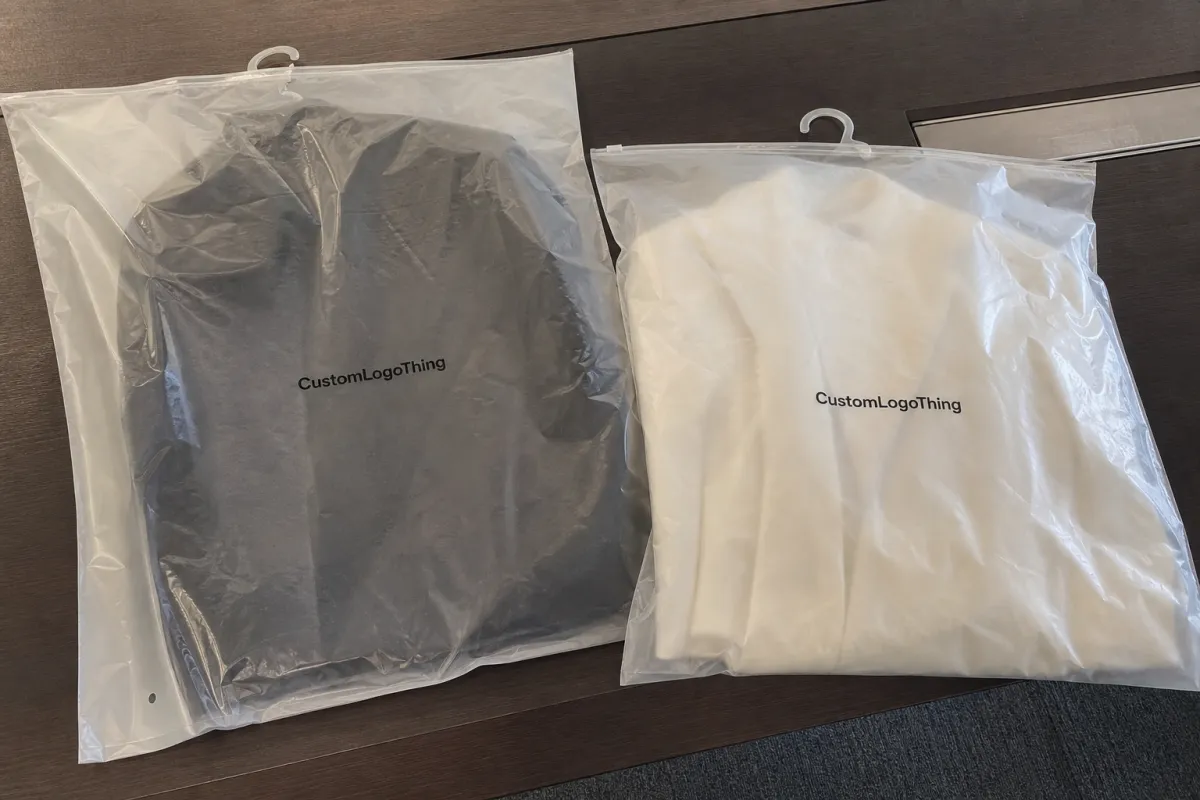
Buyers often start with a simple request: “We need a bag.” What they actually need is a packaging component that handles protection, presentation, and production speed at the same time. A private label Custom Plastic Garment Bags supplier manufactures the bag to your specification, but your team decides the dimensions, film type, logo placement, closure, and sometimes the hanger opening or gusset. That is a broader job than most first-time buyers expect.
The private label part matters most when a brand carries multiple SKUs, enters new seasons quickly, or sells through more than one channel. A sleeve that works for a blouse may not suit a coat. A format that is acceptable for warehouse storage can look too plain for retail. Once the order volume rises, inconsistency becomes expensive. The point of private label is not decoration. It is control.
There is also a subtle branding effect that buyers underestimate. A blouse inside a clean, correctly sized bag reads differently from the same blouse inside a stretched, cloudy, or overprinted sleeve. The packaging can make a product feel considered or careless. That impression is built in seconds.
Stock versus private label: stock bags are fast and cheap, but they force your product to fit someone else’s standard. Private label bags are slower to set up, but they can match the garment, the line, and the customer experience more closely. That tradeoff becomes worth it when the bag is part of the product presentation rather than just a dust cover.
How the Production Steps and Lead Time Usually Work
The production path is usually familiar: brief, quote, proof, sample, approval, film production, printing, conversion, packing, freight booking. Nothing exotic there. The problem is that every stage depends on the one before it. A vague size can stall tooling. A missing logo file can delay proofing. A late change to print placement can push the job back into the queue. Most lead-time problems are caused early, not near the end.
Sampling and mass production do not move on the same schedule. If the supplier already has compatible material and the print is simple, a sample can come back quickly. Full production takes longer, especially if the film must be extruded, the print has multiple colors, or the order needs a queue on the conversion line. For many straightforward custom programs, 12-15 business days from proof approval is a realistic production window. More complex specs, larger volumes, and freight delays can push that out.
A useful quote is one that breaks the timeline into pieces. Ask for proof turnaround, sample lead time, production time after approval, estimated freight transit, and any buffer needed for artwork edits. That gives you a schedule you can actually manage. It also exposes the difference between a supplier who has run similar jobs before and one who is guessing.
Packaging professionals often sanity-check performance standards against guidance from the Institute of Packaging Professionals and the ISTA testing community. The point is not theory for its own sake. The point is to know whether the bag will survive real handling, not just look good on a screen.
A sample that looks polished but twists on the hanger is not a sample worth approving. One weak seam or poorly placed opening can turn into thousands of weak seams or poorly placed openings.
Cost, MOQ, and Quote Variables That Change Your Unit Price
Unit price is rarely a single number. It moves with film thickness, bag size, print coverage, color count, closure style, and pack format. A clear sleeve with one-color branding is not comparable to a heavy-gauge zippered cover with a custom hanger slot. Quotes that look cheap at first glance often become ordinary once artwork, setup, freight, and repacking are added back in.
A practical MOQ for custom printed garment bags often lands around 3,000-10,000 pieces, though the real floor depends on whether the bag is stock size or fully custom. Lower MOQs are useful for testing demand, but the landed cost usually rises because setup and freight are spread over fewer units. For simpler runs, buyers may see pricing around $0.18-$0.28 per unit. More custom work often moves into the $0.30-$0.60 range, with heavy-gauge or specialty closure formats going higher. Those numbers are directional, not fixed.
| Option | Typical Use | Relative Unit Cost | Notes |
|---|---|---|---|
| Clear LDPE sleeve with one-color logo | Basic retail or warehouse protection | Low | Best for high volume and simple branding |
| Printed LLDPE bag with custom size | Standard branded apparel programs | Medium | Better fit and presentation, with more setup cost |
| Heavy-gauge bag with zipper or flap | Premium retail or storage | Higher | More material and more labor, so freight weight rises too |
| Fully custom private label format | Multi-SKU brand systems | Highest | Best consistency, but most sensitive to MOQ and tooling |
The easiest way to overpay is to over-spec the product. A 3-mil bag sounds durable, but many shirts do not need that much material. Full-bleed graphics can add cost without adding value if the garment is already visible through the film. The cleaner comparison is quote versus quote on the same size, same material, same closure, same print method, and same pack-out. Anything else is a different product dressed up as a pricing comparison.
Freight terms deserve equal attention. A quote can look attractive if it assumes ocean freight, a different Incoterm, or a more favorable carton count. Once the order lands, the math changes quickly. The supplier should be able to tell you where the cost sits: setup, material, production, case packing, and transport.
Material, Thickness, and Closure Choices That Protect Apparel
Most plastic garment bags use polyethylene, especially LDPE and LLDPE. The choice is usually a balance among clarity, softness, toughness, and price. Clear film shows the garment better. Softer film drapes more naturally around fabric. Heavier material adds strength, but too much thickness makes the bag stiff and bulky. That extra weight only helps if the garment actually needs it.
Thickness is one of the most misunderstood specs in apparel packaging. A lightweight bag around 0.8-1.2 mil can work for dry cleaning, single-use transport, and lightweight tops. Retail sleeves and bags that will be handled repeatedly often sit around 1.5-3 mil. Past that point, the gain is often more psychological than practical unless the product is especially heavy or fragile.
Closure style should match the garment and the channel:
- Open-bottom sleeves suit fast packing and hanging
- Flap closures work well for retail presentation and dust protection
- Zippers fit premium storage and repeat access
- Perforated tear-off designs help when line speed matters
- Hanger-style openings keep the garment aligned during transport
Different apparel categories need different protection. Delicate knits do better in a softer sleeve that does not flatten the hand feel. Formalwear usually needs a longer, cleaner presentation. Outerwear may require a wider opening or a heavier gauge. Uniform programs and wholesale packs often favor simple, durable formats that move quickly and tolerate rough handling.
Printing can help or harm. A logo that is too large or too opaque can make the bag feel more like a billboard than packaging. That is fine for some brands. For others, a smaller mark or a lighter print is enough. In packaging design, restraint often reads as more expensive than coverage.
When the same supplier supports multiple packaging pieces, consistency gets easier. A garment sleeve, a shipping mailer, and a carton can all carry the same brand logic if the print, color, and finish are planned together. That is where package branding starts feeling intentional instead of assembled from separate orders.
Step-by-Step Sourcing Checklist for Comparing Suppliers
Start with a spec sheet. Include bag dimensions, garment type, target quantity, branding method, desired packaging format, and delivery deadline. If some fields are still open, mark them clearly. The supplier should still be quoting the same brief every time. Otherwise, the numbers mean very little.
- Measure the garment in its actual packed state, not from a generic size chart.
- Decide whether the bag needs to fit one SKU or several sizes.
- Choose the print approach: one color, multiple colors, or no print.
- Ask for sample, tooling, artwork, and freight costs separately.
- Request a realistic timeline for proof, sample, and production.
Then judge the supplier on the things that predict repeat success. Responsiveness matters, but technical clarity matters more. A good supplier can explain seal strength, film choice, and print limitations without hiding behind sales language. If they cannot tell you why one material suits your use case better than another, that is a warning sign.
Before approving production, test the sample in real conditions: fit, transparency, seal strength, print sharpness, and how the bag behaves when a hanger is inserted and removed. Check it under the same lighting and handling conditions the bag will see in the warehouse or store. A sleeve that looks clear under office light can look cloudy under a dimmer stockroom setup.
Repeat order behavior matters too. Can the supplier hold the spec on file? Can they reproduce the same film, print, and pack format months later without drifting? That question separates a one-off vendor from a dependable private label Custom Plastic Garment Bags supplier.
Common Mistakes That Create Delays, Waste, or Weak Branding
Approving size by eye is a classic error. Measure the garment on hanger, folded flat, or in its poly-wrapped form, depending on how it ships. A bag that is even slightly off can wrinkle the product, waste carton space, or force workers to refold items on the line. Small errors scale fast once the order moves into the thousands.
Artwork causes its own problems. Low-resolution logos, missing brand standards, and vague placement instructions can turn a simple project into several proofing rounds. If the garment bag is part of a broader retail package, the logo should be checked against the tags, inserts, and cartons so the visuals do not compete with each other.
Price-shopping without confirming film gauge is another easy mistake. A quote may look lower because the supplier quietly shifted to thinner material or simplified the seal. That can save pennies on paper and create tears or cloudiness in the warehouse. A slightly higher price tied to a clear spec is usually safer than a cheap quote with fuzzy details.
If the quote does not say exactly what you are buying, it is not a quote you can trust.
Freight and case-pack details can erase savings as well. An attractive unit price can vanish if the carton count is awkward, the pallet footprint is inefficient, or the shipment has to move by air instead of sea. The same problem appears when buyers skip sampling and learn too late that the bag is too stiff, too narrow, or too cloudy for the garment.
The pattern is familiar: a small shortcut at the start becomes a larger cost later. In apparel packaging, presentation and protection are linked. Treat the bag like a commodity and it behaves like one. Treat it as part of the product, and the results usually improve.
Expert Tips and Next Steps Before You Place a Sample Order
Build a simple comparison matrix before you commit. Keep it practical: price, MOQ, lead time, material, print method, sample quality, freight assumptions, and reorder speed. Once those items sit side by side, the right supplier usually becomes obvious. The weak ones tend to rely on vague language and optimistic dates.
Request a sample that matches the real use case, not a polished display version. If the bag is meant for a women’s blouse on hanger, test it that way. If it will be used for outerwear in bulk packs, test that format instead. Many buyers approve a nice-looking generic sample and then discover the production version behaves differently because the brief was too broad.
A two-stage approval process helps. First, confirm structure and dimensions. Then, once the bag behaves correctly, lock the artwork and print placement. That sequence keeps the project from getting trapped in redesign after the technical spec is already approved. It also keeps internal feedback focused. Fit first, graphics second.
If repeat orders matter, ask how the supplier manages color consistency, spec retention, and archived approvals. A one-time win is useful. A repeatable spec is better. It cuts rework, protects brand consistency, and makes procurement easier when the next season opens.
The best Private Label Custom plastic garment bags supplier is not the one with the longest pitch. It is the one that gives you a clear spec, a believable timeline, and a sample that performs the way the final order should. When those three things line up, the packaging disappears into the process in the right way: not invisible, exactly, but dependable.
What should I ask a private label supplier before requesting a quote?
Confirm the exact bag dimensions, garment type, quantity, print coverage, and closure style so the quote matches the real use case. Ask whether sampling, artwork setup, tooling, and freight are included or billed separately. Request the expected lead time for both samples and full production so schedule risk is visible early.
How much does a custom garment bag supplier typically charge per unit?
Unit price depends on film thickness, size, print complexity, closure style, and order volume. Smaller MOQs usually cost more per bag because setup and freight are spread across fewer pieces. The best comparison is landed cost, not headline unit price alone.
What is the usual MOQ for custom plastic garment bags with private label branding?
MOQ varies by supplier and by how custom the order is. It often rises when the bag needs custom print, custom sizing, or specialty packaging. A lower MOQ can help test demand, but it usually comes with a higher unit cost. Ask whether the MOQ applies to one SKU or can be pooled across sizes.
How long does production usually take for custom garment bags?
Lead time depends on artwork approval, sample sign-off, material availability, and print method. Simple orders move faster than fully custom jobs with multiple colors or specialty finishes. Separate sample timing from production timing so planning stays realistic.
How do I know if a supplier is the right fit for branded garment bags?
Check whether they can explain materials, thickness, and print options in practical terms instead of vague sales language. Review sample quality for clarity, seal strength, fit, and branding accuracy. Choose the supplier that gives the clearest quote, the most reliable timeline, and the strongest repeat-order consistency.

