Private Label PVC Zipper Garment Bags Supplier for Brands
A private label PVC Zipper Garment Bags supplier is judged less by the logo on the bag than by what happens after the bag is handled, folded, hung, shipped, and opened again. Buyers notice whether the film stays clear, whether the zipper glides without biting the edge, and whether the garment still looks orderly after a few uses. That matters because a garment bag is more than a dust cover. It shapes presentation, protects inventory, and quietly tells the customer how much care the brand puts into detail.
The best suppliers do not just quote a price. They translate a brand brief into a workable production spec: film thickness, dimensions, zipper style, seam construction, print method, carton count, and shipping assumptions. Miss one of those pieces and the bag may still arrive, but it will likely feel generic or overbuilt in the wrong places. In packaging, small mismatches are expensive because they compound across the order.
For apparel brands, uniform suppliers, bridal businesses, and travel-focused retailers, PVC Zipper Garment Bags sit in a useful middle ground. They offer visibility, structure, and a cleaner retail signal than a loose poly cover. A clear bag also helps the garment itself do some of the selling. That is useful for premium shirts, coats, dresses, and seasonal pieces where first impression and storage performance are tied together.
What a private label pvc zipper garment bags supplier actually does
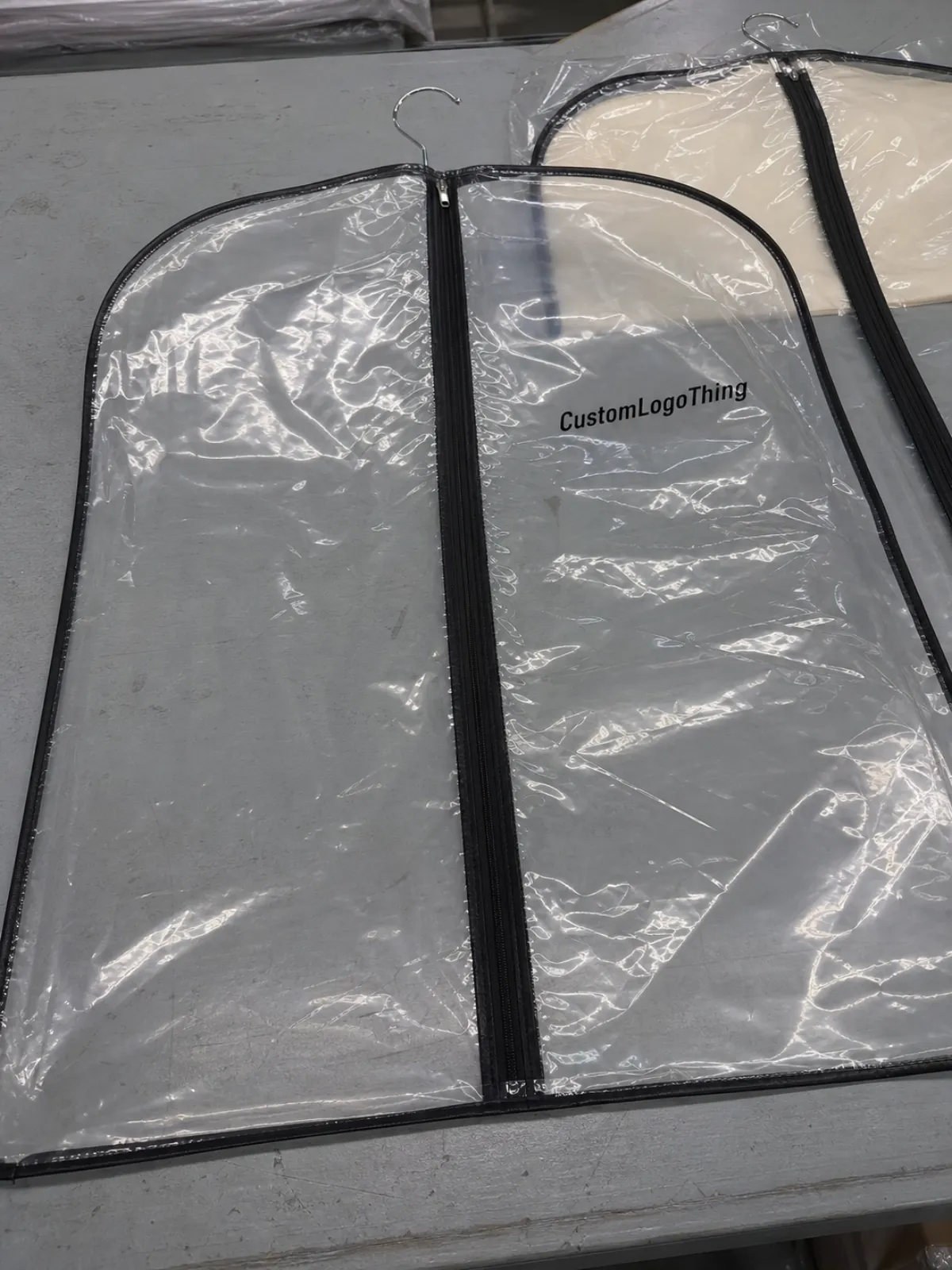
Private label sounds simple until it meets a factory floor. The supplier is not just printing a mark on a standard sleeve. They are manufacturing a branded PVC cover that needs to match the garment, the hanger, the fold, the retail environment, and sometimes even the way the product is packed for export. Logo placement, zipper color, hanger opening, gusset depth, and panel transparency all affect how the bag performs in the real world.
That role is part manufacturing partner, part spec translator. If a brand says “clean and premium,” that cannot remain a mood board phrase. It has to become a material decision. A thinner film may look elegant for lightweight fashion stock, while a heavier coat bag may need more body so it does not collapse over shoulder seams. If the supplier cannot explain those trade-offs, they are probably selling a catalog item rather than a tailored product.
The difference between PVC zipper garment bags and a simple poly cover is worth separating. Poly covers protect against dust and friction, but PVC brings visibility and a more structured appearance. That makes it useful for display, storage, and resale presentation. A buyer pays for that clarity, so the material has to earn its keep. Cloudy film, weak welds, or a sticky zipper immediately pull the bag back into commodity territory.
A practical supplier should also ask about the garment itself. A jacket, a long dress, and a uniform set do not occupy the same volume once folded or hung. The right bag size depends on the real object, not the label size. That sounds obvious, but it is one of the most common reasons custom runs miss the mark.
Because the bag is part of the broader brand system, some buyers coordinate it with hang tags, inserts, or external labels so the presentation stays consistent from warehouse to retail floor. That alignment is not decorative. It reduces mixed signals, especially when product is handled by multiple teams before the end customer sees it.
Quality also shows up in details that are easy to overlook from a quote sheet. Heat-welded seams, for example, may outperform stitched joins on a clear garment bag because stitching can create leak points or visual clutter. A zipper with a smooth pull tab often matters more to the end user than a full panel of print. The customer touches the zipper first, not the logo.
Production process and lead time: from sample to shipment
The least chaotic projects usually follow a fixed order: inquiry, spec confirmation, artwork review, sampling, approval, mass production, inspection, and shipment. That sequence sounds basic, but packaging delays often come from skipping one gate and discovering the missing detail after production has started. Once film is cut and sealed, every change becomes a cost.
Sampling is where the real buying work happens. A blank sample lets you check clarity, size, zipper feel, and folding behavior. A printed sample shows how the logo sits on transparent film and whether the color survives the visual competition of a clear surface. The pre-production sample matters most because it should reflect final materials, assembly method, and print placement. A pretty sample that does not match the actual run is not useful.
Lead time varies more than many buyers expect. If the factory has stock film and the design is one color, some suppliers can move from approval to shipment in roughly 12 to 15 business days for smaller, simpler runs. Once the order includes heavier film, double-sided print, special zipper color matching, or a larger carton program, 20 to 30 business days is more realistic. Freight time sits on top of that. Sea transit, customs clearance, and domestic delivery should be planned before approval, not after production is complete.
Delays usually come from three places: artwork revisions, unclear measurements, and zipper or color matching. “Fits a medium shirt” is too vague to be useful. A useful spec describes the actual bag size, the hem allowance, the intended fold, and the closure direction. If a supplier has to guess whether the zipper should run left to right or right to left, the project is already behind.
The cheapest quote is often the one with the most missing detail.
That sentence holds up in garment packaging more often than buyers like to admit. Missing detail creates rework, and rework is rarely visible in the first quote. A strong private label pvc zipper garment bags supplier reduces that risk by asking uncomfortable questions early: What is the hanging length? Will the bag travel by sea or courier? Does the garment have bulk at the shoulders or hem? Those questions save time later.
Inspection should happen before cartons leave the factory. Check seam integrity, zipper alignment, print registration, and the consistency of folded units in master cartons. For clear film products, even a small seal defect can turn into a visible failure once the bag is hung under weight. Sampling and inspection are not separate rituals. They are the same risk-management exercise viewed at different stages.
It also helps to think about shipping as part of product quality. A garment bag that leaves the factory flat and clear can still arrive warped if the cartons are weak or the pallet pattern is careless. Packaging groups such as ISTA focus on transit performance for a reason: the distribution system changes the product. A light, flexible item is not exempt from damage just because it weighs little.
PVC thickness, zipper styles, and spec choices that affect performance
Material thickness is the first place most buyers start, and for good reason. Clear PVC Garment Bags commonly sit in a range around 0.12 mm to 0.25 mm, depending on the intended use. Lighter film can be adequate for shirts, blouses, and promotional programs where the bag will be folded often. Thicker film makes more sense for coats, uniforms, or retail pieces that need a more substantial hand-feel and better structure.
There is a trade-off. Thicker film holds shape better and tends to resist the flimsy, clingy look that cheapens a presentation. It also adds weight, increases folding stiffness, and raises cost. For a jacket cover that stays on a hanger, that extra body is usually worth it. For a travel-friendly cover that moves through shipping and storage repeatedly, too much thickness can create bulk without enough payoff.
Zipper construction deserves equal attention. A smooth coil zipper with a durable pull tab is often the most practical choice for repeated handling. If the teeth do not align cleanly, or if the pull feels fragile, the entire bag reads as lower quality. That judgment happens in seconds. People may not describe it in technical language, but they feel it immediately.
Bag dimensions should follow the garment itself, not just the retail size label. A 24 x 36 inch format can work well for many shirts and blouses, while dresses, suits, and coats often need additional length or a gusset. Too small, and the garment compresses and wrinkles. Too large, and the bag looks sloppy and wastes material. A useful supplier will ask for measured garment dimensions, not only category names.
Printing choices are easier to get wrong than they look on paper. Transparent PVC can make light inks disappear and thin type lose legibility. A one-color logo often reads more premium than a crowded layout, especially on clear film where the garment is already contributing visual interest. If the brand wants a strong retail signal, placement matters as much as ink. Top-center marks, corner logos, and reserved clear panels create very different impressions.
Seam method is another quiet specification with real consequences. Heat welding or RF sealing may offer cleaner lines and fewer weak points than stitched construction on this kind of bag. The exact method depends on the factory and on the bag shape, but buyers should still ask. A clear answer here is a good sign. Vague answers usually mean the factory wants to keep the process flexible for itself, not necessarily for the buyer.
There is also a packaging finish issue that often gets ignored: clarity consistency. Some PVC films look bright in one batch and slightly hazy in the next. For a brand that wants a uniform shelf look, that variation matters more than many procurement teams realize. If sample approval is based on a particularly clear roll, the production lot should be checked against that sample, not against memory.
Pricing, MOQ, and unit cost drivers behind your quote
Garment bag pricing is usually driven by five variables: film grade, thickness, bag size, zipper type, and print coverage. Quantity and packaging format come next. A transparent supplier should separate the bag cost, print cost, sample charges, carton specs, and freight assumptions. If all of that is buried inside one number, comparison shopping becomes a guessing game.
MOQ, or minimum order quantity, reflects where setup cost stops making sense. Lower quantities are possible, but the unit price usually rises because cutting, sealing, printing, and packing costs are spread across fewer bags. That does not automatically make low MOQ a bad choice. For launch testing or seasonal drops, paying more per unit can be a rational trade for flexibility.
| Order profile | Typical MOQ | Indicative unit price | Best fit | Main trade-off |
|---|---|---|---|---|
| Simple clear bag, one-color logo | 2,000-3,000 pcs | $0.42-$0.85 | Basic retail or storage use | Higher cost per unit at smaller volumes |
| Medium-weight bag, gusset, printed panel | 5,000 pcs | $0.28-$0.62 | Brand launches and seasonal programs | More setup discipline required |
| Heavier coat bag, double-sided print | 8,000-10,000 pcs | $0.55-$1.10 | Premium apparel and uniform programs | More freight weight and longer approval time |
These ranges are directional, not universal. A quote can look sharp until freight, extra colors, inserts, carton upgrades, and palletization are added. A $0.34 ex-factory bag can become a $0.58 landed unit once shipping and handling are included. That is why landed cost matters more than headline unit price. The cheapest origin quote is not necessarily the cheapest delivered result.
Two buyers can receive wildly different prices for what appears to be the same product because one spec is actually thinner, lighter, or less exact. A clean quote should list dimensions, thickness, zipper style, logo placement, carton count, sample policy, and ship point. If those elements are not spelled out, price comparison is not really comparison. It is interpretation.
One useful habit is to compare quotes against the real use case. A garment bag for a bridal collection does not carry the same expectations as a bag for warehouse storage. The premium client may care more about clarity and a refined closure feel. The warehouse buyer may care more about consistency, stackability, and resistance to warping. Those priorities should change the spec, and the spec should change the price.
Step-by-step sourcing checklist for a cleaner RFQ
A strong RFQ gives the supplier enough information to price accurately without creating room for invention. Start with the garment type, target dimensions, logo files, preferred film thickness, quantity, and required delivery date. If you already know whether the order is for shirts, dresses, coats, or uniforms, say so. That single line can shift the recommended bag size and material weight.
- Describe the product use case in plain language.
- Measure the actual folded or hung garment, not only the size label.
- Send artwork in vector format and identify the exact print color.
- Request a spec sheet that lists dimensions, thickness, zipper style, and carton count.
- Ask for sample timing before you evaluate unit price.
- Confirm freight assumptions and destination terms before approval.
Visual references help, especially when the project has a specific retail feel in mind. A photo of a comparable bag, a shelf display, or an existing cover can show the supplier what “right” looks like in practical terms. The point is not to copy a competitor. The point is to remove ambiguity from a transparent, highly visual product.
Version control matters more than most teams expect. One final spec sheet should hold the approved measurements, artwork placement, zipper direction, folding method, and carton count. If procurement, operations, and sales are all working from different email threads, confusion is almost guaranteed. A disciplined private label pvc zipper garment bags supplier will usually appreciate that structure because it reduces production risk on their side too.
If the garment bag is part of a broader branded pack, align the labels, tags, and inserts early. Those items should not look as if they were designed by three different companies. Packaging looks more professional when the pieces agree on finish, hierarchy, and tone.
Common mistakes buyers make before placing the order
The first mistake is relying on clothing size labels instead of actual measurements. A medium jacket and a medium shirt are not close enough in volume for custom packaging decisions. Once the garment is folded, padded, or hung, the difference becomes obvious. Bags are physical objects; labels are just shorthand.
The second mistake is approving artwork before print limits are confirmed. Transparent PVC is less forgiving than paper or opaque film. Thin type, low-contrast colors, and delicate lines can disappear or become harder to read once placed on clear film. A logo that feels crisp in a PDF may not survive the visual noise of a transparent surface.
The third mistake is treating the zipper as a minor accessory. It is not minor to the person using the bag. If the closure catches, wobbles, or feels flimsy, the bag instantly reads as lower value. Buyers often focus on branding and forget the component that gets touched every time the bag opens and closes.
Carton planning causes its own kind of trouble. PVC film can crease, curl, or flatten if the carton size is wrong or if cartons are stacked too tightly. Ask how the bags are folded, how many units go into each master carton, and whether the carton structure is strong enough for export handling. These details are not glamorous, but they protect the actual yield of the order.
Another mistake is letting approval notes live only in email. Once revisions start, small differences creep in. One person remembers 0.18 mm film, another remembers 0.20 mm. Someone else thinks the logo moved two centimeters. By the time the run is in process, nobody has the same version in front of them. The cleanest orders are the ones with a single final spec and a single final sample reference.
Expert tips for branding, testing, and freight-ready packaging
Branding on clear film works best when the bag stays visually quiet. Simple logos, restrained panel coverage, and careful placement usually feel more expensive than crowded graphics. That is partly aesthetic and partly psychological. The clearer the bag, the more the garment itself becomes part of the design. Loud print can work for a promotional item, but it can also flatten a premium presentation.
Testing should cover the parts most likely to fail under use, not the parts easiest to admire in a photo. Check zipper cycle smoothness, seam strength near the closure, and the way the film behaves after repeated opening and closing. A quick inspection can reveal weak pull tabs, misaligned seals, or stress whitening near the zipper track. Those flaws are small in the sample room and obvious in the hands of a retailer.
Freight-ready packaging should be specified early, not left to the factory’s default method. Confirm folding direction, carton strength, pallet pattern, and stack height. The shipping route matters too. Long sea freight is much less forgiving than a short domestic move. Even a lightweight item benefits from planning that assumes pressure, vibration, and handling, not just storage in a warehouse.
There is a sustainability question here, but it should be handled without pretending PVC is paper. The bag material is what it is. What buyers can control more easily is the carton, insert, and label system. If the outer pack needs a cleaner paper trail, FSC-certified board and concise insert design are often the most practical choices. Packaging organizations such as packaging.org are useful references for teams that need shared language around material selection and distribution.
Experience in this category usually shows up as restraint. The suppliers worth listening to tend to talk in specifics: what thickness works for a coat, how a zipper behaves after repeated use, how much freight weight changes between specs, and where a logo stops being legible. The point is not to make the bag more complicated. The point is to avoid paying for features that do not improve the finished product.
One more practical observation: buyer feedback is most valuable when it is narrow. “Make it better” does not help much. “The zipper pull feels too light,” “the print sits too low,” or “the bag is narrow at the shoulders” gives the factory something they can actually correct. Clear feedback shortens the distance between sample and production.
FAQ
How do I choose a private label pvc zipper garment bags supplier for retail branding?
Start with sample quality, print accuracy, zipper performance, and how clearly the supplier explains spec trade-offs. A useful partner should be able to tell you why one film thickness fits your garment better than another and should document the final dimensions, materials, and artwork placement in writing.
What MOQ is typical for private label PVC zipper garment bags?
MOQ depends on size, print complexity, zipper style, and material choice. Smaller orders are possible, but the unit price usually rises because setup costs are spread across fewer bags. For many custom programs, 2,000 to 5,000 pieces is a common working range, while larger premium runs often start higher.
How long does production usually take for custom PVC zipper garment bags?
After sample approval, simpler runs can sometimes ship in about 12 to 15 business days if materials are in stock. More complex orders, heavier film, or double-sided printing often need 20 to 30 business days. Freight time, customs clearance, and domestic delivery should be added separately.
What should be included in a quote from a garment bag supplier?
A useful quote should break out bag cost, printing, sample charges, carton details, and freight assumptions. It should also confirm dimensions, film thickness, zipper style, logo placement, and order quantity so the price ties back to a real specification rather than a rough estimate.
Can a private label PVC zipper garment bags supplier print my logo on both sides?
Yes, but double-sided printing can affect cost, lead time, and legibility on transparent film. Ask for a mockup or sample first. On clear PVC, the back side may read differently depending on the print color, the garment inside, and the amount of visual competition from the product itself.
For brands that treat the garment bag as part of the product rather than a throwaway accessory, the supplier choice matters. The right factory is the one that makes the spec sharper, the approval process cleaner, and the landed cost easier to understand. That is a better signal than a low number on the first quote.


