A Recyclable Poly Bags Wholesale china factory is only useful if the bag holds up on the packing line, fits the product, and supports the claim you plan to make about disposal. A cheap quote does not tell you whether the film will split at the seal, drag through the loader, or arrive with gauge drift that turns a neat spec into scrap. Those failures are not theoretical. On high-volume lines, a 2% reject rate on 100,000 bags is 2,000 units, and that can wipe out any savings from a lower unit price.
For garment packing, warehouse dispatch, retail inserts, and e-commerce protection, buyers usually want the same thing: a clean-looking bag that protects the product, packs quickly, and stays consistent from one order to the next. Recyclability matters, but only if the structure still behaves like packaging. A mono-material PE bag that opens badly or tears under normal handling is not a better commercial choice than a slightly heavier bag that runs cleanly and avoids rework. The useful question is not whether the bag is advertised as recyclable. It is whether the bag is the right combination of film, seal, size, and print for the job.
The packing problem recyclable bags solve on busy lines
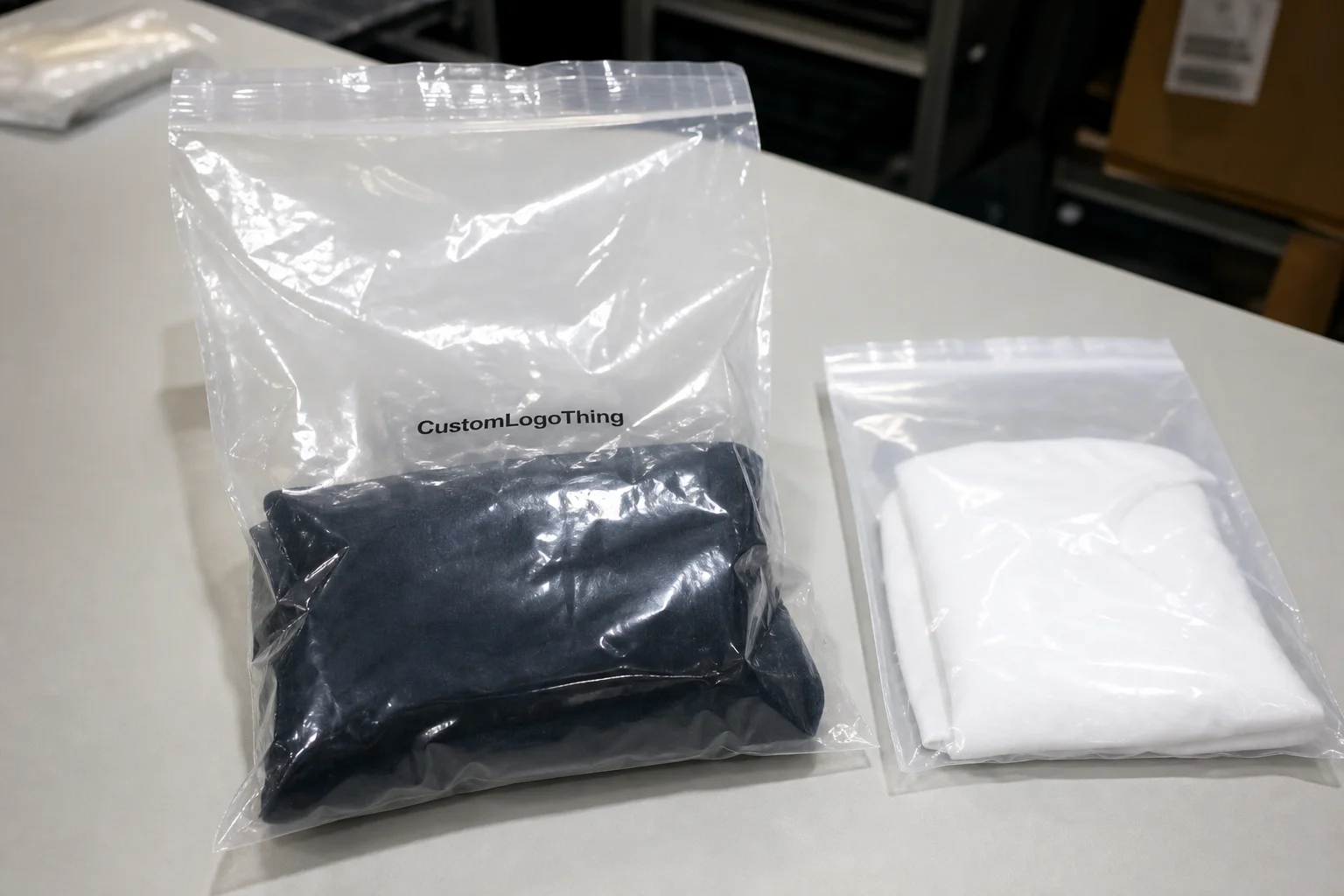
On a busy line, the best bag disappears into the process. Workers should not have to fight static, peel apart stuck mouths, or stop to sort wrinkled seals. Every extra second per unit compounds. At 3 seconds of friction on a 10,000-piece run, you have already spent more than 8 extra labor hours on one order. That is the kind of cost that never appears on a factory quotation.
Recyclable Poly Bags are often used because they combine light weight with predictable handling. That is useful for soft goods, folded apparel, printed inserts, and protected components that do not need a rigid carton. They also help buyers simplify packaging programs, since a mono-material polyethylene structure is easier to align with common recycling streams than a mixed laminate with multiple polymer layers. Still, the actual recyclability claim depends on the market, the collection system, and the exact construction, so it is risky to treat the word itself as proof.
The packing environment should drive the spec. A bag that slides neatly into a carton line has different requirements from one that sits on a shelf as retail packaging. Dust protection, moisture resistance, and scuff control are not the same thing as visual presentation. A clear sleeve for a garment needs enough clarity and slip to be handled quickly, while a shipping insert may care more about puncture resistance and seal integrity than appearance.
A bag that looks recyclable but fails in the packing room is a false economy. The real value comes from consistent seals, predictable handling, and a structure that matches the way the product is loaded, closed, and shipped.
If you are comparing bags across a wider packaging program, the broader sourcing picture matters. Our Wholesale Programs page is useful for recurring procurement, while Custom Packaging Products helps connect bags with cartons, inserts, and other components that need to work together rather than separately.
Recyclable poly bags wholesale China factory: what the factory should prove
A serious supplier should begin with the resin family, the bag style, the thickness range, the print requirement, and the market where the recyclability claim will be used. For most recyclable poly bags, the basic path is a polyethylene structure, often mono-material PE, because that is easier to match with common recycling guidance than a multi-material laminate. That does not mean every PE bag is automatically recyclable everywhere. It means the structure is more compatible with the claim, provided the local collection system accepts it.
The factory should be able to tell you more than “custom available.” Ask what resin blend is used, whether the bag is LDPE, LLDPE, or a blend, and what that means for clarity, softness, and seal behavior. LDPE tends to feel softer and may provide good clarity for retail use. LLDPE often improves puncture resistance and toughness. HDPE can offer stiffness and a crisp feel, but it is not the best choice for every application. The right answer depends on the product and the line, not on a generic sustainability label.
Before quoting, the factory should confirm dimensions, seal type, gauge target, print colors, and packing style. A plain flat bag, a gusseted bag, a wicketed pack, and a perforated roll are not interchangeable. Each one changes the setup, labor, and waste profile. A buyer should also ask for a sample and a spec sheet, not just a digital mockup. Once production starts, vague wording becomes expensive very quickly.
Useful questions to ask early:
- What resin family is being used, and is the construction mono-material PE?
- What thickness range is realistic for this size and application?
- Is the bag plain, printed, perforated, wicketed, or custom cut?
- What testing or declarations support the recyclability claim in the target market?
- What sample will be approved before the full run begins?
For broader packaging reference, Packaging offers useful education on film structures and packaging systems, while the EPA’s recycling guidance at EPA recycling resources is a practical starting point for thinking about end-of-life claims and local disposal realities.
Film thickness, size, seal type, and print options that matter
Thickness does most of the heavy lifting. Buyers usually compare microns or mils because “light” and “heavy” are too vague to be useful. A thinner film may work for soft garments, document sleeves, or dry inserts. A heavier gauge is usually safer for sharp corners, repeated handling, stacked cartons, or any line that sees rougher treatment. The wrong thickness is not a minor miss. A bag that tears once every few hundred units can create enough interruption to spoil an entire shift.
Size matters just as much. A bag that is too tight makes loading awkward and can stress the seal, while a bag that is too loose wastes film and makes the finished pack look careless. Good factories keep width and length tolerances tight because even a few millimeters can change how a bag feeds, opens, and stacks. Gussets, side seals, bottom seals, perforations, vent holes, and wicketing all influence how the bag behaves in real use. If those details are not confirmed before production, the finished order can still be “correct” on paper and wrong on the line.
Print adds another layer of risk. A simple one-color logo is easy to control. Multi-color graphics, barcodes, warning text, and legal markings are harder because registration has to stay sharp and the ink load must not interfere with the film’s hand feel or seal area. Heavy coverage can change slip and increase blocking if the curing or stacking is rushed. That is why a printed sample matters more than a rendering. A screen image cannot tell you whether the artwork is too close to the seal edge or whether the film curls after printing.
For most buyers, the practical spec checklist looks like this: exact dimensions, target thickness, seal style, print coverage, approved color standard, opening method, packing quantity per carton, and acceptable tolerance. Those details are unglamorous, but they are what keep repeat orders from becoming guesswork.
Here is a simple comparison buyers often use during early sourcing:
| Bag option | Best for | Typical MOQ | Common unit price range | Main watchout |
|---|---|---|---|---|
| Plain recyclable PE bag | General protection, inner packing, warehouse use | 5,000-10,000 pcs | $0.02-$0.06 | Thickness has to match the load, or tear rates climb fast |
| Printed recyclable PE bag | Retail presentation, branding, barcode marking | 10,000-30,000 pcs | $0.05-$0.15 | More print coverage raises cost and can affect surface feel |
| Wicketed or perforated pack | Fast line loading, high-volume packing stations | 20,000+ pcs | $0.07-$0.18 | Setup and packing method need to be agreed early |
| Heavier-gauge custom size | Puncture resistance, repeated handling, stacked shipping | 10,000+ pcs | $0.06-$0.20 | Freight can rise quickly with size, carton count, and volume |
The thickest bag is not automatically the best bag. In several packaging programs, buyers pay for extra film they do not need, then lose the saving in freight and slower packing. A better method is to match gauge, size, and seal type to the actual use, then test the bag on the real line before releasing the full order.
Cost, pricing, and MOQ drivers that change the quote
Price is shaped by a few repeatable factors: resin grade, bag size, thickness, number of print colors, packing method, and how much setup the order requires. A standard plain bag with simple dimensions is relatively easy to quote. Once you add custom sizing, multi-color artwork, wicket packing, high gauge film, or strict color matching, the order becomes more complex and the minimum quantity usually rises with it.
MOQ is not always a sales tactic. Often it reflects waste during setup, the quantity needed to stabilize extrusion or conversion, and the labor needed to finish, pack, and inspect the order. A clean supplier will explain whether the threshold is driven by tooling, print plates, material purchase minimums, or production efficiency. That answer matters because it tells you whether the MOQ is negotiable, or whether it is tied to actual process cost.
Factory price is only one piece of the equation. Landed cost is usually the number that matters. A low ex works quote can look attractive until you add cartons, pallets, freight mode, customs handling, and destination delivery. Lightweight packaging is especially sensitive to this because volume can cost more than weight. That means a bag that saves half a cent at the factory may end up costing more overall if the carton count, pallet pattern, or shipping cube is inefficient.
One practical buying habit is to ask for a quote that includes unit price, carton quantity, gross weight, cubic volume, and the destination port or address. That makes comparison possible. Without those details, suppliers are not quoting the same thing, and the cheapest line item can turn into the most expensive shipment.
For recurring purchases, the economics usually improve. Stable artwork, approved dimensions, and a fixed spec reduce sampling cycles and remove a lot of hidden cost. This is one reason a disciplined Recyclable Poly Bags Wholesale china factory relationship can be more economical than chasing the lowest quote every round. Repeatability is a cost saver. It does not look dramatic on a spreadsheet, but it matters.
Process and lead time: from approved specs to shipment
Good production starts with a complete inquiry. The factory reviews size, film structure, print requirement, and quantity, then confirms whether the order is a standard run or a custom conversion. If artwork is involved, a proof is prepared. If the bag needs physical verification, the supplier produces a sample and the buyer checks the fit, opening behavior, seal quality, and print appearance before the order moves forward.
Time is usually lost in the same few places: missing dimensions, unclear artwork, slow sample approval, and last-minute changes after production has already started. That is where many schedules slip. A buyer who changes seal position or artwork placement after approval can create delays that are avoidable. The cleaner approach is to lock one technical version, document it, and keep revisions out of the production window unless there is a real defect.
Lead time depends on material availability, order volume, print complexity, and whether the supplier is running a standard stock program or a custom job. Plain bags can move relatively quickly once the spec is fixed. Printed or wicketed bags usually need more time because setup, plate making, sample approval, production, inspection, and export booking all sit in the schedule. A reliable factory should give a staged timeline rather than one optimistic date that leaves no room for actual manufacturing.
Inspection should also be part of the schedule, not an afterthought. Basic checks include thickness measurement, seal strength, print registration, color consistency, dimensions, packing count, and carton condition. For sensitive shipments, buyers may also ask for drop or transit testing aligned with standards discussed by the International Safe Transit Association. That does not replace product-specific validation, but it gives a useful framework for comparing packaging integrity before freight leaves the factory.
A buyer should expect the supplier to confirm sample timing, production timing, inspection timing, and shipment booking separately. That level of detail is not excessive. It is the difference between a schedule that can be managed and a schedule that fails by surprise.
What a reliable China factory does differently on repeat orders
Repeat orders reveal whether a supplier is truly controlled or just lucky on the first run. A dependable factory keeps the previous spec on file, stores approved samples, and reproduces the same dimensions and print with minimal drift. That sounds basic, yet many procurement teams only find out how loose a process is on the second or third order, when the bags fit differently and the line slows down.
Process control shows up in small ways. Stable gauge control affects strength and hand feel. Stable sealing conditions affect leak risk and how the mouth opens. Stable print registration affects how the product looks on shelf or in transit. If those variables are held tightly, the bag behaves the same way each time, and the buyer does not have to renegotiate the order every cycle.
Direct technical communication matters as well. When a question comes up on resin choice, seal temperature, or print placement, a factory that can answer quickly usually saves a lot of time. That is not a marketing point. It is a practical sourcing advantage. It shortens sample cycles, reduces misunderstandings, and makes urgent replenishment less painful.
Quality control should be visible in the documentation too. Ask for the approved spec, the final sample, the production record, and the packing count. If the order is printed, ask how the supplier checks registration and whether the artwork proof matches the final plate setup. If the order is unprinted, ask how the factory measures thickness consistency across the run. Those checks are mundane, but they are the fastest way to separate a controlled supplier from one that is improvising.
For buyers who manage more than one packaging category, consistency across formats matters. If your team also sources mailers, our Custom Poly Mailers page is a useful reference for comparing construction, print handling, and packing methods against the bag program.
The best supplier relationship is not built on a single low number. It is built on repeatable quality, clear communication, and the ability to reorder without reworking the same spec every time. That is especially true for a Recyclable Poly Bags Wholesale china factory relationship, where the business case depends on stable output, not one successful shipment.
Next steps to request samples, confirm specs, and place the order
If you are ready to source, send a complete brief. Include bag dimensions, thickness target, material preference, print artwork, estimated annual or quarterly volume, and the destination port or address. Add the use case too. A garment inner bag and a shipping insert are not interchangeable, and the spec should show that difference. The more complete the brief, the less likely the quote is to be vague.
Ask for physical samples or a pre-production sample set before approving the full run, especially if the bag is printed or the seal is critical. A mockup is useful for layout, but a real sample tells you whether the film feels right, whether the opening is practical, whether the bag blocks in carton packing, and whether the seal behaves under normal handling. That is the level of feedback that actually reduces risk.
Confirm quotation terms in writing: unit price, MOQ, packaging method, lead time, payment terms, inspection standard, and what happens if artwork changes. Buyers lose time and money when these points are assumed instead of documented. If the quote leaves room for interpretation, fix the ambiguity before payment and production begin. A clean agreement is not a formality. It is part of cost control.
From there, compare sample quality, lead time, and landed price side by side. Do not choose on one number alone. The right supplier offers the right structure, the right print, and a schedule that can hold. If those three line up, the order is usually easier to manage and cheaper in practice, even if the unit price is not the absolute lowest. For packaging, stable performance beats headline savings that disappear after the first problem shipment.
What should I send for a recyclable poly bags wholesale quote from China?
Send the bag size, thickness target, resin preference, print colors, quantity, and the exact application so the factory can quote a structure that fits the job. Add the destination, carton expectations, and whether you need samples first, because those details affect both pricing and timing.
How do I compare recyclable poly bag suppliers on more than price?
Compare spec consistency, sample quality, seal strength, print accuracy, and whether the supplier can reproduce the same bag on reorder. Ask for landed cost rather than factory price only, so freight, packing, and handling are part of the comparison.
What MOQ is typical for recyclable poly bags wholesale China factory orders?
MOQ depends on size, print complexity, and construction. Plain bags usually have lower thresholds than custom printed or wicketed versions. A good factory should explain whether the MOQ is tied to tooling, plate cost, setup waste, or material purchase minimums.
Can recyclable poly bags be printed without hurting performance?
Yes, if the print coverage, ink system, and film structure are matched correctly to the bag use and sealing method. A sample approval step is the safest way to check appearance, handle feel, registration, and durability before mass production.
How long does production usually take for recyclable poly bags?
Timing depends on sample approval, artwork readiness, material availability, and whether the order is plain or custom printed. A reliable supplier should break the schedule into sample, production, inspection, and shipment booking so the lead time is visible instead of guessed.


