Buyer Fit Snapshot
| Best fit | Recycled Kraft Grocery Bags Supplier projects where brand print, material claims, artwork control, MOQ, and repeat-order consistency need to be specified before quoting. |
|---|---|
| Quote inputs | Share finished size, material target, print colors, finish, packing count, annual reorder estimate, ship-to region, and any compliance wording. |
| Proofing check | Approve dieline scale, logo placement, barcode or warning zones, color tolerance, closure strength, and carton packing before bulk production. |
| Main risk | Vague material claims, crowded artwork, missing packing details, or unclear freight terms can make a low unit price expensive after revisions. |
Fast answer: Recycled Kraft Grocery Bags Supplier: Pricing, Specs should be specified like a repeatable production item. The safest quote records material, print method, finish, artwork proof, packing count, and reorder notes in one written spec.
Production checks before approval
Compare the actual filled-product size with the drawing, then confirm tolerance on folds, seals, hang holes, label areas, and retail display edges. Reserve space for logos, QR codes, warning copy, and material claims before decorative graphics fill the panel.
Quote comparison points
Review material grade, print process, finish, sampling route, tooling charges, carton quantity, and freight assumptions side by side. A quote is only useful when the supplier can repeat the same color, closure quality, and packing count on the next order.
Custom Logo Things
Recycled Kraft Grocery Bags Supplier: Pricing, Specs, and Buying Risks
Choosing a recycled kraft grocery bags supplier sounds simple until a handle gives way at checkout and a routine transaction turns into a tiny public disaster. I have watched buyers focus on pennies per bag and then spend far more cleaning up the fallout when the packaging fails in the store. Paper bags are not glamorous. They are closer to risk management than to branding, and that is exactly why the details matter.
The right supplier is not just selling brown paper with a logo on it. A dependable recycled kraft grocery bags supplier should understand fiber content, paper weight, handle reinforcement, print limits, and the way a bag behaves once it is loaded with real groceries instead of a neat sample weight. That is the practical test. Not the brochure. Not the rendering. The moment a customer picks up two bottles, a carton of eggs, and a bunch of produce, the bag either behaves or it does not.
"The cheapest bag is expensive if it fails in front of a line of customers."
What a recycled kraft grocery bags supplier really provides
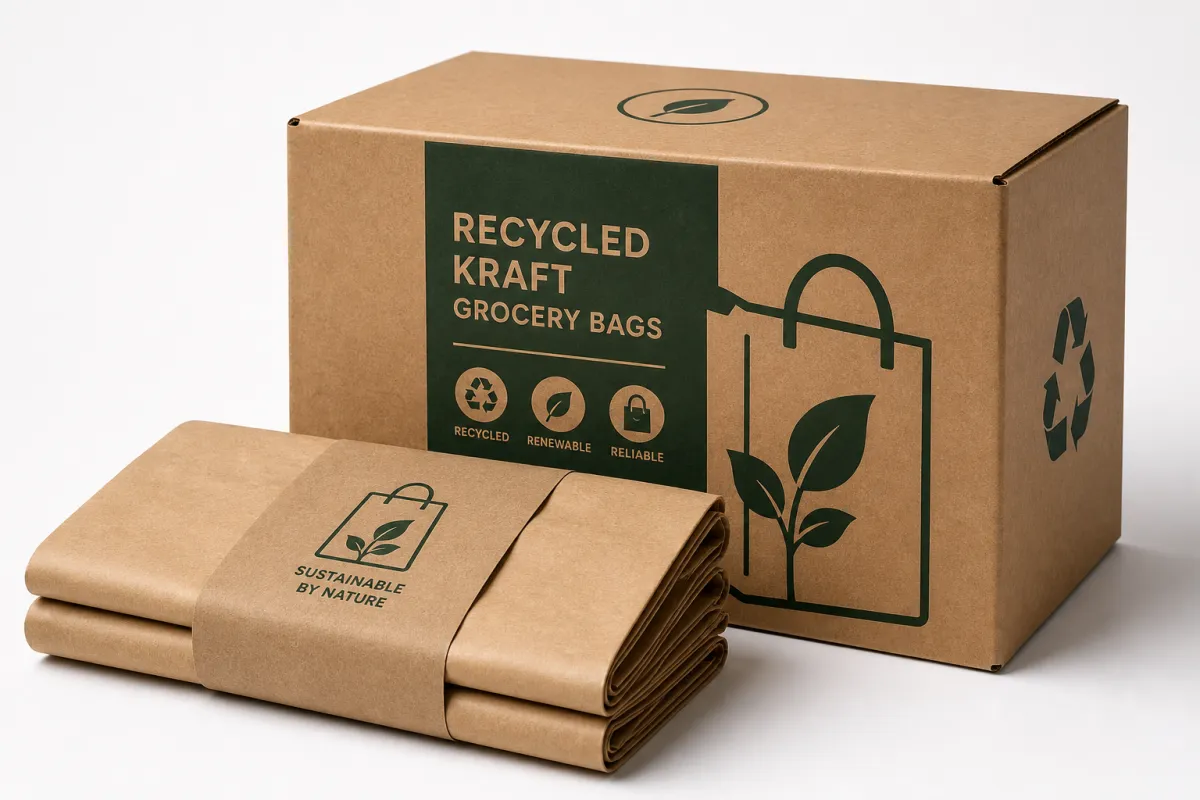
A recycled kraft grocery bags supplier should provide more than a stack of paper sacks and a price sheet. The better ones source recycled fiber, convert it into the right bag format, confirm strength, and keep consistency from one lot to the next. That consistency matters more than people think. A grocery bag has a very unromantic job: carry weight, survive handling, and not embarrass the store. Sounds basic. It is not.
Recycled kraft bags are usually sold as flat bags, SOS bags, pinch-bottom bags, or handled grocery bags. SOS means self-opening square, which is useful because the bag stands on its own and speeds up checkout. Flat bags are simple and economical. Handled bags are better for heavier loads and for shoppers who need to carry several items at once. A thoughtful recycled kraft grocery bags supplier should explain those differences in plain language instead of pushing one format for every use case.
The supplier also has to manage the quiet technical work behind the scenes. Paper sourcing. Glue selection. Handle attachment. Carton packing. Moisture exposure. Print registration. If any one of those steps goes sideways, the bag may still look fine in a product photo and still fail in a store. I have seen that happen more than once, and it usually starts with someone assuming paper is paper. It is kinda not.
Most failure points show up where the bag takes stress: the handle fold, the side seam, the top edge, or the bottom gusset. A strong bag is not just thick. It is balanced. The paper, glue, and handle style have to work together so the load spreads instead of concentrating in one weak spot. That is why a competent recycled kraft grocery bags supplier should be able to talk about burst strength, handle pull, and how humidity changes performance during storage or transport.
The real test is practical. Will the bag still feel stable after a cashier loads it with cereal, pasta, produce, and maybe a glass bottle? Will it stand long enough for the customer to grab it without a wobble? If the answer is fuzzy, the supplier has not done enough homework. A good recycled kraft grocery bags supplier makes the bag boring in the best possible way.
How a recycled kraft grocery bags supplier makes the bags
The production process is less polished than most sales materials suggest. Paper arrives as rolls or sheets depending on the factory setup. The material is cut, folded, glued, and formed into the body of the bag. Bottom construction matters a lot because it affects whether the bag stands upright and how the load is distributed. Two bags can share the same outside dimensions and still behave very differently once they are filled.
Recycled fiber changes more than appearance. It affects stiffness, print sharpness, color consistency, and fold behavior. More recycled content often gives the bag a rougher surface and a more natural tone. That can be a feature, not a flaw, if the brand wants a more honest kraft look. But it is a problem if the buyer expects a bright, uniform finish that matches a specific retail aesthetic. A reliable recycled kraft grocery bags supplier should call that out early, not after proofing starts.
Handle choice changes the whole experience. Flat paper handles are economical and common. Twisted paper handles feel sturdier and usually read as a step up in quality. Die-cut handles can work for lighter loads or for retail bags where presentation matters more than raw carrying capacity. Reinforced folds add cost, yes, but they can save the day when customers load bottles or heavy produce and just want the bag to hold together without drama. That tradeoff is exactly what a seasoned supplier should help you weigh.
Print method matters too. Kraft paper tends to perform best with simple graphics. One- or two-color flexographic printing usually stays cleaner than detailed images because the paper absorbs ink and does not forgive much. Bold logos, solid type, and strong line work usually print well. Fine text, gradients, and photo-style art can get muddy fast. If a recycled kraft grocery bags supplier promises crisp magazine-quality photography on recycled kraft without caveats, I would ask for samples and a very direct explanation.
Quality control should be built into the process, not dropped in as a buzzword. Ask about weight tolerance, burst testing, handle pull testing, visual inspection, and carton counts. Some buyers also want transport checks based on ISTA methods or distribution standards such as ASTM D4169. Not every order needs a lab report, but a strong recycled kraft grocery bags supplier should know how those tests connect to real-world use.
Recycled kraft grocery bags supplier pricing: what drives cost
Pricing is where buyers often get misled. A recycled kraft grocery bags supplier can present a low unit price that looks great until freight, setup, sampling, carton packing, and the cost of the wrong specification show up later. Unit price matters, but it is only one part of the total bill.
The main cost drivers are pretty straightforward once you know where to look. Larger bags use more paper. Heavier paper costs more. Higher recycled content can narrow the available paper grades. Handle style changes both material and labor. Printing adds setup time and run time. A plain unprinted grocery bag will usually sit well below a reinforced custom-printed one, and a transparent recycled kraft grocery bags supplier should separate those costs instead of hiding everything inside a single tidy number.
Minimum order quantity changes the economics fast. At 5,000 pieces, a custom bag often feels pricey because setup gets spread across a smaller run. At 20,000 or 50,000 pieces, unit cost usually drops, but storage and freight matter more. Smart buyers compare landed cost, not just factory cost. A recycled kraft grocery bags supplier with a great sticker price and terrible shipping economics is not really cheap.
| Option | Typical MOQ | Typical Unit Price | Typical Lead Time | Best For |
|---|---|---|---|---|
| Stock unprinted kraft grocery bags | 1,000-5,000 | $0.05-$0.12 | About 5-15 business days | Fast restocks and simple retail use |
| Custom printed handled bags | 5,000-10,000 | $0.12-$0.28 | About 12-20 business days plus transit | Branding, promotions, and standard grocery carry |
| Reinforced heavy-duty bags | 10,000+ | $0.20-$0.45 | About 15-25 business days plus transit | Heavier groceries, bottles, and premium presentation |
Those ranges are guides, not guarantees. A recycled kraft grocery bags supplier may land below or above them depending on paper market swings, shipping mode, carton count, and whether the bag needs special reinforcement. Cheap can be fine. Cheap and weak is just expensive with a friendlier first impression.
Setup charges deserve attention too. Printing plates, die changes, artwork revisions, sample runs, and special packing instructions can all increase cost. Some suppliers bury those items in the unit price. Others list them separately, which looks busier but is usually more honest. A clear recycled kraft grocery bags supplier will tell you where the one-time charges sit before anyone signs off.
Reorder risk belongs in the cost conversation as well. If the bag fails, stores double-bag, staff spend more time at checkout, and customers lose confidence in the packaging. That hidden cost is why a slightly higher quote from a competent recycled kraft grocery bags supplier can beat the lowest option over time. Unit price is useful. Total ownership cost is the real number.
Process and timeline: from quote to delivery
The quote stage should start with a clean brief. Send dimensions, intended use, quantity, handle style, print colors, and any recycled content or certification requirements. If the bags are for a grocery chain, say so. If they need to hold heavier items, say that too. The better the brief, the less guessing later. A recycled kraft grocery bags supplier can only price what it understands.
Sampling and proofing are where schedules often get damaged. A digital proof may look perfect on a screen and still miss a fold line, logo placement issue, or color balance problem once it hits kraft paper. Physical samples take longer, but they save headaches that cost far more than the extra days. If a recycled kraft grocery bags supplier pushes for quick approval before you have held the bag, slow the process down. A rushed yes is how avoidable mistakes get baked into an order.
Real timing depends on the order type. Stock-style bags can move in a week or two if inventory exists. Custom printed runs usually need 12-20 business days for production after proof approval, then transit on top of that. Ocean freight can add several more weeks. Domestic trucking is faster, but it still needs booking time. A reliable recycled kraft grocery bags supplier should give you the full schedule, not just the factory window.
The part that catches buyers off guard is everything outside the factory. Customs clearance. Port delays. Carrier booking. Warehouse receiving. Seasonal congestion. None of it is glamorous, yet all of it can move the delivery date. A good recycled kraft grocery bags supplier will help you build buffer time, especially for holiday promotions or store openings where missing the date is not an option.
Milestones make the process easier to manage. Quote. Sample. Proof approval. Production. Inspection. Transit. Delivery. If one step slips, you know where the problem sits instead of staring at the calendar and hoping it fixes itself. That kind of discipline usually separates a calm reorder from a panicked phone call to a recycled kraft grocery bags supplier that is already buried under other jobs.
Key factors to check before you choose a recycled kraft grocery bags supplier
Start with the specs that actually affect use. Dimensions. Gusset depth. Paper weight. Handle reinforcement. Load rating. Those numbers tell you more than a polished sales pitch ever will. A strong recycled kraft grocery bags supplier should quote the bag in enough detail that your team can compare one option against another without decoding vague language.
Paper weight is not a footnote. It changes stiffness, print appearance, and tear resistance. Grocery bags often sit somewhere around 60-110 gsm depending on bag size and whether the design is light-duty or heavy-duty. Higher weight usually means a sturdier feel and better resistance to stress, but it also raises material cost. A practical recycled kraft grocery bags supplier should explain that tradeoff instead of pretending every thicker bag is automatically better.
Documentation matters more than a lot of sales decks admit. If recycled content is part of your brand promise, ask for a recycled content statement. If FSC chain-of-custody matters to your label claims, ask for the paperwork and verify it through the appropriate system. If your market needs food-contact documentation, ask for that too. The clean path is to ask for proof, not poetry. For certification references, the FSC system is a useful place to start.
Moisture resistance deserves attention, especially in grocery settings where cold produce, condensation, and damp loading areas are normal. Standard recycled kraft is not waterproof, and nobody should pretend otherwise. If the bags sit in humid storage or near refrigeration, you may need a stronger glue line, a different paper grade, or a more honest storage plan. A competent recycled kraft grocery bags supplier will tell you what the bag can handle and what it cannot.
Print limits are another filter. Simple art usually looks best. A bold logo, a clean one-color mark, or a short slogan often reads better than a crowded design full of gradients and tiny type. Ask for a proof that shows logo placement, margin, and color expectations. If the recycled kraft grocery bags supplier cannot speak plainly about color matching and print tolerance, the final bag may come back as "close enough," which is not a useful brand standard.
Service quality is the sleeper issue. Fast response time. Sample turnaround. Replacement policy. Order updates without chasing. Some suppliers are technically fine and still exhausting to work with. Others cost a little more and save days of back-and-forth because they answer questions directly. A dependable recycled kraft grocery bags supplier should make it easy to get a clear answer without turning every email into a scavenger hunt.
Common mistakes when buying from a recycled kraft grocery bags supplier
The first mistake is buying on unit price alone. That habit is how buyers end up with bags that look cheap, feel cheap, and fail in the field. Freight, setup, samples, and replacement costs belong in the same conversation. A recycled kraft grocery bags supplier that seems expensive on paper may be the cheaper choice once the real costs are counted.
The second mistake is guessing the bag size because "it should fit." Grocery loads are messy. One store sells mostly produce and pantry goods. Another has frozen items, glass bottles, and bulk packs. If the bag size is wrong, the load sits too high, the handles dig in, or the sides bow out in an awkward way. A thoughtful recycled kraft grocery bags supplier will ask what actually goes into the bag, not just what logo goes on the front.
The third mistake is skipping testing with real products. Air does not tear paper. A light sample on a desk does not tell you much. Put actual items in the bag, walk with it, set it down, and see what happens when someone grabs it by the handle fold. Real handling reveals more than a spec sheet ever will. That is why a serious recycled kraft grocery bags supplier should be willing to send samples you can abuse a little.
The fourth mistake is treating sustainability claims like decoration. "Recycled" is not a magic word if nobody can document the content. "Eco-friendly" is not a substitute for a recycled fiber statement, FSC paperwork, or market-specific compliance documents. If the paperwork is fuzzy, the claim is fuzzy. A trustworthy recycled kraft grocery bags supplier gives you documentation that stands up when someone asks for it.
The fifth mistake is waiting too long. Lead time problems usually show up when the promotion is already booked, the store opening date is fixed, or the seasonal peak is close. Then everyone gets creative, which is another word for expensive. A disciplined buyer starts early enough that the recycled kraft grocery bags supplier can quote, sample, and produce without panic.
What should you ask a recycled kraft grocery bags supplier before ordering?
Ask for the full spec, not just the headline price. That means size, paper weight, recycled content, handle type, print colors, carton count, testing method, and lead time. Ask how the bags are packed, what the freight assumptions are, and which documentation comes with the order. A recycled kraft grocery bags supplier that answers clearly is already reducing your risk.
Ask for a sample you can load with the heaviest likely grocery mix. Put in bottles, produce, pantry goods, and anything with a sharp edge. Check whether the bag stands straight, whether the handles stay comfortable, and whether the bottom spreads the load the way it should. A recycled kraft grocery bags supplier that welcomes abuse testing is usually confident for a reason.
Ask how consistent the supplier is from order to order. That sounds boring, but it is where many packaging programs either stay stable or slowly unravel. Paper mills change. Weather changes. Freight changes. A strong supplier will tell you how they control variation instead of pretending it never happens. That kind of honesty matters more than a shiny sample ever will.
Actionable next steps with your recycled kraft grocery bags supplier
Build a one-page spec sheet before you request quotes. Include size, gusset, paper weight, recycled content target, handle type, print colors, quantity, delivery date, and any documentation needs. A clean brief makes every recycled kraft grocery bags supplier quote easier to compare and cuts down on gaps that later show up as surprise charges.
Request quotes from at least two or three suppliers using the same brief. If one supplier gets a looser spec, the comparison becomes useless. Ask each recycled kraft grocery bags supplier to show unit price, setup cost, freight assumptions, carton pack count, and lead time separately. That is the only way to compare apples to apples instead of comparing a polished number to a vague promise.
Ask for samples and test them with real products. Put in the heaviest likely load, not the pretty showroom load. Check whether the bag stands up, whether the handles stay comfortable, and whether the bottom holds shape when the bag is placed on a counter or floor. A good recycled kraft grocery bags supplier should welcome that kind of testing because it proves the bag can survive normal store abuse.
Compare landed cost, not just quote cost. Look at freight, customs if relevant, storage, reorder reliability, and how consistently the supplier can hold the spec. A slightly higher quote from a stable recycled kraft grocery bags supplier often beats a low quote that changes paper grade every time you reorder. Consistency is part of the product, not a bonus feature.
Lock the spec, approve the sample, check the proof, then place the order with buffer time built in. That sequence only sounds slow if you have never had a truck arrive late while a promotion starts anyway. A calm recycled kraft grocery bags supplier relationship is built on clean input, not wishful thinking.
There is one last habit worth keeping: once the bag works, leave the spec alone unless you have a real reason to change it. Switching paper weights, handle styles, or print layouts just because someone wants to refresh the look can create new problems for no gain. A dependable recycled kraft grocery bags supplier is worth keeping close because consistency lowers risk, and in packaging, risk is where money disappears.
How much does a recycled kraft grocery bags supplier usually charge?
Price depends on bag size, paper weight, recycled content, handles, and print colors. MOQ and freight can change the real cost more than the unit quote, which is why I always ask for landed cost. A recycled kraft grocery bags supplier that only shows a unit price is giving you half the picture.
What lead time should I expect from a recycled kraft grocery bags supplier?
Stock-style orders move faster than fully custom printed runs. Sampling, proof approval, production, and shipping each add time, so ask for the full schedule, not just the factory window. Build extra buffer if you need the bags for a promotion, store opening, or seasonal rush. A recycled kraft grocery bags supplier that gives a realistic timeline is saving you from a headache later.
What certifications should a recycled kraft grocery bags supplier provide?
Ask for recycled content documentation and any FSC or chain-of-custody paperwork if that matters to your brand. For food-related uses, confirm whether food-contact documentation is required in your market. Do not accept vague green claims without proof. A recycled kraft grocery bags supplier should be able to show documentation, not just good intentions.
Which bag specs matter most when choosing a supplier?
Focus on dimensions, gusset depth, paper weight, handle reinforcement, and load performance. Test the bag with your actual products because grocery loads are messy, not neat lab samples. Check whether the bag holds shape when packed and carried. That is where a recycled kraft grocery bags supplier either proves its value or quietly fails.
Can a recycled kraft grocery bags supplier customize size and printing?
Yes, most suppliers can adjust size, handle style, and print layout within their production limits. Simple graphics usually print better than tiny text or complex images on kraft paper. Ask for a proof before production so the final bag does not become an expensive surprise. A recycled kraft grocery bags supplier with decent communication will make that process much easier.
Choosing a recycled kraft grocery bags supplier is really about cutting avoidable risk. Get the specs right, confirm the documentation, test the bag with real loads, and compare landed cost instead of chasing the lowest quote in the pile. Then keep the specification stable once it works. That single habit usually saves more money than any last-minute bargain ever will.
Related packaging resources
Use these related guides to compare specs, costs, quality checks, and buyer decisions before making the final call.

