Buyer Fit Snapshot
| Best fit | Recycled Retail Packaging Boxes with Logo projects where brand print, material claims, artwork control, MOQ, and repeat-order consistency need to be specified before quoting. |
|---|---|
| Quote inputs | Share finished size, material target, print colors, finish, packing count, annual reorder estimate, ship-to region, and any compliance wording. |
| Proofing check | Approve dieline scale, logo placement, barcode or warning zones, color tolerance, closure strength, and carton packing before bulk production. |
| Main risk | Vague material claims, crowded artwork, missing packing details, or unclear freight terms can make a low unit price expensive after revisions. |
Fast answer: Recycled Retail Packaging Boxes with Logo: Board, Finish, Dieline, and Unit Cost should be specified like a repeatable production item. The safest quote records material, print method, finish, artwork proof, packing count, and reorder notes in one written spec.
Production checks before approval
Compare the actual filled-product size with the drawing, then confirm tolerance on folds, seals, hang holes, label areas, and retail display edges. Reserve space for logos, QR codes, warning copy, and material claims before decorative graphics fill the panel.
Quote comparison points
Review material grade, print process, finish, sampling route, tooling charges, carton quantity, and freight assumptions side by side. A quote is only useful when the supplier can repeat the same color, closure quality, and packing count on the next order.
Recycled retail packaging boxes with logo sound simple until the brief starts asking for shelf appeal, recycled content, and a unit cost that still leaves room for the rest of the margin. That is usually where the conversation gets real. Shoppers rarely read sustainability copy line by line; they lift the box, look at the print, feel the corners, and decide fast whether the product seems worth trusting. So these boxes need to do actual work, not just sit there with a green claim and a hopeful smile.
For a retail brand, the question is not whether a carton can be called eco-friendly. It is whether the box protects the product, supports the retail packaging plan, and still looks sharp enough to sit beside standard custom printed boxes without fading into the background. That takes the right board, the right packaging design, and a budget that spends money where buyers can see it.
What recycled retail packaging boxes with logo actually do
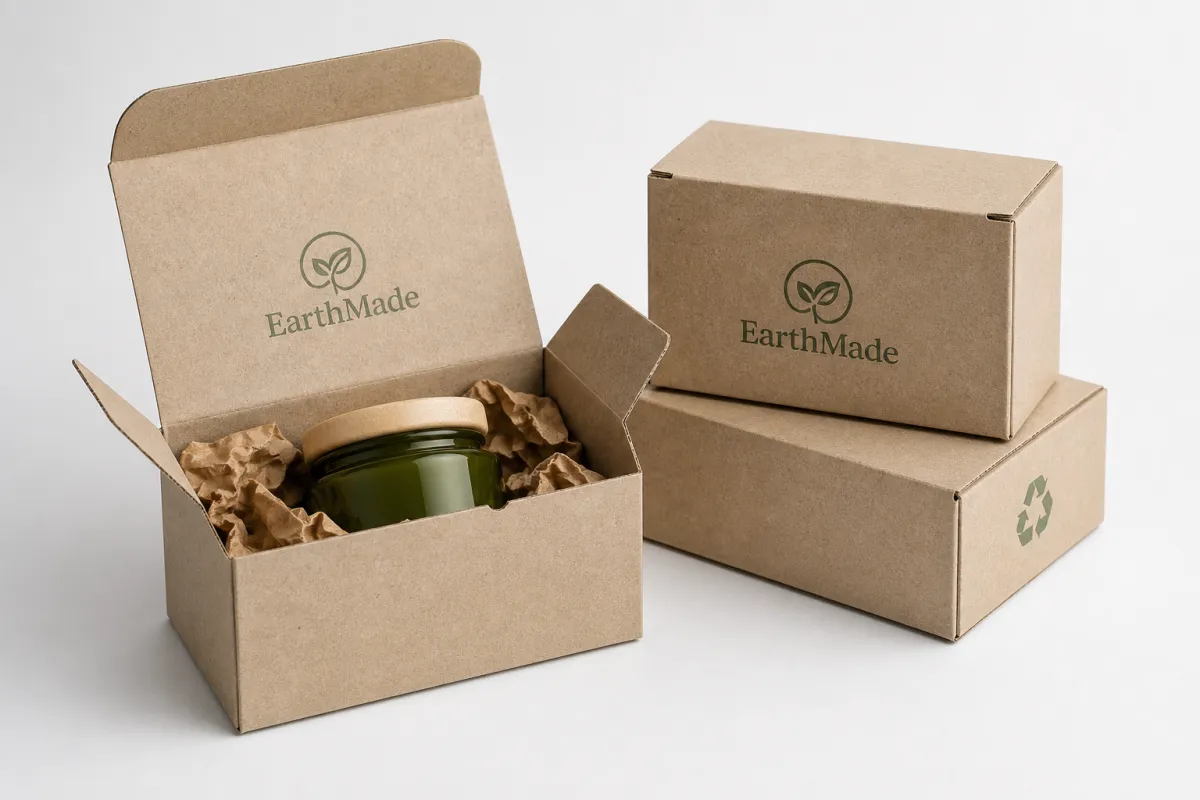
Good recycled retail packaging boxes with logo carry four jobs at once: protect, communicate, sell, and reduce waste. Leave out one of those jobs and the package starts to fail in plain sight. The strongest boxes usually look calm and deliberate rather than loud. A recycled fiber carton with a clean logo and solid construction often reads more premium than a crowded design that tries too hard to prove the point.
The word recycled can point to post-consumer fiber, post-industrial fiber, or a blend of both. Post-consumer content comes from recovered used paper products. Post-industrial content comes from manufacturing scrap that never left the production chain. Those differences matter because they influence stiffness, surface texture, print behavior, and even the faint paper scent of the finished box. That affects what can be said honestly about the packaging, which is a detail too many people gloss over.
From a buyer's point of view, the job is straightforward enough: keep the product safe, keep the shelf presentation clean, and keep the story believable. That matters most in retail packaging that sits under bright lights, gets handled by store staff, and may be stacked in transit before a shopper ever sees it. If the box dents too easily or the logo prints muddy, the sustainability message gets buried under a weak first impression.
“A recycled box does not need to shout sustainability. It needs to feel intentional, protect the product, and make the logo easy to read from a few feet away.”
Brands usually choose recycled retail packaging boxes with logo for three practical reasons. They want a lower-fiber-footprint material choice without giving up display value. They want package branding that matches the expectations customers already have for a thoughtful company. They want a box format that works in production, shipping, and retail handling rather than only in a rendering. That is the useful part of branded packaging: it has to survive the line, the truck, the shelf, and the customer before it earns the sale.
If the structure is wrong, none of the graphics matter much. Lightweight beauty items can live comfortably in folding cartons made from Recycled Paperboard. Heavier goods, subscription-style retail kits, and shelf-ready packs may need corrugated board or internal supports. The box is not decoration first. It is product packaging first, sales tool second, and sustainability statement third.
A simple rule holds up pretty well: recycled retail packaging boxes with logo should look like they belong to the product, not like they were borrowed from another aisle. A modest tea carton needs a different visual language than a premium candle box or a hardware accessory pack. That is packaging design, not just printing.
How recycled retail packaging boxes with logo are made
The material path starts with recovered paper fiber. That fiber is sorted, pulped, cleaned, and turned into board stock such as linerboard, chipboard, folding carton stock, or corrugated medium depending on the application. Recycled retail packaging boxes with logo usually fall into two common build families: folding cartons for lighter retail items and corrugated boxes for products that need more crush resistance or better shipping protection.
For lighter retail items, printers often use 18pt to 24pt recycled paperboard, sometimes with a white-top coating to improve logo clarity. For heavier units, an E-flute or B-flute corrugated structure can be a better fit. E-flute is thinner and prints nicely. B-flute gives more cushioning. If the product is fragile or awkwardly shaped, inserts, partitions, or die-cut retention features are doing the real work. A nice exterior is useful, but it will not stop a product from rattling loose inside the box.
Printing changes the final look more than most buyers expect. Digital printing works well for short runs and design testing because it avoids heavy setup. Offset printing gives sharper detail and better color consistency on larger runs. Flexographic printing is often efficient for higher-volume corrugated work. Each method affects the final feel of recycled retail packaging boxes with logo, especially when the stock surface is naturally textured or slightly speckled from recycled fiber.
That surface texture is not a defect. Sometimes it is the point. A matte, fiber-forward surface can support a quieter, more credible sustainability story than a glossy finish that tries to hide the board underneath. A logo on recycled retail packaging boxes with logo can still look premium if the artwork respects the stock. Dense photographic coverage on rough board usually performs worse than a restrained two-color layout with one strong logo and a clear product name.
The box structure matters just as much as the print. Dielines define the shape, fold lines, tabs, closures, glue areas, and any windows or cutouts. If the structural design is weak, you get crushed corners or flaps that pop open. If it is overbuilt, you pay for board and labor you did not need. Good recycled retail packaging boxes with logo use the fewest parts needed to keep the product stable and the retail presentation clean.
Coatings and adhesives deserve more attention than they usually get. Water-based coatings can improve scuff resistance without adding a plastic-heavy feel. Some laminations look attractive but can complicate recycling depending on local systems. The same goes for certain adhesive choices and window films. If recyclability matters, ask the supplier exactly what is in the board, what is on the board, and how the finish affects end-of-life handling. For fiber sourcing and certification basics, FSC guidance on recycled and certified fiber is a useful reference.
One more practical point: a decent recycled box is not just a sheet of paper with ink on it. It is a sequence of decisions. Material selection, press method, die cutting, folding accuracy, glue control, and finishing all shape the result. I have watched a carton that looked perfect on screen come back with softened corners because the board choice was a touch too light for the way stores handled it. That kind of miss is not dramatic, but it is expensive. It is also avoidable.
Key factors that change quality and shelf appeal
The first quality variable is board grade. Two boxes can both be called recycled retail packaging boxes with logo and perform very differently. One may use 100% recycled kraft with a rougher surface and good stiffness. Another may use a mixed-fiber white-top stock with better print sharpness. The right choice depends on the product weight, the brand style, and how much handling the box will face.
Thickness matters too. A lightweight folding carton around 18pt to 24pt may be enough for cosmetics, accessories, or tea. A corrugated retail shipper might need 32 ECT or 44 ECT performance depending on load and stacking pressure. If the box travels far, gets palletized, or sees rough handling, under-specifying the board is a cheap mistake that becomes an expensive one after the first crushed shipment.
Print quality is the next major factor. Large logos with simple shapes tend to read better on recycled stock than thin-line marks with delicate gradients. Dark solid coverage can look rich, but it also raises ink cost and may hide the natural fiber look that makes recycled retail packaging boxes with logo feel honest. A well-placed logo, a clear type hierarchy, and one or two brand colors often outperform a crowded layout with too many elements fighting for attention.
There is also a real tradeoff between visual drama and sustainability signal. Heavy coatings, full-bleed coverage, metallic effects, and layered embellishments can push the box toward a luxury look, but they also dilute the recycled feel and can add cost fast. If the brand wants packaging design that feels grounded and eco-conscious, restrained ink coverage usually works better than trying to impersonate a perfume carton on a lunch budget.
The retail environment matters more than people admit. A box that looks great in a studio may fail under fluorescent lighting, fingerprints, stacking pressure, or a store associate's quick handling. Shelf appeal depends on legibility from 3 to 6 feet away, not on how the logo looks at 400% zoom on a monitor. Recycled retail packaging boxes with logo should be readable, stable, and honest under actual retail conditions.
Here is a practical checklist I use mentally when looking at prototypes:
- Board feel: Does it feel stiff enough without being overbuilt?
- Logo readability: Can you read the mark at arm's length?
- Edge quality: Are cuts clean or fuzzy?
- Color behavior: Does the recycled stock shift the brand color too much?
- Retail presence: Does the box look deliberate beside competing product packaging?
Another factor is how the box performs during shipping. If the product is fragile, you may need an insert, tighter tolerances, or a structural style that reduces movement. A little extra internal restraint often costs less than replacing damaged inventory. That is especially true for direct-to-retail shipments where the same pack has to survive transit and then sit neatly on the shelf.
If you want to compare structures before committing, it helps to review a few Custom Packaging Products options side by side and ask for the same artwork on different boards. The differences show up fast once you compare them in hand. That is why recycled retail packaging boxes with logo should never be chosen from a PDF alone.
What recycled retail packaging boxes with logo cost and why
Pricing depends on a pile of boring details that become very interesting once the quote lands. For recycled retail packaging boxes with logo, the biggest price drivers are size, board type, print colors, finish, inserts, and quantity. A small folding carton with one-color print and no special coating might land in a very different range than a rigid retail box with multiple insert pieces and full-color coverage.
As a working reference, simple Recycled Folding Cartons at 5,000 units might fall around $0.18-$0.45 per unit depending on dimensions, board choice, and print coverage. Printed recycled corrugated retail boxes often land around $0.40-$0.90 per unit at that same volume. Rigid recycled boxes can move into $1.00-$2.50 per unit or more if the build includes specialty wraps or complex inserts. Those are not promises. They are the kind of ranges that make sense before the exact dieline and finish are known.
| Option | Typical Use | Approx. Unit Cost at 5,000 Units | Tradeoff |
|---|---|---|---|
| 18pt recycled folding carton | Light retail items, cosmetics, tea, small accessories | $0.18-$0.45 | Best for shelf appeal and lower board usage, but not for heavy products |
| E-flute recycled corrugated box | Retail shipper, shelf-ready pack, fragile light goods | $0.40-$0.90 | Better protection and stacking strength, slightly bulkier appearance |
| Rigid recycled presentation box | Premium product packaging, gifting, higher perceived value | $1.00-$2.50+ | Strong brand impact, but higher labor and material cost |
The hidden costs are where buyers get surprised. Dieline setup may add $75-$250. Sampling can add another $40-$150 depending on quantity and shipping. Special coatings, window films, or die-cut inserts can raise the unit cost by a few cents to well over a dollar. Freight matters too, especially for bulky but lightweight cartons. You can end up paying more to move air than cardboard if the pack is oversized.
Setup cost is why low quantities feel expensive. At 250 or 500 units, recycled retail packaging boxes with logo often look overpriced because the prepress and tooling costs are spread over fewer cartons. At 5,000, 10,000, or more, the unit cost usually improves quickly if the design stays simple. Bigger orders are not always the answer, though. If the product or artwork may still change, it is smarter to test first than to pile up inventory you do not want.
There is a clean way to save money without wrecking the box. Simplify the structure before you cut recycled content. Reduce ink coverage before you add cheap-looking embellishments. Keep the finish practical. A toned-down box with good proportions, a single strong logo, and recycled board often costs less and looks better than a box stuffed with glossy effects that nobody asked for.
For buyers comparing quotes, the real apples-to-apples test is not the listed unit price. It is the full landed cost of recycled retail packaging Boxes with Logo: board, print, finishing, tooling, shipping, and any secondary packing labor. A supplier who quotes low on the box and high on freight is not cheaper. They are just more creative with math.
Step-by-step process and timeline for ordering
The ordering process starts with product data. Measure the item in its final retail configuration, not just the bare SKU. Include length, width, height, weight, and any fragile areas that need extra clearance. If the product includes accessories, cords, caps, or inserts, those dimensions matter too. Recycled retail packaging boxes with logo are easiest to get right when the supplier sees the real item or at least a careful spec sheet with tolerance ranges.
After that comes structure choice. Decide whether you need a folding carton, corrugated retail pack, sleeve, tuck-end box, or something with a display feature. If you already know the sales channel, that helps. Shelf-ready retail packaging is not the same as a shipping-first carton. It is tempting to pick the prettiest form, but the correct form is usually the one that protects the product and fits the way stores actually receive it.
The proofing stage is where a lot of projects slow down. Artwork has to be scaled correctly, bleed has to be right, logo placement has to avoid folds, and color expectations need to be realistic on recycled stock. Digital proofs are useful, but a printed sample is better. If the box will carry an exact brand color, ask how that color behaves on the chosen board. Recycled retail packaging boxes with logo often shift slightly warmer or duller than a coated virgin stock, and that is normal.
Here is a practical timeline for a straightforward run:
- Specs and quote: 1-3 business days if dimensions and artwork are ready.
- Dieline and structural review: 1-4 business days.
- Proof approval: 1-3 business days, longer if multiple stakeholders are involved.
- Sampling: 3-7 business days for simple packs, longer for complex finishes.
- Production: often 7-15 business days after approval, depending on volume and print method.
- Shipping: usually 2-7 business days domestically, longer for larger freight loads.
That timeline can stretch quickly if the job has inserts, coatings, foil-like effects, or structural changes after the first proof. The biggest avoidable delay is late artwork revision. The second biggest is a vague brief. If the supplier has to guess about product weight or shelf orientation, the process gets slower and more expensive. Clear information saves time. Confusion charges interest.
For brands still sorting out the larger packaging mix, it helps to review a supplier's custom printed boxes options alongside the recycled carton request. Sometimes the better answer is a hybrid solution: recycled retail packaging boxes with logo for the shelf unit and a simpler protective shipper behind the scenes. That keeps the retail face strong without forcing one box to do every job badly.
If transit performance matters, ask for testing guidance aligned with ISTA transit testing standards. Not every order needs formal certification, but the logic behind the tests is useful. Vibration, drop, compression, and shock all reveal weaknesses that a neat mockup will hide.
Common mistakes with recycled retail packaging boxes with logo
The first mistake is overclaiming. A box can be made with recycled fiber and still not be recyclable in every local system if it uses the wrong coating, film, or adhesive combination. Recycled retail packaging boxes with logo should be described carefully. Ask for a recycled-content statement, a recyclability explanation, and any documentation that supports the claim. Vague eco language is cheap. Trust is not.
The second mistake is bad sizing. A box that is too loose looks careless and wastes material. A box that is too tight risks scuffing the product, buckling corners, or making packing slower than it needs to be. Good packaging design usually leaves just enough space for the product to sit securely without being crushed into the corners. That is especially true for retail packaging that must open smoothly and present well on the shelf.
The third mistake is visual overkill. Too much ink, too many spot colors, too much gloss, too many effects. All that noise can strip away the natural look that makes recycled retail packaging boxes with logo feel honest and intentional. Minimal ink can look more premium than a crowded layout, especially on recycled stock where the fiber texture is part of the message. If the logo already carries the brand, let it breathe.
The fourth mistake is skipping samples. I get why teams do it; samples feel slow. They also save orders from avoidable embarrassment. A print that looks perfect on screen can shift on recycled board. A fold that looks fine in CAD can misalign after production. A logo placed too close to a flap can disappear into a crease. One physical sample often reveals more than three rounds of email guessing.
The fifth mistake is ignoring supply-chain realities. A retail carton that passes print review but fails stacking or transit is still a failure. If the item is fragile, test the box under realistic conditions. If it will ship across long distances, consider compression and moisture exposure. Recycled retail packaging boxes with logo should survive the route they actually take, not the route a sales deck wishes they took.
One practical standard is worth keeping in mind: packaging quality is not only about appearance. It is about performance under use. If you are unsure how much abuse the pack can handle, ask for a transit test plan and compare it against the product's breakage risk. The cheaper box is not cheaper if it doubles return rates.
Expert tips and next steps for your next order
If you want better results, start with a tighter brief. Gather the product dimensions, target weight, retail channel, sustainability requirements, and logo files before asking for quotes. Recycled retail packaging boxes with logo move faster when the supplier gets the same information every time. Sloppy input creates sloppy output. Packaging math is rude like that, but it is at least consistent.
Ask for three things in every quote: a sample, a recycled-content statement, and a line-by-line cost breakdown. The sample tells you how the board feels and how the print lands. The recycled-content statement tells you what you can say publicly. The cost breakdown tells you where the money is going. If the supplier cannot explain the difference between print setup, tooling, and freight, keep looking.
- Compare like for like: same size, same board, same print count, same finish.
- Check the board source: post-consumer, post-industrial, or blended recycled fiber.
- Prioritize structure first: a clean dieline usually beats a fancy finish.
- Use a pilot run: test a smaller batch in shipping and retail conditions before scaling up.
That pilot run matters more than most people think. A 300-unit test can show whether the box opens properly, stacks cleanly, and survives real handling. If the pilot works, you can scale into a larger order with less risk. If it fails, you have not locked yourself into a warehouse full of boxes that only look good in a mockup.
Buying recycled retail packaging boxes with logo is not about finding the most virtuous material on paper. It is about making a box that fits the product, supports the brand, and performs in the channel you actually sell through. Sometimes that means a simple folding carton. Sometimes it means a sturdier corrugated build. Sometimes it means spending a little more on board and saving a lot by trimming the print. Smart Packaging Buyers treat those tradeoffs as normal, because they are.
If you are comparing vendors now, use the same spec sheet across every quote and make them answer the same questions. That is the fastest way to expose inflated promises and hidden costs. Then order the sample, check the finish, and run the box in real conditions. That is how recycled retail packaging boxes with logo earn their keep instead of just looking good in a PDF.
For brands that want packaging design to do real work, the next move is simple: Choose the Right format, lock the structure, and let the artwork support the product instead of fighting it. Start with one prototype, inspect it under actual store lighting, and approve the run only after the board, print, and closure all behave the way you need.
Are recycled retail packaging boxes with logo strong enough for fragile products?
Yes, if the board grade, wall structure, and insert design match the product weight and breakage risk. Fragile items usually need tighter sizing, better edge protection, and sometimes a molded or folded insert instead of a basic open cavity. A sample test in real transit is the safest way to know whether the pack is actually strong enough.
What recycled content percentage should I ask for in retail packaging boxes with logo?
There is no magic number. Buyers usually balance recycled content, print quality, and strength based on the product and retail channel. Ask whether the stock uses post-consumer content, post-industrial content, or both, because that is what shapes the claim you can make about recycled retail packaging boxes with logo.
Are recycled retail packaging boxes with logo more expensive than standard boxes?
Often yes at low quantities, mostly because setup, sampling, and proofing costs are spread over fewer units. At larger volumes, the gap can narrow if the design stays simple and the board choice is efficient. The cheapest savings usually come from simplifying structure and print, not from stripping out recycled content.
Which printing method works best on recycled retail packaging boxes with logo?
Digital printing is useful for short runs and quick design changes. Offset and flexographic printing are often better for larger runs where color consistency and unit cost matter more. The best method depends on the stock surface, logo detail, and how much ink coverage the design needs.
How long does it take to produce recycled retail packaging boxes with logo?
Simple orders can move quickly once the dimensions and artwork are approved. Custom structures, inserts, coatings, or special print effects add time because the proofing and setup stages take longer. The fastest path is to lock specs early, approve proofs quickly, and avoid late-stage design changes.


