Restaurant Cuffed Knit Beanies Bulk Order Planning for Teams
Restaurant cuffed knit beanies Bulk Order Planning usually starts after the first cold shift exposes a gap in the uniform program. Staff begin borrowing hats, pairing hoodies with aprons, or wearing whatever plain beanie they already own. None of that reads as deliberate. A cuffed knit beanie solves a narrower problem: it adds warmth, gives the team a consistent look, and creates a clean panel for a logo without introducing a sizing headache.
That is why restaurants, cafes, hotel outlets, catering groups, and delivery-heavy operators treat this item as a practical purchase rather than a seasonal accessory. One size can cover most of the team. The cuff gives the decoration a stable surface. Storage is easy. Reorders are straightforward. In a uniform program that already has enough moving parts, those are real advantages.
The best results usually come from early planning, not last-minute shopping. Once the weather turns, the lead time, dye lot, and decoration method matter more than the style name on a catalog page. The details are what separate a tidy bulk order from a box of hats that look fine online and awkward on the floor.
Why bulk beanies solve cold-weather uniform gaps fast
Cold-weather uniform gaps are rarely dramatic. They show up as small inconsistencies: one host wearing a knit cap from home, a delivery rider with a different logo on their outerwear, a prep cook pulling on a hoodie that clashes with the rest of the team. A cuffed beanie closes that gap quickly because it is compact, inexpensive compared with jackets, and easy to issue by headcount rather than by size chart.
For food service, that simplicity matters. Outerwear introduces fit problems, returns, and larger price swings. Knit headwear does not. Most restaurant buyers can place an order, approve one proof, and distribute the finished pieces in a single handoff. That is useful for rotating staff, fast onboarding, and locations that do not want to keep a large apparel inventory on-site.
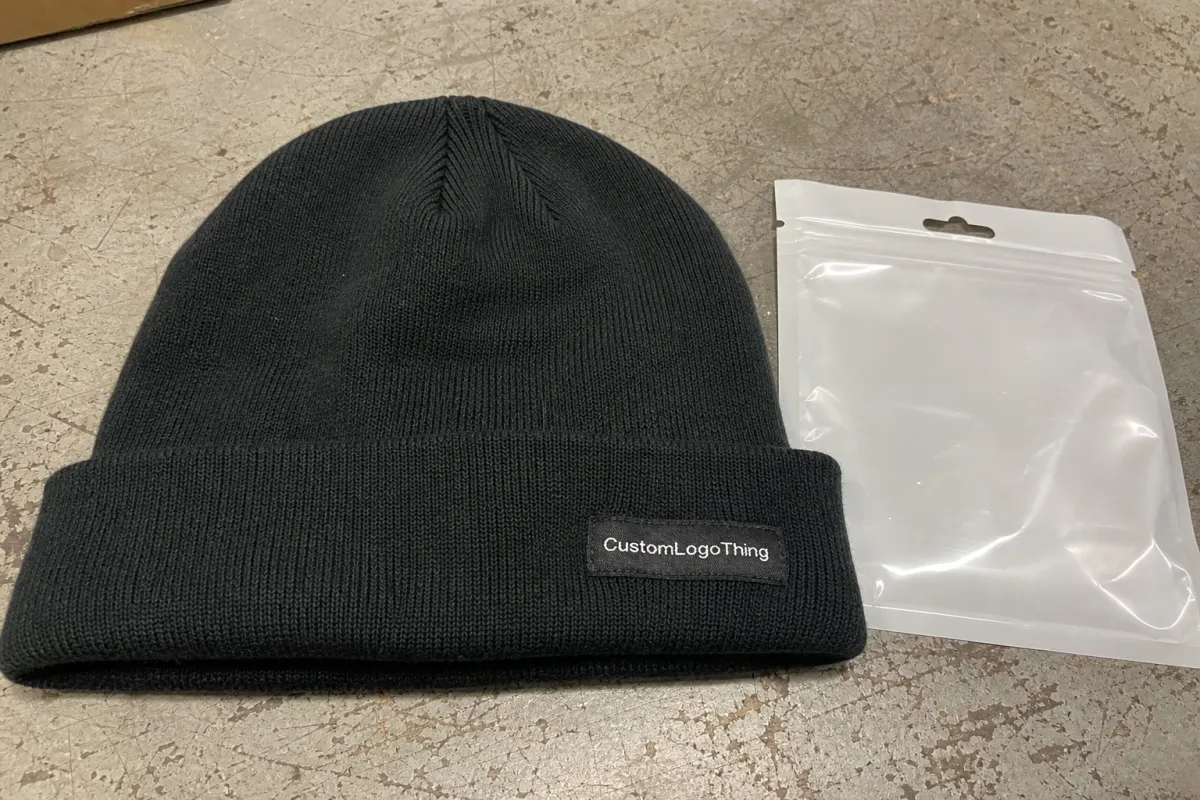
There is also a visual reason restaurants favor this item. The cuff gives the logo a flat, readable area, which is harder to achieve on a slouchy or uncuffed style. When the branding stays legible, the hat looks intentional rather than improvised. That distinction matters in guest-facing spaces, especially in cafes, hotel outlets, and casual dining rooms where the team needs to look coordinated without appearing overdesigned.
Not every operation needs the same type of beanie. A polished front-of-house program may call for a tighter fit, a subdued color, and a small mark. A delivery or patio team may want a warmer body, a deeper cuff, and a decoration method that can survive daily wear. If the role mix is varied, the best approach is usually to standardize one body style and adjust only the color or decoration placement. That keeps the order manageable while still acknowledging how the team actually works.
One practical caveat: in kitchens with strict hair restraint rules or high heat, a beanie is not always the right answer. Some teams need a lighter cap, a hairnet-compatible layer, or a completely different uniform solution. Good planning starts by matching the item to the job rather than assuming every cold-weather problem should be solved with the same hat.
Knit construction and cuff details that print cleanly
The cuff does more than hold a logo. It stabilizes the decoration area, changes the silhouette of the beanie, and gives the piece a finished look that a plain knit body often lacks. On a bulk order, that matters because decoration quality is easier to control on a cuff than on a looser crown. Embroidery sits better. Woven patches stay readable. Even a simple woven label looks more deliberate when it is anchored on a folded edge.
Construction choices shape the final result. A tighter knit usually supports cleaner embroidery and better edge definition. A looser knit can feel softer, but it may let the logo sink into the fabric or distort when stretched. The buyer sees that immediately after the hats are handed out. A sample that looks fine on a table can appear very different once it is pulled over hair, ears, and winter layers.
Most bulk cuffed beanies are built from 100% acrylic or from acrylic blends. Acrylic is popular because it is affordable, warm enough for most restaurant use, and easier to reorder consistently. Acrylic blends can improve hand feel or shape retention. Wool blends add warmth and a more premium touch, but they usually cost more and may feel too warm or slightly scratchier for all-day indoor wear. Recycled polyester exists in some programs, though it can feel slicker and is not always the best match for embroidery-heavy decoration.
Decoration method should be chosen with the knit texture in mind. Embroidery is the default option for many restaurant programs because it is durable and familiar, especially for simple wordmarks or single icons. Woven patches are better when the logo has small type or sharper detail. Sewn labels work well when the brand wants a quieter look. Heat transfers are usually less ideal on stretchy knit surfaces because they can lift or crack earlier than expected.
Several quality issues are worth checking before production starts. Look for puckering around the logo, thread tension that pulls the cuff out of shape, patch corners that do not sit flat, and yarn that pills too quickly after a few wear cycles. A good proof shows the logo size, placement, and cuff height together. A better sample is one that also shows the stretch recovery after the beanie has been pulled on and left to rebound.
Color also changes the perceived quality. A dark body with a matching cuff feels more restrained and often reads better in polished dining rooms. A contrast cuff can help the branding pop, but it can also make the hat feel more promotional. For restaurant uniforms, the right choice is usually the one that looks integrated with the rest of the apparel package, not the one that stands out most in a catalog.
Sizes, fibers, and color specs to confirm before ordering
One-size headwear sounds simple, but not every beanie fits the same way. Before you ask for pricing, confirm relaxed circumference, stretch range, cuff height, and crown depth. Those measurements tell you whether the beanie sits close to the head, covers the ears, or feels too shallow for the staff who will wear it most often. In a mixed team, the fit profile matters more than the product title.
A snug beanie stays put better during delivery shifts, outdoor service, and active prep work. A deeper, slouchier shape can feel more casual and may suit some brands, but it can also look too loose on a front-of-house team that needs a sharper profile. The same beanie can project a completely different impression depending on how it sits on the wearer. That is why a sample worn by real staff is more useful than a product photo shot on a mannequin.
Fiber content deserves the same attention. Acrylic is the most common option because it balances cost, warmth, and repeatability. Acrylic/wool blends are warmer and usually feel more premium, but they can be more expensive and less forgiving if the team washes them roughly. If the hats will be worn daily and laundered often, ask how the yarn handles pilling, stretching, and drying heat. A beanie that looks good on arrival can lose shape faster than expected if the care instructions are ignored.
Color control is another place where planning pays off. Ask for a clear reference point: a Pantone target, a physical swatch, or an approved sample that has already been compared against the rest of the uniform palette. Dye lot variation is normal in knitwear, and small shifts are more visible on darker shades and saturated brand colors. If your operation uses multiple locations, save the approved shade in writing so a reorder does not rely on memory alone.
It also helps to confirm finish. A brushed surface feels softer but may show lint. A smoother knit often looks cleaner with embroidery. A thicker gauge feels warmer, though it can reduce flexibility around the cuff. These are small differences on paper and obvious differences in use. Most restaurants do not need the warmest possible beanie. They need one that is comfortable enough for a full shift, durable enough to survive repeated wear, and consistent enough to reorder later without a new round of approvals.
If you want the order to stay simple, approve three things before production begins: the body color, the cuff specification, and the decoration method. That prevents a surprising amount of back-and-forth later.
Cost, pricing, and MOQ levers that change your quote
The price of a bulk beanie order is shaped by quantity, yarn type, decoration method, color count, and whether the body is stock or custom-built. MOQ is not an arbitrary barrier. It usually reflects setup cost, knitting efficiency, and how much labor is required to prep a run that can be repeated cleanly.
For budget planning, a blank stock cuffed beanie often falls around $2.80-$4.25 per unit at modest quantities. Add embroidery and the range can move closer to $4.25-$6.75 for 250-500 pieces. Woven patches or sewn labels often push the price into $4.80-$7.25, especially if the artwork needs more detail or the patch shape is custom. Custom knit patterns, specialty yarns, and heavier gauge builds generally move higher still. Freight, duties, and rush fees can change the landed cost enough that the cheapest unit price is not always the lowest total spend.
Here is a practical comparison of common options:
| Option | Typical MOQ | Typical Unit Price | Best Fit |
|---|---|---|---|
| Blank stock cuffed beanie | 50-100 pcs | $2.80-$4.25 | Fast issue, minimal branding |
| Embroidered logo | 100-250 pcs | $4.25-$6.75 | Simple restaurant branding, durable use |
| Woven patch or sewn label | 150-300 pcs | $4.80-$7.25 | Sharper artwork, small text, premium finish |
| Custom knit or specialty yarn build | 300-500 pcs | $6.50-$10.00+ | Large rollouts, signature uniform programs |
Setup fees are easy to underestimate. Digitizing embroidery, making patch tooling, or producing a test sample can add fixed cost before the first hat is even made. On small orders, that overhead is spread across fewer pieces, which makes the per-unit price look higher. On larger orders, the same setup gets diluted and the price becomes more efficient. That is one reason the quantity break matters so much in restaurant uniform buying.
Another budget trap is freight. A good quote should distinguish between product cost and landed cost. If the supplier is vague about packaging, cartons, duties, or transit method, the final invoice may be less pleasant than the first estimate. Restaurant buyers tend to care less about the prettiest unit price and more about whether the order arrives on time, in the right count, and without surprise add-ons that distort the uniform budget.
If the cuff cannot hold the logo clearly, the order is not saving money. It is just moving the problem from the quote to the floor.
The most economical orders are usually the ones that keep the variables under control: one body color, one decoration method, one logo placement, and a quantity that matches real need plus a small reserve. That is not flashy, but it is how winter uniform programs stay repeatable.
Process, timeline, and lead time from approval to delivery
A normal production path runs through quote, artwork review, proof approval, knitting or sourcing, decoration, inspection, packing, and freight. Delays usually appear before production starts. Finalizing the logo size, cuff position, and color target takes longer than many buyers expect, and every late change has a cost. The cleanest schedule is the one that locks the spec before the order is released.
For straightforward stock-based programs, lead time after proof approval is often around 12-18 business days. Custom yarn sourcing, more complex decoration, or overseas shipping can extend that window. Cold-season demand also compresses capacity, so a winter order placed after the first temperature drop is often competing with a lot of similar orders. If a rollout date is fixed, build buffer into the calendar rather than assuming the fastest case will hold.
Milestone dates matter more than a single promise. Ask for the proof date, production start date, inspection date, and ship date. Those checkpoints let managers coordinate staff handout, store-level packing, and any role-based sorting before the shipment lands. In multi-location operations, that structure is especially useful because one late carton can create uneven distribution across sites.
Quality control should not be treated as a generic checkbox. For knit beanies, the useful checks are specific: confirm the cuff height on the first and last piece in a production run, compare logo placement against the approved proof, verify that the yarn color matches the reference sample under normal indoor light, and count the cartons against the order sheet before freight leaves the facility. If decoration is embroidered, the thread should be tight without puckering. If a patch is used, the edges should sit flat and the backing should not feel weak.
Packaging deserves attention too. Cartons should be labeled clearly by location, role, or size group if the order is split that way. If the shipment is moving through rough freight lanes, transit testing standards can help inform expectations. The International Safe Transit Association publishes guidance on packaging and transit performance at ISTA. That kind of testing is not just for heavy goods; crushed cartons can create the same operational mess with apparel that they do with equipment.
If your order includes paper wraps, insert cards, or hang tags, confirm the material standard in writing. FSC-certified paper may be relevant if sourcing transparency matters to your brand, and the Forest Stewardship Council explains chain-of-custody standards at FSC. Small details like that can reinforce a uniform program that already has to look organized and deliberate.
What to expect from a food-service bulk beanie supplier
A good supplier should reduce uncertainty, not add it. That begins with a spec sheet that reads clearly: measurements, fiber content, color reference, logo size, decoration method, carton count, and target ship date. Food-service buyers do not need a polished pitch. They need enough information to approve an order without guessing at what will actually arrive.
Repeatability is the real test. A first sample is useful, but a reorder tells you whether the supplier can reproduce the same cuff height, logo placement, yarn feel, and body color six months later. If those details drift, the item stops functioning as part of a uniform program and becomes a one-off seasonal purchase. That is fine for some buyers. It is not fine for operators trying to keep a consistent brand across locations.
Packaging support is another signal. Carton labeling by location, role-based packing, and clear piece counts can save a manager a lot of time once the boxes arrive. That kind of service is easy to overlook while comparing unit prices, but it often has a bigger operational impact than a small difference in the quote. The less time your team spends sorting hats on a back counter, the better.
Honesty about limitations matters as much as speed. A supplier should say plainly when a logo is too detailed for knitwear, when a certain patch style will not sit cleanly on a cuff, or when a custom yarn build will delay the order enough to miss the season. Good planning depends on those warnings. In a restaurant environment, a small correction early is far cheaper than a late scramble after staff has already been scheduled.
These are the questions that usually separate a solid vendor from a transactional one:
- Can you provide a confirmed spec sheet with measurements and materials?
- Will you show a proof with logo scale and placement?
- Can you save the style code and color reference for reorders?
- How do you pack by location or by role?
- Which changes affect MOQ, lead time, and landed cost?
If those answers are clear, the order usually stays under control. If they are vague, the risk shows up later as a delayed shipment, a color mismatch, or a logo that looks much smaller in person than it did on screen.
What to lock before you release the order
Before releasing the PO, gather headcount by location, target delivery date, logo artwork, color standard, and shipping addresses. If the team has distinct roles, decide whether everyone will wear the same beanie or whether front-of-house, back-of-house, and delivery staff need different colorways or decoration placements. Those choices affect pricing and production more than most buyers expect.
Then save the approved spec in one place. Keep the cuff height, decoration method, art file, and color reference together so a future reorder does not depend on memory. That matters more than it sounds. Restaurant uniforms are often reordered months later, and the person placing the new order may not be the one who approved the original sample.
It also helps to keep a small reserve at each location if turnover is high or if the beanies will be worn outdoors. Lost pieces, stained pieces, and new hires are part of the normal pattern. A modest overage is easier to manage than scrambling for a quick reorder in the middle of winter.
For seasonal programs, the most reliable version of restaurant Cuffed Knit Beanies bulk order planning is simple: lock the spec early, approve the proof with real measurements, and give production enough time to do the work properly. That approach keeps the order practical, repeatable, and ready for the floor instead of the corrections file.
How many restaurant cuffed knit beanies should I order per location?
Start with current headcount, then add a small buffer for new hires, replacements, and lost pieces. If turnover is high, keep extra units on-site instead of relying on one central reserve. Multi-role teams may also need a separate count for managers or delivery staff.
What decoration is best for cuffed knit beanies in restaurants?
Embroidery is usually the most durable and familiar choice. Woven patches or sewn labels work better when the artwork includes fine detail or small text. Very thin lines tend to disappear into knit texture, so simple marks usually hold up best.
What does MOQ mean for bulk knit beanies?
MOQ is the minimum quantity a supplier or factory will run efficiently. Stock body colors and one decoration method usually keep the MOQ lower. More colors, custom yarns, or multiple logo placements can push the minimum upward.
How long is the lead time after proof approval?
Stock-based orders often take about 12-18 business days after approval, though custom components or freight delays can extend that. Peak winter demand also affects capacity. If a delivery date is fixed, build in extra time rather than relying on the fastest possible schedule.
Can I reorder the same restaurant beanie later?
Yes, if the supplier has the approved spec, art file, and color reference on record. Reorders are faster when the original style code and purchase history are saved together. Ask whether dye lots may shift slightly between runs.
Good planning for Cuffed Knit Beanies is mostly about controlling the variables that actually affect the result: fit, cuff height, decoration method, color accuracy, unit cost, and delivery timing. Once those are locked, the order becomes straightforward. The team gets a warm, branded item that fits the uniform program instead of competing with it.