A strong stationery Cuffed Knit Beanies material sample guide does something a photo sheet cannot. It shows how the fabric behaves under tension, how the cuff folds, how the crown sits, and whether the piece still looks intentional once it leaves the flat lay and meets a head. That sounds obvious until a buyer receives a sample that looks polished on screen, then feels flimsy, too tight, or strangely shallow in person.
Cuffed Knit Beanies are deceptively simple. A few millimeters in rib depth can change the whole silhouette. A small shift in yarn twist can make the surface feel either soft and premium or dry and wiry. A decoration method that appears clean on a mockup can pucker the knit once it is sewn down. The sample stage is where those differences surface early enough to matter.
Buyers often use samples to answer four questions at once: does the yarn feel right, does the fit recover after stretch, does the shape hold after folding, and will branding sit cleanly on the cuff? If the answer to any of those is unclear, the sample has done its job by revealing risk before bulk production starts.
Stationery Cuffed Knit Beanies Material Sample Guide: What It Actually Proves
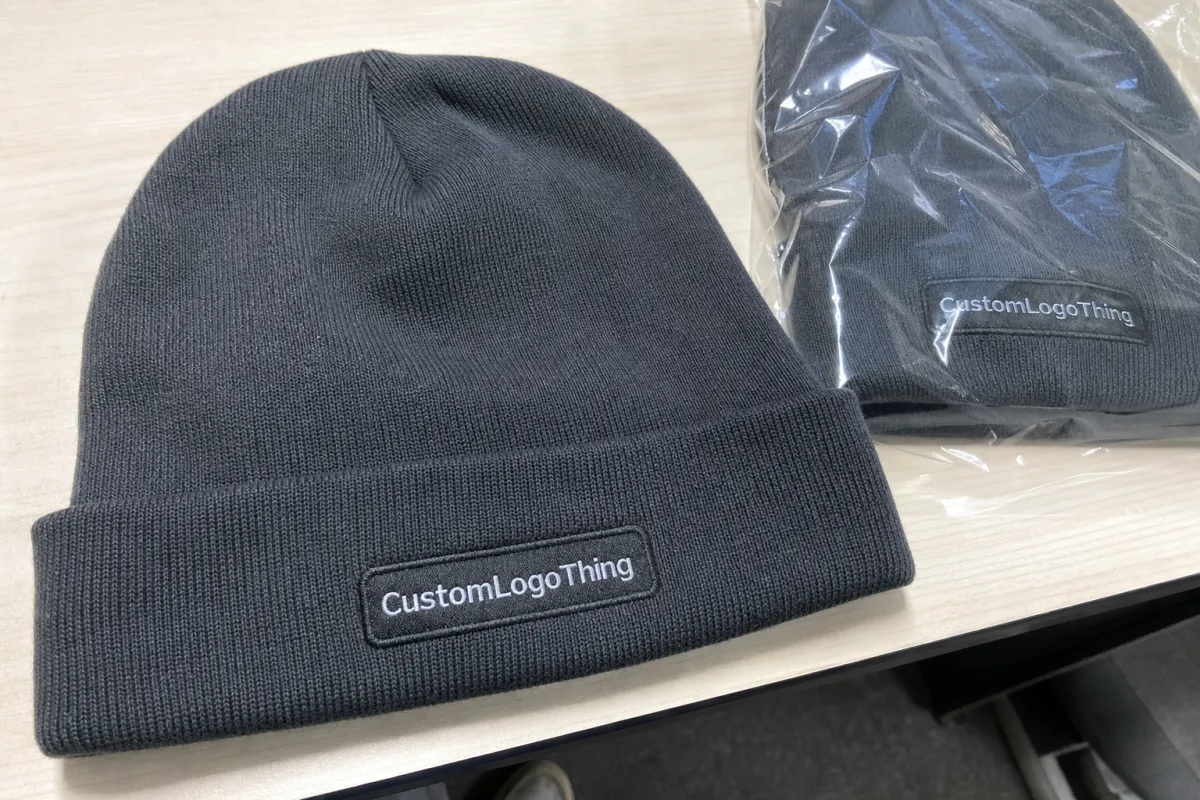
The first thing a sample proves is not style; it proves structure. A beanie can look refined in a rendered image and still fail in basic wear because the rib edge is too loose or the body is too long. That is why the stationery cuffed knit Beanies Material Sample guide should be treated as a decision tool, not a presentation piece.
What should the sample reveal? Yarn hand feel, stretch recovery, density, seam quality, color stability, and the way the cuff supports decoration. Those are practical checks, not aesthetic preferences. A soft yarn may be pleasant, but if it grows baggy after two wears, the comfort is not enough. A firmer knit may feel less luxurious at first touch, yet perform better in a cold-weather retail line where shape retention matters more than plushness.
It also helps to remember that cuffed beanies are judged differently from unstructured knit caps. The cuff is not just a design detail. It is the visual anchor for a label, patch, or embroidery placement, and it changes how the hat sits when worn. If the cuff rolls unevenly or collapses after handling, the whole product loses clarity.
A useful sample tells the truth under tension: folded, stretched, worn, and inspected under real light.
That is the point of sampling. Not to produce the prettiest specimen in the room, but to show whether the factory can reproduce a finished piece that behaves consistently. For programs tied to uniforms, retail assortments, event giveaways, or seasonal drops, that consistency matters more than a glamorous first impression.
How the Sampling Flow Runs From Fiber to Finish
Sampling starts with fiber choice because fiber affects almost everything else downstream. Acrylic usually brings predictable color, easier care, and a smoother cost profile. Wool adds warmth and a more natural hand, though it can introduce variation in texture and sometimes a higher price ceiling. Blends sit somewhere between those extremes. The right choice depends on what the beanie needs to do, not just how it looks in a catalog.
Yarn construction matters just as much. Two yarns with the same nominal fiber content can behave very differently if one is tightly spun and the other is looser. Twist affects surface clarity, pilling resistance, and the way knit lines read from a distance. A denser yarn can create a cleaner cuff edge and a more stable logo area, while a softer yarn may feel more comfortable but can obscure detail.
After yarn comes gauge and stitch pattern. A tighter gauge generally gives a cleaner silhouette and better support for decoration. A looser knit can look relaxed and casual, but it may also stretch out faster. The rib structure around the cuff deserves special attention because that section does the most work. It must expand enough to get on the head, then recover enough to stay neat.
Finishing steps are where many small issues appear. Seams can wander. Thread tails can be clipped too short or left too visible. The crown can sit slightly high or slightly flat depending on how the shaping was blocked. On a beanie, a few millimeters can be the difference between “good enough” and “why does this look off?”
If the sample needs to be shipped, packaging should protect the knit from distortion. A crushed cuff can mislead the review, especially if you are checking fold memory or patch placement. Simple protection is usually enough: a tidy carton, tissue or paper wrap, and enough space to prevent hard creasing. If the brand has packaging standards, recycled-content paper, FSC-certified board, or other responsible materials may be part of that brief. The point is not to overdesign a sample box. The point is to let the beanie arrive looking like itself.
Transit quality can be checked with packaging tests or parcel simulations that reflect real handling. Suppliers that pay attention to this usually understand an uncomfortable truth: if a sample is damaged on arrival, the review becomes noise. A torn label or compressed cuff can trigger a false rejection, even when the construction itself is acceptable.
Material and Fit Points That Deserve Close Comparison
Once the sample is in hand, compare it in a disciplined order. The best reviews avoid vague impressions and move through the same checklist every time. That approach makes revision notes cleaner and reduces back-and-forth later.
Hand feel comes first. Some beanies feel dense and controlled, which can be ideal for branded headwear that needs a sharper retail appearance. Others feel brushed and soft, which may be better for comfort-driven programs. Softness alone is not a quality score. If the yarn is too loose, it may lose shape; if it is too stiff, it can feel cheap despite looking neat.
Fit and recovery come next. Stretch the cuff, release it, and see what happens. A good sample should return close to its original shape without visible wobble or slack at the rib edge. If the beanie relaxes too much after a few stretches, that is usually a warning sign for long-term wear. If it snaps back too aggressively, the fit may feel restrictive on a broader range of head sizes.
Surface quality is easy to miss if you only inspect the outer face. Check the inside too. Loose yarn ends, irregular linking, seam drift, and uneven blocking all matter. A retailer may never describe those details explicitly, but they can still affect whether the product reads as premium.
Decoration compatibility deserves its own pass. A woven label, patch, embroidery, or hem tag can work well on a cuffed knit beanie, but not every knit structure supports every method equally. Dense cuffs tend to handle embroidery better, while very open knits may allow a patch to ripple or lift at the edges. If the backing is too stiff, the decoration can distort the cuff instead of sitting with it.
- Test softness and density together, not separately.
- Check recovery after stretching the cuff several times.
- Inspect both the inside and outside for seam consistency.
- Confirm that the branding method sits flat on a folded cuff.
- Compare the sample in daylight and indoor lighting.
Lighting changes the picture more than many buyers expect. A charcoal beanie can look crisp in daylight and dull under fluorescent fixtures. A heather tone can read warmer or cooler depending on the room. If color fidelity is sensitive, a lab-dip reference or a second yarn-lot sample is safer than trusting one photo.
Measurements should be checked in two states: relaxed and stretched. That gives you a better sense of real-world tolerance. If the cuff depth or body length shifts outside the agreed range, the beanie may still look acceptable on a table but miss the intended fit on a person.
Lead Time, Revisions, and Approval Sequence
A clean sampling process follows a simple order: specification, prototype, review, revision if needed, and final sign-off. The complication is that each change resets some part of the timeline. If a buyer changes yarn weight, asks for a different cuff depth, or swaps decoration after the first sample arrives, the calendar stretches quickly.
For that reason, the first review should focus on the most structural items: yarn choice, size, cuff proportion, overall length, and placement of any major branding. Decoration finesse can wait until the silhouette is approved. There is little value in perfecting embroidery on a beanie whose body length is already off.
Lead time varies with the sample type. A stock-yarn prototype can move quickly. Custom-dyed yarn, specialty trims, or a more exact production reference usually take longer. A realistic window for a straightforward sample may be under two weeks, while a revision cycle can add several business days each time the brief changes. Shipping time needs to be counted separately, especially if the sample has to travel in a protective carton to preserve its shape.
Factories that work with knit goods every day tend to understand a quiet but important constraint: yarn availability changes the schedule as much as sewing capacity does. Even a small tweak in color or fiber can shift the sample from “ready this week” to “wait for the right lot.” Buyers usually save time by locking the spec before the first prototype is made rather than trying to fix everything after the sample lands.
Documentation matters too. Notes should be dated, changes should be traceable, and the approved sample should be stored or labeled clearly. If the process gets messy, teams lose track of what was actually approved. That is how production arguments start later, usually at the worst possible moment.
A disciplined review also helps avoid false urgency. If the sample is close but not perfect, another round is often cheaper than releasing a full order that needs correction. That tradeoff is especially clear on branded headwear, where a small misalignment can be obvious across an entire run.
Sample Pricing, MOQ, and Real Cost Drivers
Sample pricing usually feels high until the setup behind it is unpacked. A single beanie prototype carries knitting setup, finishing, inspection, packing, and freight. Those costs are spread across one piece instead of a bulk order, so the unit price naturally looks inflated compared with production.
For a simple stock-yarn sample, a common range might fall around $30-$45 before shipping. More customized samples, especially those with custom color work, special trims, or a production-matching finish, often sit around $45-$80. Detailed versions with extra revision time or complex decoration can rise to $60-$120 or more. Shipping may add another $8-$25, depending on destination and packout.
MOQ changes the economics because setup cost becomes less painful as volume rises. A buyer testing fifty pieces does not have the same cost absorption as a buyer planning a thousand. That is not a sign of inefficiency; it is basic production math. A higher sample cost is often easier to accept than a wrong bulk order that has to be reworked or discounted later.
Cost drivers are usually predictable:
- Fiber type: wool blends and specialty yarns often cost more than standard acrylic.
- Color method: stock shades are faster and cheaper than custom dye work.
- Decoration: embroidery, woven labels, and patches each add their own setup and labor.
- Finishing: blocking, linking, trim cleanup, and inspection influence the final price.
- Packaging: protective cartons, paper wraps, and branded packouts change the freight profile.
There is also a hidden cost that buyers tend to underestimate: delay. A cheap sample that fails the fit test can cost more in time than a pricier sample that gets the brief right the first time. In knit headwear, the cheapest option is not always the least expensive.
Packaging claims deserve a careful read as well. If the sample ships in recycled-content board or paper-based protection, that may align with a broader sustainability standard. The claim should be specific enough to verify, not just decorative language on a box. Keep that standard practical. A beanie protected by paper and board is useful; a beautifully branded carton that crushes the cuff is not.
Mistakes That Mislead Buyers During Sample Review
The most common mistake is trusting the screen more than the sample. Knit goods are unusually sensitive to lighting, compression, and camera treatment. A piece that looks balanced in a mockup can reveal a very different face once it is stretched, worn, or viewed beside a reference shade.
Another mistake is failing to wear-test the cuff. That sounds basic, yet it is often skipped. Fold it, stretch it, put it on a head form, remove it, repeat the process. Some beanies loosen after a single pull. Others twist at the seam or lose their cuff memory. Those problems are not dramatic in isolation, but they become visible in display, packing, and customer use.
Decoration placement is another trap. A label can look centered on a flat sample and still sit slightly off once the cuff is folded. A patch may curl if the backing is too rigid for the knit weight. Embroidery can pull the fabric if the stitch density is too high or the knit is too open. These are ordinary production risks, not rare defects, which is exactly why they need checking.
Many buyers also stop at the first acceptable sample and fail to compare it against the specification sheet. That is risky. A half-inch difference in length or a small change in cuff depth can change the overall proportion enough to matter in retail. The eye picks up proportion faster than it picks up measurement, which is why the spec sheet and the sample need to be reviewed together.
- Check for color bleed or fiber pilling after a simple wash or rub test.
- Measure the relaxed and stretched circumference.
- Verify the exact position of logos, labels, and patches.
- Confirm that the seam and crown finish remain clean after wear.
Keep a version log. A single comparison sheet for each round saves time later because it records what changed and whether the change improved the piece. Without that record, teams end up relying on memory, and memory is a weak production tool.
Practical Tips for Fit, Decoration, and Color Control
The best sample reviews are systematic. A simple scoring sheet keeps the conversation grounded: hand feel, stretch recovery, stitch consistency, color match, trim quality, and decoration alignment. Mark each item as pass, caution, or fail. That kind of structure is plain, but it works.
Fit should be tested on more than one head size or form. A cuffed beanie that looks perfect on a smaller form may feel too firm on a broader one. A looser fit can look relaxed in photography but fail to hold position in daily use. If the product is meant for a wide audience, the most extreme silhouette is usually the least forgiving.
Color control deserves extra caution if the beanie sits inside a broader brand system. Ask whether the yarn is stock-dyed or custom-dyed, and whether the sample came from the same lot that would feed production. Small lot variation happens even in well-run programs. If the launch depends on a very specific shade, the sample should be treated as a reference point, not a promise without verification.
Decoration should be inspected from the inside and outside. The back of an embroidered area can reveal whether the stitch density is too heavy for the yarn. The edge of a patch can show whether the knit underneath is strong enough to carry it. If the branding method stiffens the cuff too much, the beanie may no longer fold naturally, which changes both appearance and comfort.
The most useful final step is to approve only what has been measured, handled, and compared directly. Keep the approved reference sample labeled and accessible. Production teams need an objective benchmark, especially if later lots begin to drift. That reference is not a formality; it is the only way to make future checks meaningful.
For buyer teams that care about packaging consistency, the sample shipment should also be reviewed as part of the process. A beanie arriving in a well-sized carton with paper protection and documented sample notes is easier to approve than one that lands creased, unlabeled, or compressed. Packaging is not separate from product quality. For knit goods, it is one more condition the product has to survive.
Handled well, the stationery Cuffed Knit Beanies Material Sample guide becomes a practical filter between concept and bulk order. It reduces guesswork, exposes construction limits, and gives the buyer a physical standard to defend later if the production run starts to drift.
What should I check in a stationery cuffed knit beanies material sample?
Check yarn feel, cuff recovery, stitch consistency, seam finish, color tone, and how the decoration sits once the cuff is folded. A good sample should still look controlled after stretching and should match the approved size and placement notes.
How many samples should be reviewed before approval?
One sample is enough to identify major issues, but a second version is useful when the first sample is close and revision notes are needed. Side-by-side comparison makes changes easier to judge, especially for color, cuff depth, and branding placement.
What drives sample cost the most?
Fiber type, dye method, decoration, finishing, and shipping are the main cost drivers. Custom colors and detailed branding usually cost more because they require more setup and more handling than stock constructions.
How long does sampling usually take?
Simple prototypes may be ready within about a week to two weeks, while custom yarn, revisions, and special trims can extend the schedule. Shipping and approval feedback should be planned separately so the sample cycle does not compress the production timeline.
Can one sample represent the final bulk order accurately?
It can provide a strong benchmark, but only if the same yarn, construction, and finishing method are used in production. Lot consistency, tolerance control, and final inspection still matter, especially on orders where fit and color need to stay tight across the run.
A careful stationery cuffed knit Beanies Material Sample guide keeps the process practical: fewer surprises, cleaner approvals, and a better chance that the final order matches the sample buyers actually signed off on.

