Restaurant Frosted Zipper Bags bulk order planning is rarely about finding the lowest quote. The real work is more practical: prevent bag failures, avoid stockouts during busy shifts, and keep inventory from swallowing storage space. A bag that arrives on time but tears at the seal, jams at the zipper, or slows down line work costs more than a slightly pricier alternative that simply performs.
Frosted Zipper Bags occupy a useful middle ground for foodservice buyers. They look cleaner than plain clear pouches, but they stay lighter and less expensive than rigid packaging. That matters because restaurants buy packaging for three reasons at once: protection, presentation, and speed. If a package helps with only one of those, it tends to create pressure somewhere else in the operation.
Bulk planning matters because restaurants do not order in a vacuum. Demand shifts around menu changes, holiday promos, catering jobs, seasonal retail items, and weekend traffic. A bag that seemed sufficient in a slow month can disappear quickly once volume rises. The goal is not to guess perfectly. It is to buy with enough precision that the next reorder is planned, not rushed.
Why Restaurant Buyers Order Frosted Zipper Bags in Bulk
Most packaging waste does not come from the bag itself. It comes from bad timing. A restaurant may have enough bags on paper, yet still run short when a catering program takes off or a seasonal menu generates more takeaway volume than expected. That is why restaurant Frosted Zipper Bags Bulk Order planning starts with usage patterns, not with a simple annual estimate.
These bags do a surprising amount of work. They hold sauces, snack portions, bakery add-ons, dry toppings, prep portions, and small branded items that leave with customer orders. In back-of-house use, they can organize mise en place, cold-storage portions, and ingredient staging. One format can reduce SKU clutter, but only if it is sized and specified correctly.
Bulk buying also changes the economics. The unit price usually drops as the order rises, but the larger benefit is fewer emergency purchases. Emergency buying almost always brings higher freight, faster decisions, and less time for proof review. A rushed reorder can cost more than a well-planned larger run, even if the invoice looks smaller at first glance.
Operational reality: packaging problems usually show up first as labor problems. A zipper that slows the line, a bag that needs double-handling, or a carton that arrives short creates hidden cost long before it appears on a spend report.
Restaurant teams often want the same basic outcome from packaging: quick packing, dependable closure, and a presentation that does not cheapen the product. Frosted Zipper Bags can deliver that balance, but only when the buyer treats the order like an operational decision instead of a stationery purchase.
Frosted Zipper Bag Product Details That Matter to Restaurants
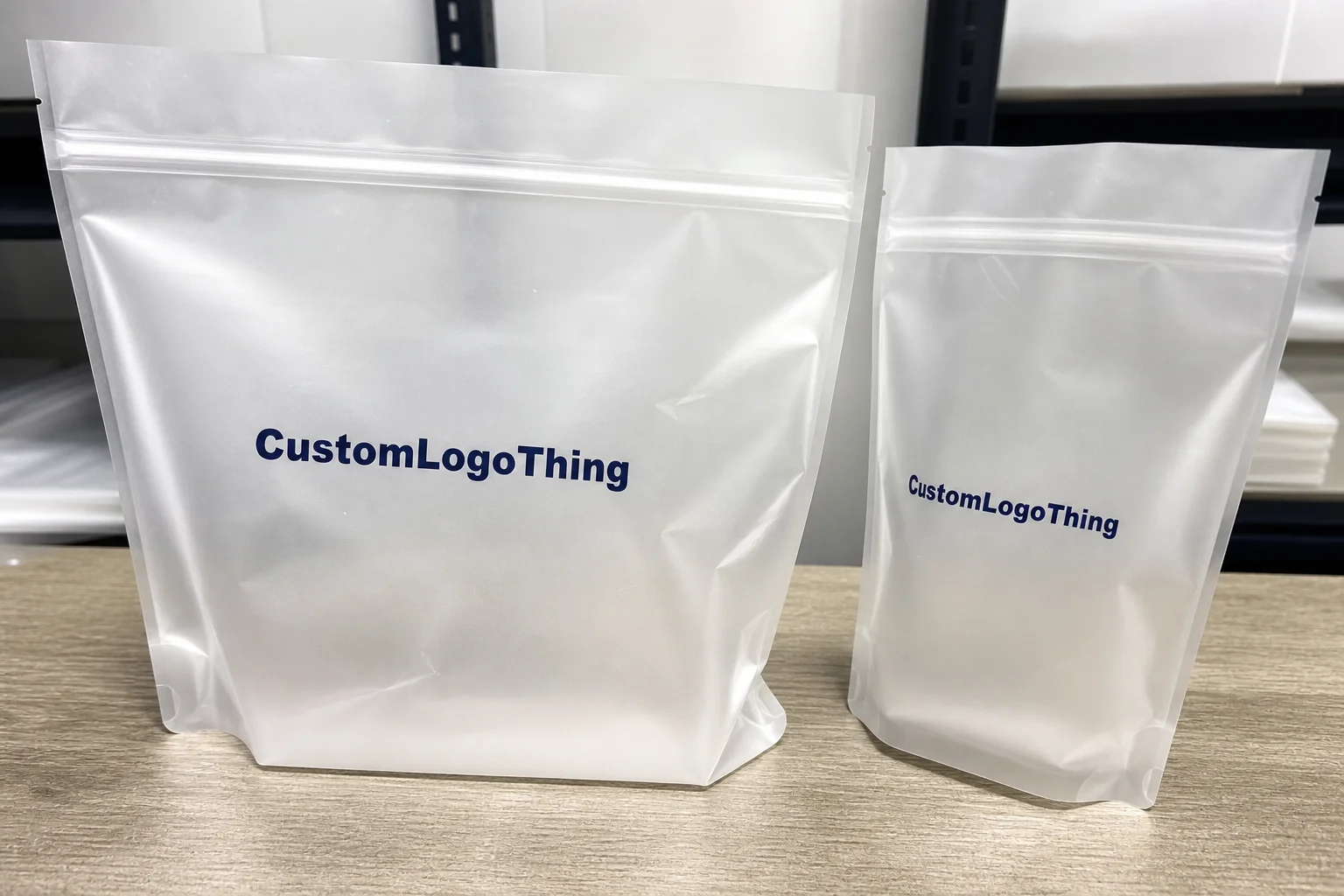
The frosted finish is usually the first reason buyers notice the bag. It softens the look of the package without turning it opaque, and it does a better job than plain clear film at hiding fingerprints, scuffs, and the visual clutter that can make a pouch look low-end. For counter service, that visual restraint is useful. It reads as cleaner, even when the contents are simple.
The zipper is the real performance feature. A good closure needs to open easily, reseal reliably, and survive repeated handling without splitting or warping. In restaurant use, that matters more than it does in one-time retail packaging. Staff may open the bag, close it, reopen it, and hand it across the counter all within a few minutes. If the zipper starts failing under that routine, the bag becomes a source of friction.
The same bag can be used differently across departments. Prep teams may care most about portion consistency and cold storage. Takeout teams care about speed and spill control. Bakeries may use bags for add-ons or finished items. Catering teams often care about compact storage and clear labeling because they are assembling multiple pieces at once. That variety is why a buyer cannot evaluate the product by appearance alone.
Customization changes the purchase too. Some restaurants want a printed logo on the frosted surface. Others prefer a plain bag with a label added later. Some need a larger imprint area. Others prioritize odor neutrality, food-contact use, or film thickness. A bag used for dry condiment packaging does not always need the same construction as one used for general restaurant storage.
Frosted zipper bags also tend to sit well between presentation and practicality. They are flatter and easier to stack than rigid packaging, and they usually feel more intentional than a commodity clear pouch. In a counter-service environment, that small shift in perception can matter. Customers notice packaging faster than operators expect.
Key Specifications to Lock Before Ordering
Before requesting pricing, lock the specs that drive both performance and cost: dimensions, material type, thickness, zipper style, and the level of transparency. If those details are vague, the quote will be vague too. The final product may also miss the intended use, which is worse than paying a slightly higher price for the right build.
For restaurant buyers, performance specs matter as much as appearance. Ask about moisture resistance, puncture resistance, cold-storage suitability, and how the zipper behaves after repeated open-close cycles. If the bag will sit in a cooler, pass through delivery, or be handled multiple times by staff, those details are not optional. They determine whether the packaging supports the workflow or interrupts it.
Size matching is where many orders go off track. Oversized bags waste material and occupy more shelf space. Undersized bags slow down packing and may lead to product damage, awkward fills, or staff frustration. The best way to size is to match the bag to actual portioning reality: the average sauce volume, the most common snack quantity, or the typical prep portion. That approach is more reliable than estimating by eye.
If the order includes printing, confirm the artwork specs early. Ask for the imprint area, color count, preferred file format, and proof process. On a frosted surface, ink contrast can change depending on coverage and color choice, so a logo that looks sharp on screen may need adjustment in production. Buyers should request a proof that reflects the actual bag finish, not only a flat digital mockup.
Compliance belongs in the spec sheet too. Ask whether the bag is intended for food contact, whether the material is odor-neutral, and what QA documentation is available. Suppliers should be able to answer clearly. If they cannot explain the basic product standard, that is a warning sign. For packaging references and sustainability context, industry resources such as the Packaging School / Packaging Industry resources and the EPA can help frame internal review.
Cost, Pricing, and MOQ for Bulk Restaurant Orders
Pricing for restaurant frosted Zipper Bags Bulk order planning usually comes down to five variables: size, thickness, customization, print complexity, and order volume. A small unprinted pouch usually sits near the lower end of the market. Increase film thickness, add multiple print colors, or request tighter artwork control, and the cost rises quickly. That is normal. Packaging pricing is a stack of manufacturing decisions, not a single commodity number.
MOQ, or minimum order quantity, deserves a closer look than many buyers give it. A lower MOQ is helpful for testing a new format or pilot-testing a new menu line. Larger runs usually reduce unit price and reduce repeated setup charges. The right MOQ is the one that validates the bag in real operations without trapping cash in inventory that sits too long.
| Order scenario | Typical unit price range | Best use case | Buyer tradeoff |
|---|---|---|---|
| 1,000 units | $0.24-$0.38 | Trial run, menu test, small location | Higher per-unit cost, lower inventory risk |
| 5,000 units | $0.18-$0.28 | Established takeout volume, single brand line | Better economics, moderate storage need |
| 10,000 units | $0.14-$0.22 | Multi-location rollout, recurring packaging program | Lowest unit cost, more cash tied up |
These ranges are directional, not universal. Freight, artwork setup, sample charges, and rush requests can move the landed cost quickly. Storage matters too. A large bulk run that saves $0.03 per unit can still be the wrong choice if it forces extra storage costs or creates shrink from cartons that sit too long. For that reason, buyers should ask for tiered pricing and compare 1,000, 5,000, and 10,000-unit options side by side.
The cheapest bag is not always the best purchase. If the zipper slips, the film tears, or the print smears, labor cost rises and the package stops doing its job. A better bag can pay for itself through fewer rejects, fewer repacks, and less staff time spent dealing with packaging that should have worked the first time.
Order Process and Lead Time: What Happens After Approval
The order sequence is usually straightforward: sizing review, material selection, artwork confirmation, sample approval, production, inspection, and shipping. The part that controls the schedule is not the sequence itself. It is the point at which final approval happens. That is the moment production can actually begin.
Artwork delays are a common reason packaging gets pushed back. If proofs sit in someone’s inbox for three days, that delay usually follows the entire order. Production does not compress just because a menu launch is approaching. Buyers should assign one internal decision maker for proof review and sample sign-off, especially if multiple departments are involved.
Lead time depends on customization and order size. Stock inventory can move faster than custom printed orders, and larger runs usually need more time for production and inspection. A practical planning window for many custom jobs is around 12-15 business days after proof approval, though quantity, complexity, and shipping method can push that longer. If the launch date is fixed, buffer time should be built in from the beginning.
Holiday promotions, store openings, catering spikes, and menu refreshes are the pressure points. Those are the moments when packaging disappears faster than expected. Ordering “just enough” before one of those periods usually leads to a second purchase at a worse cost, or worse, a shortage during service.
Ask for a ship window, not only a production estimate. “Production in 15 days” is not the same thing as “ships on day 15.” Restaurant operations need receiving time, storage space, and the ability to slot inventory into the correct station. That distinction matters more than it sounds like it should.
How to Compare Suppliers Without Overpaying
Price comparison alone is a weak sourcing strategy. A better framework looks at material consistency, zipper performance, print clarity, response speed, and how clearly the supplier handles proofs and freight. A quote that looks cheap but leaves out key details is not a real savings. It is a future problem with a smaller first invoice.
Samples should be judged like a buyer, not like a designer. Test the reseal cycles. Check the frosted finish under your actual lighting. Fill the bag and see whether it holds shape. If the bag will be used in a cooler or passed across a counter, see how it behaves with gloved hands and repeated handling. Small tests now can prevent expensive surprises later.
Several red flags tend to repeat. Vague specs. No MOQ transparency. Freight hidden until late in the process. Promises that skip sample approval. Inconsistent formatting between the first quote and the second. Those are signs that the order may become harder to manage than it should be.
A repeatable bag is more valuable than a one-time bargain. If a supplier can deliver the same frosted zipper bag across multiple orders, stores, or seasons, the operation gains consistency. That matters in restaurants, where shift turnover is real and training time is limited. Standardization reduces friction.
Where direct manufacturing relationships are available, communication loops are usually shorter and customization control is stronger. That does not guarantee the lowest price, but it often reduces surprises. For buyers managing multiple packaging programs, that can matter more than shaving a few cents off a single order. For broader sourcing support, the Wholesale Programs page is a useful starting point.
Bulk Planning Mistakes That Drive Up Packaging Spend
The most expensive mistake is ordering from a rough estimate instead of measured usage. Buyers should review monthly consumption across all stores, stations, or service lines. If one location uses 800 bags and another uses 300, the average alone can mislead you. Good planning needs actual consumption data, not a back-of-the-envelope guess.
Another common mistake is choosing a bag that is too large for the standard portion. That adds material cost, increases storage footprint, and often makes the package feel less polished than a properly fitted size. Oversized bags can also encourage overpacking, which creates waste on the line.
Skipping sample testing is another budget leak. A zipper that looks acceptable in a quotation may fail once staff opens and closes it hundreds of times per shift. Testing should cover more than appearance. It should cover speed, seal reliability, and how the bag behaves after regular handling. A five-minute test is cheaper than a bad pallet.
Print approvals create their own costs when handled casually. If the logo is too small, too faint, or placed in the wrong position, the order may need rework. That slows launch dates and can create extra setup expense. Teams that treat proofing like a checkbox often pay for it later.
Storage is the last blind spot. Large bulk runs take space, and space is not free. Restaurants ordering for multiple locations often underestimate carton volume and receiving requirements. Good planning means thinking through not only the unit price, but the full life of the inventory after it arrives.
Shipping performance matters too, especially for packaging that moves through distribution before it reaches the kitchen. Transit durability, carton strength, and pallet handling are not abstract concerns. Industry references such as ISTA can help frame those expectations when evaluating how packaging should survive the trip from supplier to storage.
Next Steps to Place a Smarter Bulk Order
Start with an internal usage audit. How many bags are used weekly? Which sizes are tied to which tasks? Does every department need the same format, or are there separate requirements for prep, retail, and catering? Those answers shape the quote more than any sales pitch does.
Then gather the details a supplier actually needs: dimensions, quantity range, print colors, target delivery date, and any food-contact or internal QA requirements. If branding is involved, ask for the artwork file format up front. If the organization wants consistency across stores, include that in the brief too. A specific brief tends to produce a more accurate quote.
Request samples or a spec sheet before final approval. Test the fit. Test the seal. Test the appearance under your counter lighting, because packaging can look different under warm LEDs than it does in a product photo. That test is inexpensive. A bad bulk order is not.
Build a reorder schedule around peak demand windows so inventory does not dip below a safe threshold. Restaurants do not need endless stock; they need enough buffer to move through the next rush without panic ordering. A safety stock policy is more useful than waiting until a shelf is nearly empty.
If the goal is to move from browsing to buying, ask for pricing, MOQ, and lead time based on the exact use case. Keep the request specific. The clearer the brief, the better the quote. For packaging buyers refining a restaurant frosted zipper bags bulk order planning process, Custom Logo Things can support sourcing based on usage, not assumptions. The FAQ page covers common ordering questions and helps turn a rough idea into a practical purchasing plan.
FAQ
What should I confirm before a restaurant frosted zipper bags bulk order?
Confirm bag size, thickness, zipper style, print needs, and whether the bag will be used for food-contact packaging or general restaurant storage. Ask for MOQ, unit pricing tiers, freight details, and lead time before approving the order.
How do frosted zipper bags compare with clear zipper bags for restaurants?
Frosted bags usually look more premium and hide fingerprints or minor product clutter better than clear bags. Clear bags offer maximum visibility, but frosted versions often feel more polished for branded takeout or retail presentation.
What affects pricing on bulk restaurant zipper bag orders?
Pricing is driven by size, material thickness, print complexity, and order volume. Freight, setup fees, sampling, and rush requests can also change the final landed cost.
How long does production usually take after artwork approval?
Lead time depends on whether the bags are stock or custom printed and how large the order is. Production usually starts after final artwork approval, so delays in proofing can extend the schedule.
What is the best way to estimate MOQ for restaurant packaging?
Estimate monthly consumption across all stores or stations, then compare that number with supplier tiers. Choose an MOQ that supports testing without creating excess inventory or storage pressure.


