Stationery Frosted Zipper Bags Bulk Order Planning Tips
Most stationery brands do not lose money on the bags themselves. They lose it by guessing sizes, zipper styles, and pack counts during stationery frosted Zipper Bags Bulk order planning, then paying for reprints, replacement cartons, and rushed freight after the product is already scheduled.
Frosted Zipper Bags are a practical fit for stickers, journaling kits, notepads, and pen sets because they show enough product to help the item sell without exposing every small flaw on the shelf. That balance matters. Clear packaging can look clinical. Opaque packaging can hide too much. Frosted film sits in the middle, which is usually where stationery brands need to be.
The order starts making money or wasting it long before production begins. If the bag is too small, the zipper sits under stress and the finished pack looks cramped. If the bag is too large, the product shifts, the presentation drops, and the freight bill goes up for no real gain. Packaging is one of the few line items that can reduce damage, improve shelf appeal, and lower labor time at the same time, but only if the spec is set with care.
Why stationery frosted zipper bags bulk order planning saves money
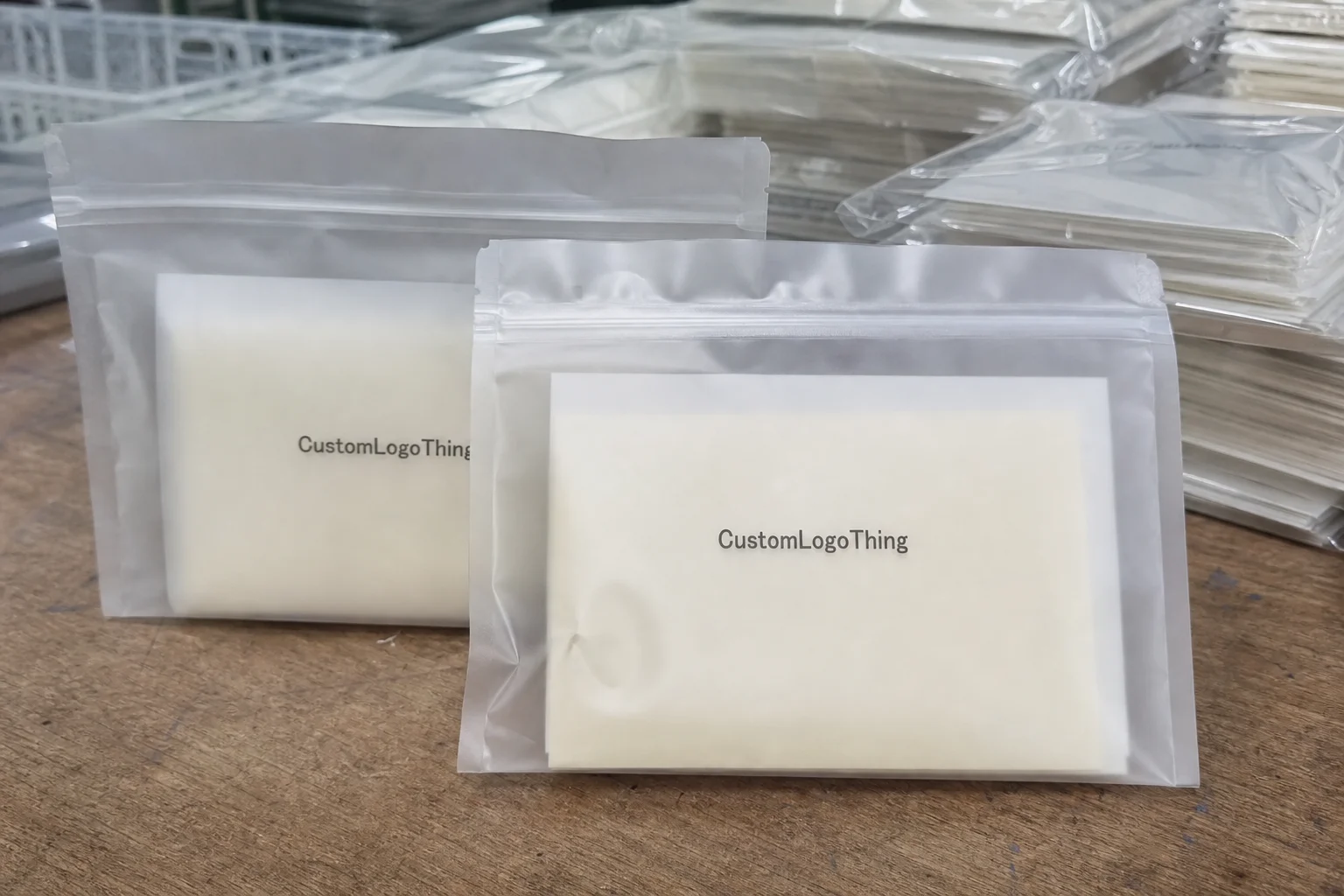
For small stationery brands, the biggest cost mistake is treating packaging as an afterthought. A bag that is 5 mm too narrow, a zipper that feels loose, or a print area that clips the logo can turn a launch into a second purchase order. That is why stationery Frosted Zipper Bags bulk order planning pays off before production starts, not after.
From a buyer's point of view, frosted zipper bags solve three problems at once. They give product visibility without full exposure, they make shelf presentation look cleaner, and they protect paper goods from dust, fingerprints, and light scuffing during shipping. For stationery, that is often enough protection without moving into expensive rigid cartons or custom inserts.
The savings show up in the details. SKU count affects how many sizes you need to stock. Insert thickness changes the usable bag size. Zipper style changes both feel and cost. If you need hang holes, writable panels, or retail labels, those options should be decided before the first quote, not after the art file is approved. The same is true for seal style. A stronger seal line may add cost, but it can prevent the slow failures that only show up once the bags are loaded.
"I do not need fancy. I need a bag that fits, seals, and arrives on time." That is the right standard for most stationery packaging buys. Pretty is fine. Mis-sized is expensive.
Planning also reduces waste. If one bag size can cover a sticker sheet, a postcard set, and a refill pack with only a small insert change, you cut inventory complexity and avoid dead stock. That is the real value of stationery frosted zipper bags bulk order planning: lower unit cost, fewer packaging SKUs, and fewer launch delays.
The other hidden gain is labor. Packaging that opens cleanly, stacks flat, and closes without fighting the product saves minutes on every carton. That does not sound dramatic until the order reaches a few thousand units. Then those minutes turn into real money, especially if the bags are being packed by hand alongside cards, inserts, or bundled stationery sets.
Frosted zipper bag formats, finishes, and closure options
The first decision is the film construction. Standard frosted PE is the common entry point for stationery because it looks clean, is light enough for shipping, and usually lands in a sensible price band. Matte-frosted blends feel a little more premium, while clear-window styles are better if the product itself is part of the display. Heavy-gauge versions make sense when the kit is bulky or the brand wants a stiffer retail look.
Closure style matters more than most buyers expect. A standard press-close zipper is fine for sticker packs and refill bundles. A smoother upgraded zipper is worth the extra cents if the bag will be opened often, such as for journaling kits or pen sets that customers may reorganize. Child-resistant hardware is not common in stationery, so do not pay for that feature unless there is a real compliance reason.
Not every bag should be specified the same way. A minimal sticker pack can live in a thinner, flatter pouch. A pen set with metal clips needs a little more body so the corners do not bite through the film. A mixed stationery kit with washi tape, tabs, cards, and a small notebook usually benefits from a wider opening and a small gusset. The more uneven the product mix, the more the bag structure matters.
Here is the practical use case split:
- Sticker packs: lighter frosted PE, standard zipper, slim profile.
- Notepad bundles: mid-gauge film, stronger seams, wider mouth opening.
- Pen sets: slightly thicker film to stop flex and corner punctures.
- Journaling kits: heavier film, writable panel, better shelf presence.
- Seasonal gift sets: premium finish, print coverage, and a hang hole if retail display matters.
Gusset depth is another quiet decision that changes the whole order. A flat pouch may be cheaper, but a small bottom gusset often improves packout and gives the bag enough volume to close cleanly. If the stationery set includes multiple pieces, the gusset can save you from overstuffed bags that look wrinkled and cheap.
Design teams also forget the little operational details. A hang hole matters if the bags go on pegs. A writable panel matters if the warehouse needs batch labeling. And if the surface finish is too glossy, fingerprints show up fast. Frosted film hides a lot. That is part of the appeal.
Size, gauge, and print specs that actually matter
Before you ask for a quote, confirm the internal usable size, not just the outside measurement. Bag lips, zipper placement, and seam allowances reduce real space. If your stationery stack is 8 mm thick, a bag listed as 120 mm by 160 mm may still be too tight once the seal line and zipper are included. That is why a packed sample, even a rough one, is more useful than a flat product spec alone.
Gauge is the second number that decides whether the bag feels cheap or reliable. Lighter gauges reduce unit cost, but they can fold too easily, scuff faster, and show wrinkles at retail. Heavier gauges improve stiffness and puncture resistance, which helps with bundles that include metal clips, pens, or thicker paper goods. For most stationery kits, the sweet spot is usually in the middle, not the thinnest spec available.
For frosted zipper bags, a common material range is about 0.12 mm to 0.18 mm, depending on the finish and closure design. That range is not a rule, but it is a realistic place to start comparing quotes. Below that, the bag can feel flimsy. Above that, the cost and freight weight rise fast, and the improvement may not justify the extra spend unless the kit is genuinely heavy.
Print choices should be simple unless the bag is doing real brand work. One-color logos, short copy lines, and a barcode area are usually enough. Frosted film can mute very fine detail, so tiny type and hairline art often look weaker than they do on screen. If you want a crisp logo, widen the strokes and keep contrast high. A monochrome mark usually survives the film better than a dense, multi-shade design.
These are the specs worth locking before production:
- Internal usable size, not just outer dimensions.
- Product thickness, including inserts, cards, or bundles.
- Zipper placement and lip allowance for easy opening.
- Print area for logos, instructions, and barcodes.
- Surface finish if you want a softer premium look or more transparency.
Food-contact rules are irrelevant here, but quality still matters. Ask about seal consistency, odor control, and batch color variation. A frosted bag that looks slightly different from one carton to the next can make a stationery line look sloppy. That is not a design problem. It is a supplier control problem.
For transit testing and packaging stress checks, ISTA standards are the right reference point: ISTA. You do not need the harshest test for every stationery order, but you do need a repeatable method that makes breakage and scuffing visible before the full run ships.
Cost, pricing, MOQ, and unit cost breakdown
Pricing is built from a few moving parts: film type, bag size, print count, zipper style, total quantity, and packing method. Add shipping destination and freight method, and the quote starts making sense. Strip out one of those inputs, and you get a vague number that is not useful for buying. The same bag can look cheap or expensive depending on whether the supplier is quoting ex-works, FOB, or landed cost.
For Custom Frosted Zipper Bags, MOQ usually depends on how much the supplier has to set up for your run. Stock-style sizes with light custom print can start lower, often in the 3,000 to 5,000 piece range. Fully custom sizes, heavier gauges, or more detailed print work often push MOQ higher, commonly 5,000 to 10,000 pieces or more.
Setup fees matter too. A quote that looks good on unit price can become less attractive once plate charges, print setup, carton labeling, and sample revisions are added. Those fees are not unusual, and they are not a sign of a bad supplier. They are part of the real cost structure. The cleaner the artwork and the more precise the specification, the lower the risk of paying for extra proof rounds.
| Bag style | Typical MOQ | Approx. unit cost at 5,000 pcs | Best use | Main tradeoff |
|---|---|---|---|---|
| Standard frosted PE | 3,000-5,000 | $0.14-$0.24 | Sticker packs, thin paper inserts | Lower stiffness |
| Matte-frosted blend | 5,000-8,000 | $0.18-$0.30 | Retail-ready kits, premium stationery sets | Slightly higher cost |
| Clear-window style | 3,000-5,000 | $0.12-$0.21 | Products that need high visibility | Shows clutter and fingerprints |
| Heavy-gauge premium | 5,000-10,000 | $0.22-$0.40 | Bulky bundles, gift sets, higher perceived value | Higher unit price and freight weight |
The unit-cost curve is real. Going from 3,000 pieces to 10,000 can drop the per-bag cost enough to matter, but only if the extra inventory will sell. Overordering because the unit price looks better on paper is how brands end up with boxes of dead stock after a product refresh. The smart move is to price a few quantity tiers, then compare them against actual demand, not wishful demand.
Good quote requests are specific. Send the dieline or exact dimensions, the art file format, the target quantity tiers, the ship-to ZIP, and the required delivery date. If you already have a physical sample, send that too. Guesswork costs money. Suppliers rarely price uncertainty generously.
Freight deserves its own line item. Air freight can make sense for emergency reorders or very small runs, but it often erases any savings from a low factory price. Sea freight is usually better for larger stationery packaging buys, yet it adds time and sometimes extra handling risk. For the planning stage, ask for both unit price and landed estimate so the final decision is based on the same math across suppliers.
Production steps and turnaround from quote to delivery
A clean order follows a predictable path: inquiry, spec confirmation, art review, sample or proof approval, production, inspection, packing, and freight booking. Skip one step and the schedule slips. That is why stationery frosted zipper bags bulk order planning should start before the artwork is final, not after everyone is already waiting on a launch date.
Delays usually come from the same places. Missing dimensions create a round of clarification. Unclear print files create a proof with awkward crop lines. Approval lag adds days because production is not going to start on a maybe. And if the first sample misses the fit by even a few millimeters, a revision can cost a full extra week or more.
Turnaround depends on the order type. Stock-style bags with minimal print can move faster, especially if the factory already has the film width or zipper format in-house. Custom sizes, special finishes, or stricter QC add time. A realistic planning window is often 12-15 business days after proof approval for simpler orders, and longer for more complex builds. Freight is separate. Always separate it.
For launches and seasonal drops, buffer time is not optional. Build in extra days for one revision cycle, final production inspection, and transit. If the order crosses borders, customs can also move the schedule. That is boring, but it is the part that decides whether the bags arrive before the launch or after the social posts are already live.
Paper inserts, header cards, and mailer components can also affect the timeline. If those pieces need FSC-certified stock, confirm it early and request proof from the supplier. The FSC standard is a practical reference when your stationery packaging includes paper-based add-ons.
If the order includes custom printing, approval speed matters more than most teams expect. A delayed proof does not just pause artwork. It holds up material allocation, carton scheduling, and sometimes the freight booking window. In practice, a supplier can be ready to run while the buyer is still deciding whether a logo should sit 3 mm higher. That kind of delay is expensive because it affects every downstream step.
One more thing: do not compress the schedule just because the quote looks good. Cheap freight plus rushed approval usually costs more than a slightly earlier order. That math has not changed, no matter how optimistic the calendar looks.
Quality control and supplier checks for stationery packaging
Suppliers should be able to show more than a nice sales sheet. Ask for material photos, zipper test results, print proof images, carton count confirmation, and inspection photos before dispatch. Those are basic proof points, not luxury extras.
Comparing suppliers gets easier if you keep the specs identical. Same size, same gauge, same print method, same packing method. Otherwise you are comparing one quote for a light-duty bag against another quote for a heavier one and pretending the numbers mean something. They do not.
For stationery, the practical durability checks are straightforward:
- Corner tearing when the bag is filled and handled repeatedly.
- Zipper reclose performance after several open-close cycles.
- Scuff resistance during shipping and shelf handling.
- Fingerprint visibility on the frosted surface.
- Clouding or curl after storage in a warm warehouse.
If the order includes printed cartons or branded paper inserts, check how those pieces are packed inside the master carton. A bag that passes inspection but arrives with bent inserts is still a problem. Packaging is a system. The components have to survive the same trip.
For stores and subscription kits, a small sample test goes a long way. Load the actual stationery product, close the zipper 20 to 30 times, drop the pack from table height, and leave one sample stored for a few weeks to see whether the film curls or loses clarity. That test is simple, and that is exactly why it works. It catches weak seams, loose closures, and films that look fine on day one but age poorly under normal storage conditions.
Shipping carton details deserve a quick review too. If the bags are packed too tightly, the zipper line can deform. If the cartons are underfilled, the bags can slide and crease. Ask for carton count, master carton dimensions, and net weight before production is finished. A supplier that can answer those questions quickly is usually easier to work with when something does go wrong.
Best next steps for placing the order cleanly
Lock the dimensions first. Then choose the finish and gauge. After that, confirm print area, quantity tiers, and the shipping method. That order matters because each choice affects the next one. It is hard to price a bag correctly if the size is a guess and the artwork is still floating around in a design file somewhere.
Send a physical sample of the stationery set if you have one. If not, send a packed photo with measurements and a note on the parts that must fit. A better brief means fewer revisions, and fewer revisions mean fewer chances to miss the launch window. That is plain buying logic.
Before production starts, approve these four things:
- Artwork proof with size and placement marked clearly.
- Sample photos or an approved pre-production sample.
- Carton spec including count per carton and packing method.
- Final shipping method with realistic transit time.
One more practical move: price the order at two or three quantity tiers. You will usually see a meaningful drop in unit cost at a higher tier, but only one of those tiers should match your actual sell-through. That keeps the buying decision honest instead of optimistic, which is where packaging budgets tend to get sloppy.
Keep the spec sheet short enough that a warehouse team can use it without interpretation. If the document needs a paragraph of explanation just to identify the zipper type, the order is not ready. A good spec sheet is plain, specific, and hard to misread. That is what prevents avoidable back-and-forth.
For the cleanest start, use one target size, one quantity plan, and one delivery deadline. That is enough to get a real quote and avoid the usual confusion that slows down stationery frosted zipper bags bulk order planning. Everything else can be refined after the numbers are in front of you.
FAQ
What should I confirm before a stationery frosted zipper bags bulk order?
Confirm exact dimensions, product thickness, zipper style, film finish, print area, and target quantity before asking for pricing. If any of those are vague, the quote will be vague too. That is not a mystery; it is how packaging math works.
How do frosted zipper bags compare with clear bags for stationery sets?
Frosted bags usually look more premium and hide minor product clutter while still showing enough of the contents to sell the item. Clear bags give maximum visibility, but they also expose imperfections and can look cheaper on retail shelves.
What MOQ is normal for custom frosted zipper bags?
MOQ depends on size, print complexity, and material, but custom runs usually start higher than stock-style orders. Higher quantities reduce unit cost, so compare the MOQ against your actual sell-through instead of guessing.
How long does production usually take after approval?
Turnaround depends on whether you need a proof, custom print, or special specs, but approval time is part of the schedule too. Build in extra days for freight and one round of revisions so your launch does not drift.
What files and details should I send for the first quote?
Send dimensions, quantity, logo artwork, desired finish, closure type, and shipping destination. A physical sample or product photo helps prevent size errors, which are expensive and avoidable.


