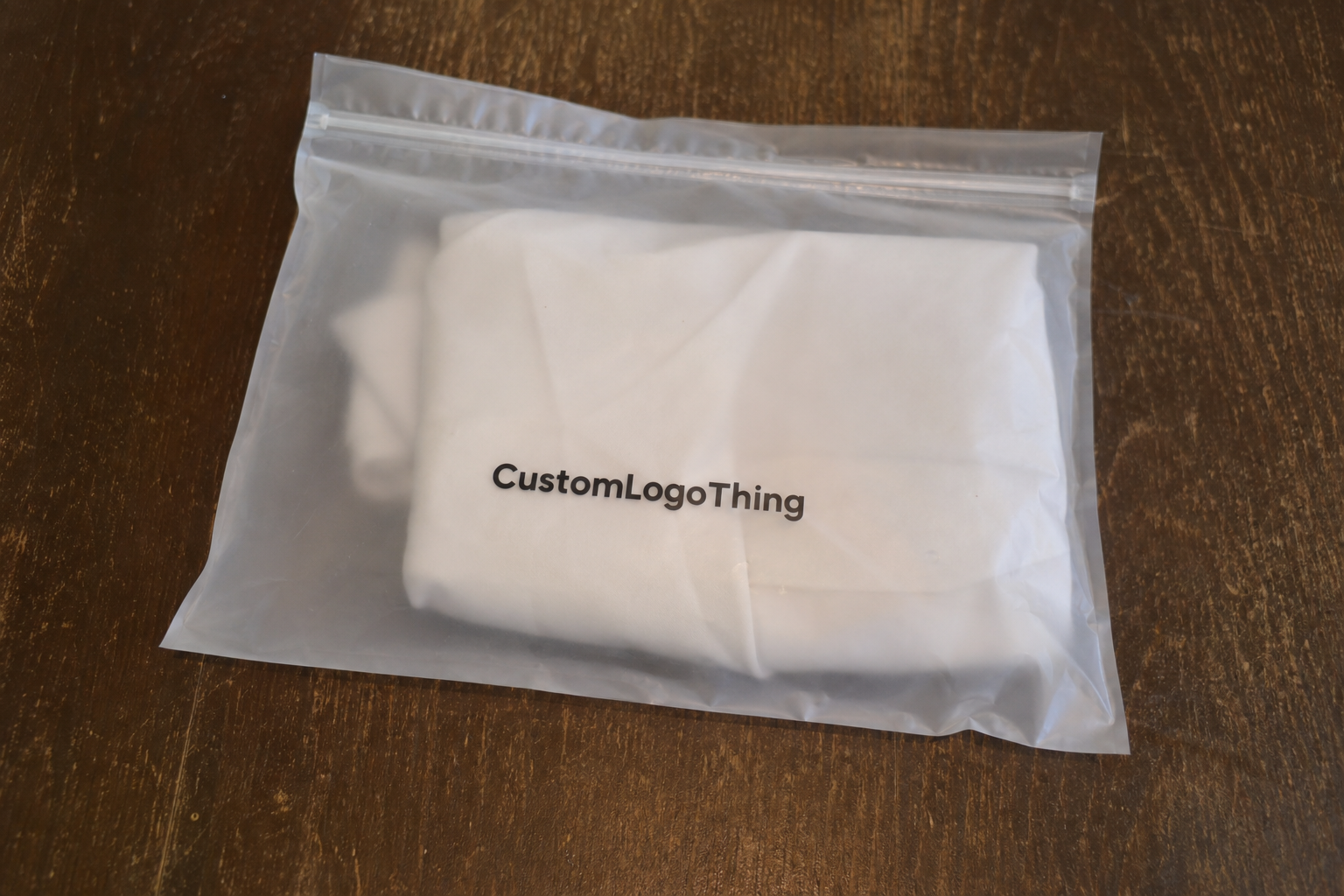
Two frosted zipper bags can sit next to each other and look nearly the same at a glance. Then the quote comes back, and the gap makes perfect sense. Film thickness, zipper profile, print coverage, pack-out method, and tolerance control all change the retail frosted zipper Bags Unit Cost Review faster than most buyers expect. The bag that looks cheapest on screen is not always the one that survives packing, transit, and shelf handling.
Frosted film is popular for a reason. It softens what the customer sees without hiding the product completely, which helps for apparel accessories, cosmetics, sample packs, and small hardware. Clear film can show every wrinkle and every bad fill line. Frosted film covers some of that noise and gives the package a more composed look. That visual effect matters because retail packaging has to do more than hold a product. It has to carry the first impression too.
The common mistake is to focus only on the bag price. That is a narrow view, and it tends to produce expensive surprises later. A slightly stronger zipper, a more stable film gauge, or a cleaner print setup can save money on packing line delays, replacement bags, and customer complaints. The real comparison is not just unit cost. It is unit cost against how the bag performs in real use.
Retail frosted zipper bags unit cost review: what drives it fastest
The fastest cost shifts usually come from the parts buyers cannot see in a mockup. Film grade, zipper design, and print method matter more than a lot of teams realize. A thin frosted bag with a light one-color logo may appear close to a premium pouch in artwork review, but the factory side tells a different story once the bag has to be made at volume and packed consistently.
Start with the film. Most retail frosted zipper bags are based on polyethylene, often with an LLDPE or LDPE blend to balance flexibility and seal behavior. The frosted look can be created through the film structure or surface treatment, depending on the production method. Either way, the finish affects both appearance and cost. A smoother, more even frosted surface usually looks better under store lighting and reduces the cheap, blotchy effect that can show up on low-grade stock.
Then look at the zipper. A single-track zipper is usually the lower-cost option and works fine for simple retail packs and sample bags. A double-track zipper costs more, but the closure often feels more secure and more refined in the hand. That tactile difference matters. Customers notice it even if they do not know why the package feels better.
Finish details can also move the number. Tear notches, hang holes, rounded corners, and special edge seals each add small steps or extra handling. None of those items feels dramatic on its own. Put them together, and the unit cost climbs in a way that is easy to miss if the quote is not broken down clearly. That is why a useful review separates the bag body from the closure and the finishing operations instead of treating them as one line item.
There is also a practical visual benefit to frosted film. Under bright retail lighting, clear bags can show glare, fingerprints, and every tiny loading mistake. Frosted material softens those distractions. It gives the product a calmer background, which helps when the item inside has its own color or texture to sell. For small apparel accessories, beauty tools, or bundled promotional items, that softer presentation is often worth the small premium.
Use case changes the right build. A cosmetic set needs surface quality and good print registration. Small hardware needs puncture resistance and stable seals. Apparel accessories usually care more about appearance and fast packing. A promotional kit may need the zipper to survive repeated opening and closing because the package stays in circulation longer than a normal shipper. The same bag style does not fit all of those jobs equally well.
Film, zipper, and finish choices that change the bag feel
A buyer can usually narrow the design by asking three direct questions: How much protection does the product need? How often will the bag be opened? How much shelf polish is expected? Those answers shape the film, zipper, and finish better than any broad packaging trend.
- Single-track zipper: lower cost, simple reseal function, good for light retail use and sample packs.
- Double-track zipper: better closure feel, stronger reseal impression, worth considering for premium presentation.
- Tear notch: helps first opening, especially if the bag is meant to be reused after opening.
- Hang hole: useful for peg displays and retail display systems.
- Gusset: adds volume and improves stand-up shape, but increases material use.
Material thickness is where many quotes start to separate. Common retail runs often sit around 1.5 mil to 4 mil, with 2 mil to 3 mil a practical middle zone for a lot of custom zipper bags. Thicker film feels more substantial and resists puncture better, but it also raises material cost and can slow some packing steps if the bag is stiff. Thinner film lowers the price but can wrinkle more easily, show compression marks, and feel less dependable in the hand.
The zipper profile matters in a different way. A closure that opens and closes with a clean, even snap creates confidence. A closure that fights back or feels loose can make the entire package seem lower grade, even when the print and film are acceptable. Buyers often focus on appearance first and forget that the closure is the feature people touch most often.
Print coverage is another major cost lever. A small logo on one side is very different from full-front artwork, back-side print, or multi-color registration across both panels. More coverage usually means more setup, more time spent dialing in the press, and more scrap risk during startup. Tight line art and exact color matching can also push up the job price because the factory has less room to correct small mistakes.
On a repeated run, tolerance matters more than the sales sheet suggests. A few millimeters of drift in width or zipper placement can change how the product fits and how the bag lines up on shelf. It can also slow packing if operators keep correcting orientation by hand. Good suppliers state the tolerance range up front. That saves everyone from arguing over a bag that is technically made, but not practically usable.
For buyers who want a technical checkpoint, material discussions often reference ASTM D882 for tensile properties and ASTM D1709 for impact resistance. Those references do not replace real samples, but they help structure the conversation. If the bags will travel through rough distribution, pairing material checks with transit testing guidance from ISTA is a smart move. The bag, carton, and handling method need to work together. A strong bag in a weak carton is still a weak system.
Dimensions, thickness, and print coverage that affect performance
Bag size sounds simple until the packing team tries to use it. Nominal size, usable inside space, seal allowance, and gusset depth are not the same thing. If the bag is too tight, loading slows down and the zipper can be harder to align. If it is too loose, the product shifts and the display looks sloppy. Either way, the unit cost analysis gets distorted if the size spec is vague.
Thickness affects more than durability. It also changes how the bag hangs, folds, and stacks. A very light gauge may be acceptable for inner retail packs, but it can show creases faster and resist less when product corners press against it. A heavier gauge can feel better and protect better, though it may not be necessary for soft goods or low-risk items. The best spec is usually the one that matches the product load without adding dead weight.
Print coverage changes cost because it changes process control. A simple logo is fast. A full flood, detailed illustration, or multi-panel design requires more setup time and tighter registration. If the artwork needs consistent color across future reorders, that adds another layer of control. Matching a spot color on a frosted surface can be less forgiving than matching it on a clean white substrate, since the frosted base slightly changes how color reads.
It helps to ask for dimension tolerance, zipper alignment tolerance, and print shift limits before approving production. Those numbers are not decorative. They define whether a bag is acceptable or not. Without them, buyers end up judging a shipment by feel after it lands, which is a bad time to discover ambiguity. A clean spec sheet gives the supplier a target and gives procurement a basis for rejection if needed.
There is another practical angle here: carton efficiency. A bag designed with the wrong ratio can waste space in the carton and on the pallet, which raises freight cost. Bulk packing usually moves cheaper than retail-ready individual packing or extra sleeves. If the package has to be sold in a certain display format, that needs to be part of the Unit Cost Review from the beginning, not added at the end as a surprise.
Pricing, MOQ, and quote levers buyers should compare
Quantity changes the math fast. A trial order carries more setup cost per piece, while a larger run spreads fixed work across more bags. That is why 3,000 pieces, 10,000 pieces, and 50,000 pieces can produce very different unit prices even when the bag spec looks almost unchanged. The unit cost drops as volume rises, but only if the job stays stable and does not require extra revisions.
MOQ should never be treated as one universal rule. Some suppliers set it by size, some by print version, and some by the total production load across multiple SKUs. If a buyer needs three sizes with the same artwork, the factory may treat each size as a separate run. Or it may combine them if the tooling and film spec allow it. That is why the right question is not simply "What is your MOQ?" but "How do you calculate MOQ for this construction?"
| Order profile | Typical unit cost range | Common fixed costs | Best fit |
|---|---|---|---|
| Trial run, 3,000 pcs | $0.16-$0.30 | Higher setup charges, sample handling, possible tooling fees | Spec validation and first retail launch |
| Reorder, 10,000 pcs | $0.09-$0.18 | Lower fixed cost per bag, standard packing | Stable SKUs with repeat demand |
| Scale run, 50,000 pcs | $0.05-$0.11 | Bulk pricing, freight and carton optimization | High-volume retail programs |
Those figures are only a working range. Size, film gauge, zipper profile, artwork complexity, destination, and packing method all move the final number. Still, a table like this is useful because it shows the shape of the pricing, not just the headline quote. Buyers need to see where the fixed charges sit. That is what exposes whether the low unit price is truly strong or just hiding costs elsewhere.
Ask for three price points every time: a small trial quantity, a normal reorder quantity, and a larger scale run. That makes the breakpoints visible. It also helps internal teams understand whether a design should stay as-is or be adjusted for better economics. A package that is fine at 3,000 pieces may become much more attractive at 10,000 if the supplier can keep the same spec and reduce setup burden.
"If the bag looks right but the zipper feels weak, the shelf effect disappears fast."
Production steps and lead time from proof to shipment
A realistic production flow usually goes through request, spec confirmation, artwork proof, sample or approval copy, production, inspection, packing, and shipment. A retail frosted zipper Bags Unit Cost Review should include that timeline, because a cheaper bag that misses a launch date is not cheap. Lead time is part of cost. If the product cannot hit the shelf when planned, the business loses more than the packaging saved.
The schedule usually slips for predictable reasons. Missing dielines slow artwork. Unclear zipper requirements delay sourcing. Print matching adds approval rounds. A supplier who has to guess at any part of the build will move slower, not faster. Clean specs shorten the process more than pressure ever does.
For straightforward jobs with materials in stock, a lead time of roughly 12-15 business days from proof approval to completion is common. Complex orders can take longer, especially if the zipper style is custom or the print work needs tighter color matching. Shipping adds its own timeline. Air freight is faster and more expensive. Sea freight is slower but usually better for larger volumes. The right choice depends on inventory pressure, not habit.
Ask the supplier to break the schedule into proof approval, production start, production completion, inspection, and freight booking. That makes the calendar legible. It also shows whether the supplier is thinking in real production steps or just handing over a loose estimate. For buyers managing carton components or paper inserts alongside the bag order, FSC can be relevant if the paper side of the package has sourcing requirements or brand standards.
Packing method can change landed cost in quiet but meaningful ways. Bulk carton packing is generally cheaper than retail-ready bundling, extra sleeves, or individual wrap. The bag unit price may stay the same while freight and warehouse handling rise. That is why landed cost reviews need to include the carton count, inner packing, and pallet pattern, not just the bag itself.
Supplier consistency that keeps reorders on spec
The first run is where a supplier proves they can make the bag. The reorder is where they prove they can repeat it. That second step matters more than many teams admit. Frosted finish can shift slightly, zipper feel can change, and print position can drift if the production record is weak. A buyer who only checks the first delivery is missing half the risk.
Consistency starts with documentation. The supplier should keep an approved sample, a spec sheet, and a record of any agreed exceptions. If the bag is reordered six months later, the production team needs the same size, same thickness, same closure style, and same packing count. Without that paper trail, the chance of a surprise goes up. It is a small administrative habit that saves real money later.
Communication matters too. A strong supplier flags likely problems early: a zipper profile that is hard to source, a print layout that is too tight for the material, or a bag size that may cause wrinkling during fill. That kind of feedback is worth more than a quote that looks good and says little else. Good suppliers are specific. Weak ones are vague and optimistic.
For repeat business, the best outcome is boring: same spec, same feel, same pack count, same carton load. That is not glamorous, but it is exactly what keeps a retail program from wasting time. If the reorder behaves like the approved sample, the packaging stops being a problem and starts doing its job.
One more practical point: suppliers who can show stable processes usually reduce hidden costs. Less rework. Fewer rush charges. Fewer mismatched cartons. Fewer headaches in receiving. A slightly higher quote can still win if it keeps the job on spec and avoids the sort of drift that forces a buyer to re-approve everything from scratch.
What to send for a fast quote and cleaner reorder planning
The better the input, the cleaner the quote. A simple spec packet should include dimensions, thickness, zipper style, artwork files, estimated quantity, shipping destination, and any retail display requirement. If the bags need a hang hole, a gusset, or a specific carton count, include that too. A quote is only as useful as the assumptions behind it.
Reference photos help more than most buyers expect. A picture of the current bag, a sample zipper style, or a mockup showing how the product should sit inside the pouch can remove a lot of back-and-forth. Visual references are especially useful when the finish is hard to describe. "Frosted but still see-through" means different things to different people. A photo makes the target clearer.
For pricing comparison, ask for separate line items where possible. Unit price, setup cost, sample fee, tooling fee, packing method, and freight should not all be buried in one number. If they are separated, it becomes easier to see whether the low quote is actually competitive or just rearranged. It also helps the buyer compare suppliers without guessing at what is included.
Reorder planning is easier if the approved sample, final artwork, carton count, and any special notes live in one place. That sounds basic because it is. Basic systems tend to work. They make it much easier to repeat the order without rediscovering old decisions. They also reduce the chance that a new buyer or account manager has to reconstruct the spec from scratch.
Use the quote stage to define the landed picture. That means looking at unit cost, MOQ, print version, freight method, and packing style together. If those pieces line up, the comparison is real. If they do not, the lowest number can be misleading. A careful retail frosted zipper bags Unit Cost Review should leave you with a spec you can actually buy again, not just one number to file away.
What affects retail frosted zipper bags unit cost the most?
Film thickness, zipper style, print coverage, and order quantity usually move the price the most. Packing method and freight also affect landed cost, which is the number that matters to procurement. If the spec is loose or changes during proofing, soft costs like revisions and sample rounds can add more than people expect.
What MOQ is typical for custom frosted zipper bags?
MOQ depends on size, print setup, and production complexity. Smaller orders are possible, but the unit price often rises because setup work is spread across fewer pieces. Ask whether MOQ is tied to one SKU, one print version, or total volume across multiple sizes.
Are frosted zipper bags more expensive than clear zipper bags?
Often yes. The frosted finish usually adds material or process cost compared with standard clear film. The difference can narrow on larger runs or when the clear version needs extra print or special features. The better comparison is total value: shelf look, durability, and reseal performance alongside price.
How long does production usually take after approval?
For simple jobs with complete files and available materials, production may take about 12-15 business days after proof approval. Complex artwork, custom zipper sourcing, or tighter print matching can extend that. Freight time sits on top of production time, so the shipping method matters as much as the factory schedule.
What should I send to get an accurate quote?
Send dimensions, thickness, zipper style, artwork files, quantity, and shipping destination. A sample photo and carton requirement help too. The more complete the spec, the less room there is for assumptions that distort price or delay production.