A retail Ribbon Handle Paper Bags Unit Cost Review only makes sense if you judge the bag by what it does to the sale, not just what it costs to print. A ribbon handle changes the perceived value fast. In retail, gifting, and premium takeaway, that matters more than most buyers want to admit.
The cheap-looking option usually costs more in hidden ways. You get weaker shelf impact, more complaints, and a package people throw away instead of keep using. That is why buyers who compare only cost per piece often miss the better commercial choice.
Why these bags sell better than their unit price suggests
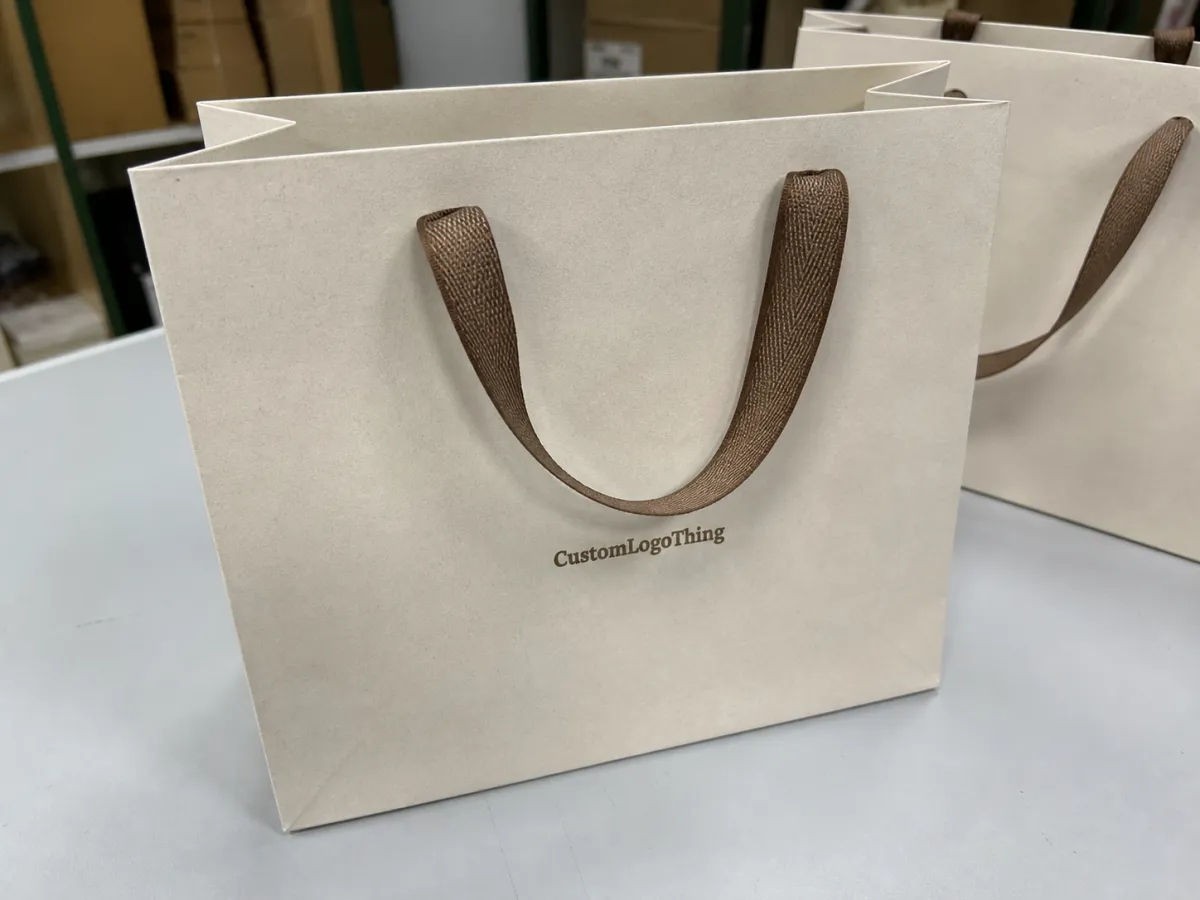
Paper bags with ribbon handles sit in a useful middle ground. They are still practical, but they feel more finished than a flat-handled sack or a thin generic carrier. That small visual upgrade often supports a higher ticket item, especially in boutiques, candles, cosmetics, wine, and event packaging.
In practice, the ribbon does three jobs. It improves hand feel. It signals care. And it makes the bag more likely to be reused, which keeps the brand in front of the customer longer. That is the part many buyers miss in a retail ribbon handle paper Bags Unit Cost Review: the bag is not just carrying the product out of the store, it is carrying the brand impression home.
Commercially, that can change sell-through. A sturdier, better-looking bag reduces the chance that a customer thinks the purchase was underpacked or rushed. It also helps stores that want a premium look without moving into a rigid box for every order. That is not glamour. That is practical retail presentation.
"If the bag is meant to do more than carry the item, price it like packaging, not like an afterthought."
So the decision is not "ribbon or no ribbon." The real question is whether the upgrade supports the product margin, the store environment, and the customer experience without adding features nobody asked for.
Bag build choices that change the look and feel
The biggest mistake buyers make is treating all ribbon handle bags as the same. They are not. The paper grade, body shape, handle attachment, top fold, and bottom reinforcement all change how the bag looks in hand and how it behaves in use.
Handle styles
Ribbon handles usually use satin or polyester ribbon in widths from 10 mm to 25 mm. Smaller gift bags often look balanced with 10-12 mm ribbon, while heavier retail bags need 16 mm or wider so the handle does not dig into the hand. A narrow ribbon on a large bag can look elegant in a sample and annoying in real use. Buyers discover that quickly, which is not a fun surprise.
Twisted paper handles cost less and recycle more easily. Rope handles feel sturdier and can carry more weight. Ribbon handles win on presentation, but they are usually the first place the budget moves up. If the store sells premium accessories or gifts, that spend is often justified. If the bag is for a low-margin promo item, it may be pure decoration with a higher invoice.
Surface and finish
Matte lamination gives a softer, more muted look. Gloss lamination pushes color and makes the surface easier to wipe clean. Hot foil, spot UV, and embossing all add visual depth, but they also add setup charges, tooling fees, and more room for production error. For a bag that will live in a humid shop, in a car, or near food, the finish choice affects durability as much as appearance.
Body structure matters too. A square-bottom bag with a reinforced board sits better on shelves and counters than a soft-sided bag. A gusseted side panel gives more volume without making the bag feel oversized. For boutique retail, that matters because the bag should protect the item and still look intentional.
Use case should guide the spec. Cosmetics want clean print and precise color. Wine wants stronger board and reliable base support. Candles need a bag that resists denting and carries the weight without handle failure. Event bags need visual impact and decent fill volume. Same outer dimensions, different job.
Retail Ribbon Handle Paper Bags Unit Cost Review
Here is the clean way to think about pricing. Unit cost is built from paper grade, bag size, handle material, print coverage, finishing, and packing method. MOQ shifts with every one of those choices. So does the real bulk pricing you will pay once freight and sampling are included.
For a rough buyer-side range, these are common scenarios:
| Option | Typical MOQ | Unit cost range | Best fit | Watchouts |
|---|---|---|---|---|
| Plain stock-size ribbon handle bag | 500-1,000 pcs | $0.28-$0.55 | Events, simple retail, short-run gifting | Limited size choice, fewer branding options |
| One-color custom print | 1,000-3,000 pcs | $0.42-$0.85 | Boutiques, cosmetics, candles, seasonal retail | Setup charges, color matching, print area limits |
| Laminated premium bag with ribbon handle | 3,000+ pcs | $0.85-$1.80+ | Premium retail, wine, gift packaging | Tooling fees, higher freight weight, longer lead time |
| Foil, embossing, or complex finish | 3,000-5,000+ pcs | $1.20-$2.50+ | Flagship launches, luxury brands, high-margin sets | More approval steps, more rejection risk if artwork is sloppy |
Those ranges are not fantasy numbers, but they are also not a quote. They assume standard retail sizes, sensible print coverage, and normal carton packing. If you want custom sizing, specialty ribbon colors, or extra board reinforcement, the cost per piece moves up. Fast.
The quote traps are usually boring, which is why people miss them. Freight can add a lot on lower-volume runs. Sampling may be charged separately. Plates, screens, and die tooling can turn a "cheap" project into an expensive one if you did not ask what is included. Some suppliers also hide packing upgrades or special inner polybags in the footer of the quote, then act shocked when the invoice is higher than the headline price.
If you are comparing two vendors, ask for the landed cost, not just factory unit cost. A bag at $0.45 that arrives with $280 in freight and $120 in setup charges can be worse than a bag at $0.58 with cleaner quoting and lower add-ons. Buyers do themselves no favors by pretending the first number is the whole answer.
Production steps, proofing, and lead time
The process should be straightforward, even if the supplier likes to act like it is mysterious. It usually goes like this: brief collection, dieline confirmation, artwork check, sample approval, mass production, inspection, and export packing. If a vendor cannot explain that sequence clearly, the order is already at risk.
For a simple custom run, a sample often takes 5-10 business days after artwork and structure are confirmed. Mass production is often 12-20 business days after sample approval, though more complex finishes or a busy schedule can stretch that. Freight is separate. Sea and air timelines are not the same thing, and pretending they are is a great way to disappoint a launch date.
Where delays happen
Most delays are self-inflicted. Incomplete artwork slows proofing. Wrong size specs force dieline changes. Ribbon color changes after approval delay sourcing. Late edits after sign-off are another classic mistake. Once the proof is approved, the factory is not your sketchpad anymore.
If the launch date is fixed, work backward. Leave room for proofing, sample review, production, transit, customs, and a small buffer. That buffer is not waste. It is insurance against the usual nonsense that shows up in packaging projects.
For shipping performance, ask whether the bag needs any transit-style testing or drop-test logic. If the package will travel with heavier products or be stacked in distribution, it is worth aligning expectations with ISTA guidance. If your claim depends on certified paper, ask for FSC documentation rather than accepting a vague promise and hoping for the best.
Paper weight, handles, and print specs that matter
Ask for specs in writing. Not "nice paper." Not "strong handle." Get the actual numbers. Paper gsm, board thickness if used, handle width, handle length, adhesive type, and whether the top opening has reinforcement patches all belong in the spec sheet.
For most retail ribbon handle bags, 210-250 gsm art paper is common for the outer shell, while heavier premium builds may use 250-300 gsm or laminated stock with an internal support board. If the item is heavy, a thin paper body with a pretty handle is not enough. The bag should hold the load without the side wall collapsing or the bottom panel bowing.
Print coverage and color
One- to four-color print is normal. Full-surface branding pushes the price up because coverage, registration, and waste all increase. Dark backgrounds often need more ink or a white underprint. Metallics and solid black across large areas can look rich, but they also expose every variation in finish quality. That is why poor artwork management shows up so quickly on premium bags.
Lamination can help moisture resistance and scuff resistance, but it changes texture and can affect recyclability claims. If the bag will live in a dry boutique, matte laminate may be enough. If it will go near chilled drinks, outdoor events, or repeated handling, durability may be worth the extra cost. The right answer depends on store conditions, not mood board vibes.
Load and handling
A pretty bag is useless if the handle tears or the base fails. Ribbon handles should be attached with enough reinforcement to handle the product weight without pulling through the paper. In many runs, that means a stronger top fold, better adhesive control, and a clear load target from the buyer. The supplier cannot guess your product weight and guess well.
For cosmetics, candles, and small gift sets, presentation may matter more than maximum load. For bottles and dense retail items, strength matters first. That is the part where a buyer saves money by refusing unnecessary decoration and spending it on structure instead.
What to verify before you compare suppliers
Start by checking whether the supplier is a factory or a trading layer. That one detail changes pricing transparency, sample control, and how fast issues get fixed. A direct factory is not automatically better, but you should know who actually owns the tooling, the ribbon sourcing, and the final quality check.
Then verify the non-negotiables: material certificates if needed, color control method, inspection standard, packaging format, and repeatability for the next order. If a supplier cannot reproduce the same build again without drifting in size or color, the first order is not really a success. It is just the first round.
- Material proof: Ask for paper grade, ribbon spec, and any FSC claim support.
- Inspection control: Confirm how they check print alignment, handle strength, and carton counts.
- Reorder stability: Ask how they store the dieline and color references for repeat runs.
- Communication speed: Fast quoting matters because it catches spec mistakes before they become setup charges.
Honestly, the best vendors do not just send one number. They send options. Plain version, upgraded version, and the premium version with the extra finishing clearly separated. That lets you compare bulk pricing without guessing where the extra cost came from. Hidden fees are a choice, not a law of nature.
Clear quotes beat pretty promises. If the supplier cannot itemize the cost, they probably do not want you to see the weak spots.
How to request a quote and lock the next order
If you want an accurate quote, send a complete brief. Size, quantity, paper grade, handle style, print colors, finishing, shipping destination, and target launch date all belong in the first message. Leave out the vague stuff. "Premium" is not a spec.
- State the bag size and product weight.
- Send artwork and say how many print colors you need.
- Choose the ribbon width and color, or ask for options.
- Confirm whether you need lamination, foil, embossing, or none of that.
- Ask for MOQ, unit cost, tooling fees, setup charges, sampling cost, and freight separately.
Then ask for at least two quote scenarios. One should match your target budget. One should show the upgraded build so you can see where the price jumps. That makes the buying decision obvious instead of emotional. It also protects you from spec creep, which is how many packaging jobs go from "easy" to "why is this so expensive?"
Ask for a sample before bulk production if the ribbon color, finish, or load requirement matters. A pre-production sample checks print alignment, handle strength, and overall look under real light, not under a polished PDF. Keep one approved sample for future reorders. It saves time and prevents the classic "this is not exactly the same as last time" conversation.
For a retail ribbon Handle Paper Bags unit cost review, the smartest move is simple: narrow the spec first, then ask for an itemized quote. That gives you a real cost per piece, a realistic MOQ, and fewer surprise add-ons when the bags land at your warehouse.
What drives retail ribbon handle paper bags unit cost the most?
Paper weight, bag size, handle style, and print coverage are the biggest drivers. Finishes like lamination, foil, and embossing raise the price quickly. Freight, sampling, and packing details can change the landed cost more than buyers expect.
What MOQ should I expect for custom ribbon handle paper bags?
MOQ usually rises when you change size, add more print colors, or specify premium finishing. Plain or lightly printed stock-size bags often start lower than fully custom retail runs. If a supplier offers an unusually low MOQ, check whether the quote includes real customization or just a generic bag with a logo stamp.
How long does the production timeline usually take?
Sampling normally takes longer than the mass run because structure and artwork need approval first. Production lead time depends on bag complexity, finishing, and factory schedule. Freight time should be planned separately so the retail launch is not tied to only the factory timeline.
Can I get a sample before placing a bulk order?
Yes, and you should ask for one if the bag has a specific ribbon color, finish, or load requirement. A pre-production sample helps check color, handle strength, and print alignment before the full run. If a supplier skips sampling on a custom order, that is not efficiency; that is gambling with your budget.
What information do you need for an accurate quote?
Send the size, quantity, paper spec, handle type, artwork, and destination. Include whether you need lamination, foil, embossing, or other finishing. If you have a target budget, share it; a good quote can usually be shaped around it instead of wasting time on vague back-and-forth.

