Cosmetics ribbon handle paper bags Bulk Order Planning is less about choosing a pretty carry bag and more about getting the spec right before the launch clock starts shouting at everyone. A bag can photograph well and still fail the real test: carrying glass, staying flat in cartons, and arriving on time without turning the quote into a surprise.
The best bag does three jobs at once. It sells the set, protects the product, and fits the production schedule. Ribbon handles usually land in that sweet spot because they feel more polished than a standard twisted-paper handle, but they do not carry the weight, storage cost, or rigidity of a box. That middle ground is exactly why beauty buyers keep coming back to them.
There is also a reason they work so well for cosmetics specifically. Beauty packaging lives and dies on perceived care. A ribbon handle suggests the brand paid attention to the details, even before the customer opens the bag. That is not fluff. It is a retail signal, and retail signals matter.
“A cosmetic bag should look polished, stack flat, assemble quickly, and still survive the walk from counter to car. If it only does one of those things, it is not doing its job.”
From the buyer side, the real value is consistency. Retail teams want easy assembly. Warehouses want cartons that stack cleanly. Finance wants a price that does not drift every time a finish changes. Good cosmetics ribbon handle paper bags Bulk Order Planning keeps those pieces aligned instead of treating the bag like a one-off design exercise.
There is one rule worth keeping early: do not overbuild the bag just to make it feel premium. If the set is light, a heavy board can waste money. If the set includes glass bottles, pumps, or boxed kits, a flimsy bag becomes a liability. Packaging should match the load, not the mood board.
Why Ribbon Handles Beat Plain Carry Bags for Cosmetics
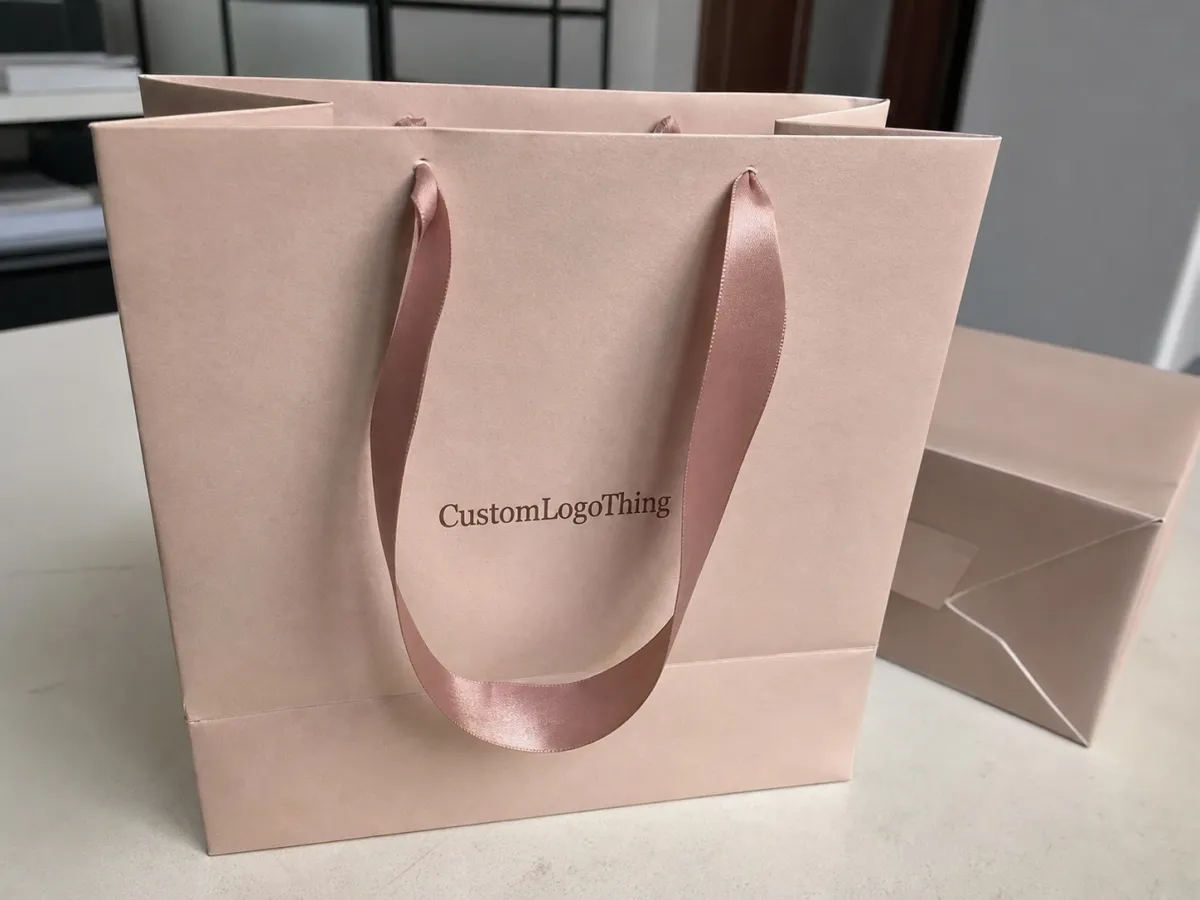
For cosmetics Ribbon Handle Paper Bags Bulk Order Planning, the first question is simple: how much perceived value do you need before the budget starts complaining? Ribbon handles deliver a gift-ready look that works for fragrance sets, skincare bundles, launch events, holiday promotions, and counter pickup. They feel intentional. Plain carry bags often feel like they were chosen because nobody wanted to argue.
That difference shows up quickly in a store. A satin or grosgrain ribbon adds softness and a little ceremony. The bag becomes part of the purchase experience instead of a throwaway carrier. Customers notice that. They may not say it out loud, but they register the difference between “product handed over in a bag” and “brand experience carried out the door.”
Comfort matters too. Ribbon handles usually sit better in the hand than narrow paper cords, especially when the bag carries multiple items or heavier skincare. Grosgrain is often the safer choice for weight because it grips better and resists slipping; satin looks richer, but it can feel slick if the bag gets heavy. That tradeoff is small until somebody has to carry the bag through a mall, an airport, or a long parking lot.
Bag performance also affects how the product is perceived after purchase. If the handle digs in, the bottom bows, or the top edge crushes under load, the premium feeling disappears fast. A customer may still like the product, but the packaging will not have done its job. Beauty brands spend enough on product development to know better than to underfund the last five feet of the experience.
Another practical advantage: ribbon handle bags are easier to store and ship than rigid boxes. They fold flat, take less warehouse space, and usually need less protective packing in transit. That does not make them cheap to produce. It just makes them easier to live with once the order is in motion.
For limited-edition launches, ribbon handles also give the design team more room to do something distinct without changing the whole structure. A color-matched ribbon, a foil logo, or a textured paper stock can shift the bag from basic to giftable without adding an entirely new packaging format. That flexibility is part of the appeal.
The catch is that ribbon handle bags still need disciplined spec control. If the ribbon color is off, the print is muddy, or the glue line fails, the whole package feels careless. Pretty is not enough. The structure has to hold up after the first customer touch.
Product Details That Change the Final Quote
The final price is built from a stack of choices, and none of them are mysterious. Paper type, board thickness, print coverage, finish, handle style, reinforcement, and packing method all move the number. Buyers usually focus on the unit price first. That is normal. But the real cost is shaped by how the bag is built and how much labor the factory has to put into each piece.
Paper selection is usually the first cost fork. Coated art paper gives you a smoother print surface and sharper graphics, which is useful for color-heavy beauty branding. Kraft board creates a more natural look and works well for minimalist cosmetics lines, earthy product stories, or brands that want the print to feel quieter. Specialty laminated paper is a better fit when the bag needs a richer tactile effect or a stronger moisture barrier. None of those is universally better. Each one fits a different use case.
For a practical baseline, many cosmetic buyers work in the 210 gsm to 300 gsm range for paper bags, with reinforcement inserts added where needed. Heavier sets may need a thicker liner board at the base or a reinforced top edge so the opening does not warp. If a supplier quotes only the outer paper and ignores reinforcement, the quote is incomplete.
Handle construction matters just as much as the paper. Ribbon width often falls between 6 mm and 25 mm. Narrow ribbon can look elegant, but it may cut into the hand if the bag is loaded. Wider ribbon feels better and spreads weight more evenly, though it adds material cost. Stitching, knot style, adhesive area, and anchor reinforcement all affect how secure the handle feels once the bag is full. A neat knot is nice. A handle that survives repeated use is better.
Finish choices create another common budget swing. Matte lamination gives a cleaner, quieter look. Soft-touch coating adds a more luxurious feel, though it can mark more easily than buyers expect if the bags are stacked or handled before the event. Foil stamping, embossing, and spot UV can all work well in beauty packaging, but they should reinforce the branding instead of trying to rescue weak artwork. If the logo already carries the design, one finish upgrade is often enough.
| Option | Typical Use | Cost Impact | Best For |
|---|---|---|---|
| Coated art paper | Full-color cosmetic branding | Moderate | Retail sets, promotional launches |
| Kraft board | Natural or minimal branding | Lower to moderate | Eco-leaning lines, simpler print |
| Laminated specialty paper | Premium hand feel and visual depth | Higher | Gift sets, prestige cosmetics |
| Foil + embossing | High-impact branding details | Higher | Launch kits, holiday packaging |
One of the more useful habits in quote review is asking the supplier to show price shifts one variable at a time. If the same bag gets 10% more expensive just because the ribbon color changes, that tells you something. If adding a bottom insert barely changes cost, that tells you something else. Clear pricing logic is more valuable than a polished sales pitch.
If the supplier only quotes one build and refuses to break down the alternatives, treat that as a warning sign. A serious quote should show where the money goes and which choices are actually driving the number.
Sizes, Finishes, and Reinforcement Specs to Lock Down
Do not start with the bag size in isolation. Start with what goes inside it. A lipstick box, a serum duo, and a full skincare gift set are not the same job. If the inner package is tall, heavy, or awkwardly shaped, the bag needs enough headroom and base support to make the set look intentional instead of crammed.
For cosmetics ribbon handle paper Bags Bulk Order planning, I usually tell buyers to define three things before asking for a quote: the heaviest SKU, the fullest set, and the display situation. A counter bag for a single product can be compact. A holiday bundle may need extra width for tissue paper, inserts, and a little breathing room. If the bag is too tight, the top edge buckles. Too loose, and it starts to look wasteful.
Common cosmetic bag sizes usually fall into a few practical bands: small boutique bags around 120 x 80 x 180 mm for single items; medium bags around 180 x 100 x 250 mm for sets and duos; larger bags around 250 x 120 x 320 mm for gift bundles or multiple boxed products. Those are starting points, not rules. Final dimensions should follow the product, not a template borrowed from another brand’s campaign.
Reinforcement is where cheap bags either earn respect or expose themselves. Bottom boards help with glass jars and stacked sets. Mouth folds keep the opening neat after repeated handling. Handle anchors need enough glue area, stitching, or reinforcement tabs to resist pull-out. If the bag is meant for repeat use, load testing should be part of the approval process, not an afterthought.
- Bottom board: useful for heavier jars, multi-item kits, and fully packed gift sets.
- Handle anchor reinforcement: helps avoid tearing where ribbon meets the top edge.
- Side gusset depth: improves fit for boxed cosmetics and tissue-wrapped bundles.
- Surface finish: affects scuff resistance during transport and shelf handling.
Ask for a sample, or at least a strike-off, before bulk production. A decent sample should show print registration, color accuracy, ribbon feel, and load behavior. A lot of cosmetic brands only notice color drift once the whole run is sitting in cartons, which is a painful way to learn that the “soft blush” they approved came back as dusty peach. Handle feel gets ignored too often. That sounds minor until somebody actually carries the bag.
Small detail, big effect: the ribbon attachment point should match the bag’s intended weight. A light boutique bag can get away with less reinforcement. A bag built for boxed skincare or multiple items needs a tougher anchor and a stronger top edge. If the supplier cannot explain the difference, the spec is still too vague.
Pricing, MOQ, and Unit Cost Breakpoints
The fastest way to miss the budget is to focus only on unit price without understanding the setup math. Bulk packaging pricing rewards volume, but not evenly at every step. A 500-piece order carries a much heavier share of setup work than a 5,000-piece order. That is not the factory being difficult. That is just how the numbers behave.
For cosmetics ribbon handle paper Bags Bulk Order planning, typical MOQ ranges often start around 500 to 1,000 units for simpler builds, then climb for custom ribbons, specialty finishes, or more complex print. If you want a custom-dyed ribbon, foil stamping, and a reinforced structure, expect the MOQ to rise. If you want a simple one-color logo on kraft board, you will usually have more flexibility.
Here is the useful part: the cheapest quote is not always the best order. Buyers should compare landed cost, not just factory cost. Freight, cartons, inserts, plate charges, sampling, and any special packing instructions all belong in the same calculation. A quote that looks cheap until shipping lands is not cheap. It is incomplete.
| Quantity | Typical Unit Range | Cost Behavior | Buyer Takeaway |
|---|---|---|---|
| 500 units | $0.90-$1.60 | High setup share | Good for testing or limited launches |
| 1,000 units | $0.55-$1.10 | Better spread on prep costs | Often the first workable bulk tier |
| 3,000 units | $0.32-$0.78 | More efficient production | Useful for active retail programs |
| 5,000 units | $0.18-$0.55 | Best cost efficiency per piece | Strong option for stable, repeat SKUs |
The table above is directional, not a promise. Country of origin, paper grade, labor cost, freight mode, and finishing method all shift the number. Still, the shape of the market is consistent: small runs carry a setup premium, while larger runs start to reward planning discipline.
Ask suppliers to quote multiple tiers in one sheet. That makes the tradeoff visible. If moving from 1,000 to 3,000 units barely changes the per-piece price, then the inventory risk may not be worth it. If the price drops sharply, the break-even point is telling you to think harder about the reorder plan.
There is also a hidden cost in changing specs late. Each new finish, ribbon color, or dimension revision can trigger fresh sampling, new approval cycles, and occasional extra tooling. The cost is not always dramatic, but the schedule damage can be.
Production Steps, Lead Time, and Shipping Buffer
A realistic schedule keeps the launch alive. The usual workflow runs like this: spec confirmation, artwork check, proofing, sampling, mass production, quality control, and final packing. If you skip the sample step because the calendar is tight, you often create a bigger delay later. Packaging projects love punishing that decision.
Timing depends on complexity. Simple paper bags with standard ribbon handles move faster than premium builds with foil, embossing, and custom color matching. As a working range, proofing may take a few days, sample approval another few days, production often runs 12 to 20 business days after approval, and shipping can take anywhere from a few days to several weeks depending on route, customs, and delivery method. Peak season stretches all of it.
Where do delays usually happen? Artwork revisions are a classic problem. Someone wants the logo larger. Someone else wants the ribbon a shade darker. Legal changes a line of copy. Color matching can also slow things down if the brand expects a perfect ribbon shade from a stock catalog. Then there is the production queue itself. If the factory is busy, a simple order still waits its turn.
For cosmetics ribbon handle paper bags bulk order planning, I prefer a backward schedule. Start with the delivery date, subtract shipping time, subtract production time, subtract sample and approval time, then add a buffer. That buffer should cover at least one revision cycle plus a little freight drama. If the launch date has zero flexibility, the plan is not realistic enough yet.
Shipping terms matter too. Ask whether the quote is EXW, FOB, or delivered, because each one changes who controls freight and who carries risk. Carton strength matters as well. If cartons are packed too densely or the outer cases are weak, bags can arrive scuffed, warped, or flattened. Good suppliers usually know the difference between a product that leaves the factory clean and a product that survives a long transit chain clean.
For shipping expectations, many buyers use broad packaging standards such as ISTA testing guidance as a reference point for transit durability. That does not mean every order needs formal lab testing, but it does mean the carton and pack-out method should be chosen with transit stress in mind, not optimism.
Build a shipping buffer even for domestic deliveries. Courier delays, route congestion, and warehouse receiving windows all create friction. A bag that arrives two days late for a launch is not a small miss. It is the wrong timing.
What a Reliable Supplier Should Prove Before You Order
Look past the mockup. A pretty render is easy. Repeatable production is the real test. A reliable supplier should show saved specs, consistent handle attachment methods, color control practices, and a basic QC routine. If they cannot explain how they keep the second order looking like the first, keep walking.
Ask for proof of load testing or pull-strength checks. The exact numbers are less important than the existence of an actual check. A bag built for cosmetics should hold the full retail load without the handle tearing out or the bottom bowing badly. If the supplier only says “strong enough,” that is not a specification. That is a hope.
QC for cosmetic bags should usually cover a few predictable failure points: ribbon symmetry, handle pull resistance, print registration, edge glue, corner squareness, surface scuffing, and carton count accuracy. The things that get missed are often the things customers notice first. Slightly off-center handles or weak glue lines do not stay subtle for long.
Material traceability matters too, especially if the brand needs FSC documentation or specific paper sourcing records. If sustainability claims are part of the packaging story, ask for the paper chain-of-custody paperwork before production starts. Do not let that become a last-minute scramble after the bags are already in motion.
Speed of communication is another filter. Slow answers on dimensions, print setup, or handle details now usually become slow answers during production. That is not always a disaster, but it is usually a pattern. A supplier that replies clearly and quickly on technical points tends to catch issues before they become expensive.
- Repeatability: can they reproduce the same bag on the next reorder?
- QC method: do they inspect color, glue points, and handle attachment?
- Documentation: can they save specs and approval records cleanly?
- Retail support: can they handle barcode areas, insert notes, and reorder continuity?
One more useful question: what changes between a sample approval and a production approval? A credible supplier should be able to answer that without drifting into vague reassurance. If the answer is clear, they understand process. If it is fuzzy, the risk usually shows up later in the run.
What to Send for a Fast, Accurate Bulk Quote
The quote gets better when the brief gets sharper. A one-page packaging brief saves time for both sides and cuts down on back-and-forth. Start with quantity by SKU, exact dimensions, product weight, ribbon color, print coverage, and delivery city. That is the minimum. If you want a quote that reflects reality, do not make the supplier play detective.
Send vector artwork if you have it. If you do not, send the best available file and ask for a preflight review. Pantone targets help a lot, especially for beauty brands that care about exact color tone across packaging, labels, and retail displays. If the ribbon color needs to match the brand palette, say so clearly and ask whether the match is stock or custom dyed. That one detail can change MOQ and lead time.
It also helps to ask for at least two size options and two MOQ tiers. That gives you a clean view of tradeoffs: smaller size versus shelf presence, lower MOQ versus better unit cost, and lighter structure versus stronger reinforcement. A good supplier should not hide those choices. They should make them visible.
Before you sign off, confirm sample approval, shipping terms, carton count, and schedule buffer. That is the point where cosmetics ribbon handle paper bags bulk order planning becomes a real purchase plan instead of a loose design idea. Put the production timing in writing, and make sure the delivery window leaves room for one revision cycle if needed.
For brands managing multiple campaigns, the smartest move is to standardize the core structure and vary only the visual details. Keep the bag anatomy stable. Change the artwork, ribbon color, or finish only when there is a reason. That keeps reorders manageable and reduces the odds of a new launch accidentally turning into a new tooling project.
From a buyer’s point of view, that is the whole game: stable specs, clear pricing, realistic lead times, and a supplier who can explain the tradeoffs without dressing them up. If those pieces stay tight, the packaging stops being a moving target and starts acting like a controlled part of the launch process.
What MOQ is normal for cosmetics ribbon handle paper bags?
A common starting range is 500 to 1,000 units, depending on paper stock and print complexity. Simple one-color builds usually sit lower, while custom ribbon colors, foil, or heavy reinforcement push the MOQ higher. Ask for tiered pricing so you can see the breakpoints instead of guessing.
How do I choose the right paper strength for cosmetic gift sets?
Match the paper weight to the heaviest item in the set, not the lightest. For many beauty bags, 210 gsm to 300 gsm works as a practical range, with a base insert or board added for glass jars, pumps, or stacked kits. If the bag will be reused, prioritize handle comfort and tear resistance over the cheapest stock.
Can ribbon handle colors be matched to my brand palette?
Yes, but the supplier should confirm whether it uses stock ribbon colors or custom dyeing. Pantone references help, but you should still approve a swatch or strike-off before bulk production. Custom matching can increase MOQ or lead time, so get that tradeoff in writing.
What changes the price most in bulk ordering?
Finish upgrades, extra print colors, and custom handle construction usually move the price fastest. Order quantity matters because setup cost is spread across the run. Freight, sampling, and packing details can also raise landed cost even when the unit price looks fine.
How early should cosmetics bulk order planning start before launch?
Start as soon as the bag size and artwork are close to final, ideally before the launch schedule gets locked. Allow time for proofing, sample approval, production, and shipping buffer. If the launch date is fixed, plan backward from delivery and leave room for one revision cycle.

