A ribbon handle bag can look simple until a supplier breaks down the build. That is why a Ribbon Handle Paper Bags quote checklist matters: the price can shift quickly once paper grade, ribbon width, reinforcement, print coverage, lamination, and packing method are written out. Two bags with the same outside dimensions can still land in very different cost buckets because one is a lightweight retail carrier and the other is a reinforced presentation bag with more labor folded into each unit.
From a packaging buyer’s point of view, the real question is not “What is the cheapest quote?” It is “Which quote covers the same structure, finish, and service level?” Ribbon handles usually signal a more polished presentation for retail, gifting, events, and product launches, but they also add touchpoints in production. If one supplier is quoting a plain paper bag and another is quoting a reinforced ribbon-handle construction, the numbers are not comparable until the spec is written down clearly.
That difference shows up in the sample room before it shows up on paper. A bag that feels right in a hand sample may still fail a production run if the handle anchor is weak, the fold memory is poor, or the lamination adds stiffness in the wrong place. The quote should reflect those realities, not smooth them over.
If you want a faster way to line up bids, use the points below as a working buying sheet before samples, artwork, or purchase approval. The more complete the first brief, the fewer assumptions get priced into the order.
Ribbon handle paper bags quote checklist: what the bid really reveals
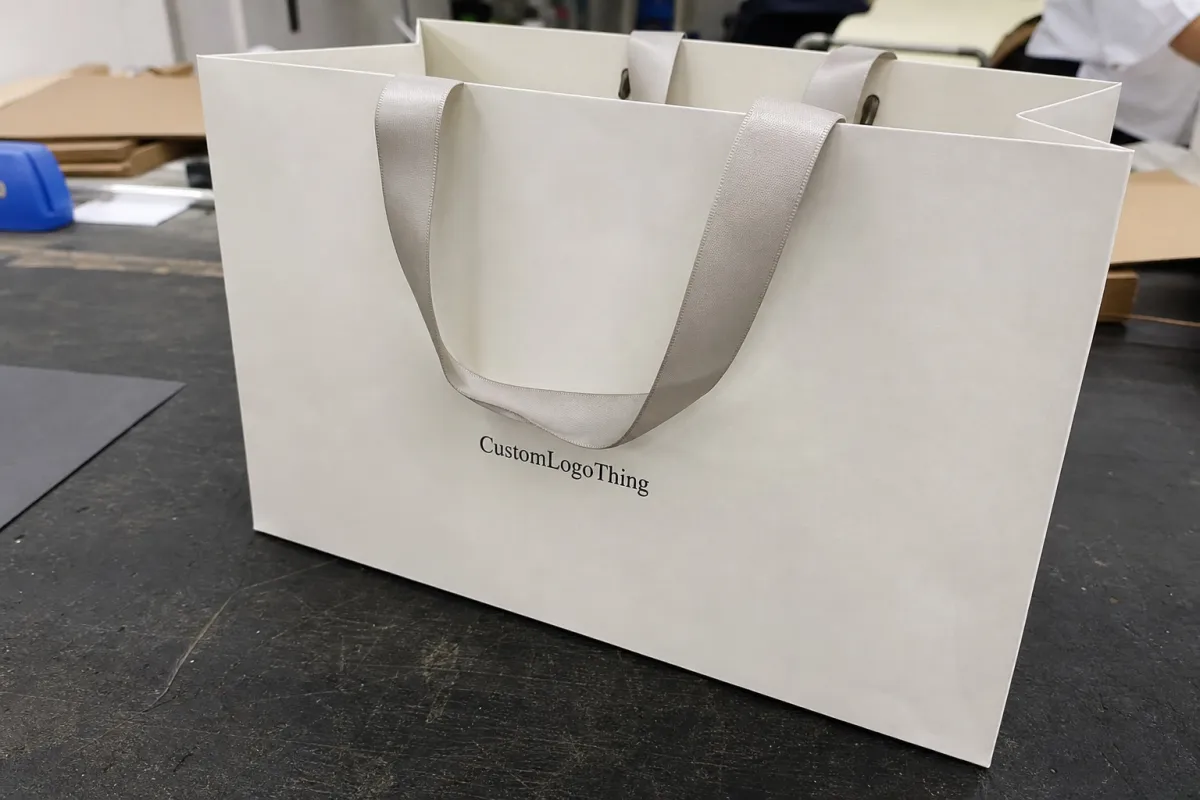
A useful quote does more than show a unit price. It reveals how the bag is built, where the labor sits, and which parts of the job are driving cost. A clean Ribbon Handle Paper Bags quote checklist helps you catch the details that often hide behind a neat number on the first line.
In practice, the same bag size can price very differently depending on whether the maker is using a simple paper body, a laminated art paper structure, or a heavier board-based build with handle patches and bottom reinforcement. Ribbon handle bags also sit closer to premium retail packaging, so buyers usually expect tighter print registration, cleaner folding, and better carton presentation. That is why a quote should be judged on the full spec, not the headline.
A quote is only useful when every build detail is named: paper, finish, ribbon, reinforcement, packing, and delivery terms.
When I look at a quote for this type of bag, I want to know three things right away:
- What is included? Paper stock, ribbon, lamination, handle attachment, reinforcement, and carton packing should all be explicit.
- What is excluded? Artwork changes, tooling, sample fees, freight, and customs-related charges should not be vague.
- What is being compared? A quote for a luxury retail bag should not be stacked against a basic paper carrier with decorative cord.
That level of clarity matters even more when buyers are working with seasonal launches, event kits, or product gift sets. A small difference in structure can affect how the bag stands on shelf, how it feels in hand, and whether the customer reads it as premium or merely decorated. The better the brief, the less room there is for a supplier to quietly substitute a lighter board, a thinner ribbon, or a simplified finish.
One practical sign of a serious quote is whether the supplier describes the method, not just the material. “Ribbon handle attached by reinforced knot and inner patch” tells you more than “luxury handle.” “Bottom board included” is more useful than “strong base.” Those phrases matter because they signal labor, waste, and durability, which are exactly the things that later turn into complaints if they were never defined.
Paper stock, ribbon style, and finishing choices that change the bag build
Paper choice is the first major cost lever. Kraft paper gives a natural, sturdy look and usually handles simpler graphics well, especially when a buyer wants a more earthy or understated presentation. Coated art paper gives a smoother print surface and usually supports richer color and sharper detail, which is useful when the artwork carries brand photography or fine typography. Specialty board or heavier SBS-type structures can push the bag into a more rigid, gift-ready category, but they also raise material and finishing costs.
Weight is part of that decision too. A light cosmetic bag may only need a modest board thickness, while a bottle set, boxed candle, or multi-piece gift assortment usually benefits from a stiffer wall and a better base. If the bag has to sit upright on a counter, it needs enough board memory to hold its shape after opening. That is not cosmetic; it affects how the product is perceived before a customer touches it.
Ribbon selection matters just as much as paper. Width, weave, sheen, and color matching all influence the final presentation. A narrow satin ribbon can feel elegant on a smaller boutique bag, while a wider woven ribbon often reads better on a larger format because it fills the handle proportionally and feels more secure in the hand. Attachment method matters too: some builds use internal knotting or patch reinforcement, while others rely on punched anchors or reinforced eyelets. That detail changes both labor and pull strength.
Finishing is where many buyers accidentally under-spec the quote. Matte lamination gives a quieter, softer look; gloss lamination pushes color and helps protect against scuffing; spot UV can lift logos or patterns; foil adds contrast and brightness; embossing creates tactile depth. Each one changes setup, waste, and inspection time. If the job is for retail or gifting, the finish is not an afterthought. It is part of the brand signal.
These are the build features I would confirm before comparing offers:
- Paper type: kraft, coated art paper, specialty board, or another substrate.
- Paper weight: enough to support the load without making the fold brittle.
- Ribbon spec: width, material, color reference, and attachment method.
- Finish: matte, gloss, soft-touch, spot UV, foil, or embossing.
- Reinforcement: top fold, bottom panel, handle anchors, and any patch board.
If you need a higher-end retail look, ask how the supplier handles corner protection, edge folding, and ribbon alignment, because those are the visible cues buyers notice first. A quote that names those details is usually far more dependable than one that simply says “premium bag.”
Specification checkpoints for size, load, print area, and structure
Size sounds straightforward, but it is one of the most common sources of quote confusion. Finished width, gusset, and height need to be written clearly, and buyers should also note whether the bag needs extra clearance for boxed products, folded apparel, glass bottles, or gift sets with inserts. A bag that is technically large enough on paper may still be awkward in the hand if the proportions are off.
Load matters as much as footprint. A ribbon handle bag for a 300 g cosmetic kit is not the same as a bag carrying a hardback box, a bottle set, or a multi-piece gift assortment. If the handle will support repeated carrying in-store, ask about reinforcement thickness and whether the maker has a pull-test or internal weight guideline. For transit-oriented validation, some buyers reference ISTA methods or comparable distribution testing logic so the bag is judged in a real shipping context, not just by hand feel.
Print area is another line item worth confirming. Full-surface print can change sheet yield and make registration control more demanding, while a small logo or single-color mark usually prints with less waste. If the artwork includes tight reverse type, tonal gradients, or metallic ink, ask for a note on color tolerance and proofing method. Buyers who want brand consistency should ask whether the supplier is matching a Pantone reference or working from process color only. A small mismatch on a ribbon-handle bag is more visible than on a plain carton because the bag is usually seen close up and often under retail lighting.
Structure also shapes how the quote should be read. A bag with a reinforced base, folded top edge, and internal board patch will cost more than one with a simple glued seam, but it will also be less likely to warp or tear in distribution. If the product is heavy at the bottom, such as glass or a dense gift set, the base board matters more than the handle style. If the bag is visually important but carries a lighter item, handle finish and print quality may matter more than sheer carrying strength.
Use this list to keep the structure honest:
- Finished dimensions: width, gusset, height, and any allowance for inserts or box corners.
- Weight target: expected product load and whether the bag is for retail carry or display use.
- Print coverage: single-side, double-side, wraparound, or full-panel artwork.
- Structural details: bottom board, top fold, handle anchoring, and corner reinforcement.
- Artwork format: dieline, bleed, safe area, and final color references.
The best quote is the one that shows the supplier understood all five of those points. If any of them are missing, the numbers may still be useful, but only as a rough starting point.
Cost, MOQ, and unit price: how to compare ribbon-handle quotes fairly
Price comparisons only work when the spec is aligned. For ribbon handle bags, the biggest cost drivers are usually paper grade, finishing complexity, ribbon selection, quantity, and packaging method. Setup labor also matters, especially when the order has multiple print colors, special coatings, or custom ribbon sourcing. A lower unit price can still be a worse overall value if it quietly excludes proofing, cartons, or freight.
MOQ is not a random supplier mood swing. It usually comes from sheet yield, setup time, and how much waste the printer expects during color matching and finishing. A more intricate bag with premium ribbon and multiple decoration steps often needs a higher minimum because the changeover cost is spread across fewer pieces. A simpler build can usually run smaller. There is also a practical point many buyers miss: if a factory has to source a special ribbon color or a nonstandard paper weight, the minimum may rise even if the bag itself looks simple.
As a rough buyer range, small custom runs for ribbon Handle Paper Bags can land around $0.90 to $1.60 each before freight, mid-size orders often sit in the $0.45 to $0.95 range, and larger runs may move closer to $0.28 to $0.60 depending on size, paper, and finish. Those ranges are not fixed. A heavy board construction with foil and custom ribbon will sit higher than a plain laminated kraft design, and a short run can climb quickly if the setup is complicated.
It is also useful to separate what is being priced. Some quotes bundle almost everything into one line, which makes them look clean but harder to audit. Others break the order into product, tooling, proofing, packing, and shipping. The second format is usually better for decision-making because it shows where the cost pressure sits and makes later negotiation easier if one element is out of line.
| Order scenario | Typical cost pressure | What to confirm in the quote | Best use case |
|---|---|---|---|
| Short run, 300-1,000 pcs | High setup share, more manual handling | Tooling, proof fee, ribbon sourcing, carton count | Launches, pilot programs, event kits |
| Mid run, 2,000-5,000 pcs | Balanced setup and production efficiency | Unit price tiers, finish cost, packing method | Boutique retail, seasonal promotions |
| Larger run, 10,000+ pcs | Better sheet yield, stronger price leverage | Storage plan, freight terms, reorder pricing | Chain retail, recurring gift programs |
When two bids look close, ask for a breakdown that separates product cost, tooling, sample charges, packing, and shipping. That format makes it much easier to compare apples to apples and avoids the common mistake of choosing the cheapest line item while missing the expensive one hidden in the back half of the quote.
Process and lead time from artwork approval to packed shipment
A disciplined process keeps a custom bag order moving. The usual sequence is simple on paper: spec confirmation, artwork review, proof approval, production, inspection, packing, and dispatch. The hard part is making sure every handoff is clear before the job is released. If any point is vague, delay tends to show up later as a rerun, a color correction, or a packing dispute.
Lead time depends on the work inside the bag, not just the date on the calendar. Standard ribbon handle paper bags with finalized artwork and ordinary finishes often fit into a 12 to 15 business day production window after approval, while special coatings, custom ribbon colors, or a difficult color match can push the job into the 15 to 25 business day range. If the order requires a revised sample, add time for that round as well. Freight timing should be added separately, especially if the bags are moving into a warehouse window or a launch-date allocation.
Buyers protect schedule more effectively when they do three things early:
- Submit a final dieline: avoid changing the structure after proofing starts.
- Lock the copy: names, addresses, legal text, and barcode content should be final.
- State the delivery need clearly: “needed in warehouse by” is better than a loose target month.
Production visibility also matters. Ask when proof images will be shared, whether a pre-production sample is available, and how the supplier confirms the packed carton count before shipping. A good factory partner will tell you where the order stands without forcing you to chase every update. Just as important, they should be able to explain what happens if the first printed sheets reveal a color drift or if the ribbon batch arrives slightly off tone. The earlier that conversation happens, the less likely it is to become a delivery problem.
One more practical point: if your packaging is tied to a launch date, do not assume express freight will rescue a late artwork file. The bag still has to be made, checked, packed, and cleared. An accurate timeline beats an optimistic one every time.
Quality checks that keep repeat orders consistent and saleable
Repeat orders live or die on consistency. A ribbon handle bag can look excellent in the sample phase and still drift on the second production run if the supplier has not frozen the reference standard. That is why a clear approved sample, master proof, or signed-off production reference is worth keeping on file.
The most important checks are usually the simplest. Print registration should stay clean. Color should remain within the agreed tolerance. Handle attachment should feel even on both sides. Fold lines should stay square. Carton count should match the packing list. If a supplier cannot speak clearly about those points, the order is probably still too loose.
Packaging discipline matters too. A premium bag can be ruined by bad carton protection long before it reaches the shelf. Inner wrapping, corner protection, and sensible stacking prevent crushed shoulders, scuffed lamination, and ribbon distortion. For transit-sensitive programs, buyers often ask for a packing method that reflects the logic behind FSC and other responsible sourcing requirements where applicable, while also checking whether the outer cartons can survive the distribution path without cosmetic damage.
There are also a few failure points that only show up after production starts. Ribbon ends can fray if the cut edge is not sealed correctly. Lamination can crack at sharp folds if the board is too heavy for the adhesive and crease method. Metallic foil can hold well on flat areas and still lift at the gusset if the pressure is uneven. Those are not dramatic defects, but they are the kind that make a premium bag look cheaper than it should.
Here is a practical quality checklist worth keeping on repeat orders:
- Print registration: no drifting text, blurred solids, or misaligned elements.
- Color consistency: visible match to the approved reference sample.
- Handle strength: even attachment and no tearing at the anchor point.
- Fold accuracy: clean edges, correct gusset depth, and square bottom panels.
- Packing count: correct piece count per inner pack and master carton.
That discipline supports retail planning, event campaigns, and seasonal programs where the buyer expects the same look every time. A bag that is “close enough” is not close enough when the brand sits in front of a customer.
What to prepare before requesting a ribbon handle bag quote
The cleanest quotes start with clean input. If the buyer sends a half-finished brief, the supplier has to guess at structure, and guessing is expensive. Before you request pricing, gather the basic facts that define the job.
- Finished size: width, gusset, and height.
- Product load: the weight or product type the bag must carry.
- Quantity: target order size plus any likely reorder volume.
- Artwork files: editable source files, dieline, and final copy.
- Color references: Pantone targets, sample images, or brand standards.
- Delivery location: exact ship-to address and receiving constraints.
- Use case: boutique retail, gift packaging, trade show kits, or launch events.
- Special requirements: FSC paper, food-safe use, lamination preference, or specific ribbon color.
It also helps to say what matters most. If the bag is for a luxury retail counter, presentation may outrank price. If the bag is for a giveaway, cost and lead time may matter more than a soft-touch finish. If the supplier knows the end use, they can steer you toward the right build instead of simply quoting the most expensive version. That saves time on both sides and usually produces a more realistic first price.
Buyers should also be honest about the acceptable tradeoffs. If the budget is fixed, say whether print coverage can be reduced, whether ribbon color can be selected from stock, or whether the finish can be simplified. A quote built around those limits is more useful than a polished number that cannot survive approval.
One last point: deadline pressure changes the quote. If you need staged delivery, split shipments, or a narrowed production window, say so early. A supplier can often work with that request, but only if the schedule is part of the first conversation.
Next steps after the quote: sample review, approval, and order release
Once the quotes arrive, compare them against one written spec sheet, not against memory. That keeps the decision focused on construction, timing, and service instead of whichever number happens to look lowest on the page. A quote that includes the right paper, the right ribbon, and the right packing method often saves money later by avoiding reruns and rework.
If the bag will represent a premium brand, request a sample or pre-production proof. Check the size in hand, the ribbon feel, the print quality, the finish, and the way the bag stands when filled. Buyers sometimes overlook those details until the boxes arrive, and by then the correction window is gone. The same is true for the inside of the bag: if the reinforcement creates a visible bulge or the fold is too stiff, the customer may feel it before they can identify why it bothers them.
A clean approval sequence usually looks like this:
- Confirm artwork and dieline.
- Lock the paper, ribbon, and finishing spec.
- Approve the sample or proof reference.
- Sign off on quantity, price, and delivery term.
- Release the order only after every detail is aligned.
Save the approved quote, the sample reference, and the final artwork archive together. That file set becomes the fastest route to a consistent reorder, especially when the same ribbon handle Paper Bags Quote checklist is used again for a seasonal refresh or a second location. It also gives you a reference when the next supplier claims a quote is “equivalent” but cannot match the same handle patch, same board weight, or same finish standard.
For buyers who want a reliable starting point, the smartest move is simple: define the build, compare the bids line by line, and only then place the order. If you keep the spec clean and the approval trail tight, the final bag usually looks the way it should on the shelf. That is the real value of a ribbon handle paper bags quote checklist.
Frequently Asked Questions
What should I include in a ribbon handle paper bags quote request?
Provide finished size, paper type, print colors, ribbon color and width, quantity, delivery address, and the product weight the bag must support. If the bag needs a premium finish or a specific retail look, note that too so the supplier quotes the right structure from the start.
Why do two ribbon handle paper bag quotes look different?
Price changes with paper grade, finishing, handle construction, quantity tier, packaging method, and whether the quote includes proofing or freight. Even a small shift in ribbon specification or reinforcement can move the cost more than buyers expect.
What MOQ should I expect for custom ribbon handle paper bags?
MOQ depends on size, print complexity, and finishing, so ask for the lowest viable run and the unit price at higher volume tiers. A simple printed kraft bag can often run lower than a fully laminated, ribbon-trimmed retail bag with multiple decoration steps.
How long does production usually take after approval?
Lead time depends on artwork readiness, sampling needs, finishing, and shipping method, so the fastest path is to approve complete specs early. Standard jobs may fit in about 12 to 15 business days after approval, while more detailed builds can take longer.
Can I request samples before placing the full order?
Yes, and it is smart for premium retail or color-critical work; use the sample to verify size, handle feel, print quality, and overall presentation. A sample also helps confirm that the ribbon attachment and bag structure hold up the way you expect.

