If you are sourcing running caps with logo Fit and Sizing guide for a team, a race, a retail program, or a branded event, the logo is usually not the part that causes trouble. Fit is. That is where orders go sideways: the crown feels too tall, the closure runs out of room, the front panel digs into the forehead, or the cap rotates once the wearer starts sweating. A mockup can hide most of that. Real movement exposes it in minutes.
Good fit is measurable, not subjective fluff. A performance cap should sit low enough to stay stable, stay light enough to fade into the background, and avoid the hot spots that show up after ten minutes of running, walking stairs, or standing in the sun. If the only approval happens on a desk, the buyer is guessing. If the sample is tested on real heads in motion, the order has a chance of being worn, not just received.
That is the job of a Running Caps with Logo fit and sizing guide: to keep a batch from looking right and behaving wrong.
Fit problems show up in motion. Still photos hide them.
What fit really means for running caps with logo fit and sizing guide
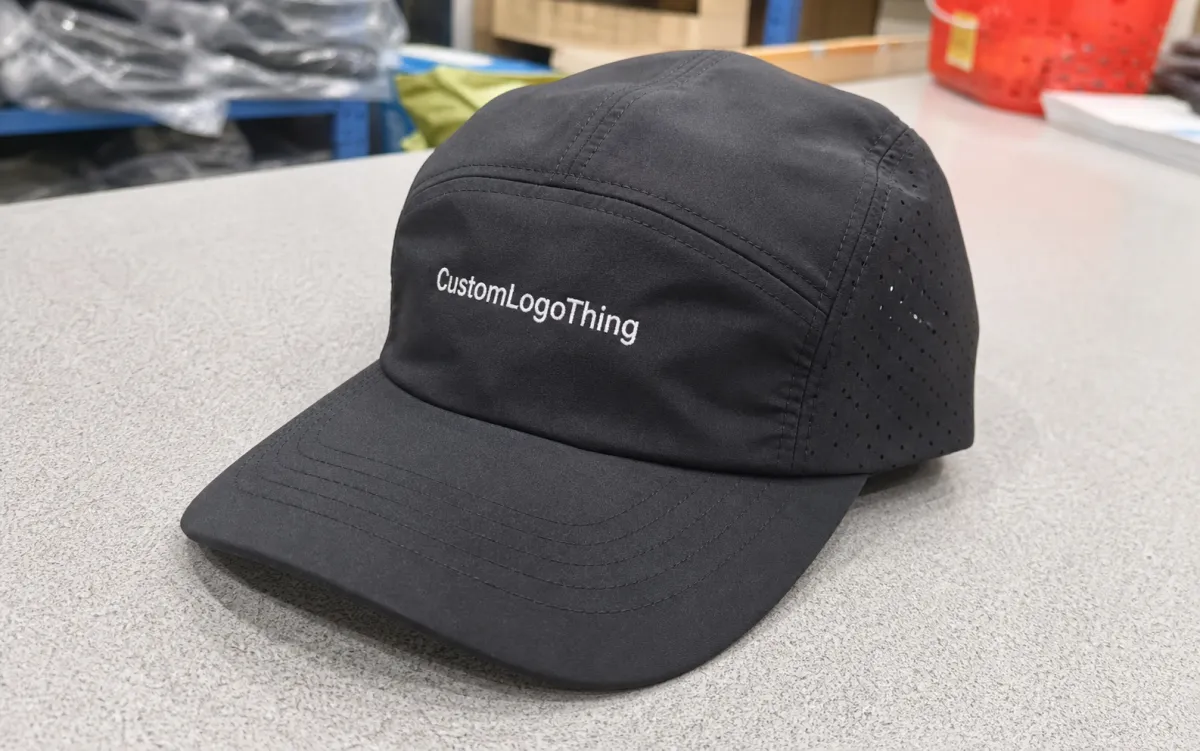
For running caps, fit comes down to three things: crown depth, adjustment range, and fabric behavior. Circumference matters, but it is only one piece. A cap can technically fit a head size and still feel wrong if the crown sits too high or the front panel pushes into the forehead. Running changes the equation because heat builds, sweat changes how the fabric sits, and small pressure points become irritating fast.
A proper running cap should feel secure without clamping the temples. The brim should block glare without making the front feel heavy. The closure needs enough range for the real wearer group, not the optimistic size range on a sales sheet. And the logo should not stiffen the front panel so much that the cap starts to behave like a small billboard that does not want to move with the head.
Branded performance caps are less forgiving than casual caps because they are worn during movement and moisture. Cotton can get away with a sloppy fit more often. Polyester and nylon usually cannot. Once sweat gets involved, some fabrics relax, some cling, and some begin to rotate. For mixed groups, that difference matters more than whatever color the artwork used.
Think of sizing as product performance, not just comfort. If the cap is worn for a 5K, a volunteer shift, or a two-hour outdoor activation, the wearer judges it by whether it stays put and disappears from attention. That is the target.
A useful baseline for adjustable styles is a head range around 54-62 cm, but only if the pattern and closure support it. Some stretch-fit styles sit lower and more securely, yet they narrow the usable range. The right answer depends on the wearer group, the fabric, and how much structure the logo adds.
How sweat, shape, and stretch change the fit
The fit of running Caps with Logo changes once the sample leaves the table. Sweat, heat, and motion expose weak spots quickly. A stretchy cap with a soft inner band may feel excellent at first, then loosen slightly after ten minutes. A firmer front panel may hold shape, but if the backing is too rigid, it starts pressing where the forehead needs relief. There is no fabric that fixes bad proportions.
The main variables are straightforward, but balancing them is less neat:
- Material stretch - polyester spandex blends and knit backs usually fit more head shapes than rigid shells.
- Panel construction - 5-panel, 6-panel, structured, and unstructured caps all sit differently on the head.
- Brim curve - a flatter bill can feel better for some runners, while a pre-curved brim may reduce bounce for others.
- Sweatband feel - a soft inner band improves comfort, but an overly thick one crowds the forehead.
- Closure style - hook-and-loop, elastic, snap, and stretch-fit each create a different adjustment window.
Moisture makes each variable louder. Some fabrics absorb a little and settle. Others stay dimensionally stable but cling where they should not. Mesh-back styles breathe better, but the front panel still needs enough structure to keep the logo readable. A cap that feels fine in a climate-controlled room can become irritating on a warm road run. That is normal, not a defect.
Structured and unstructured running caps also create different effects under a logo. Structured fronts usually give embroidery a cleaner look, but they can feel firmer. Unstructured fronts sit softer and lower, which often suits running better, yet they may wrinkle or collapse if the artwork is large or heavily backed. If comfort and silhouette both matter, test both before locking the spec.
Material choice matters more than many buyers expect. Lightweight polyester around 110-130 gsm is common for performance caps because it dries quickly and keeps the cap light. Nylon can feel smoother and slightly more premium. Spandex blends improve recovery. If the cap starts above roughly 75 g after decoration, some wearers will feel it during longer runs. That is not a hard rule, but it is a useful warning sign.
One sample does not tell the whole story. A cap worn while standing in front of a mirror tells you very little. A cap worn while jogging, walking stairs, bending, and sweating for fifteen minutes tells you a lot more. Fit testing in motion is not optional if the order matters.
Sizing factors that actually matter on a production order
Buyers usually focus on size labels, but the numbers that matter are more specific. For a production order, look at head circumference range, crown height, front panel depth, and closure adjustment span. Those four details tell you whether the cap covers real wearers or only the middle of the group.
Here is the trap: many buyers size to the smallest person in the group because they want nobody left out. That sounds fair. It also creates an overly tight cap that annoys everyone else. A better approach is to size around the middle, then confirm the closure comfortably covers both ends of the range.
For adjustable performance caps, a useful target is often 56-61 cm of practical comfort if the pattern is forgiving. If the group includes broader head sizes, ask for more closure range and a softer internal finish. If the cap is stretch-fit, check the recovery after the sample is worn and removed several times. A cap that grows loose after one wear cycle is not a good sign.
Logo placement changes fit more than buyers expect. A front logo that is too large, too dense, or backed with a stiff substrate can alter how the front panel bends. The wearer feels that stiffness even if they cannot name it. On a running cap, that can turn an otherwise good fit into something that feels like it is pushing forward.
For a production order, useful spec notes include the brim length, the closure type, the logo width, the stitch or patch finish, and the exact placement from the brim seam. A common running-cap brim sits around 6.8-7.5 cm, but the real number depends on the style and whether the cap is meant for direct sun protection or a lighter, lower-profile feel.
If you are ordering for a team, spell out the wearer profile. Are these caps for marathon volunteers, retail customers, outdoor staff, or participants who will wear them only for short sessions? That changes the fit priority. Long wear wants softness and breathability. Short wear can tolerate more structure. Mixed groups need the widest practical adjustment window.
Cost and pricing: what changes the unit price
Price moves quickly on custom headwear, and there is a reason. The main drivers are cap construction, fabric choice, closure type, decoration method, color count, and order quantity. If the cap is lightweight, uses a standard closure, and carries one simple logo, the unit cost stays friendlier. Add specialty fabric, reflective trim, multiple placements, or a custom sweatband, and the cost rises. That is labor and material reality, not supplier drama.
As a working range, a straightforward custom running cap with one logo often lands around $2.10-$3.80 per unit at 3,000+ pieces, $3.20-$5.50 at 1,000 pieces, and $4.50-$7.50 or more at 300-500 pieces. Those are broad buying ranges, not quotes. Heavier structure, premium trims, and more complex decoration can push the number higher.
| Option | Typical setup fee | Added unit cost | Fit impact | Best use |
|---|---|---|---|---|
| Flat embroidery | $35-$85 | $0.60-$1.50 | Low to medium if the stitched area is large | Clean front logos with moderate detail |
| Woven patch | $45-$120 | $0.80-$2.00 | Low if the patch stays small and thin | Sharper detail and a slightly premium feel |
| Heat transfer | $25-$75 | $0.40-$1.10 | Very low on soft panels | Fine graphics and a lighter front feel |
| Silicone or raised badge | $60-$150 | $1.00-$2.50 | Medium because the front becomes firmer | High-impact branding and retail presentation |
Sample cost matters too. A fit sample or pre-production sample often falls somewhere between $30-$120, depending on decoration and pattern complexity. That cost is usually minor compared with the cost of fixing a bad batch, but it should still be included in the budget. If the sample process reveals that the cap needs a softer front panel or a different closure, that is money saved before the order scales.
The cheapest quote is not always the cheapest buy. If the fit is wrong, the budget gets hit again through returns, replacements, or dead stock. A cap that fits well and gets worn beats a bargain piece that lives in a box because half the group dislikes it.
If the use case is retail, the balance shifts slightly. A woven patch or silicone badge may justify the extra cost because presentation matters on shelf. If the use case is pure performance, a lighter heat transfer on a breathable cap may be the smarter choice. The right answer depends on wear time and expectation, not just decoration taste.
Process and turnaround: from sample to shipment
A clean order usually follows the same path: tech spec, artwork review, fit sample, approval, bulk production, inspection, and shipment. The fastest orders are the ones where the buyer gives clear measurements and clear artwork from day one. Orders slow down when the spec is vague, the sample keeps changing, or nobody wants to approve fit.
Timing depends on quantity and complexity. A sample often takes 5-10 business days in many production setups. Bulk production usually lands around 12-20 business days after approval for simpler runs, and longer when special fabrics, multiple logo placements, or peak-season capacity are involved. If the buyer changes crown depth or closure type after sampling, the clock resets. That is not punishment. It is how production works.
There are a few repeat delay points:
- Logo files arrive in the wrong format or without placement instructions.
- The sample is approved visually but never tested while moving.
- Fit notes are vague, so the factory builds to guesswork.
- Material changes are requested after the sample is already approved.
Quality control should not stop at the sewing line. A useful pre-shipment check includes crown symmetry, closure function, stitch consistency, logo alignment, and fabric contamination such as oil marks or color transfer. A tolerance of roughly 3-5 mm on logo placement is often acceptable for production headwear, but exact tolerance depends on the decoration method and the buyer's spec. For crown depth, a deviation of a few millimeters can be noticeable on a running cap, especially if the front shape is already slim.
Packaging deserves attention as well. If caps are headed into retail cartons or event kits, ask how they are folded, packed, and protected in transit. For packaging references and transit expectations, ISTA is a useful standard point. If the order includes inserts or hangtags, asking for FSC-certified paper is a clean way to improve the packaging side without inflating the order in a dramatic way.
Production lead times also tend to stretch during rainy-season shipping peaks, holiday congestion, and factory booking spikes. A buyer who needs the caps for a race date should work backward from the event, not from the quote. That gives room for sample approval, small revisions, and shipping delays that nobody likes but everybody should expect.
Step-by-step sizing method for a clean order
If you want fewer headaches, use a basic sizing process and write it down. Nothing elaborate. Just a method that keeps everyone aligned.
- Define the wearer profile. Are these caps for runners, event staff, volunteers, or customers? The use case tells you how strict the fit needs to be.
- Measure a small test group. Five to ten people is enough to expose obvious fit issues. Mix head sizes. Include the edges of the range, but do not size only to the extremes.
- Compare against the vendor spec sheet. Look at head circumference range, crown depth, brim length, and closure span. Do not assume a standard baseball-cap spec is close enough. Often it is not.
- Test in motion. Have people walk, jog, bend, and sweat in the sample. Check forehead pressure, ear clearance, and whether the brim shifts or the cap rotates.
- Lock the approved settings. Record closure position, logo size, placement from the brim, and any comments about crown height or front stiffness.
The last step matters more than people think. A written approval note removes the usual argument later: "It fit the sample, not the batch." If the supplier has to guess what was approved, the order is already on thin ice. A simple spec sheet prevents most of that.
It also helps to state the acceptable range plainly. For example: adjustable cap, fits 56-61 cm comfortably, soft front panel, logo no wider than 85 mm, pre-curved brim, and no pressure at the temples after a 20-minute wear test. Those notes are not exciting. They do save money.
A good sizing sheet also should mention the wear environment. A cap for an indoor charity walk does not need the same sweat management as one for a summer road race. That single sentence can prevent a lot of overbuilding. Overbuilding sounds safe until the cap ends up too hot, too stiff, or too expensive.
Common mistakes that create returns and complaints
The most common mistake is buying by appearance alone. Buyers pick the color, approve the logo, and forget that crown depth and closure range are the things people actually feel. A cap can look polished in a mockup and still be poor on a run because it sits too high or feels too rigid.
Second mistake: approving a sample without sweat testing it. Dry indoor fit tells only part of the story. Running caps get used in heat, humidity, and motion. If the sample starts sliding after a few minutes, that is the warning. Ignore it and the complaints usually arrive later in bulk.
Third mistake: underestimating decoration weight. A large front logo, a layered patch, or heavy backing can change the way the front panel bends. That extra stiffness is not always visible in photos, which is why buyers get surprised. They should not. The cap is a wearable object, not a flat sign.
Fourth mistake: skipping a written spec sheet. Without one, everyone remembers the sample differently. The factory thinks the logo was centered. The buyer thinks it sat lower. The team says the brim was softer. Then the order stops being about caps and becomes a memory contest, which is a poor production tool.
Another quiet problem is choosing the wrong closure for the group. Snapbacks can be convenient, but they may not give enough fine adjustment for smaller or larger heads. Elastic styles feel neat and minimal, but they only work well if the size spread is controlled. Hook-and-loop closures are more forgiving, though some buyers dislike the look. None of these choices is universally best. The wear context decides.
Finally, a lot of returns trace back to sampling on one person. One head, one opinion, one approval. That is too little data for a product that must fit a crowd. Even a small test group reveals whether the cap is truly comfortable or just comfortable for one unusually forgiving tester.
If the fit notes are not written down, they were never really approved.
Expert checks and next steps before you place the order
Before you place the order, run one final checklist. Keep it practical: fit range, closure type, logo size, sample feedback, quantity, budget, and delivery date. If any of those is unclear, pause and fix it. That pause is cheaper than correcting a batch later.
Ask for one approved reference sample or one approved spec sheet, not a half-written blend of both. Everyone should be judging the same target. If two people on the buyer side have different ideas of the fit, the supplier will split the difference, and nobody ends up happy with a compromise cap.
The tradeoff is simple and a little unforgiving: the cap that looks best on a mockup is not always the cap that survives real wear. Softer, lighter styles usually win for runners because comfort beats drama. More structured styles can work well for retail display. Pick based on the actual use case, not on whatever looks prettier in a PDF.
Buyers also should think about materials and packaging as part of the order, not as an afterthought. If the caps are being shipped long distance or packed tightly for an event, transit handling deserves attention. If the order includes inserts or sleeves, recycled content or FSC-certified paper can keep the packaging side cleaner without adding much complexity.
For brands that want fewer returns and fewer "this feels off" complaints, the rule is blunt: approve running Caps with Logo fit and sizing guide in motion, on real heads, before bulk production starts. Looks matter. Fit decides whether the cap gets worn.
How should running caps with logo fit for different head sizes?
Aim at the middle of the wearer range first, then make sure the closure comfortably covers smaller and larger heads. Use several people, not one tester, because mixed feedback tells you far more than one strong opinion.
What is the best closure for running caps with logo?
For mixed groups, adjustable closures are usually safer. Stretch-fit styles can feel better if the size range is tightly controlled, but they are less forgiving. Choose the closure based on how the cap will be worn, not just on the lowest unit price.
Do running caps with logo need a different size spec than baseball caps?
Often, yes. Running caps usually sit lower, use lighter materials, and need less bulk in the crown. Ask for the exact spec sheet instead of assuming a standard baseball-cap fit will carry over.
How much does sizing affect the price of running caps with logo?
Sizing itself usually does not add much cost, but custom fit requirements can increase sampling, approval time, and the risk of rework. The bigger price swings usually come from fabric, decoration method, and quantity.
What should I check on a sample before approving running caps with logo?
Check forehead pressure, ear clearance, crown depth, logo placement, and how the cap feels after a few minutes of movement. If the sample slips, pinches, or feels too stiff, do not approve it just because it looks good on the table.


