Put a folded shirt in a weak bag and the problems show up quickly: dust, wrinkles, a dull shelf presentation, and a package that feels less finished than the garment inside. That is why Slider Lock Clothing Bags material options comparison matters more than many buyers first assume. The closure gets attention, but the film usually decides whether the bag feels crisp, protects properly, and survives warehouse handling or transit without turning cloudy, stretching out, or splitting at the seal.
For apparel brands, these bags have to do three things at once. They protect the garment, present it clearly, and allow repeated access for storage, returns, or pack-and-check workflows. Material choice affects all three. Once you compare Slider Lock Clothing Bags by clarity, durability, softness, printability, moisture resistance, and the way the film behaves after compression, the price difference starts to make more sense.
What slider lock clothing bags actually do for apparel packaging
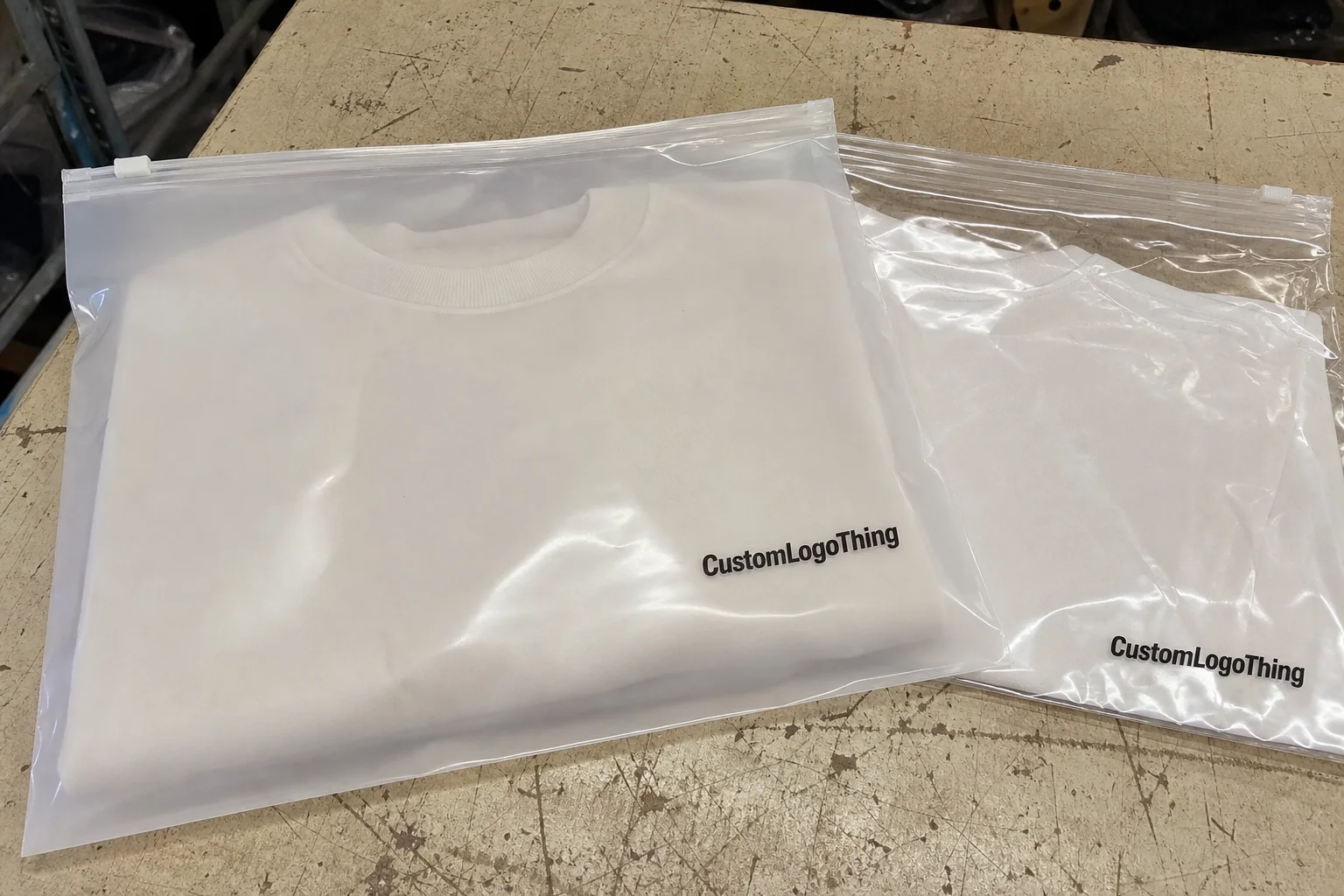
A slider lock clothing bag is a resealable plastic pouch built for apparel presentation and protection. The track-and-slider closure gives the user a cleaner opening and closing motion than a simple fold-over seal or tape closure. That matters for a folded T-shirt, a hoodie, or a bundled set that may be opened several times before final use.
From a packaging buyer’s point of view, the bag has to do more than hold the product. It should keep dust off, show the garment clearly, and create a premium unboxing feel without becoming expensive or fragile. That is where Slider Lock Clothing Bags material options comparison starts to become practical rather than theoretical: the film often affects shelf appeal and shipping performance more than the closure style alone.
There is also a subtle commercial angle. A bag that looks hazy, noisy, or stiff can make a well-made garment feel less desirable. Buyers may be comparing two nearly identical products and still choose the one that looks better in its packaging. The bag becomes part of the product story whether the brand plans for it or not.
“The bag should disappear enough to show the apparel, but not so much that it feels flimsy in the hand.”
When buyers compare slider lock clothing bags, the same six factors come up repeatedly:
- Clarity for display and branding visibility
- Strength for shipping and repeated handling
- Printability for logos and care messaging
- Softness or noise for perceived quality
- Moisture resistance for storage and transit
- Cost at the target order volume
That list sounds simple, but the tradeoffs are rarely simple. A film can look beautiful and still be frustrating on a packing line. Another can be inexpensive and still outperform a more expensive option because it suits the garment and the distribution method better.
How the slider lock closure works and why material matters
The closure itself is straightforward. Two interlocking tracks meet, the slider presses them together or separates them, and the bag opens or closes with less finger pressure than a press-to-close seal. That easy motion is a big reason slider bags are used for clothing, bedding, and other items that benefit from repeated access.
But the closure is only half the story. Film thickness, stiffness, and surface behavior influence how well the track aligns during packing. A film that is too soft can feel floppy at the top, which slows operators down and makes the opening harder to present cleanly to the slider. A film that is too stiff can resist the natural fold at the top and increase the chance of misalignment in a busy packout line.
The best material supports the zipper area instead of fighting it. Some films recover well after bending and compression. Others develop whitening, clouding, or fine stress marks near the closure after a few cycles. If the bag is meant for heavier knitwear or a multi-piece set, that small difference can become visible quickly.
Closure reliability is tied to material behavior. A bag that opens smoothly but does not reseal cleanly damages perceived quality in seconds, and customers usually blame the packaging rather than the resin blend. They are not wrong. In apparel packaging, the user experience is often decided by the first and second opening, not the first glance alone.
How the material changes the user experience
During packing, a film with the wrong balance of stiffness and slip can slow operators down. During shipping, a brittle film may crack under pressure from corrugated cartons or tight case packing. During consumer use, a film with poor memory can look tired after only a few openings.
That is why the slider lock clothing bags material options comparison should always be done with real garments, not empty bags on a bench. Empty bags can look excellent and still perform poorly once a folded sweater or a three-pack of tees is inserted. Weight distribution, corners, seams, and folded edges change the way the material behaves.
A useful comparison also checks whether the bag opens and closes cleanly after compression. A slider that works perfectly before cartonization may bind after the bag has been packed tightly with other units. If the package is going into a retail shelf program, the material also has to look good under store lighting, not just in a sample photo.
Material comparison: PE, PP, EVA, and laminated options
Most slider lock clothing bags come down to a few film families. Each has a different feel, visual effect, and cost profile, which means the best choice depends on the garment, the brand position, and the shipping environment rather than one universal standard.
| Material | Typical strengths | Typical tradeoffs | Best fit |
|---|---|---|---|
| PE (polyethylene) | Soft hand feel, impact resistance, good value, flexible packability | Less crisp presentation, can feel less premium, lower clarity than PP in some grades | Storage, distribution, basic apparel packaging, high-volume value programs |
| PP (polypropylene) | High clarity, crisper appearance, cleaner retail look, more rigid feel | Can feel noisier or stiffer, may be less forgiving under compression | Retail display, premium basics, apparel that benefits from strong shelf visibility |
| EVA | Softer touch, premium hand feel, good flexibility, smoother handling | Usually costs more, not always the clearest option, sourcing can vary by supplier | Higher-end garments, brands that want a softer unboxing feel |
| Laminated or co-extruded films | Improved barrier, stronger structure, better print results, upgraded performance | Higher cost, more material complexity, may add lead time | Premium packaging, special print needs, better durability or moisture protection |
PE: the value-first workhorse
Polyethylene is often the most practical choice for clothing storage and distribution because it balances softness and impact resistance well. It also tends to be easier on the budget. For large-volume programs, that matters. A common quote range for simple PE Slider Lock Bags at moderate volume may land around $0.18-$0.28 per unit for 5,000 pieces, depending on size, thickness, and print coverage.
PE is not usually the most dramatic-looking option, but it gets the job done. If your apparel line prioritizes utility, repeat opening, and pack efficiency, it deserves serious consideration. It is also the type of film that can hide minor pack variation a little better than very clear, high-gloss alternatives.
The main caution is presentation. If the bag is part of a retail-facing program, PE can look less crisp than PP, especially under bright lighting. That does not make it a weak choice; it just means the visual goal has to match the material.
PP: the shelf-friendly option
Polypropylene usually offers better clarity and a sharper visual effect. It can make a folded shirt look more defined, especially under retail lighting. If the bag is going to sit on a shelf or hang in a display, that cleaner appearance can influence perceived value immediately.
The tradeoff is feel. PP may sound or feel stiffer than PE, and some buyers read that as premium while others see it as less forgiving. It is also more likely to show handling marks if the line is rough on the product during packing. For brands with a retail display focus, that can still be an acceptable trade if the presentation is doing real selling work.
EVA: softer and more tactile
EVA often appeals to brands that want a smoother hand feel and a more upscale tactile impression. It can be a good middle ground when the packaging needs to feel friendlier and more refined without becoming rigid. In practice, that softer hand is one of the reasons it can perform well for premium basics, gift sets, and higher-end apparel programs.
EVA does not always win on price, and it is not always the clearest film in a side-by-side comparison. Still, it can create a more pleasant opening experience, which matters more than many teams expect once the product reaches customers. That sensory impression is difficult to recreate with a spec sheet alone.
Laminated and co-extruded structures: when performance matters most
These structures are used when a buyer wants better barrier performance, more stiffness, or improved print results. They can also help when the garment is premium and the packaging needs to support a stronger brand story. Some programs use multi-layer films for added toughness, especially when the bag needs to handle repeated opening, heavier contents, or tighter shipping conditions.
If sustainability is part of the brief, the discussion needs to be specific. Ask whether the supplier can offer recyclable PE variants or evidence of FSC certified paper components in the broader packaging system. Slider bags themselves are typically plastic, so vague “eco” language is not useful. Material reality matters more than messaging.
For biodegradable claims, the fine print matters even more. Some films are compostable only in industrial facilities, while others sacrifice clarity or durability to the point that they no longer suit apparel use. Those tradeoffs should be tested, not assumed from a brochure line.
Film thickness also changes the outcome. A thin, clear PP bag may look impressive but feel fragile if it is paired with a heavy knit. A thicker PE film may add durability without improving shelf appearance much. The right answer depends on how the product is stored, displayed, and shipped, not just on a sample’s appearance on a white table.
Cost, pricing, and MOQ factors that change the quote
Most quotes are driven less by the bag shape than by the resin type, thickness, size, closure quality, and print count. Add custom dimensions or special finishes, and the price can move quickly. The difference between a plain transparent PE bag and a premium PP or laminated structure is often visible on the invoice before it is visible on the shelf.
MOQ matters too. Lower quantities usually mean higher unit cost because setup, film runs, and print preparation are spread across fewer bags. Larger orders spread those fixed costs better. A brand ordering 2,000 bags is rarely buying at the same economics as a brand ordering 20,000.
There are also smaller costs that can sneak into the final number:
- Custom color matching for sliders or print elements
- Extra thickness for heavier garments
- Special dimensions for folded sets or plus-size apparel
- Shipping weight and carton configuration
- Packaging inserts or label cards
A useful buyer checklist keeps quotes comparable:
- Confirm film type and gauge.
- Specify zipper or slider style.
- Match print method across suppliers.
- Check whether the quote includes cartons, inner packs, or labeling.
- Ask for lead time tied to approved artwork.
Do you always need the most expensive film? No. If the bag is only for storage or warehouse protection, PE may be perfectly adequate. If the apparel is higher-end or the bag is part of retail display, spending more can be justified because the packaging is doing brand work. Cost should be weighed against how visible the package is and how often it will be handled.
When comparing prices, watch for quotes that are not truly equivalent. A thicker bag, a higher-clarity film, a better slider, or extra print coverage can all change the result. If those details are not matched carefully, the cheapest quote may just be the least complete one.
Process and lead time: from spec sheet to production steps
The cleanest production process starts with a simple spec sheet: garment size, folded dimensions, closure preference, desired look, budget range, and order quantity. That document saves weeks of back-and-forth later. The faster the supplier understands the job, the less chance there is of sampling the wrong material.
Material choice has to happen early. Change the film too late, and you can affect print quality, bag thickness, sealing settings, and even how the slider runs. That is not just a technical nuisance; it can turn a promised delivery date into a moving target.
Typical production flow
- Spec review: confirm dimensions, closure style, and artwork placement.
- Material selection: compare PE, PP, EVA, or laminated options.
- Sample or proof: check clarity, feel, and zipper function.
- Artwork approval: verify logos, line weights, and color match.
- Mass production: run film, print, cut, and assemble.
- Final inspection and packing: carton count, seal integrity, visual check.
Timing depends heavily on sample approval speed, print complexity, and whether the supplier needs to source a less common film. A basic order may move faster than a custom-printed order, but first orders almost always need extra buffer. It is better to plan for that than to discover it at the freight stage.
If you are comparing several suppliers, build time for the full slider lock clothing bags material options comparison process, not just one sample. The best-looking sample does not always come from the fastest factory, and a rushed approval can hide problems that only appear after production starts.
For shipping and handling standards, it can help to ask whether the supplier tests packaging to any recognized protocols. Industry references like ISTA are useful when you want to know whether a bag and carton combination can survive transit stress rather than simply looking fine on a desk.
Lead time also rises when the bag spec is unusual. A custom slider color, a special film blend, or a nonstandard width can all add sourcing and setup time. For reorders, keeping the approved spec on file reduces that risk, especially when a packaging program scales across seasons or product categories.
Common mistakes buyers make when choosing apparel bag films
The first mistake is easy to recognize once you have seen it enough: choosing the clearest film and ignoring whether it can handle the actual garment weight. A bag can look beautiful with nothing inside and still fail when loaded with a heavy hoodie or a multi-item set.
The second mistake is sensory. Noise, odor, and stiffness all affect how a bag feels in hand. A film can be technically fine and still read as cheap if it crackles too much or feels too rigid under the fingers. That matters for retail display, but it also matters for customers who open the packaging at home and judge the brand by touch as much as appearance.
Third, some buyers choose a low-cost material that works for storage but not for repeated open-close use. That might be fine for one warehouse application. It is not fine if the packaging is part of the customer experience.
Other common misses:
- Ignoring zipper compatibility
- Not testing with the actual folded garment
- Skipping print tests on the chosen film
- Assuming thickness alone equals quality
Thicker does not always mean better. It can mean heavier, more expensive, and harder to handle. Quality is the balance between protection, appearance, and packability. That balance changes depending on whether the bag is going into a retail environment, a shipping box, or a storage system that may also include corrugated cartons or other secondary packaging.
Another common issue is approving a sample that looks good but does not pack efficiently. If the closure catches, the film is too slippery, or the top edge folds unevenly, the line slows down and the labor cost shows up later. Packaging errors do not always appear as product damage; sometimes they appear as lost time.
Expert tips for choosing the right bag for your apparel line
Start with garment category. Lightweight tees do not need the same structure as knitwear, and premium basics may deserve a more polished material than entry-level stock. The more precisely you define the product, the easier it is to narrow the field.
Use clarity strategically. High-clarity PP can make retail displays stand out, but a slightly frosted PE film may hide folding irregularities better. That can be useful if you are packing quickly or if the garment has seams that look uneven through very clear plastic. Sometimes the best visual result is not the highest transparency.
Ask for samples under real lighting, not studio lighting and not only on a white desk. Real shelf lighting, real carton conditions, real handling: that is the environment that matters. A film that looks great under one light can look dull, reflective, or overly busy under another.
“Test the bag the way your customer will see it, not the way a sales sample tries to flatter it.”
Also test closures after compression. A slider lock that performs well before cartonization may bind after the bag has been packed tightly with other units. That small test can save frustration later and is one of the simplest quality checks available before a full production run.
If your packaging program includes other substrates, keep the full system in view. A branded apparel bag may sit inside a corrugated shipper, with supporting materials like recycled paper inserts or FSC certified hang tags. Consistency across those layers often does more for brand trust than a flashy design on one component alone.
Finally, document the preferred spec. Film type, thickness, print method, slider style, tolerance range, and approved sample reference should all live in one place. Reorders go better when that information exists before someone tries to match the previous one from memory. That is especially true when teams change, seasons shift, or a line expands to new sizes.
One practical rule helps keep the decision grounded: choose the film that protects the garment, supports the brand, and stays easy to use in daily operations. That is the real value of a disciplined comparison, and it is why material choice deserves more attention than a quick price check.
Next steps: build a smarter spec before requesting samples
The easiest way to avoid bad comparisons is to make the quotes comparable from the start. Create a one-page spec and send it to every supplier. Use the same size, the same closure style, and the same print details so the differences you see are truly material differences.
That is the heart of a good slider lock clothing bags material options comparison: apples to apples, not a stack of mismatched samples that only look similar. Ask for at least three options, usually a value option, a presentation option, and a premium option, and test them under the same conditions.
A practical spec should include:
- Garment dimensions and folded size
- Target film type and thickness range
- Closure preference and slider color
- Print area and artwork file format
- Target order quantity and acceptable MOQ
- Budget range and delivery window
Then request physical samples and put them through the real workflow. Fold the garment. Pack it. Compress it. Open it twice. Check how the film behaves under retail lighting and in a shipping carton. Compare clarity, closure smoothness, and perceived value. That process usually tells you more than a spec sheet ever will.
If one sample wins, keep it as the master reference for future production. That reduces variation across lots and suppliers, and it keeps the packaging tied to the brand instead of the luck of the next purchase order. It also shortens future approvals because the baseline is already clear.
A final detail that helps in practice: record acceptable variation. If the bag is produced in multiple runs, slight shifts in film gloss, stiffness, or slider feel can happen. Defining what is acceptable ahead of time makes quality control easier and prevents avoidable disputes later.
FAQ
Which slider lock clothing bags material option is best for retail display?
PP is often preferred for a crisp, high-clarity look that reads as more premium on shelves. If the product needs softer handling or better flexibility, EVA or PE may be a better fit. The right choice depends on lighting, garment type, and how much the package has to sell visually.
How do I compare slider lock clothing bags material options by cost?
Compare identical sizes, thicknesses, and print specs so the quote reflects material differences only. Factor in MOQ, shipping weight, and any premium for clarity or multilayer construction. If one supplier includes cartons or label cards and another does not, the unit price is not directly comparable.
Do thicker slider lock bags always mean better quality?
Not always. Thickness can improve durability, but the wrong film can feel stiff, cloudy, or expensive without improving performance. The best choice balances protection, appearance, and packability for the actual garment, not just the sample size.
What lead time should I expect for custom clothing bags with sliders?
Lead time depends on material sourcing, printing complexity, sample approval, and production scheduling. First orders usually need more buffer than reorders because artwork and specs may still be in refinement. Less common films or special slider colors can extend the schedule further.
How do I test whether a material will work for my apparel line?
Pack the real garment, compress it, reopen it several times, and inspect clarity, closure smoothness, and film stress. Also test how the bag looks under retail lighting and how it holds up in shipping cartons. If the bag is meant for repeated use, make sure the seal still feels clean after several openings.


