For apparel brands, slider lock clothing Bags Low MOQ Custom Order requests are not just about choosing a plastic sleeve. They are about protecting folded garments, speeding up handling, and making the first physical touchpoint look deliberate rather than improvised. A shirt that arrives in a clean slider bag reads differently from one tucked into an oversized sleeve, and that difference affects perceived quality, shelf presentation, and the chance of avoidable returns. In many cases, the bag is what the customer sees before they ever feel the fabric.
That matters because clothing packaging has to do three jobs at once: present the product, protect it, and fit the economics of the launch. For brands that want branded packaging without moving into rigid cartons or higher-cost printed boxes, slider lock apparel bags sit in a practical middle ground. They are straightforward, functional, and, with the right supplier, available at quantities that make sense for a test run instead of a full-scale rollout.
Low MOQ is not only about buying fewer units. It is also about reducing exposure while a new style, collection, or retail channel is being tested. A packaging format that looks good on a spec sheet but is awkward in the warehouse or on the sales floor will create costs later, usually in labor or rework. That is why the details matter before anyone signs off on a quote.
Why slider lock clothing bags solve retail packaging friction
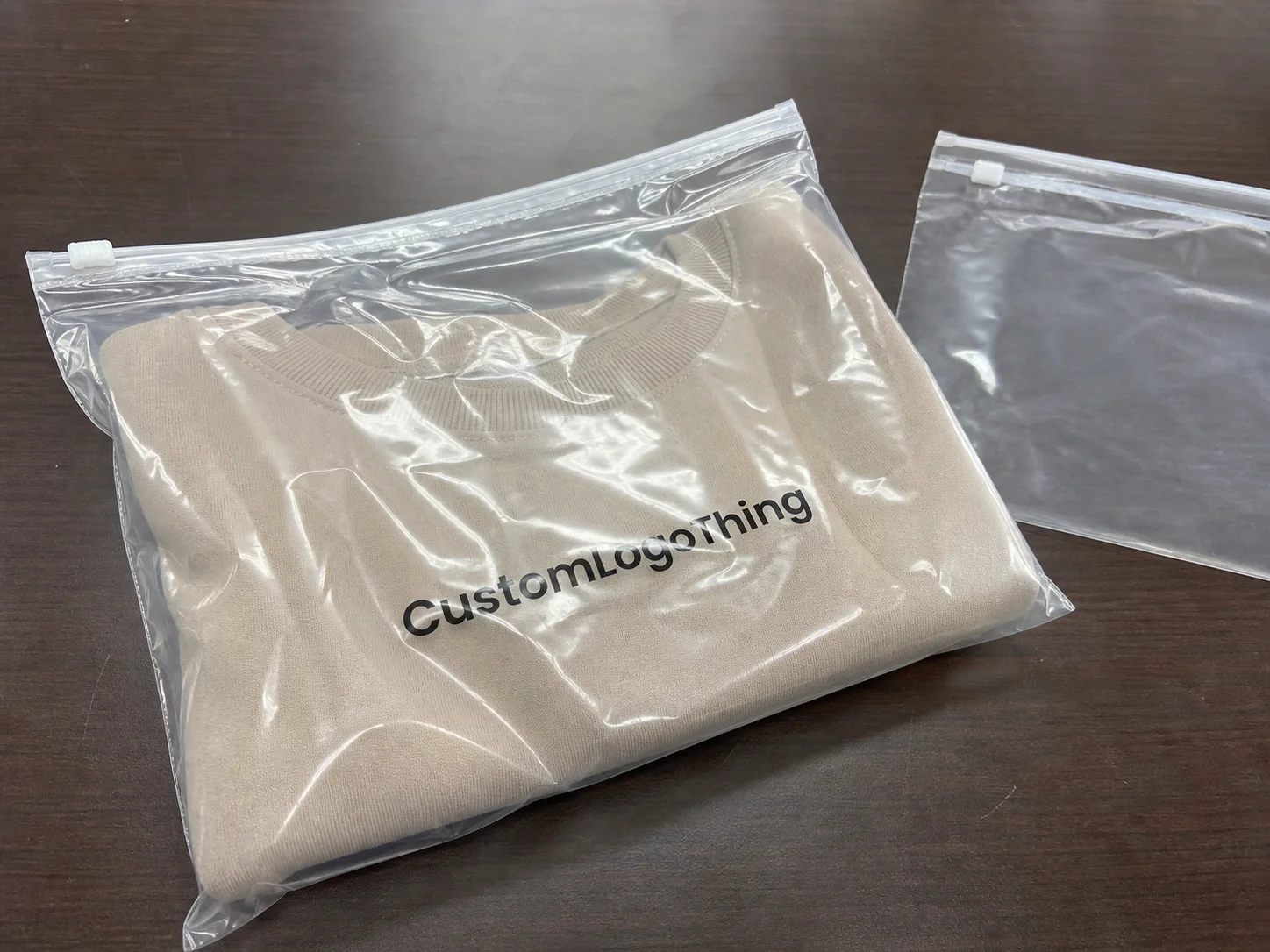
Folded apparel tends to hold its shape better in a bag, but repeated opening on the sales floor creates friction quickly. Dust gets in. Creases return. Staff spend extra time re-bagging items after inspection, and customers often handle a garment more than once before buying. Slider lock closures help because they are typically faster to open than many zip-only formats, and they are easier to reseal without the alignment issues that can slow busy retail teams.
There is also a brand signal here. Packaging is often the first physical touchpoint after the hang tag, and that touchpoint affects perceived quality before the fabric does. A clean slider bag tells the customer the brand thought through the presentation, not just the product. For boutiques, DTC apparel labels, subscription kits, seasonal capsule drops, and fulfillment programs, that consistency matters. It is a modest upgrade, but a meaningful one, especially when the alternative is a loose poly sleeve that looks temporary.
“If the bag is easy to open, easy to reseal, and sized correctly, staff stop fighting the packaging and start trusting it.”
That is the real value of Slider Lock Clothing Bags low moq custom order programs: they reduce handling irritation and help the product stay presentable after inspection, transfer, or stockroom movement. They also reduce the chance that a garment returns to inventory with fresh wrinkles, fingerprints, or a bent insert card. From a packaging standpoint, that is not a small detail. It is operational efficiency with a retail-facing finish.
For brands comparing options, the trade-off is usually clear. Printed boxes can create a stronger unboxing moment, but they are heavier, often cost more to ship, and usually require larger commitments. Slider Lock Clothing Bags take up less space, weigh less, and are easier to adapt across multiple SKUs. They will not replace every packaging format, but they solve a very common apparel problem without forcing the brand into a more expensive system than it needs.
Product details that matter before you request samples
The basic structure is simple: a flexible film body, a slider lock closure, and optional gusseting for thicker garments or bundled sets. Even so, small changes in structure can alter the whole user experience. A flat bag can work well for a single folded T-shirt. A gusseted version may be the better fit for hoodies, coordinated sets, or bulkier activewear. If the bag is too shallow, the closure binds and the front panel buckles. If it is too large, the garment shifts and the presentation looks loose.
Appearance options are more varied than many buyers expect. Clear film maximizes visibility and works well when the garment itself is part of the shelf appeal. Frosted film softens the view and often reads as more premium. Tinted or lightly opaque film can create a more consistent look across a collection. Printed surfaces are useful when the bag needs to carry the logo, care notes, or retail warnings. For some labels, a simple logo print is enough. For others, the bag becomes part of the brand system and replaces separate stickers or extra inserts.
Common uses include T-shirts, underwear, activewear, children’s clothing, socks, scarves, and multipacks. If a product is folded consistently and handled often, a slider bag is worth testing. If the product is irregularly shaped, compressed, or sold with thick inserts, the specification needs closer attention. That is where custom packaging products do the real work: the format should be matched to the item rather than forcing the item into a generic sleeve.
Practical features often requested in apparel packaging include the following:
- Hang holes for peg displays or retail hooks
- Tear notches for cleaner opening
- Venting for items that need airflow or reduced trapped air
- Warning text for safety and retail compliance
- Recycled-content options where the material spec allows it
- Barcode or SKU zones for warehouse and shelf control
Thickness and closure style should match the garment weight, shipping method, and intended use. A bag meant for boutique display does not need the same performance profile as one packed into cartons for e-commerce fulfillment. That is a frequent mistake: buyers focus on size, then ignore handling conditions. The result is a bag that looks correct on paper and fails in use because the film is too light, the slider feels flimsy, or the pouch is cut with too little margin around the garment fold.
| Bag option | Best for | Typical strength | Cost tendency |
|---|---|---|---|
| Clear flat slider bag | Single folded tops, socks, lightweight apparel | Simple presentation, easy visibility | Lower unit cost |
| Frosted printed slider bag | Branded retail packaging, premium DTC | Better visual consistency, stronger branding | Moderate unit cost |
| Gusseted slider bag | Thicker garments, bundles, sets | More internal volume and better fit | Higher unit cost |
A useful rule of thumb: if the fold is tight and the garment is flat, the bag can stay simple. If the item has bulk, layered seams, or an insert card, it needs more room and a more forgiving closure path. That is why sample approval is so valuable. A bag can look right in a mockup and still feel awkward once a real garment is folded and inserted.
Specifications buyers should confirm for a custom fit
Before requesting samples, the buyer should have a spec sheet ready. At minimum, that means width, height, gusset depth, film thickness, closure width, and printable area. If those six fields are vague, the quote will be vague too. Vague quotes are expensive later because they hide rework, extra sampling, and avoidable delay.
One common error is sizing the bag from the garment label size rather than the folded garment dimensions. Two medium shirts can require different packaging footprints depending on fabric weight, sleeve length, collar structure, and folding method. A heavyweight tee may look medium on paper but need a wider body and a slightly taller bag to keep the fold clean. Measurement should start with the folded garment, not the size tag.
It also helps to know whether the bag must survive e-commerce fulfillment or only boutique handling. That changes how much abuse the film, closure, and carton packing need to take. If the bag is going through fulfillment centers, ask about seal integrity, closure smoothness, and how the slider performs after repeated openings. If it is going to be used for in-store display only, transparency and finish may matter more than transit durability.
For compliance, some programs need recycled resin content declarations, suffocation warnings, or material disclosure language. Depending on the market and product category, warning text placement can be non-negotiable. If the item is for children’s clothing, the specification review should be stricter. Brands operating across regions should also check whether the film and printed ink set align with their internal packaging standards and sustainability claims. For broader packaging guidance, the Institute of Packaging Professionals is a useful industry reference.
Requesting a sample set with multiple thicknesses and sizes is the safest move. A sample that looks fine on screen can feel too flimsy or too bulky in hand. Testing a few variations side by side is the fastest way to make the fit decision without guessing. It is also the easiest way to catch practical issues such as slider snagging, static cling, or a print area that disappears once the garment is folded.
When a buyer is unsure, a small matrix of samples is more useful than a single “best guess” prototype. Three widths, two thicknesses, and one or two closure styles often tell the whole story. That kind of comparison makes the trade-offs visible before production starts.
Cost, pricing, and MOQ factors that change the quote
Pricing is driven by size, film thickness, print coverage, closure mechanism, and volume. That list sounds obvious until a buyer asks for one change after another and wonders why the quote jumps. In production, every extra specification has a cost trail attached to it. More color means more setup. Larger dimensions mean more material. Special finishes usually mean extra conversion steps. The unit cost moves accordingly.
The MOQ logic is straightforward: lower quantities usually raise unit cost because setup, printing plates, and material conversion are spread across fewer pieces. That is not a penalty. It is the arithmetic of short runs. A buyer ordering 1,000 bags is paying for the same setup burden as a buyer ordering 10,000, only divided differently. The smart move is not always to chase the lowest possible unit price. It is to compare unit cost against inventory risk, particularly if the design is still being tested.
Here are the main cost drivers buyers should watch:
- Custom printing — one-color branding is usually simpler than multi-color artwork
- Special finishes — frost, tint, matte effects, and premium film blends can raise cost
- Recycled content — useful for claims, but not always the cheapest route
- Closure format — the slider component can add material and assembly complexity
- Secondary packaging — inner packing, carton labeling, and palletization can affect landed cost
A simple clear bag is usually more economical than a fully printed branded version, but the cheapest unit price is not always the cheapest program. If the printed bag replaces separate labels, outer stickers, or insert cards, the total packaging cost can narrow quickly. From a packaging design perspective, the comparison should include labor. If staff save 10 to 20 seconds per unit by using a bag that already carries the brand message, that is real money over a run.
For supply planning, it helps to think in ranges rather than promises. A simple low-decor clear slider bag may sit near the lower end of the market, while a printed, thicker, or frosted version can move higher depending on quantity. A buyer should ask for quotes at two or three volumes so the step-down in unit cost is visible. If the 5,000-piece run only saves a few cents over the 2,000-piece run, the lower-risk option may be the better one. If the savings are meaningful, the larger run can make sense. That is where an honest supplier earns trust.
Lead time also affects price decisions, especially for seasonal launches. Rush freight, short proof windows, and multiple revisions can turn a clean packaging project into an expensive one. A lower MOQ is useful only if the production schedule is realistic enough to support the launch date.
Process and lead time: from artwork approval to delivery
The standard workflow is simple: inquiry, sizing confirmation, artwork review, sample approval, production, quality check, and shipping. In theory, that sounds predictable. In practice, the timeline depends heavily on how ready the buyer is at the start. Print-ready artwork shortens the schedule. Poorly prepared files slow everything down. If the logo needs cleanup, the dieline needs adjustment, or compliance text is missing, the clock keeps moving.
Typical delays come from three places: unclear dimensions, last-minute color changes, and approvals that stall after the sample arrives. The most efficient buyers gather folded garment specs, logo files, and warning text before the first quote request. That lets the supplier check whether the structure and artwork are compatible before production begins. Once the specs are locked, repeat orders are usually faster because the shape, print setup, and material spec already exist.
For many programs, production can move in roughly 12 to 15 business days after proof approval, though this depends on quantity, print complexity, and factory workload. Sampling can add time, especially if the buyer wants to compare thickness or test closure feel. If a brand needs the bags for a launch date, it should not wait until the final week to ask for changes. The schedule is far more controllable when artwork is final before the order is placed.
Quality control should not be treated as optional. Basic checks should include film thickness, closure function, print registration, and carton packing verification. For transit-sensitive projects, some buyers also ask about compliance with shipping test protocols such as ISTA methods or internal drop testing. If the bag is going into a wider distribution system, those checks matter more than a glossy presentation sheet ever will. The ISTA site is a useful reference for packaging transport test standards.
A few practical notes from a production standpoint: sliders must move cleanly without binding, printed panels should not shift out of registration, and the film should hold up under handling without excessive scuffing. Clear film may show fingerprints more easily than frosted film, which is one reason some brands prefer a soft matte look for higher-end collections. None of these choices is universally better; the right answer depends on where the bag will be used and how the product will move through the supply chain.
How custom packaging support reduces risk for apparel brands
Apparel packaging looks easy until a buyer has to launch three SKUs, two colors, and a tight retail deadline at the same time. That is where supplier experience becomes valuable. A team that understands garment bags knows that clean folding fit, stable print registration, and reliable sealing behavior are not cosmetic details. They are the difference between a bag that supports the product and one that creates extra labor on the line.
One operational advantage of working with a single source is coordination. If dimensions, printing, and production are handled in separate places, the brand becomes the project manager whether it wants that role or not. When those steps sit under one supplier, the risk of mismatched specs drops. So does the chance that artwork is approved on one version of the bag and produced on another. That sounds basic. It is still where many packaging mistakes begin.
Quality controls should be visible, not hidden. Buyers should ask how thickness is checked, how closure function is tested, how print is inspected, and how cartons are packed for shipment. If the supplier can explain those checks clearly, that is a good sign. If the answers are vague, the quality process may be, too. A practical buyer cares more about repeatability than marketing language.
Low-MOQ flexibility is especially useful for testing new SKUs, seasonal launches, and limited editions. Nobody wants to sit on 30,000 bags for a style that turns out to be a one-season winner. That is why short-run packaging programs are attractive: they let a brand validate presentation and demand before committing to larger inventory. The same logic applies to other apparel packaging formats, but slider bags are especially useful because they are easy to compare, easy to handle, and easy to adapt.
Responsiveness also has a measurable value. Fast proofing reduces schedule drift. Clear quoting reduces decision time. Realistic timelines reduce expensive rush freight. For brands building package branding into a broader retail packaging strategy, those savings are not theoretical. They show up in less rework, fewer errors, and better launch timing. If sustainability is part of the brief, it is also worth checking whether the material options align with broader environmental goals and documented resin claims. The EPA is a sensible source for general environmental and materials guidance.
There is also a practical limit to what packaging can solve. If the garment itself wrinkles badly, if folding instructions are inconsistent, or if the insert card is oversized, even a well-made slider bag will only do so much. Packaging should support the product system, not carry all of its weaknesses. That is why the best results usually come from matching the bag spec to the actual packing workflow, not just the marketing design.
Next steps to place a low MOQ custom order confidently
Before requesting a quote, prepare three inputs: folded garment size, target quantity, and whether the bag needs print or only material and closure customization. That alone will improve the first estimate dramatically. If the garment is bulky, premium, or has unusual folding constraints, order samples first. It is cheaper to catch a fit problem at sample stage than in the middle of a production run.
It also helps to gather artwork files, brand colors, compliance text, and retail display requirements before the request goes out. A supplier can work much faster when the core information is ready. The decision path should stay simple: choose size, choose material, confirm closure style, approve artwork, then lock production. Too many brands reverse that sequence and wonder why the project feels slow.
If you are comparing slider bags against other apparel packaging options, think about the full presentation. Do you need the bag to sit next to a hang-tagged garment on a shelf? Do you need it to survive fulfillment? Do you need the same package branding across a collection, or just a clean protective layer for a few styles? Those answers determine the right spec more than any generic “premium” label ever will.
For most buyers, the best next step is to submit specs for a quote and ask for a sample comparison. That gives a real view of fit, finish, closure behavior, and packaging labor before a commitment is made. And if the goal is a Slider Lock Clothing Bags Low MOQ Custom Order that supports retail presentation without overbuying inventory, the sample stage is where the smartest decisions get made. Use it to confirm the actual garment, not the assumption.
What is the minimum order for slider lock clothing bags low MOQ custom order?
MOQ varies by size, print complexity, and material, but low-MOQ programs are typically designed for smaller test runs and launch quantities. Request pricing at multiple volume levels so you can compare unit cost against inventory risk.
Can I get custom printed slider lock apparel bags with a low MOQ?
Yes. Many programs support custom printing at lower quantities, although setup costs can make the unit price higher than stock bags. Simple one-color branding is usually the most cost-efficient low-MOQ print option.
How do I choose the right size for clothing packaging bags?
Measure the garment after folding, not just the label size. Leave enough room for smooth insertion, closure function, and any insert cards or hang tags.
What affects the price of custom slider lock clothing bags the most?
Size, thickness, print coverage, closure style, and order quantity are the biggest cost drivers. Special materials, tinted finishes, and compliance text can also increase cost.
How long does a custom order usually take from approval to shipment?
Lead time depends on artwork readiness, sample approval speed, and production volume. Repeat orders are usually faster because the specs and artwork are already approved.


