Soap Woven Label Beanies Material Sample Guide for Buyers
A soap Woven Label Beanies material sample guide matters because the sample is where design intent meets fabric reality. A woven label can look sharp on a screen and still fail once it is stitched to a ribbed cuff, pulled over a head form, or washed a few times. That small difference can decide whether the beanie feels premium, technical, or cheap.
Buyers usually learn this by comparison. Retail teams watch shelf impact, promo buyers watch speed and cost, and teamwear buyers care about whether the same label can be repeated across multiple runs without drifting. A physical sample answers questions a render never can: how the weave behaves under stretch, whether small type stays readable, whether the edge feels clean, and how the color looks in daylight instead of under office lighting. The details are tiny. The consequences are not.
“A good sample is not the one that looks impressive in isolation. It is the one that still looks right once it is sewn onto the beanie, handled, stretched, and worn.”
Soap Woven Label Beanies Material Sample Guide
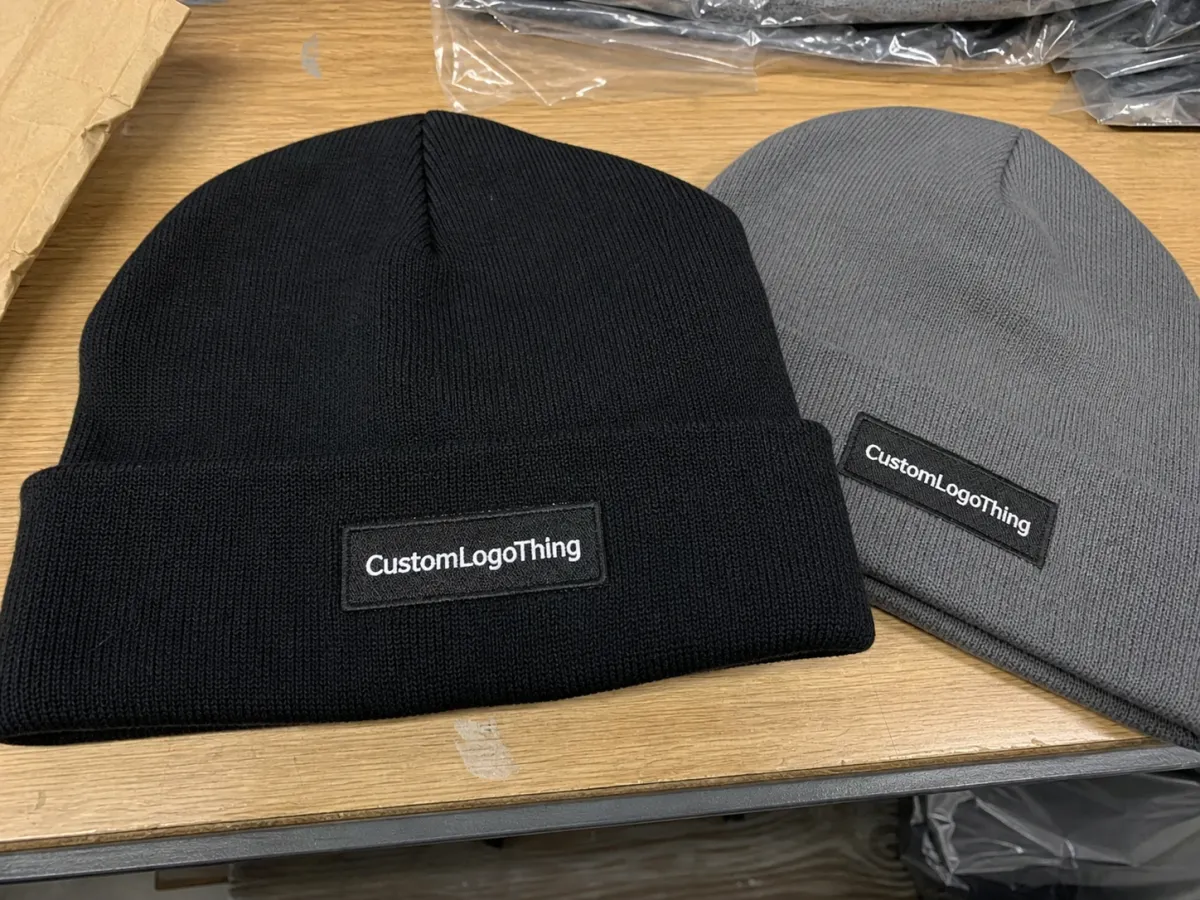
A useful sample is more than a color chip. It should define the label material, the weave structure, the finish, the backing, and the way the artwork sits against the actual beanie fabric. That is the difference between a sample that photographs well and one that can survive production.
For buyers, the value is practical. A tight damask-style weave may be the right call if the logo includes small text or fine borders. A softer, looser construction may be the better answer if comfort and drape matter more than absolute detail. The goal is not to pick the “best” woven label in theory. It is to choose the version that fits the product, the price point, and the customer’s expectations.
That is also why a sample beats a digital proof for repeat orders. A render can look clean while the physical label turns scratchy, loses edge definition, or shifts slightly in color when viewed against the beanie fabric. Once approved, the sample becomes the standard reference for later buys, especially when it is stored with trim specs, color notes, and order history in your Custom Labels & Tags records.
Packaging affects perception too. If the sample arrives bent, scuffed, or crushed, a good label can look worse than it is. Sturdy corrugated cardboard, plain kraft paper inserts, and decent inner protection usually present better than a thin envelope. Buyers who track environmental claims may also ask whether the pack uses recycled materials or FSC certified paper. That does not change the label itself, but it can affect how the sample is received internally, especially if procurement or merchandising needs to sign off.
A beanie label sample should also reflect the way the final garment will be worn. A cuff label on a stretchy rib knit behaves differently from a flat sewn patch on a heavier knit. Placement changes the look, but it also changes tension on the stitches. If the sample is not tested on the actual beanie body, approval is only partial.
Sample request process, turnaround, and approval flow
The sampling flow is simple on paper and easy to slow down in practice. First, the buyer sends artwork, dimensions, placement, and fabric details. Then the supplier confirms whether the artwork can be woven cleanly at that size. After that comes yarn selection, proofing, sample production, and final sign-off. If one of those steps is skipped, the revision cycle usually gets longer later.
- Request specs: send artwork, target size, placement, and intended beanie fabric.
- Confirm construction: choose weave density, backing, edge finish, and label fold.
- Review the proof: check spelling, spacing, sizing, and color references before weaving starts.
- Receive the sample: inspect it flat, then on the actual beanie.
- Mark changes clearly: note only the changes that affect fit, readability, comfort, or durability.
- Approve for bulk: freeze the sample as the production standard.
Turnaround depends on material availability and how many decisions still need to be made. In-stock yarns and standard constructions can often produce a sample in about 5-10 business days, plus transit time. Custom yarn matches, unusual weave structures, or multiple revision rounds add time. Shipping should be treated as part of the schedule, not an afterthought. International transit can add several days, and label samples are small enough to get damaged if they are packed poorly. For anyone who manages sample shipments often, the handling logic behind ISTA is a useful reference even for small textile parts.
Approval usually happens in layers. First is the artwork proof. Then comes the woven strike-off or physical sample. Then the sample is checked on the beanie itself. Only after that should production be released. If there are multiple trims in the order, keep the label sample aligned with the rest of the build. A label can look correct on its own and still feel too stiff once it sits next to other components.
Material, weave, and finish factors buyers should compare
Material choice affects both appearance and wear. Polyester is common because it holds detail well, stays stable through repeated handling, and usually keeps the artwork crisp. Cotton can feel softer and a little more natural, but it is not always the strongest choice for tiny text or high abrasion. Acrylic often gives a fuller, warmer appearance. Blends sit between those positions, which is why they show up often in budget-sensitive or comfort-led programs.
Weave density matters just as much. A tighter weave can support finer letters, cleaner borders, and more precise logos, but it can also make the label feel firmer. A looser weave usually softens the handfeel, yet the artwork may blur if the design is too detailed. Buyers often underestimate how much this changes the final read. A logo that looks elegant on a proof can turn muddy if the yarn is too thick or the count is too low.
Finish changes the final impression again. Edge treatment can make the label feel neat or rough. Backing changes how it sits against the beanie and how much it moves during wear. A matte surface generally reads more understated and utility-driven. A slight sheen pushes the label toward a cleaner, more polished look. The same artwork can land in a very different category with only a small construction change.
Thread thickness is another quiet variable. Finer yarn supports sharper curves and more detailed logos. Thicker yarn can look richer from a distance and feel more substantial in hand, but it may soften corners or close up small counters in the type. If the artwork includes micro text, hairline borders, or tight icon details, ask for a sample at the exact intended size rather than assuming the art will scale down cleanly.
Backing deserves attention because it affects comfort more than most buyers expect. A label that feels fine when held by hand can irritate once it is sewn into a cuff and pressed against skin. That matters on beanies, where the label often sits near the ear or forehead. A softer backing, a different fold, or a slightly modified weave may be worth a minor increase in unit cost if it prevents complaints later.
For sustainability-led orders, packaging still matters. FSC certified cartons, recycled materials, and plain kraft paper inserts are increasingly common, and they help procurement teams justify the sample internally. The label itself may not be the part that carries the environmental claim, but the sample presentation often shapes the buyer’s confidence in the supplier. If the paperwork is loose and the pack looks careless, the label has to work harder to win approval.
| Option | Typical sample fee | Typical bulk unit cost | Best fit |
|---|---|---|---|
| Standard polyester woven label | $20-$35 | $0.10-$0.22 | Clear logos, repeat orders, promo beanies |
| Cotton or cotton-blend woven label | $25-$45 | $0.14-$0.30 | Soft handfeel, heritage branding, retail pieces |
| Custom yarn match with premium finish | $35-$60 | $0.18-$0.45 | Color accuracy, detailed art, higher perceived value |
Those ranges are not universal. The sample fee, setup cost, and unit price all move with order volume, artwork complexity, and finishing method. Still, the pattern is consistent: more precision up front usually means fewer surprises later. A buyer who saves a few cents at the unit level but spends another round correcting the sample has not really saved money.
Cost, pricing, MOQ, and unit cost tradeoffs
Price conversations get distorted when people focus only on the lowest quote. A $20 sample that fails twice is expensive. A $45 sample that prevents a bad bulk run is cheap. The better view is to compare the full structure: sample fee, setup fee, MOQ, and landed unit cost.
MOQ works like a pressure valve. Lower MOQ reduces risk if the first sample is wrong, but it usually raises the per-unit price. Higher MOQ lowers unit cost, but it makes any mistake more expensive. That tradeoff becomes visible fast on seasonal beanies, where the selling window is short and there is little room for rework. A minor spec error on a 1,000-piece run can erase the savings from a lower piece price.
Buyers often separate the costs this way:
- Sample fee: proofing, yarn selection, and physical sample production.
- Setup fee: loom preparation, file handling, and sometimes color matching.
- Landed unit cost: production, packing, and the freight needed to get the goods delivered.
For basic woven labels, a sample fee in the $20-$35 range and a landed unit cost under $0.20 at scale are common starting points. Once the artwork adds more colors, custom yarn matching, or specialty finishing, costs can move closer to $0.30-$0.45 per unit. That jump is not always bad. It can be justified if the label is carrying a premium brand mark or if the client expects a more refined finish.
MOQ also influences how much room you have to correct course. If the run is small, there is less waste but more price pressure. If the run is large, the unit price gets better, yet every error has a wider impact. For buyers managing multiple styles, it often makes sense to keep a simpler woven construction for large replenishment runs and reserve the more complex label for limited retail pieces.
Packaging around the sample can affect value perception too. A supplier who ships in sturdy corrugated cardboard with neat kraft paper protection may charge slightly more than one who uses a thin mailer, but the first impression is usually stronger. That matters when the sample has to travel through several hands before approval. If the order sits inside a larger branded kit, a clean sample pack can carry more weight than a raw material sheet ever will.
A step-by-step method for judging the right sample
Good sample review is methodical. Start flat. Then stretch. Then rub. Then compare against the actual beanie. That sequence sounds basic, but it catches the failures that matter most.
- Inspect the label flat: check spacing, edge finish, and whether the text remains legible at normal viewing distance.
- Stretch it on the beanie: confirm that the label does not warp, curl, or pucker when sewn to the cuff.
- Rub it between your fingers: catch scratchiness, stiffness, or loose weave issues before production starts.
- Look under daylight: sheen and color shift show up faster in natural light than under office LEDs.
- Compare it with the final fabric: the label should belong to the beanie, not just survive as a standalone piece.
I also recommend using the same scoring sheet for every sample. Keep it simple: clarity, softness, edge quality, wash resistance, and brand fit. A 1-to-5 score in each category makes preference easier to separate from performance. A sample that “looks nice” on first glance can lose quickly once comfort and legibility are scored separately.
If possible, test the sample against the exact beanie fabric instead of a substitute. Rib knit, gauge, and yarn density all change the way the label sits. A sample can be excellent on one knit and awkward on another. That is why the best approvals happen on a real garment, not on a spreadsheet.
Think about aging too. A first-day sample should still read properly after wear, storage, and repeated handling. Even a simple wash check can reveal thread instability, edge fraying, or backing issues. The point is not lab perfection. The point is to avoid approving a label that only works in a controlled room.
Common mistakes when approving beanie label samples
The most common mistake is approving from photos alone. Lighting, compression, and camera angle hide a lot. A weave that looks clean in a photo can arrive softer, flatter, or slightly off-color in hand. Physical review is not optional for woven labels on beanies.
Another mistake is over-specifying every detail on the first round. Too many variables make the sample slower and more expensive without necessarily improving the result. A better path is to lock the essentials first: size, yarn family, backing, and dominant colors. Then revise only the area that actually affects the final product.
Production tolerance gets overlooked too often. Even a good sample will vary a little in bulk, and that is not automatically a defect. The problem comes when the tolerance range is never discussed. Then the first production carton arrives with labels that are technically acceptable but inconsistent enough to bother a retail buyer.
Comfort is another trap. Some teams approve the sharpest sample and forget that beanies sit against skin, hair, and sometimes the ear. If the label scratches, the logo does not matter much. A softer backing or a different weave can be the smarter commercial choice, even if it gives up a bit of crispness.
Packaging can also bias the decision. A sample that arrives in neat recycled materials and clean kraft paper may feel more polished before anyone inspects the label itself. Good packaging deserves credit, but it should not substitute for close evaluation of the woven piece. The label has to earn approval on its own.
There is one more error worth calling out: approving a label without checking the sew-in behavior. A woven label can be perfectly accurate before attachment and still sit badly once stitched. The seam allowance, fold style, and stitch line all change the final appearance. On a beanie cuff, those changes are visible from arm’s length.
Next steps to lock the spec and place the order
Once the sample is approved, convert it into a one-page spec. Include dimensions, thread colors, backing, edge finish, placement on the beanie, approved photos, and any notes about handfeel or washing. Without that page, the next reorder becomes guesswork.
If one revision is still needed, make it now. After the sample is good enough, further tweaking usually adds cost without much benefit. The better move is to freeze the approval, confirm the production timeline, and set a reorder threshold if the style is likely to repeat. A clean approval is worth more than a perfect one that keeps moving.
It also helps to document why the sample won. Was it the sharper type, the softer edge, the better daylight color match, or the way it sat on the cuff? Those notes are useful the next time someone asks for a colorway change or a different handfeel. That is how a soap woven label beanies material sample guide becomes a repeatable sourcing process instead of a one-off decision.
Before the order is placed, cross-check the label spec against the full trim stack: beanie fabric, packaging, and any other attached labels. If the same supplier handles Custom Labels & Tags, keep the reference file in one place so later reorders do not pull the wrong version. A missing note can cost more than a modest setup fee.
The best sample is the one that reduces surprises in bulk. It should hold shape, stay readable, feel acceptable against skin, and look like it belongs on the beanie. That is the real job of a sample guide: not to admire a swatch, but to approve a label that can be ordered with confidence.
FAQ
What should I check in a woven label beanie material sample first?
Start with legibility. The logo, small text, and edge definition should stay clear at normal viewing distance. Then stretch the label, rub it between your fingers, and compare it against the actual beanie color and fabric so the pairing feels intentional. A soap woven label Beanies Material Sample guide should always put those checks ahead of aesthetics alone.
How many sample options should I request for beanies with woven labels?
Two or three options is usually enough: one baseline sample, one premium version, and one safer production choice. More options can slow the decision and add cost without improving the final order if the spec is already clear. If the artwork is highly detailed, ask for a control sample and one revision so you can isolate the real variable.
How long does sample turnaround usually take for beanies?
In-stock materials and simple artwork can move quickly, but shipping still affects the calendar. Custom yarn matches, new weave structures, or revisions usually add extra days because the supplier has to rework the sample. Ask for separate dates for proofing, sampling, shipping, and production so the schedule stays realistic.
What affects sample pricing and MOQ the most?
Weave complexity, number of colors, backing choice, and special finishes are the biggest price drivers. A higher MOQ can reduce unit cost, but it raises your exposure if the first sample needs changes. Request the sample fee, setup fee, and bulk price together so you can compare the true landed cost.
How do I know a sample is production ready?
It should match the approved dimensions, colors, and handfeel without surprises when placed on the actual beanie. It should survive basic stretch and abrasion checks without distortion, fraying, or visible loss of detail. The supplier should confirm the same materials, weave settings, and finishing method will be used in bulk.


