Stationery Brands OPP Header Bags Warning Label Guide: What Buyers Miss
A notebook brand can approve a sharp-looking clear header bag on Monday and fail a retailer compliance check on Thursday. The logo sits perfectly in the header. The hang hole lines up on the peg. The product looks bright and premium through the film. Then someone notices the suffocation warning is too small, partly hidden by the flap, or missing.
That is why a stationery Brands OPP Header Bags warning label guide belongs in the buying process, not in the cleanup folder after a shipment stalls. The goal is simple: balance retail presentation, safety labeling, and production reality before a purchase order becomes 25,000 unusable bags.
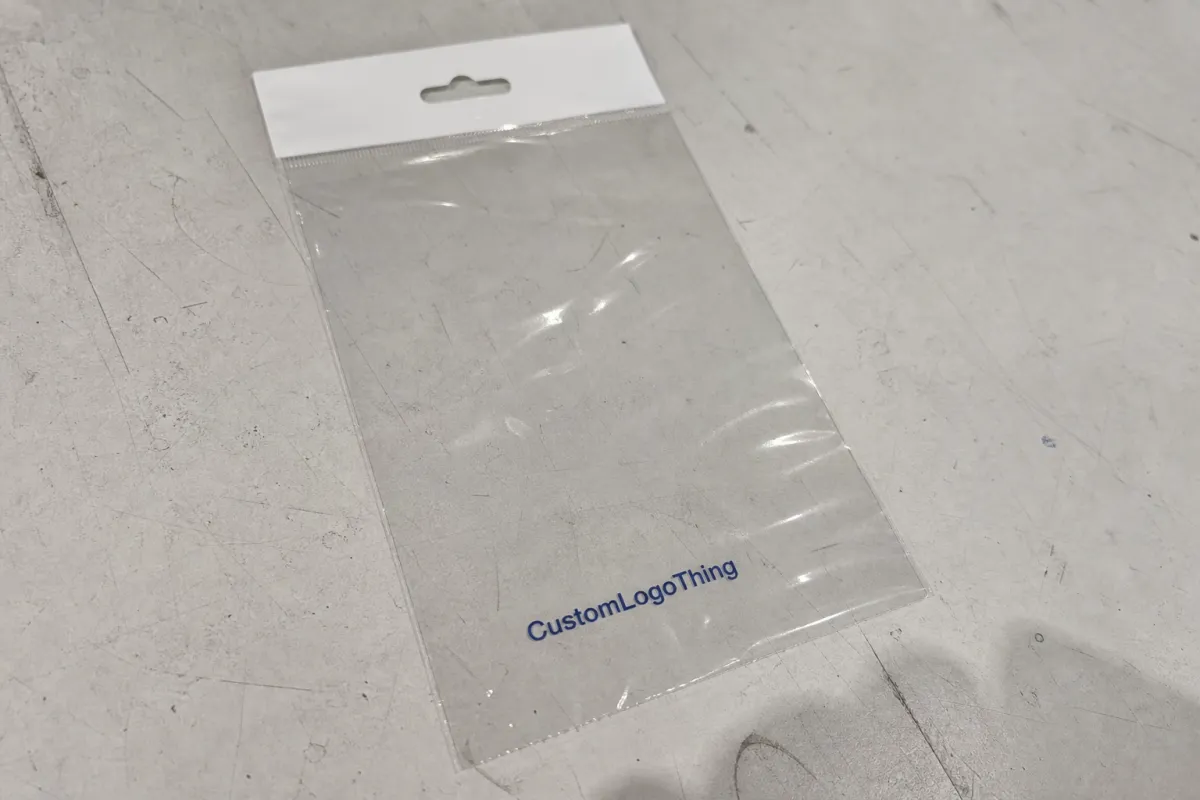
OPP Header Bags are clear oriented polypropylene bags with a product cavity and a header area above it. The header may be plain, printed, or paired with a card insert. Most versions include side seals, a bottom seal, a hang hole, and an adhesive flap. Some carry a printed warning, sticker warning, barcode block, recycling mark, batch code, or retailer-required copy.
Stationery brands use them because they are efficient. Sticker sheets, pens, erasers, greeting cards, bookmarks, washi tape, flat craft kits, paper ephemera, and small school supplies all benefit from clear packaging. Shoppers can see color, texture, finish, and size without opening the pack. Visibility does a surprising amount of selling.
The awkward part: the warning label is often one of the cheapest components, yet its absence can become the most expensive defect. A missing or unreadable label can trigger relabeling, delayed shipments, rejected inbound inventory, chargebacks, or a rushed sticker application job in a warehouse. None of those repairs improves margin.
Buyers also mix up different labeling jobs. A suffocation warning addresses risk from the plastic bag itself. A choking hazard warning usually relates to small parts inside the pack. A resin code or recycling statement identifies material or disposal guidance. A barcode supports retail scanning. Brand copy is marketing. They can share the same bag, but they do not perform the same function.
Packaging buyer reality check: “Clear bag with logo and hang hole” is not a specification. It is a sketch. A usable spec includes dimensions, film gauge, flap style, warning copy, barcode placement, seal type, packing method, and approval steps.
Treat this guide as a buyer’s checklist: what to ask for, what to confirm on the dieline, and what to test before production starts.
How OPP Header Bags Work for Retail Stationery Displays
An OPP header bag is simple, not crude. It has a front panel, back panel, bottom seal, side seals, adhesive flap, and header strip above the product cavity. The header is the retail billboard. The cavity is the product window.
The header supports shelf merchandising through several hole styles. A Euro hole works well across many retail peg systems. A sombrero hole gives extra clearance and can reduce tearing on heavier packs. A round hang hole is cheap and common, though less forgiving if product weight shifts during shipping. Custom slots can work, but they need testing on the actual display fixture.
Transparency is the big advantage. A matte sticker sheet, metallic washi tape, textured card, or pastel pen set looks more convincing when the shopper can inspect it. OPP is typically clearer and crisper than PE. PE feels softer and more flexible. CPP may offer better puncture resistance at certain gauges, but it does not always deliver the same sharp display look. For lightweight stationery, film clarity and clean seals often matter more than brute thickness.
The header area can carry a logo, SKU, barcode, retail price sticker space, and warning copy without blocking the product. That sounds easy until the bag is only 60 mm wide and the buyer wants a logo, barcode, batch code, warning, and decorative pattern in the same strip. Space runs out quickly.
The warning label can be printed directly on the bag, applied as a sticker, or integrated into a printed header card. Direct print looks cleaner for larger runs. Stickers work well for low-volume SKUs, market testing, or packs sold under different retailer requirements. Header cards give the most design control, but they add material, insertion labor, and another artwork file to approve.
Most failures in header bag specs do not come from OPP as a material. They come from mismatched bag size, poor flap placement, unreadable warnings, weak hang holes, or retailer rules discovered after printing. The bag did what it was asked to do. The request was incomplete.
Warning Label Requirements Stationery Buyers Should Verify
Warning requirements vary by market, retailer, product type, and bag dimensions. Copying a competitor’s warning is tempting. It is also risky. Their bag opening may differ. Their sales channel may differ. Their legal review may have considered details that are invisible from a shelf photo.
Common suffocation warning triggers relate to plastic bags large enough to pose a risk and thin enough to cling. Buyers should verify applicable rules for every market where the product will be sold. Retailers, marketplaces, school suppliers, and subscription box partners may also add their own labeling rules on top of legal expectations.
A typical suffocation warning includes four elements: a signal word, a suffocation risk statement, keep-away-from-children language, and disposal instruction. Exact wording should be reviewed by the brand’s compliance or legal contact. For broader packaging safety and distribution guidance, buyers can reference organizations such as the International Safe Transit Association, especially if packed goods will move through parcel networks before reaching stores.
Readability is where many stationery packs fail. The warning should not sit under an adhesive flap. It should not disappear behind a product insert. It should not be covered by a barcode sticker, retail price label, or hang tab reinforcement. If the shopper and receiving team cannot see it, the label is not doing its job.
Typography deserves more scrutiny than it usually receives. Ask about font size, contrast, ink color, and whether the warning remains legible over printed artwork. White type on a pale pink cloud pattern may fit the brand palette, but it can become nearly invisible under store lighting. Black or dark gray copy on a clear or light background is often safer. All caps can add urgency, though dense all-caps text becomes harder to read at small sizes.
Stationery kits add another layer. Mini clips, beads, erasers, pen caps, magnets, charms, pencil sharpeners, and decorative accessories may create small-parts concerns. A choking hazard warning for the product inside is not the same as a suffocation warning for the bag. One does not replace the other.
Ask for a dieline or annotated mockup before approving bulk production. It should show exact warning placement, product position, flap location, hang hole, seals, barcode, and any retailer copy. A flat artwork proof alone can hide practical problems because it does not show how the product will fill the bag.
This is not legal advice. Packaging teams still need to verify rules by sales market and product type. But a disciplined review prevents the most common operational mistake: treating warning copy as decoration instead of a functional requirement.
Key Specs to Lock Before Artwork, Seals, and Hang Holes
Before artwork starts, lock the physical bag specification. The core list is short but consequential: bag width, usable height, header height, flap length, lip style, film thickness, hang hole type, side seal style, bottom seal style, print method, and warning label method.
Usable interior size matters more than outside dimensions. A 100 mm wide sticker sheet may not fit comfortably in a 100 mm internal bag once seal tolerance, product thickness, and insertion angle are considered. Thick notebooks, layered sticker packs, folded greeting card sets, and bundled bookmarks need more clearance than a flat artwork file suggests. A practical starting clearance is often 3–5 mm per side for flat goods, with more for bulky or irregular items.
Film thickness should match the product, not the buyer’s instinct to “make it premium.” Too thin can wrinkle, tear around the hang hole, and make a $12 stationery kit look like a discount-bin item. Too thick can raise unit cost and make a small sticker pack feel overpacked. Many lightweight stationery items sit in the approximate 30–50 micron range, although the right gauge depends on bag size, product corners, hang weight, and machine capability.
Header height is a design tradeoff. A taller header gives room for branding, barcode, warning copy, and a clean hang hole. It can also make a tiny eraser or bookmark look lost. A shorter header keeps proportions neat but creates a fight between logo, hole, and warning text. For very small items, buyers often shift warning copy to the back panel instead of squeezing it into the front header.
Hang hole placement needs testing. The hole should align with retail pegs and leave enough material above and around the cutout to resist tearing. If a product shifts upward during transport, it can stress the hole area. A header reinforcement, wider header, or different hole shape may be needed for heavier pen sets or multi-card bundles.
Adhesive choice changes the user experience. Resealable strips are useful for samples, refill packs, and products shoppers may inspect after purchase. Permanent seals improve tamper resistance for retail display, though they reduce reusability. Some buyers want both: a permanent bottom seal and a resealable top flap. That is common, but it must be stated clearly.
Printed warning text versus sticker warning? Use the decision table below as a starting point.
| Option | Best Fit | Typical Cost Pattern | Watchouts |
|---|---|---|---|
| Stock OPP bag plus warning sticker | Testing, small batches, mixed SKUs | Lower setup; added label and labor cost, often practical below 5,000–10,000 units | Sticker placement can vary; appearance may feel less premium |
| Direct printed warning on custom bag | Larger repeat runs with stable artwork | Higher setup; lower labor per unit as quantity rises | Less flexible if warning copy or market rules change |
| Printed header card with warning | Premium retail packs and multi-language needs | Added card material, printing, and insertion cost | Card can block product visibility if oversized |
Barcode planning is not optional. Leave a flat, readable area with enough quiet zone around the code. Avoid seams, curves, glossy interruptions, and flap overlap. If retailers require carton marks, inner pack labels, or SKU-specific barcodes, include those requirements before comparing quotes.
A simple specification sheet prevents supplier confusion. Without it, one vendor may quote a 40 micron printed bag, another may quote 30 micron stock bags with stickers, and a third may exclude warning labels entirely. Those are not comparable prices. They are different products.
Cost, MOQ, and Unit Cost Drivers for Custom Header Bags
Unit cost is shaped by film type, film thickness, bag size, print coverage, number of colors, label method, order quantity, packing requirements, and freight. One small change, such as moving from one-color warning copy to full-color header printing, can shift both price and lead time.
Plain stock OPP Header Bags with applied labels are usually faster for testing. They also avoid custom print setup on early product launches. Fully custom printed bags can become more efficient at higher quantities, especially if the same bag size supports multiple stationery SKUs. The catch is artwork stability. If product dimensions, logo treatment, legal copy, or barcode data changes often, custom print becomes expensive fast.
MOQ reality is blunt. Very low quantities are possible in some workflows, but setup time, print preparation, artwork handling, sampling, and machine changeovers do not shrink just because the order is small. Buyers may see steep unit prices below 5,000 pieces and a noticeable drop at 10,000, 25,000, or 50,000 pieces. Exact pricing depends on specification, supplier, origin, and packing method.
A practical benchmark: a simple small OPP header bag may sit in the low cents per unit at larger volume, while a printed, thicker, multi-color custom header bag can climb meaningfully. For a 5,000-piece run, buyers might see a broad range such as $0.06–$0.18 per unit for basic configurations, before freight and special handling. More complex printed retail packs can exceed that. Treat any benchmark as directional, not a promise.
Hidden costs deserve scrutiny. Multiple SKU sizes create separate setup and inventory. Separate warning versions for different markets add complexity. Individual barcode changes can require variable printing or label management. Special cartons, retailer carton marks, inner pack bundling, and pre-applied price stickers can all add cost. Freight can erase the savings of a cheaper unit quote if cartons are bulky.
A cheaper quote may not be cheaper if it excludes warning printing, sample approval, freight, carton labels, or pre-production proofs. Ask suppliers to separate tooling or setup, per-unit cost, sample cost, packing cost, and freight. Then compare the same scope.
Quote tiers help. Request 5,000, 10,000, 25,000, and 50,000 pieces using one specification sheet. The goal is not the lowest unit cost in isolation. The goal is the bag that passes compliance checks, protects presentation, scans cleanly, and arrives before the retail date.
Over-ordering can be expensive, too. If artwork changes, a retailer updates warning language, or a sticker sheet grows by 4 mm, leftover bags become dead stock. For seasonal stationery and school promotions, buying “just in case” inventory can quietly consume cash and storage space.
If Custom Hang Tags, barcode labels, or warning stickers are already part of the pack, coordinate the bag project with Custom Labels & Tags. Aligned label dimensions, material, adhesive, and artwork standards reduce mismatched components on the packing line.
Production Steps, Timeline, and Approval Process
A clean order follows a sequence: product measurement, specification sheet, artwork or dieline, quote, sample or proof, approval, production, quality check, packing, and shipping. Skip steps and the risk moves downstream, where fixes cost more.
Start by measuring the actual stationery product stack. Not the flat artwork file. Not the catalog size. Measure width, height, and thickness after the product is collated, folded, stacked, or bundled. A greeting card with envelope behaves differently from the card alone. Ten sticker sheets have a different edge profile than one sheet. A pen with a clip may need extra clearance at one point, not across the whole bag.
Artwork preparation should include logo, header design, barcode, warning copy, recycling marks if used, retailer information, and any batch or lot coding area. Recycling claims need care. For U.S. environmental messaging, the EPA recycling resources are a useful starting reference, although local acceptance and claim substantiation still need review.
Proofing has layers. A digital proof confirms layout, spelling, logo placement, warning position, and barcode location. A physical sample confirms fit, clarity, flap function, seal strength, hole placement, and warning readability with the product inside. Both have value. Neither replaces the other.
Lead time depends on custom printing, quantity, multi-SKU complexity, special hang holes, film availability, and production schedule. Stock bags with labels can sometimes move in a shorter window. Fully custom printed header bags often require more time for proofing, plate or setup preparation, printing, conversion, QC, and freight. A practical working range might be 10–20 business days after proof approval for simpler domestic workflows, with longer schedules for complex or imported orders.
Buyer approval is often the bottleneck. Legal review sits in someone’s inbox. A barcode has not been assigned. The retailer has not confirmed whether the warning must appear on the back panel or header. These delays can add more time than production itself.
Build buffer for retailer launches, school-season promotions, subscription box deadlines, and trade show shipments. Packaging is a poor place to run a zero-margin timeline. One missed approval can push the whole order into expedited freight.
Use a quality control checklist before the shipment leaves the supplier:
- Count accuracy: confirm units per inner pack and carton.
- Seal integrity: check side seals, bottom seals, and flap adhesion.
- Hole placement: verify alignment and tear resistance.
- Film clarity: look for haze, scratches, wrinkles, or blocked bags.
- Warning position: confirm visibility with the product inserted.
- Print registration: check logo, barcode, and warning copy sharpness.
- Carton labels: confirm SKU, quantity, and retailer marks if needed.
- Sample retention: keep approved samples for repeat orders.
Store final specs, approved artwork, packed product photos, and signed proofs in one shared folder. Repeat orders move faster when nobody has to reconstruct the bag from an old invoice and a blurry phone photo.
For brands comparing packaging outcomes across multiple launches, reviewing examples in Case Studies can help internal teams see how specification discipline affects production reliability.
Build a Safer, Cleaner Header Bag Order
Start with product samples. Pull one item from each stationery SKU family: one sticker sheet pack, one pen set, one greeting card set, one bookmark bundle, one craft kit. Measure width, height, and thickness. Photograph the stack from the front, side, and top. Small details show up quickly.
Create a packaging matrix. It does not need fancy software. Use columns for SKU, product dimensions, target bag dimensions, header height, hang hole type, warning text, barcode needs, print colors, target quantity, and sales channel. Add a column for “approval owner” so legal, design, and operations do not assume someone else signed off.
Approve warning language before artwork begins. Compliance review after printing plates are prepared is expensive and frustrating. If different markets need different warning versions, decide whether to use stickers, alternate print runs, or a header card strategy.
Request at least one dieline or annotated mockup showing the warning label, hang hole, flap, seal areas, barcode, and product placement. For bulky, sharp-cornered, unusually small, or retailer-sensitive products, order a prototype. A $50–$200 sampling step can prevent a four-figure rework bill.
Compare supplier quotes using the same specification sheet. Confirm film gauge, print method, MOQ, proofing, cartons, freight terms, and warning label method. If one supplier includes physical samples and another does not, mark that difference. If one quote assumes stock bags and another assumes custom print, do not treat the lower price as a win.
Run a small in-house test. Pack the product. Hang it for 24 hours. Scan the barcode with a phone and a basic scanner if available. Open and reseal the flap if resealability matters. Check whether the warning remains visible after the product shifts. Drop a few packed samples into a carton and shake gently; crushed corners and torn hang holes reveal themselves fast.
Document final approval with photos of the packed product, not just the empty bag. Customers, retailers, and marketplace reviewers judge the finished pack. So should the brand.
The practical aim is not complicated: a clear bag that displays the stationery well, carries the right warning in the right place, scans properly, hangs cleanly, and reaches the sales channel without avoidable drama. Use this stationery brands OPP Header Bags Warning Label guide as a working checklist before placing a purchase order.
FAQs
Do stationery brands need warning labels on OPP header bags?
Often, yes, especially when the plastic bag size and opening could create a suffocation risk. Requirements vary by market, retailer, product type, and bag dimensions, so brands should confirm rules before printing. If the pack includes small parts such as mini clips, beads, charms, pen caps, or small erasers, product-level choking hazard warnings may also be needed.
Where should a warning label go on OPP header bags for stationery?
Place it where shoppers, warehouse teams, and retailer compliance staff can see it clearly. Common locations include the back panel or header area. Avoid placing it under the adhesive flap, behind the product, across a seam, or where a barcode sticker or price label may cover it. Request a dieline showing exact placement before approving production.
Is it better to print the warning directly or use a sticker label?
Direct printing usually looks cleaner and works well for larger custom runs with stable warning copy. Sticker labels are useful for low-volume orders, test launches, or different warning versions for different markets. Compare labor, appearance, flexibility, and MOQ before choosing either method.
What information should I send for an OPP header bag quote?
Send product dimensions, desired bag size, film thickness, header height, hang hole type, quantity, artwork, warning label copy, barcode needs, packing requirements, and shipping destination. Include photos or samples if the stationery product is thick, bundled, sharp-cornered, or irregular. Ask for tiered pricing so you can see how MOQ affects unit cost.
How long does the OPP header bag production timeline usually take?
Timelines depend on artwork readiness, proof approval, quantity, printing complexity, and whether the bag is stock or fully custom. Stock bags with applied warning labels are typically faster than fully printed custom header bags. Build in extra time for compliance review, physical samples, retailer approvals, QC, and freight.


