A warning label can delay an otherwise simple boutique packaging order. Annoying? Yes. Common? Also yes. This wedding boutiques OPP Header Bags Warning Label guide explains how bag material, header layout, label method, MOQ, and proofing all affect whether packaging arrives usable or becomes a very clear pile of regret.
OPP Header Bags look clean, glossy, and retail-ready, which is why wedding boutiques use them for veils, jewelry cards, favors, hair accessories, stationery sets, garment add-ons, and small gift bundles. But the warning label cannot be slapped on at the end like a price sticker. It needs space. It needs contrast. It needs to stay readable after the bag is filled, sealed, stacked, or hung on a peg display.
Pretty packaging is useful. Pretty packaging that fails the practical check is expensive inventory.
Wedding Boutiques OPP Header Bags Warning Label Basics
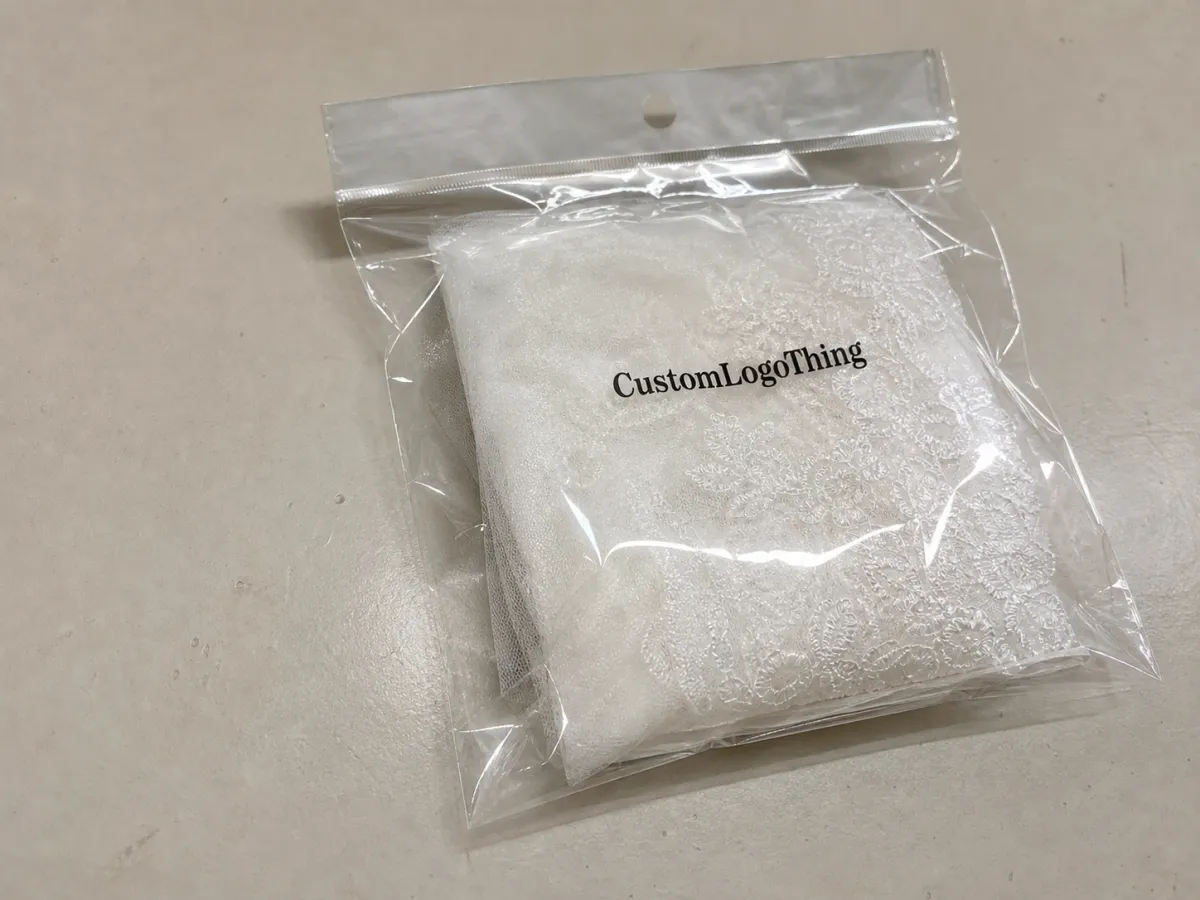
A surprising number of OPP header bag orders slow down because the warning label is treated as “legal copy we’ll add later.” That sounds harmless until the artwork is approved, the header is too short, the hang hole cuts through the only blank space, or the warning text lands over lace where nobody can read it. That is not a manufacturing miracle problem. That is a spec problem.
Start with the job. Is the bag meant to protect a delicate item from dust? Hang on a boutique peg wall? Bundle wedding favors in sets of 10? Serve as secondary retail packaging for belts, gloves, hair combs, jewelry, or bridal party gifts? Each use changes the correct size, film gauge, header height, and label position.
For small, lightweight accessories, a 1.5 mil to 2 mil OPP film often works fine. For thicker gift sets or products with sharp corners, buyers usually move closer to 2.5 mil or add a stronger seal style. OPP is crisp and transparent, but it is not armor. If the item has corners, hooks, pins, clips, or rigid cards, test the fit before ordering 10,000 pieces because “it looked fine on the screen.” Famous last words.
The header matters just as much as the body. A typical header might run 1.25 inches to 2 inches tall, depending on bag width and hang style. Add a round hole, sombrero hole, or euro slot, and your usable print area shrinks fast. The practical order of work is simple: plan the function first, then decorate around it.
For wedding retail, the package has to do two jobs at once. It must look refined enough for a bridal environment, and it must carry required or practical information without looking like a hazard sticker from a warehouse aisle. Clear hierarchy helps. Put branding where shoppers notice it. Put warning or care copy where it can be read quickly. Do not bury it in 5-point light gray type on a glossy clear surface and call it compliance. That is optimism, not packaging strategy.
Packaging buyer rule: if the warning text is part of the use case, it is part of the design brief. Treat it like artwork, not housekeeping.
How OPP Header Bags and Warning Labels Work Together
An OPP header bag is simple from the outside, but several zones compete for space. You have the clear OPP film body, the sealed or reinforced header, the hanging hole or euro slot, the brand mark, possible barcode or SKU copy, and the warning text. Cram all of that into a 4-inch-wide bag and “just add the label” becomes comedy.
The body is usually clear so shoppers can see the product. The header is often printed or finished with a brand color, logo, product name, or collection detail. If the warning label is printed directly on the header, contrast matters. Black ink on white or pale blush works. Silver on clear? Pretty, but hard to read under bright boutique lighting.
There are four common ways to handle warning copy:
- Direct print on the header: Cleanest look for stable copy and larger runs. Best for repeat SKUs where the warning language will not change every other month.
- Adhesive warning label: Flexible and practical for smaller runs, mixed SKUs, or changing information. Pairs well with Custom Labels & Tags if you need branded or compliant stickers.
- Inserted notice: Useful for longer care instructions, material disclosures, or multi-language copy, but easier for staff or customers to remove.
- Pre-printed copy on the bag body: Good when the header must stay brand-heavy, though readability can suffer if the product behind the film is patterned, white, metallic, or reflective.
The right choice depends on order volume, copy stability, appearance standards, and labor. Separate labels cost less up front for many small runs, but someone has to apply them. If staff are labeling 2,000 bags by hand before a bridal show, that “savings” gets less charming by hour three.
Direct print looks more polished, especially for premium wedding retail. It also locks you into that exact wording. If a regulation, internal policy, language requirement, or product use changes, you may be stuck with printed inventory that cannot be used without an over-label. Not always a disaster, but not elegant either.
Buyers often miss one awkward truth: a label can pass on a flat PDF and still fail in real life. OPP reflects light. Clear film shifts visually once filled. The header can bend when hung. Bags can overlap on a peg display. Folded inventory can hide the label entirely. A useful wedding boutiques OPP Header Bags warning label guide has to ask early: how will the bag actually sit, hang, ship, and get handled?
For broader packaging testing standards, buyers who ship finished goods can review resources from the International Safe Transit Association. ISTA testing is more relevant to shipping cartons and distribution systems than a tiny header bag by itself, but the thinking is useful: design for the real journey, not the prettiest mockup.
What OPP Header Bags Actually Cost at Different MOQs
Pricing moves because specs move. Anyone quoting “OPP header bags” without dimensions, film thickness, print colors, label method, and quantity is guessing. Maybe educated guessing. Still guessing.
Most custom OPP header bag quotes are shaped by six factors: bag width and length, film gauge, header height and hang feature, number of print colors, warning label method, and whether the order is stock, semi-custom, or fully custom. A 3-inch by 5-inch accessory bag with a 1.5-inch header is not in the same cost universe as a 9-inch by 12-inch bag with heavy ink coverage, euro slot, barcode, and bilingual warning text.
As a practical range, small semi-custom runs using stock clear bags plus applied labels may land around $0.12 to $0.35 per finished bag at 1,000 to 3,000 pieces, depending on label size, application labor, and whether the bags are standard sizes. Fully custom printed OPP header bags often make sense at 5,000 to 10,000 pieces and may range from $0.08 to $0.22 per unit for common small-to-medium formats, with higher costs for larger sizes, heavier film, specialty finishes, or multiple artwork versions.
Very low MOQs can be useful, but they are rarely cheap on a unit basis. Setup, artwork review, proofing, plate or screen prep, and machine changeover do not politely disappear because the order is small. If warning copy varies across five accessory types, each version may create another artwork file, another proof, and another chance for someone to paste the wrong text into the wrong SKU.
| Order Type | Typical Quantity | Warning Method | Common Unit Range | Best Fit |
|---|---|---|---|---|
| Stock bag with plain warning label | 500-2,000 | Adhesive label | $0.15-$0.40 | Small boutique tests, short runs, changing copy |
| Stock bag with branded label | 1,000-5,000 | Custom adhesive label | $0.12-$0.32 | Mixed SKUs, seasonal wedding collections |
| Semi-custom header bag | 3,000-10,000 | Printed header or applied label | $0.10-$0.26 | Repeat accessories and boutique programs |
| Fully custom printed OPP bag | 5,000-25,000+ | Direct print on bag or header | $0.08-$0.22 | Stable artwork, higher-volume retail packaging |
Printed warnings usually look better at scale. Separate labels usually win for flexibility. That is the tradeoff. If you sell 400 units of a limited-run bridal favor pack, do not overbuild the packaging like it is going into national retail. Use a smart label. If you reorder the same veil accessory bag every month, print the warning into the header and stop paying for hand-applied stickers.
A clean quote request should include exact outside dimensions, usable fill dimensions if known, film gauge target, header height, hang hole type, warning text, number of artwork versions, print colors, and target quantity. Add whether the bag must meet retailer-specific packaging requirements, suffocation warning expectations, barcode placement rules, or sustainability preferences such as recyclable packaging claims. If you need matching tags or stickers, keep the language consistent across the bag and Custom Labels & Tags so the finished kit does not look like three departments designed it during a power outage.
The main lesson is practical rather than glamorous: build the quote around real variables, not a vague idea of “clear bags with branding.” Vague requests produce vague quotes. Then everyone acts surprised. Cute.
Process and Lead Time: From Artwork to Delivery
A typical custom OPP header bag order follows a clear sequence: request the spec, confirm dimensions, choose film thickness, define the header, place the warning copy, review artwork, approve the proof, manufacture, inspect, pack, and ship. Most delays happen before production starts, not while the bags are being made.
For a straightforward label-based order using stock bags, proofing may take 1 to 3 business days after final files and copy are supplied. Label printing might take 3 to 7 business days. Assembly or application can add 2 to 5 business days depending on quantity and labor setup. Transit is separate, and yes, transit still counts even if someone forgot to put it on the calendar.
For a custom printed OPP header bag, artwork review and digital proofing often take 2 to 5 business days. If a physical proof or production sample is needed, add 5 to 10 business days in many cases. Production after proof approval commonly runs 10 to 20 business days for standard quantities, with longer windows for larger volume, special film, heavy ink coverage, or multiple SKUs.
- Spec request: Confirm bag width, length, header height, film gauge, and display method.
- Artwork setup: Place logo, product name, barcode, care copy, and warning text at full size.
- Proof review: Check spelling, label position, contrast, trim, seal margin, and hang hole clearance.
- Approval: Lock the proof before production timing starts.
- Production: Print, convert, seal, apply labels if needed, inspect, and pack.
- Delivery: Ship cartons with enough buffer before launch, event, or boutique floor date.
The biggest timeline killers are boring. Missing dimensions. Low-resolution logos. Warning copy that is “almost final.” Late language changes. A buyer realizing after proof approval that the label is hidden when the bag hangs on a peg. These are not rare. They happen constantly because packaging gets treated as a finishing touch instead of a production item.
For wedding boutiques, the rule is simple: the more the package depends on custom copy placement, the more important the proof becomes. A tiny accessory bag with a hang hole, logo, SKU, and warning copy has less forgiveness than a large flat mailer. Every millimeter is competing for attention.
If the order has a firm event date, bridal market launch, seasonal drop, or retailer delivery window, build in a 7 to 14 day cushion after the quoted delivery date. Not because suppliers are villains. Because artwork, freight, inspection, and approvals involve humans. Humans are where timelines go to wobble.
Common Mistakes That Trigger Reprints or Rejection
The fastest way to ruin a nice OPP header bag is to make the warning text technically present but practically unreadable. Tiny type, low-contrast ink, glossy film, and a busy product behind the bag create a visibility mess. If staff need to tilt the package under a light to read the label, the layout has already failed.
Many buyers underestimate the header area. A 1.5-inch header sounds generous until you subtract the seal margin, hang hole, logo, product name, and any decorative border. The warning copy then gets shoved into the corner like an apology. Bad plan. If the warning matters, give it a real zone.
Another common mistake is changing copy after proof approval. One word can matter. Language swaps, punctuation edits, product age warnings, material claims, and SKU-specific instructions all need review before approval. Sending copy from a similar product is also risky. Similar is not the same. Brides may tolerate many things. Packaging compliance should not be one of them.
Multi-language layouts deserve extra caution. English-only copy that fits nicely on a header may double in length when Spanish, French, or another language is added. If the bag is going into a retailer with specific requirements, ask for those requirements before the art is built. Do not wait until cartons are packed and then discover the warning must be larger, relocated, or repeated on both sides.
Compliance and presentation belong in the same conversation. Some bags fail not because the OPP film is wrong, but because required information is displayed poorly. Plastic bag warning expectations can vary by location, product use, and buyer requirements. For environmental claims or recyclability language, avoid casual green claims unless you can support them. The EPA recycling resources are a useful starting point for consumer-facing recycling language, though packaging claims should still be checked against your market and legal requirements.
Watch these issues hardest:
- Type too small: Anything under 6-point can become questionable on glossy film, especially after filling.
- Weak contrast: White ink on clear film may disappear against pale products like veils, lace, ivory cards, or tissue.
- Hang hole conflict: Warning copy too close to a euro slot can get punched, distorted, or visually ignored.
- Wrong SKU copy: Similar accessories often have different warnings, care notes, or age guidance.
- No filled sample check: Flat proofs do not show how the product behind the film affects readability.
The better your proofing discipline, the fewer reprints you buy. Reprints are not a badge of perfectionism. They are tuition.
Expert Checks That Keep Boutique Orders Clean
A hard-copy proof or physical sample is worth considering when the order is high value, visually sensitive, or headed for a premium boutique setting. Screen mockups are useful, but they do not show reflection, film clarity, ink density, or how a product changes the visibility of text behind clear OPP.
For small runs, a full production sample may not be practical. Still, ask for a full-size PDF proof and print it at 100% scale on paper. Cut it down. Place it over a clear bag. Hold it near the product. Crude? Yes. Useful? Very. It catches size problems faster than staring at a zoomed-in artboard on a laptop.
Use a quick scan test before approving the layout:
- Can the warning copy be read in 2 seconds?
- Does the brand still feel premium, or does the label dominate the header?
- Is the text clear when the bag is filled with the actual product?
- Does the hang hole interfere with the copy, barcode, or logo?
- Will staff know which side faces out on a peg display?
That last point sounds basic. It is not. Boutique staff may hang bags quickly during restocks, especially around weekends and event traffic. If the warning label, branding, or product name only works when the bag faces one precise direction, make that direction obvious. Better yet, design the layout so it still works when handled by normal people moving at normal speed.
Also verify warehouse or backroom handling. Bags may be bundled with rubber bands, stacked in cartons, folded near the header, or counted in batches before being filled. Folding across the warning zone can create a permanent crease. Stacking clear bags with labels in different locations can make inventory look inconsistent. If the packaging must look elegant on a boutique table, do not ignore how it gets there.
Create a master spec sheet. It should list outside size, usable fill size, OPP gauge, header height, hang hole type, seal style, print colors, label stock, label size, warning copy, barcode location, artwork file name, proof date, and reorder quantity. Keep one approved PDF attached. For repeat orders, this can cut days from quoting and reduce the odds of accidental changes.
For structured packaging requirements, buyers can also reference organizations like the Forest Stewardship Council when paper components such as header cards, inserts, or tags are involved. FSC does not certify OPP film itself, but it may matter if your boutique packaging set includes paper labels, card backers, or printed inserts. Material claims should be precise. “Eco-friendly” without proof is not a spec. It is a wish wearing makeup.
The best process behind any wedding boutiques OPP Header Bags Warning Label guide is not complicated. Confirm the physical package. Confirm the copy. Confirm the display method. Approve the proof at real size. That discipline saves money, lead time, and several unpleasant emails.
Next Steps for a Cleaner Quote and Faster Approval
Before asking for pricing, gather the details that actually matter. Exact bag width and length. Product dimensions. Target film thickness. Header height. Hang hole preference. Warning copy. Artwork files. Number of SKUs. Target quantity. Desired delivery date. If you have a current bag, measure it flat and photograph it with a ruler. Suppliers love clarity. They do not love treasure hunts.
Ask for the label position at full size. Not a tiny thumbnail buried in a presentation deck. Full size. If the warning is printed, confirm ink color and contrast. If the warning is applied as a label, confirm label size, label stock, adhesive type, and whether application is included. If it is inserted as a notice, confirm who inserts it and whether it can shift during shipping.
Compare quotes on the same basis. Same MOQ. Same film gauge. Same bag dimensions. Same warning method. Same artwork count. Same proofing support. Same shipping terms. A lower unit price is not a win if the supplier quoted 1.5 mil film while another quoted 2 mil, or if one included label application and the other quietly left it to your staff.
For boutique buyers, ask these questions before placing the order:
- What is the finished outside size and the usable fill area?
- Will the warning text remain visible after the product is inserted?
- Is the hang hole centered, and how much clearance does it need?
- Are warning labels printed, applied, or supplied separately?
- What is the proof approval cutoff before production timing starts?
- How are multiple SKUs identified during packing?
If you need related packaging pieces, keep the same design system across bags, stickers, tags, and inserts. A matching set of Custom Labels & Tags can make a small boutique line look much more organized, especially for bridal accessories where shoppers notice presentation details. Just do not let style bury the required copy. Pretty still has to function.
The practical advice is boring and profitable: write one reusable spec template and keep using it. The next order will quote faster, proof faster, and reorder with fewer surprises. If repeatable sourcing matters, keep the same dimensions, warning text, artwork version, and approval notes in your purchase records so the next round stays consistent instead of starting from scratch.
FAQs
What is the right MOQ for wedding boutiques OPP header bags with warning labels?
The right MOQ depends on whether the warning copy is printed, labeled, or inserted. Each method changes setup cost, proofing time, labor, and unit pricing. Smaller boutiques usually do better with lower-MOQ label-based runs around 500 to 3,000 pieces, especially if copy changes by SKU. Higher-volume programs often get better pricing when the warning copy is printed directly into the bag or header, usually starting to make sense around 5,000 to 10,000 pieces.
Should the warning label be printed on the bag or added separately?
Print it on the bag when you want the cleanest look and the warning message will stay stable across reorders. It looks more intentional and reduces hand application. Use a separate adhesive label when the order is small, the copy may change, or you need flexibility across different SKUs. For wedding boutiques testing new accessory lines, separate labels are often the safer first move.
How long do custom OPP header bag orders usually take?
Simple reorder-style jobs can move quickly once the proof is approved, often within 7 to 15 business days for basic label or stock-bag programs. New custom printed builds usually take longer because artwork, warning placement, physical proofing, and production setup need review. A realistic custom timeline is often 15 to 30 business days after final proof approval, plus transit.
What bag specs matter most for wedding boutiques?
Start with size, film thickness, header height, and display method. Those four choices control appearance and handling. A small jewelry card may only need 1.5 mil to 2 mil OPP, while a thicker favor bundle may need a stronger gauge or larger seal area. Then match the warning label format to the layout so the finished package still looks polished instead of crowded.
How do I compare quotes without getting tricked by unit price?
Compare the same quantity, same film gauge, same dimensions, same warning method, same artwork count, and same proofing support before judging the number. A low unit price can hide thinner film, no label application, longer lead time, weaker print quality, or missing proof stages. The best quote is not always the cheapest. It is the one that matches the actual packaging job.


