A stationery cuffed knit Beanies Unit Cost Review only works if it shows the full landed number. A blank price alone is a mirage. The real bill usually includes decoration, setup, packing, carton labeling, and freight, and those items can change the economics more than the knit itself.
That matters for office onboarding kits, winter event packs, and retail programs where budgets are fixed before the order is placed. A quote that looks light by fifty cents can turn heavy fast once digitizing, patch tooling, or rush handling gets added. Buyers who compare only the headline price end up comparing fiction.
The better approach is simple: break the order into the blank beanie, the decoration method, and the pack-out. Then check the material spec, the cuff size, and the production timeline against the quantity. The result is less glamorous, but it is the number that survives receiving, invoicing, and reorders.
Stationery Cuffed Knit Beanies Unit Cost: What Buyers Miss
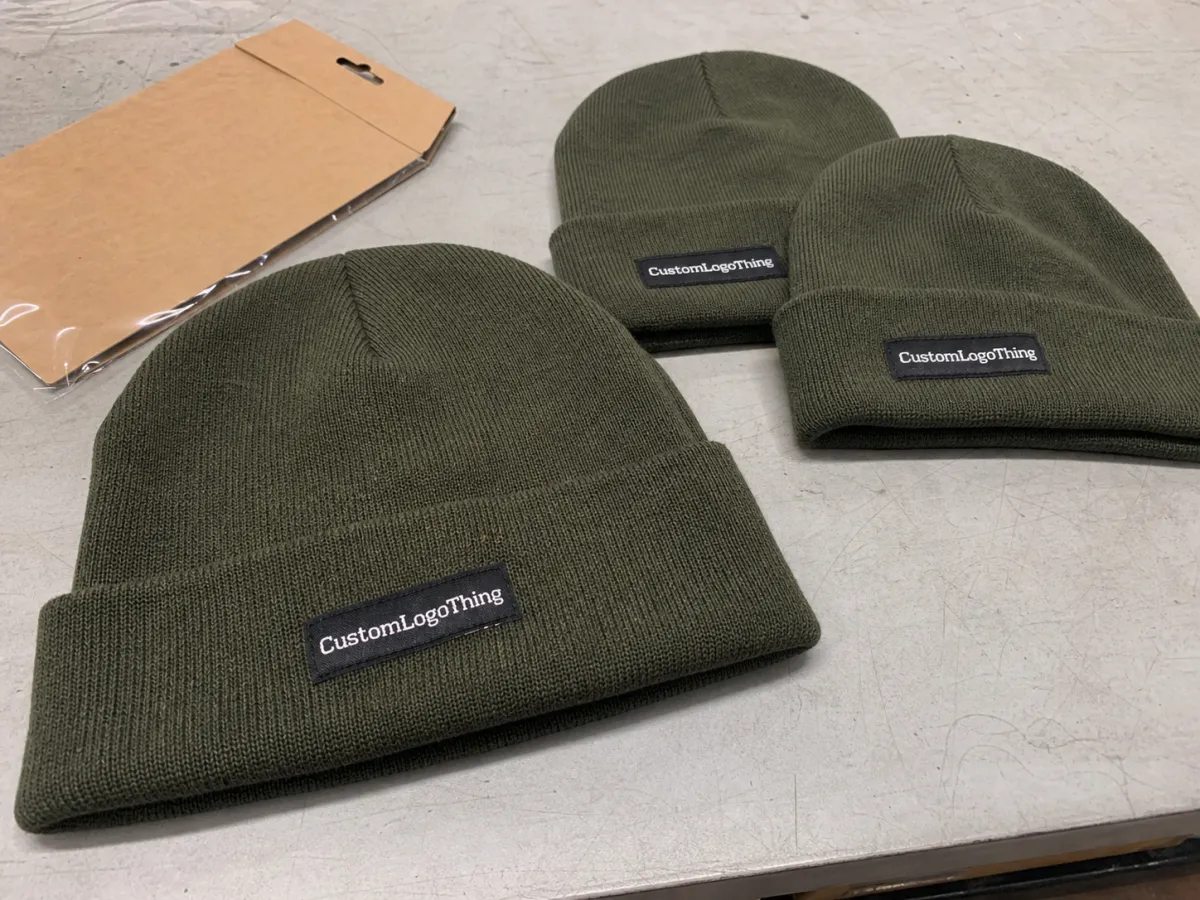
The first mistake is assuming all Cuffed Knit Beanies are close enough to compare. They are not. A 100% acrylic blank, a thicker acrylic-poly blend, and a heavier rib knit can sit in the same category on a quote sheet while behaving very differently in wear, decoration, and shipping. The yarn, stitch density, and cuff depth all affect perceived value.
The cuff is the most underestimated part of the spec. A wider cuff gives more room for embroidery or patch placement, which can reduce the need for a second branding position. A shallow cuff can force a smaller logo or make the mark sit too close to the edge. Once that happens, the item starts looking like a compromise, even if the yarn quality is fine.
There is also a trap in low minimums. A small run sounds safer, but fixed costs do not shrink just because the order is small. Digitizing, proofing, packaging, and freight often land harder on a 100-piece job than on a 500-piece job. The unit cost rises because the overhead has fewer units to absorb it.
The cheapest quote is rarely the lowest-cost purchase. The useful number is the one that still makes sense after decoration, packing, and freight are added.
For office kits, the buyer usually wants consistency and fast replenishment. For events, the main issue is uniformity across a large run. For retail, the item has to look sharp enough to sit next to a higher-margin product without feeling cheap. Different end uses, same lesson: do not compare a teaser rate with a fully built quote.
Blank Quality and Cuff Construction That Holds Shape
Blank quality should be judged by construction, not by vague adjectives on a product sheet. “Soft,” “cozy,” and “premium” mean very little unless the supplier can show yarn composition, knit gauge, and measured dimensions. For most bulk programs, the practical options are 100% acrylic, acrylic blends, and heavier rib knits. Acrylic usually gives the lowest entry price and is common for promotions. Blends can improve handfeel and shape recovery. Heavier knits usually look cleaner, but the cost per piece rises with the material and the knitting time.
The cuff is more than a branding strip. It affects structure, fit, and how the beanie sits after it has been folded, shipped, and worn. A cuff that is too loose can drift after the first wear. A cuff that is too tight can feel rigid and lose the easy drape people expect from a knit cap. Most buyers notice the shape long before they notice the yarn content.
Watch the seam finish too. A sloppy join at the top, weak edge stitching, or uneven ribbing can lower the value of the whole order. That becomes obvious in photography, but it is just as obvious in hand. A beanie can use decent yarn and still look budget if the top closes poorly or the cuff loses form after unpacking.
Ask for plain measurements: body height, cuff depth, relaxed circumference, stretch range, and knit gauge. Those numbers tell you whether the item reads as a retail beanie or a giveaway piece. A true unisex fit often covers most adult heads, but the feel changes with gauge. Tighter gauges usually sit closer to the head and look neater. Looser gauges give more slouch, but they may stretch out faster.
- Standard blanks: common acrylic yarns, regular cuff heights, and familiar body lengths are easier to source and easier to reprice.
- Adjustable points: cuff depth, body height, and label style can often be changed without redesigning the whole item.
- Cost drivers: specialty yarns, unusual stitching, and custom sizing usually add sampling time and raise the unit price.
Packaging should not be treated as an afterthought. If the beanies are traveling in bulk cartons, the carton spec matters almost as much as the cap itself. Compression-resistant cartons, inner-pack counts, and clean labeling help prevent crushed product and receiving delays. For teams that care about transit testing language, ISTA is a common reference point.
Yarn Weight, Fit, and Decoration Specs That Actually Matter
Buyers should ask for numbers, not adjectives. Request body height, cuff width, relaxed circumference, stretch range, yarn composition, and knit gauge. That reveals whether the beanie will fit cleanly, whether the cuff can carry decoration, and whether the blank looks substantial enough for the intended use. If the supplier cannot provide those details, the quote is not ready for a serious comparison.
Decoration choice affects both cost and lifespan. Embroidery is usually the most durable choice for simple logos. It handles folding, shipping, and repeated wear better than most alternatives. Woven patches work well when the artwork has fine detail, multiple colors, or tiny type that would get muddy in thread. Labels and applique can hold down cost on some runs, but they need closer inspection because weak adhesive, loose stitching, or poor edge finishing can make the product feel cheap.
| Decoration method | Typical add-on per piece | MOQ behavior | Best use case | Tradeoff |
|---|---|---|---|---|
| Embroidery | $0.35-$0.85 | Often workable at 100-500 pcs | Simple logos, office kits, long wear | Fine detail is limited |
| Woven patch | $0.50-$1.10 | Usually stronger at 250+ pcs | Small text, detailed marks, retail looks | Patch tooling and setup can add cost |
| Printed label or applique | $0.20-$0.55 | Can suit lower MOQs | Budget promos and faster turnaround | Wear and wash performance can vary |
Artwork size matters more than many buyers expect. Thin lines can disappear in knit decoration. Small text below roughly 4 mm in height becomes risky, especially on a looser cuff or a textured knit. Large logos need enough flat area to sit cleanly, or they will wrap awkwardly around the cuff. A supplier that quietly enlarges or shrinks the mark after proofing is not helping; they are changing the product without changing the spec.
Color matching deserves more attention than it usually gets. Pantone references help, but knit yarns behave differently than printed paper or coated stock. A deep navy in thread can read slightly flatter than the same reference in print. Heathered yarns can pull color toward gray, and that changes the mood of the piece. Buyers who want strict brand matching should ask for yarn swatches or a preproduction sample before the full run starts.
Durability is the other half of the decoration conversation. Beanies get folded into bags, stuffed into lockers, and tugged on during cold weather. Embroidery usually survives that abuse well. Some labels curl after a few wears, and low-grade yarns can pill. If the item is part of a winter program that will be handled often, ask how the finish holds up after repeated wear rather than relying on a product photo shot under ideal light.
For hang tags, belly bands, and insert cards, FSC-certified paper is a sensible upgrade if the program needs a cleaner presentation. It does not fix weak product quality, but it does make the packaging feel more deliberate without a major cost jump.
Unit Cost, MOQ, and Quote Breakpoints for Bulk Orders
This is where the review becomes practical. The unit price normally falls as quantity rises because the fixed costs stop biting so hard. Digitizing, proofing, and setup do not shrink much between a 100-piece order and a 1,000-piece order. They just spread over more units. That is why a quote often drops sharply at the common breakpoints.
Most suppliers will tier pricing around 100, 250, 500, and 1,000 pieces, although the exact thresholds vary by factory and decoration type. The table below is not a promise; it is a realistic view of how the numbers often behave when the spec stays stable.
| Quantity | Blank beanie cost per piece | Typical embroidery add-on | Estimated all-in range | What changes here |
|---|---|---|---|---|
| 100 pcs | $1.80-$3.10 | $0.55-$1.10 | $2.60-$4.80 | Setup and freight dominate the total |
| 250 pcs | $1.55-$2.60 | $0.45-$0.95 | $2.20-$3.90 | Fixed costs spread more efficiently |
| 500 pcs | $1.25-$2.15 | $0.35-$0.85 | $1.85-$3.25 | Production usually becomes steadier |
| 1,000 pcs | $1.05-$1.85 | $0.30-$0.75 | $1.60-$2.85 | Bulk pricing typically becomes defensible |
These are typical ranges for a standard cuffed knit beanie with common decoration. Heavier yarn, extra cuff depth, a stronger patch, private-label trim, or multiple logo placements will move the number up. A rush timeline can do the same. The point is not to chase the lowest line item. The point is to compare quotes that are actually equivalent.
Hidden charges are where many purchases drift out of budget. Digitizing often runs about $35-$95 for a simple logo, and more if the art needs cleanup or stitch mapping. Woven patch tooling can add a separate setup cost. Packaging changes, carton labels, and individual polybags each add small amounts that look harmless until they stack together. Freight should always be included in the comparison, especially if the order crosses regions or ships internationally.
Compare the same spec, the same decoration, the same pack-out, and the same delivery terms. Anything less is just a cheaper-looking quote.
A useful stationery cuffed knit beanies Unit Cost Review should also show how the price changes if the order changes. If 250 pieces is a lot cheaper than 100, the buyer can decide whether to increase volume or reduce decoration complexity. If 500 pieces barely improves the unit price, it may be smarter to keep the order smaller and spend the savings on better packaging or a cleaner finish.
Process and Lead Time From Artwork to Packed Cartons
Most schedule problems begin before production begins. A clean workflow should look like this: quote approval, artwork proof, sample or virtual proof sign-off, production, inspection, and final packing. If any step is left vague, the delivery date becomes a guess. Buyers often ask for lead time and forget that artwork feedback alone can add days.
Typical timing depends on quantity, decoration type, and season. A straightforward run may need 1-3 business days for proofing, 5-10 business days for sampling if a sample is required, and 12-20 business days for production after approval. Peak season compresses those numbers in the wrong direction. Rush service exists, but it usually costs more and leaves less room for correction.
Delays usually come from the same few issues:
- Low-resolution artwork or unclear vector files.
- Missing Pantone references or loose color targets.
- Late changes to logo size, placement, or stitch count.
- Shipping instructions that arrive after production has started.
Packaging instructions matter more than many buyers expect. If a team needs cartons labeled by department, inner packs of a certain count, or split shipments for multiple sites, that has to be stated early. A supplier may be able to handle it, but the cost and timeline change once the order is planned around a specific pack-out. That is especially true for onboarding kits and conference merch, where the beanies are only one piece of a larger order.
Carton integrity should not be left to chance. If a shipment is traveling a long distance, testing language tied to transit and compression is a useful safeguard. It does not guarantee a perfect arrival, but it lowers the chance that the boxes land crushed or the product shows up with broken shape. For teams that want a formal reference point, ISTA is still a sensible place to start.
Final documents matter too. Packing lists, carton counts, and shipping labels should match the purchase order. If the order includes private-label tags or branded belly bands, approve the placement before the full run is packed. Reworking every unit because one line on the proof was wrong is not dramatic; it is just expensive.
Why Reorders Stay Cheaper for Office and Event Teams
Reorders are where the earlier work starts paying off. Once the spec is locked, the supplier does not have to interpret the product from scratch. Approved artwork, cuff dimensions, yarn type, and pack-out notes reduce back-and-forth and lower the chance of correction charges. That matters more than it sounds, because small changes in logo size or cuff width can ripple through production.
Office and event teams benefit most from stable specs. Keep the color set fixed. Keep the decoration position fixed. Keep the packaging fixed. After that, the next order is easier to quote, easier to approve, and less likely to arrive with a surprise charge because someone changed a detail that was never supposed to move.
There is also a practical benefit on the operations side. Fewer variables mean fewer mistakes. Fewer mistakes mean fewer remakes, fewer proofs, and fewer delays. That sounds dull, and it is. It is also the reason repeat orders usually land closer to budget than first-time orders.
Reorders are a chance to improve the item without changing its identity. A team might move from a printed label to embroidery, or from loose polybags to folded carton packs. As long as the core fit and decoration placement stay the same, the product remains recognizable from one season to the next. That continuity helps purchasing, receiving, and end users alike.
One buyer habit pays for itself here: keep a master spec sheet. Include the approved cuff depth, yarn content, logo size, stitch count, packing preference, carton count, and delivery terms. That document makes the next quote faster and keeps assumptions from drifting. It also keeps the next stationery cuffed knit beanies Unit Cost Review honest, because the supplier is quoting against the same target instead of improvising a new one.
FAQs
What does a stationery cuffed knit beanies unit cost review include?
It should separate blank cost, decoration, setup, packaging, and freight so the real unit number is easy to compare. A useful review also shows MOQ thresholds, sample charges, and any extras tied to labels, special folds, or rush handling. If those items are missing, the quote is incomplete.
How does MOQ change cuffed knit beanie pricing?
Lower quantities spread fixed costs across fewer pieces, so the unit price rises quickly. Most suppliers will show better pricing at common breakpoints such as 100, 250, 500, and 1,000 pieces. Ask for tiered quotes at the same spec so the comparison stays meaningful.
Which decoration method gives the best value for office beanies?
Embroidery usually gives the best durability-to-price balance for simple logos. Woven patches work better for detailed marks or small text. Printed labels and applique can be cheaper on some runs, but they should be checked carefully for wear and finish quality before approval.
What lead time should I expect before shipment?
Lead time depends on artwork approval, sampling, production queue, and shipping method. A straightforward order can move quickly once proofs are approved, but peak season or late revisions can add days. Build buffer time if the beanies must arrive before a launch, event, or holiday window.
What should I send to get an accurate quote?
Send target quantity, delivery location, artwork file, decoration method, color choice, and packing preference. Include any requirements for unisex sizing, private-label tags, or individual polybags. The cleaner the brief, the fewer quote revisions you will need.


