Stationery Embroidered Beanies Unit Cost Review: What Buyers Actually Pay For
Embroidered beanies look more expensive than they usually are. That disconnect is exactly why a careful stationery embroidered beanies unit cost review matters. The blank hat is only part of the bill. The rest comes from setup, stitch count, logo handling, packaging, and the plain arithmetic of how many units you order.
For stationery programs, that distinction changes the buying decision. A beanie is not being judged like a fashion accessory. It is being judged like a branded object that has to sit comfortably beside notebooks, pens, desk accessories, and onboarding inserts. The job is to look considered, not loud. A restrained embroidered cuff does that better than most print methods, especially when the rest of the kit is already doing some visual work.
There is also a practical reason buyers keep coming back to embroidery: it holds up. Print can crack, peel, or look thin on a knit surface. Thread sits differently. It has texture, and texture reads as quality even before the recipient puts the hat on. That is why the same beanie can feel like throwaway swag in one quote and like a usable gift in another. The difference is rarely just the logo.
The first mistake is comparing quotes by headline price alone. The second is assuming a low minimum order means a good deal. Often it just means the fixed costs have been hidden somewhere else. A proper review looks at the full landed cost, then checks whether the materials and production method justify it.
Why stationery orders make embroidered beanies a smarter spend
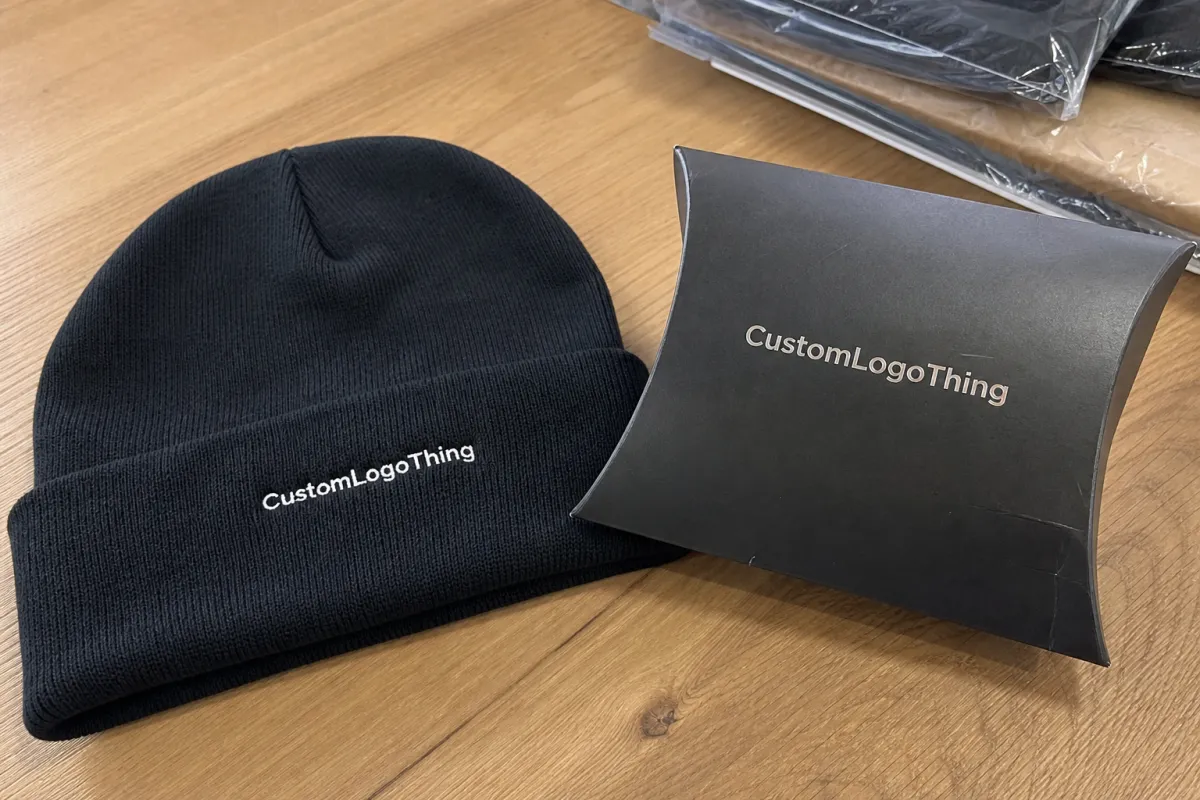
Stationery buyers tend to care about consistency. A notebook, a pen set, a desk pad, and a beanie all have to feel like they belong to the same program. Embroidery works in that environment because it looks deliberate without feeling overdesigned. A small front cuff logo, usually around 2 to 3 inches wide, is enough to signal brand identity without turning the item into a walking billboard.
That restraint matters. A lot of branded apparel fails because the decoration tries to carry the entire idea. Beanies are more effective when they let the material do the work. A dense knit, a clean fold, and a tidy stitch line communicate more than a large graphic ever will. The result is usually better retention too: people wear the hat because it feels like something they would have chosen themselves.
For office gifting, onboarding kits, event packs, and client mailers, that is a useful combination. It helps the whole bundle feel intentional. If the hat looks premium while the notebooks and inserts are basic, the mismatch is obvious. If the hat, the stationery, and the packaging all pull in the same direction, the perceived value rises fast. That uplift is often larger than the cost of the embroidery itself.
There is a second advantage that gets overlooked: beanies compress well. They ship more efficiently than hard goods, and they work in mailers, boxes, or nested kits without much drama. That makes them a good companion item for stationery programs that need to travel. Packaging still matters, though. If the hat is arriving with paper goods, the fold and carton plan should be set early so the beanie does not crush the rest of the presentation.
A useful comparison is this: a plain acrylic beanie can feel generic, but the same piece with clean embroidery and a good fold often reads like a retail item. The unit cost may rise by only a few dollars, while the perceived value can rise by much more. That ratio is the reason buyers keep choosing embroidery even when cheaper decoration methods exist.
Practical takeaway: the best stationery beanie orders usually win on balance, not on flash. If the logo is crisp and the product feels durable, the spend is easier to defend.
Product details buyers should verify before quoting
Before asking for pricing, pin down the garment itself. The fabric, cuff shape, and knit density change both the decoration result and the final cost. A cuffed beanie in midweight acrylic is still the most common starting point because it is predictable and accepts embroidery well. Acrylic-wool blends can feel better in hand, but they usually cost more and can introduce more variation in finish. Recycled fiber blends are increasingly common, though quality can vary widely from one mill to the next.
Cuff depth deserves more attention than most buyers give it. A deeper cuff gives the embroidery a flatter, more stable surface. That helps the logo read cleanly and reduces the chance of puckering. A shallow cuff can still work, but it tightens the usable area and may force the logo too close to the edge. Once that happens, the stitch line starts competing with the fabric stretch.
The knit gauge matters too. Tighter knits generally hold embroidery better because the structure is more stable. Looser knits can look softer, but they are less forgiving. If the design includes small text, fine outlines, or a dense mark, a loose knit will make the art look more fragile than it does on screen. The same logo that looks sharp in mockup can blur slightly on the wrong fabric.
Placement should be decided before digitizing. The front cuff is the standard choice because it is the most visible and easiest to control. Side placement can work when the logo is small or the brand wants a quieter look. 3D puff embroidery is usually a poor fit for compact logos and small text, even if it looks impressive in samples. Flat embroidery is safer for stationery programs because readability usually matters more than novelty.
Ask for these details before you compare quotes:
- Beanie style: cuffed, slouchy, or rib-knit.
- Fiber blend: acrylic, acrylic-wool, recycled blend, or mixed yarn.
- Logo size: usually 2 to 3 inches wide for a cuff placement.
- Decoration method: flat embroidery, patch, or puff only if the artwork supports it.
- Packaging: bulk packed, folded with an insert, or individually bagged.
Artwork quality is another hidden cost driver. Thin lettering, gradients, tiny spacing, and multiple color shifts all increase complexity. That does not mean the artwork cannot be used. It means the embroidery version may need simplification. A good supplier should tell you that directly instead of promising to stitch anything and hoping the result passes. If the logo is important, request a digital proof and, for a meaningful run, a pre-production sample or stitched strike-off.
Specs that affect wearability, durability, and logo clarity
Three specs dominate the result: fabric weight, fiber blend, and cuff depth. Fabric weight affects warmth and drape. Fiber blend affects softness, stretch, and how the hat holds shape after repeated wear. Cuff depth affects how much room the logo has to sit flat without fighting the knit. If one of those is off, the beanie starts looking cheap even when the embroidery itself is technically fine.
Cheap beanies tend to fail in familiar ways. The yarn is too thin, so the crown collapses. The cuff loses structure after a few wears, so the logo begins to warp. The embroidery is stitched too densely, so the fabric puckers around it. None of that is mysterious. It is the predictable result of chasing the lowest blank cost and not adjusting the stitch plan to match the material.
For stationery-led orders, use a spec sheet rather than a mood board. The visual direction matters, but the production details matter more. Compare the following:
- Fit: one-size items are common, but crown depth and stretch vary more than buyers expect.
- Color: black, charcoal, navy, forest, and oatmeal tend to be the safest choices for broad appeal.
- Labeling: woven label, tear-away label, or a custom inside tag can change the perceived finish.
- Packaging: loose bulk, folded in polybag, or inserted into a stationery kit.
Durability is more than a nice-to-have. If the beanie is part of an internal welcome pack, clients will wear it more than a one-time event handout. That means the logo needs to survive repeat stretching, storage in bags, and casual washing. A supplier that understands knitwear should be able to explain what backing they use, how they stabilize the embroidery area, and why a certain stitch density is safer than another. If that explanation is vague, the quote may be cheap for the wrong reason.
Packaging also deserves serious treatment because it changes the unboxing experience and the damage risk. Beanies with inserts or custom folds can arrive looking polished, but they can also create extra labor and a higher unit price. When the order is shipping with paper goods, check how the carton is packed and whether the hats will press into notebooks or mailers. A thoughtful pack-out prevents the whole kit from arriving tired.
Transit testing is not overkill if the order is going to multiple recipients. A carton that looks fine at dispatch can still arrive crushed, especially if it contains both soft goods and stationery. Simple drop and compression checks tell you more than a beautiful mockup ever will. That is why the packaging conversation should happen before production, not after the first damaged box shows up.
Stationery embroidered beanies unit cost, pricing, and MOQ
Here is the part most buyers want first: unit cost. For a standard cuffed acrylic beanie with one-location flat embroidery, the following ranges are a realistic starting point before freight. The exact number depends on the blank, the design, the packaging, and the factory’s order volume, but these bands are useful for planning.
| Order size | Typical cost per piece | What is usually included | What can push price higher |
|---|---|---|---|
| 50-99 units | $7.50-$11.00 | Beanie, one logo location, standard digitizing | Extra colors, low MOQ, special packaging |
| 100-249 units | $5.50-$8.25 | Beanie, embroidery, basic proof | Complex logo, patch add-on, rush fees |
| 250-499 units | $4.20-$6.80 | Better bulk pricing, setup spread across more units | Premium yarn, individual bagging, multiple placements |
| 500+ units | $3.25-$5.20 | Lowest cost per piece for standard specs | Custom knit details, custom labels, extra handling |
Those bands move for predictable reasons. A one-color logo with a moderate stitch count is cheaper than a design with small type and several thread changes. A front cuff hit is easier and faster than a large side placement. Premium yarn, custom labels, and individual folding all add labor. Freight can matter more than buyers expect too, especially if the shipment is split or the boxes are oversized for the order volume.
Setup charges are where budget accuracy often falls apart. Digitizing can be a one-time fee, commonly in the $25 to $60 range depending on complexity, although some suppliers roll it into the unit price. That is not automatically good or bad. It just means the buyer has to compare total cost, not a single line item. The same logic applies to mockups, sampling, and revised proofs. If those are included, the unit price may look higher but the risk of surprise charges is lower.
MOQ should be treated as a business constraint, not a quality signal. A low MOQ is useful if you are testing a design, buying for a small team, or matching a limited event list. It is rarely the cheapest path per piece. The cost drops once the fixed setup is spread across more hats. That is why a 50-piece order and a 500-piece order can feel like different products even when the artwork stays the same.
There is also a hidden trap in quotes that are too tidy. If a supplier does not mention freight, sample approval, packaging, or rush timing, they may be giving you only the base number. That number can still be real, but it is not the complete cost. A good stationery embroidered beanies Unit Cost Review should always check landed price against the actual delivery plan.
One useful comparison: a small run may cost nearly twice as much per piece as a larger run, yet the larger run only adds a few cents in actual embroidery labor per unit. The difference is mostly setup absorption and production efficiency. That is why scale matters so much in decorated knitwear.
Production steps, turnaround, and approval checkpoints
The production sequence is straightforward, but the approval points are where orders succeed or stall. The usual flow starts with artwork review, then digitizing, then a proof or mockup, then bulk embroidery, then folding and packing, then freight booking. The physical stitching is only one stage. Delays usually come from waiting on files or changing details after the proof has already been prepared.
For straightforward orders, turnaround is often around 12 to 15 business days after proof approval. That is a practical estimate, not a promise. Simple runs can move faster. Larger quantities, custom labels, or packaging insert work can add days. If the design has tiny details, the proof stage may take longer because the supplier has to test whether the logo can be made legible at stitch scale.
Three variables push a job into a slower lane:
- Artwork complexity: small text, fine outlines, gradients, or frequent thread changes.
- Packaging detail: custom inserts, retail folding, bagging, or kit assembly.
- Deadline pressure: events, onboarding launches, seasonal gifting, or replacement stock.
Approval checkpoints keep the job from drifting. At minimum, buyers should confirm the artwork sign-off, the proof or sample sign-off, and the final pack-out spec. If the beanies are part of a broader stationery bundle, the assembly order should be written down too. “Bulk packed” is too vague on its own. One team may mean folded in cartons, another may mean polybagged and stacked, and those are not the same thing in a warehouse.
Good suppliers separate lead time by stage. They can tell you how long digitizing will take, how long the proof will take, and how long the bulk run takes once approved. That matters because a four-day delay in approval often causes more trouble than the embroidery itself. If the timeline is blurred into one vague estimate, the order is harder to manage and harder to trust.
Seasonality can distort lead times too. Q4 gifting, conference season, and back-to-school campaigns can all crowd the schedule. In those periods, even a simple run may move more slowly than a supplier’s standard promise suggests. Buyers who work backward from a ship date, rather than forward from the quote date, usually get fewer surprises.
How to judge a supplier beyond the first quote
A strong supplier talks about stitch quality, placement, and packaging before they brag about price. That is usually the first sign that they understand the product. Cheap is easy to say. Repeating a design on knit fabric without distortion is harder.
Pay attention to how the proofing process works. Clear mockups, direct notes about logo scale, and honest feedback on artwork limitations are all good signs. So is a supplier who flags potential problems early. If they tell you the logo is too small, the knit is too loose, or the cuff is too shallow, they are protecting the result rather than just chasing approval. That honesty is worth something.
Consistency matters as much as cost. A run that looks fine in isolation can still be a bad buy if it cannot be repeated later. Stationery programs often reorder, which means the next batch has to match the first. Color drift, logo shift, and stitch density changes become obvious when the item is placed next to earlier stock. A vendor that can explain repeatability is usually a better long-term choice than one that only knows how to quote the first order.
These are the credibility markers that usually matter most:
- Production transparency: clear specs, no vague allowances, no hidden add-ons.
- Sample handling: willingness to provide a mockup or strike-off when the order justifies it.
- Packaging control: ability to pack for kits, mailers, or a cleaner retail-style presentation.
- Reorder stability: the ability to match color, size, and placement on future runs.
There is a simple rule here: if a supplier can explain the quote in production terms, they probably know what they are doing. If they can only describe the deal in price terms, expect more friction later. The lowest quote is not the same thing as the lowest-risk quote.
Next steps to lock specs and request the right quote
Before requesting pricing, gather five things: logo file, target quantity, preferred color, decoration placement, and deadline. That is enough for a meaningful quote. If the beanies need to fit a stationery budget, say so directly. A useful supplier can often work backward from a target spend and suggest a spec that fits the program without stripping away the parts that make it look finished.
Ask for two pricing paths if the goal is real comparison. The first should use standard flat embroidery with no extras. The second can show the effect of higher-end yarn, individual bagging, a custom label, or a more complex stitch approach. That makes the tradeoff visible. It also exposes where the money is going, which is usually more useful than arguing over a single all-in number.
Confirm these four items before you approve production:
- MOQ: make sure the minimum fits the actual buying plan.
- Sample timing: know whether approval is based on a digital proof or a stitched sample.
- Shipping method: bulk carton, mailer, or kit assembly.
- Packaging spec: bulk packed, folded, bagged, or inserted with stationery items.
Then do the unglamorous math. Add embroidery, setup, packaging, freight, and any rush fee. If the order still lands inside budget, the quote is workable. If it does not, adjust the spec before production starts. That is the point of a proper stationery embroidered beanies Unit Cost Review: not to hunt for the cheapest possible hat, but to settle on the right material, the right decoration, and the right delivered cost for the job.
A clean beanie order usually succeeds for a simple reason. The buyer knows what matters and leaves out what does not. The supplier can explain the blank, the embroidery, and the packing plan without hiding the hard parts. Everything else is noise.
What affects beanie unit cost the most?
Blank quality, stitch count, logo complexity, and order quantity usually drive the price more than anything else. Setup charges, digitizing, packaging, and freight can also change the final number if they are not clearly included in the quote.
What is a realistic MOQ for embroidered beanies in stationery programs?
MOQ depends on the factory, but lower minimums usually carry a higher per-piece price. For a test run, that can still make sense if you want to validate the design before a larger replenishment order.
How long does production usually take after approval?
Most straightforward orders take about 12 to 15 business days after proof approval, though custom packaging, larger quantities, or complex logos can extend that timeline. Slow artwork feedback is often the biggest delay.
Can I use a complex logo on embroidered beanies?
Yes, but small text and fine detail may not read cleanly on knit fabric. A simplified embroidery version usually looks sharper and performs better for stationery bundles and corporate kits.
What should I ask for in a quote review before ordering?
Confirm what is included: digitizing, proofing, setup, packaging, shipping, and any rush fees. Ask for the exact unit cost at your target quantity so there are no surprises after approval.
For stationery buyers, the strongest quote is usually the one that names the tradeoffs plainly. If the logo is simple, the knit is stable, and the packing plan is realistic, the beanie can deliver more perceived value than its base cost suggests. If the quote looks cheap because it omits half the production process, it is not really cheap. It is just incomplete.

