Supplement Brand Padded Mailers Material Guide to Order
Compare barrier strength, print quality, landed cost, and lead times before you place the order.
Supplement brands tend to obsess over capsule counts, label copy, and claim language. Fair enough. Those details are visible on a shelf or on a product page. The supplement Brand Padded Mailers material guide is where a lot of shipping trouble quietly starts, because a light product can still land dented, scuffed, split at the seal, or popped open after a hard ride through the parcel network. I have seen a tidy sample pack leave a warehouse in perfect shape and arrive with a crushed corner and a weak closure, which is how a small order becomes a refund, a replacement shipment, and a customer who is now a little less forgiving.
Padded mailers are outer shells with cushioning built in. That shell can be poly, kraft paper, or a recycled blend. The padding can be bubble film, paper fiber, or another cushioned layer. For supplement shipments, the right choice protects sachets, bottles, blister packs, sample kits, and compact DTC bundles without forcing every order into a box. That tradeoff matters. The supplement brand padded mailers material guide exists because pretty packaging and functional packaging are often two different animals.
From a packaging buyer’s angle, the real question is blunt: what material protects the product, holds the seal, prints cleanly, and still makes sense on a purchase order? If you need other packaging formats while you compare options, browse Custom Packaging Products or compare Custom Poly Mailers against other shipping formats.
Plainly: the cheapest mailer is not the cheapest choice if it triggers damage, replacement shipments, or sloppy-looking deliveries. That happens more often than teams like to admit, and the bill usually shows up later.
Supplement Brand Padded Mailers Material Guide: The Part Nobody Tests
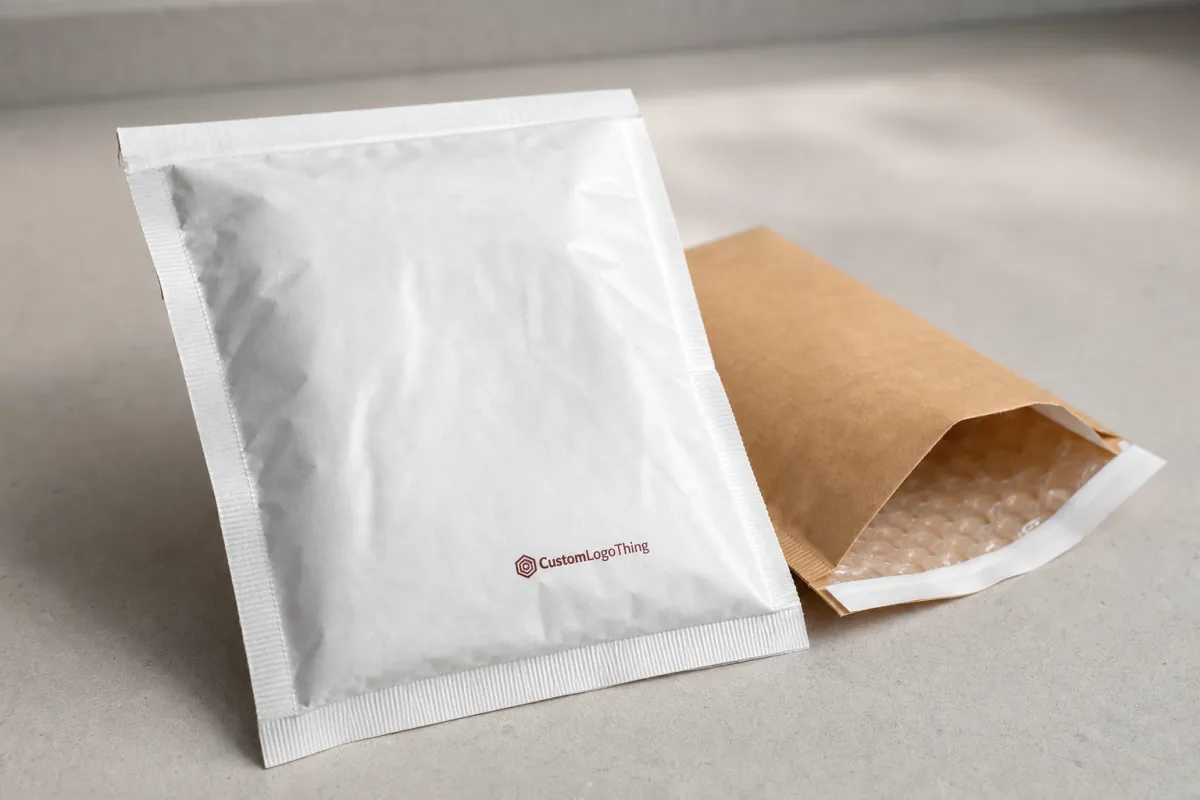
The weak point in the supplement brand padded mailers material guide is that most people judge mailers by the mockup, not the abuse. A sample pack can look sharp in a render and still fail when it gets dropped, compressed under other parcels, or dragged across warehouse belts. Customers never see the polished spec sheet. They see the seam that split, the adhesive that let go, or the scuff marks that made the package look cheap before they even opened it.
Supplements create a strange packaging profile. Many SKUs are light, but they are not always forgiving. Powder sticks can break. Sachets wrinkle. Single jars can dent outer cartons. Gummies can soften in heat if the package sits on a truck too long. That is why the supplement brand padded mailers material guide should start with abuse resistance, not appearance. You are not buying a photo prop. You are buying a small shock absorber with branding on it.
Padded mailers are usually built from an outer layer and a cushioning layer. The outer layer may be printed film, kraft paper, or a recycled paper face. The cushion may be bubble, paper fiber, or another fill structure. Thickness matters, but only to a point. What matters more is how the layers behave under stress. Some materials resist puncture yet look rough after shipping. Others print cleanly yet tear at the edges. The best choice depends on whether you are shipping a flat sachet, a bottle with a cap, or a mixed starter kit with inserts and promo cards.
I once spent a week comparing two mailers that looked almost identical on a spec sheet. One held up fine in a hand test but split on the lower corner after a few stacked cartons and a rough sort line. The other looked a little less polished, but it survived the same route without drama. That is the sort of boring, expensive lesson packaging teaches you when nobody is paying attention.
One practical rule I give buyers: if the mailer survives a packed-carton drop test, a shake test, and a few corners rubbing against corrugated cardboard, then it is worth discussing. If it only looks premium in a sample photo, it is not ready. The supplement brand padded mailers material guide is really a stress test checklist in nicer clothes.
“A mailer that only looks good on screen is a decoration. A mailer that survives fulfillment is packaging.”
Brands that sell direct-to-consumer also care about the unboxing experience, and that matters. A matte kraft finish can feel calm and earthy. A crisp white poly mailer can feel efficient and clean. A printed recycled option can support a stronger brand identity without pretending the product traveled through the mail untouched. The trick is choosing a material that supports the story while still doing the ugly, practical job.
Overpacking creates a hidden cost. Some brands jump straight to rigid boxes and too much filler because they do not trust the mailer. That can make sense for heavier sets, but it is often unnecessary for flat or compact orders. A well-chosen padded mailer can reduce dimensional weight, lower freight cost, and speed up pick-and-pack. The supplement brand padded mailers material guide is about finding the middle point where protection and cost stop fighting each other.
If you want a benchmark for real shipping abuse, the parcel testing methods used by organizations like ISTA are useful because they focus on drops, vibration, and compression rather than marketing language. That is the standard of thinking you want here. Not glamour. Survival.
Supplement Brand Padded Mailers Material Guide: How Materials Work
Inside the supplement brand padded mailers material guide, material choice comes down to four things: protection, printability, feel, and environmental story. No single material wins every category. Poly mailers tend to be tougher and more moisture resistant. Kraft-lined mailers can feel more natural and print nicely. Recycled paper options often help brands support a cleaner sustainability message. Compostable or bio-based blends can work in certain applications, but only if real specs back them rather than a confident claim.
Here is the main material family breakdown in buyer terms.
- PE poly: strong against puncture and moisture, usually best for lightweight DTC supplements that need a dependable seal.
- Kraft-lined padded mailers: good for a natural look, decent stiffness, and a closer visual match with earthy supplement branding.
- Recycled paper mailers: useful when a brand wants more recycled content in the packaging mix and wants to avoid a plastic-heavy presentation.
- Bio-based or compostable blends: niche fit, usually higher cost, and only worth it if the end-of-life claim is credible and the format actually performs.
The inside construction matters as much as the face material. Bubble padding gives more consistent cushion, while paper or fiber-based padding can improve the feel of recyclability and may fit better within an FSC-certified or paper-forward packaging story. Paper padding is not magic, though. Sharp edges and rough shipping lanes tend to favor bubble when impact protection is the main test.
For supplements, moisture resistance is a bigger issue than many new buyers expect. Powder products, gummies, vitamins, and botanicals may not ship in a fully hermetic pouch. That means the mailer should help keep out humidity, damp warehouse air, and minor spills from neighboring parcels. A good supplement brand padded mailers material guide should ask whether the outer material resists water splash and whether the seal adhesive holds in heat.
Seal strength deserves its own sentence because weak seals are the favorite failure mode of lazy packaging. A solid closure should survive handling without peeling at the flap. If you are using a peel-and-seal strip, ask for the adhesive type and the recommended closure pressure. If the mailer needs a second adhesive strip for returns or resealing, say that up front. The gap between a secure closure and a broken one can be a few cents. The gap between a secure closure and a broken one can be a bad review.
Printability also matters. Poly can take bright graphics, but some finishes need better ink-adhesion planning. Kraft gives a more muted, natural look, and that can fit wellness brands that lean into clean-label visuals. Recycled paper stocks may vary in surface consistency, which can affect color accuracy. The supplement brand padded mailers material guide should treat print finish like a functional decision, not just a style preference. Matte coatings hide scuffs better. Gloss can pop in photos, but it also shows wear faster.
For brands that care about environmental claims, avoid sloppy language. If you say recyclable, make sure the material actually meets local recycling expectations. If you say biodegradable packaging, make sure you are not using that phrase as a hand wave. Check the substrate, the adhesive, the ink coverage, and the local recovery path. The EPA recycling guidance is useful because it reminds brands that recovery depends on actual material pathways, not wishful thinking.
There is also a subtle timing issue here. A material that is technically recyclable but too heavily printed, laminated, or mixed with incompatible adhesives can create friction in recovery systems. Packaging engineers see this all the time: the marketing deck says one thing, the substrate says another. That disconnect is where trust starts to leak out of the package.
Key Material Factors for Supplement Mailers
Every strong supplement brand padded mailers material guide needs a filter for real-world use. Start with the product, then work outward. A flat sachet or sample card has different requirements than a glass bottle, a pouch refill, or a mixed starter kit with inserts. Shape is not a minor detail. Shape decides stress points. Weight decides how much the mailer flexes. Sharp edges decide whether puncture resistance matters more than appearance.
Weight and format should guide your shortlist first. A lightweight sample kit may be fine in a 2.5 to 3.0 mil poly mailer with bubble padding. A heavier bottle order may need stronger seams, better corner resistance, or a move to a padded format with more structure. If your product includes a rigid insert, that insert can scratch the outer skin of a thin mailer during transit. That is how you learn, the expensive way, that the bag was not the only weak point.
Route and climate matter more than many buyers want to admit. A short regional route with controlled warehouse handling is not the same as a cross-country route through hot docks and humid depots. If you ship to warm regions or through slow freight lanes, you need stronger adhesives and better moisture control. The supplement brand padded mailers material guide should make room for climate, because supplements are often sold on wellness promises and sent through very unwell logistics.
Brand presentation matters, but only after the package survives. Matte kraft usually signals natural, low-disruption branding. White poly feels bright and tidy. Dark printed mailers can look premium if the graphics are controlled well. Still, if the finish scuffs in transit or the ink rubs off, the package stops doing brand work and starts doing damage control. That is not the kind of unboxing experience anyone wants.
Sustainability claims need careful handling. A brand can use recycled materials and still fail to explain what part is recycled, how much post-consumer waste is present, or whether the full mailer is recyclable through standard channels. Some sellers mix a paper face with a plastic liner and then call the result eco-friendly without qualification. Buyers are getting better at seeing through that. So are regulators. Be precise.
Fulfillment compatibility is the unglamorous piece that saves money. If the mailer is too stiff, it can slow pack speed. If the opening is awkward, workers waste time forcing products in. If the closure strip is tiny, seals get inconsistent. If the mailer is too bulky, dimension-based freight costs climb. A solid supplement brand padded mailers material guide should be grounded in how the line actually runs, not how the product looks on a mood board.
One more practical note: the material should work with your label system. Some adhesives do not love textured kraft. Some printed films reject low-grade label stock. A full pack test should include labels, inserts, outer marks, and any compliance sticker you need. A few sample runs usually expose these issues before they become a warehouse headache.
When I review mailer specs with a buyer, I ask a very unglamorous question: what happens after the first 30 seconds in the fulfillment center? If the answer is “the team has to fight the packaging,” the spec is wrong. Packaging that slows human hands is already costing you money, even if the unit price looks attractive.
| Material Type | Typical Use | Strength Profile | Estimated Unit Range | Best Fit |
|---|---|---|---|---|
| PE poly padded mailer | Sample kits, sachets, compact DTC orders | High puncture resistance, strong moisture barrier | $0.14-$0.28 at 5,000+ units | Fast-moving supplement SKUs that need reliable transit protection |
| Kraft-lined padded mailer | Wellness brands, lighter bottle shipments, branded bundles | Good stiffness, moderate moisture resistance | $0.18-$0.35 at 5,000+ units | Brands prioritizing natural presentation and print feel |
| Recycled paper padded mailer | Paper-forward packaging programs | Solid for light to medium loads, variable scuff resistance | $0.20-$0.40 at 5,000+ units | Teams focused on recycled materials and lower plastic use |
| Bio-based / compostable blend | Niche sustainability messaging | Depends heavily on substrate and closure system | $0.28-$0.55 at 5,000+ units | Brands with verified end-of-life claims and lighter loads |
Those ranges are broad on purpose. Exact pricing swings with size, print coverage, thickness, color count, finishing, and shipping method. A quote for a simple one-color mailer is not comparable to a full-coverage custom print job unless every spec matches. A proper supplement brand padded mailers material guide insists on apples-to-apples comparison, not “this one looks cheaper” nonsense.
If you want to sanity-check whether a quote is truly comparable, ask the supplier to list substrate, thickness, closure type, print count, pack quantity, and freight terms on the same page. A lot of pricing confusion disappears when the spec stops hiding in the margins.
Cost, Pricing, and MOQ for Supplement Mailers
Cost is where the supplement brand padded mailers material guide turns into a buying tool instead of a theory exercise. The cheapest option is rarely the best, but the most expensive option is not automatically smarter either. The right answer sits in the middle, where total landed cost, damage risk, and order volume all line up.
For stock-style poly mailers or simpler padded formats, unit pricing can be fairly low at scale. Once you move into printed kraft, recycled paper, or custom barrier features, costs climb. A realistic view looks like this: stock poly can often land around the low teens per unit in larger lots, while Custom Printed Kraft or recycled padded mailers often move into the high teens or low thirties depending on size and coverage. Specialty compostable formats usually sit at the top end because substrate cost, testing, and conversion are all more expensive.
Then come the hidden costs. Setup fees are common. Plate or file prep may be charged separately. Color matching can require extra proofing. Freight can surprise you, especially if the mailer is bulky and ships in large cartons. Sample charges are worth paying, because a few test units are cheaper than a full reprint. The supplement brand padded mailers material guide should force you to ask for every cost line, not just the glossy unit price.
MOQ is another lever that changes the math. Lower minimums are helpful for a launch or a seasonal promotion. They let you validate size and print without tying up cash. Higher minimums usually reduce unit cost and make repeat orders less annoying. That tradeoff is simple. A 1,000-unit order is easier to swallow today. A 10,000-unit order usually behaves better on the spreadsheet, assuming you are confident in the size and artwork.
Here is the quote comparison structure I recommend when you are collecting bids:
- Same finished size.
- Same material thickness.
- Same print coverage and color count.
- Same closure type.
- Same carton pack and freight terms.
If those five items do not match, the cheapest quote can turn into a bait-and-switch without anyone using the words. This is where Case Studies are useful, because you can see how similar mailer specs performed for other packaging programs instead of guessing from a sales pitch.
For a more concrete buying picture, think in total landed cost. A mailer that saves two cents per unit but causes a higher breakage rate, more replacements, and slower packing is not saving you money. It is hiding the bill. The better supplement brand padded mailers material guide question is: how much are you paying to avoid damage, not just how much are you paying for the bag?
Packaging buyers often forget that larger or denser mailers can raise shipping cost even before the product ships. If the outer carton gets bigger because the mailer is bulky, freight can climb. That is why brands sometimes test slimmer formats against corrugated cardboard mailers or rigid mailer boxes before scaling. The answer is not always more padding. Sometimes the answer is better dimensions.
One practical budget rule: if the package holds low-value samples, keep material cost lean and focus on reliable closure. If the package holds premium bottles or bundled sets, spend more on puncture resistance and print quality. The supplement brand padded mailers material guide should match spend to loss exposure. That is a much less romantic way to buy packaging, but it is usually the right one.
Process, Timeline, and Lead Time for Custom Orders
Ordering well is half the battle. The other half is not making production guess. A clean supplement brand padded mailers material guide should walk you through the process before you ask for a quote. Start with the basics: product type, filled dimensions, unit weight, print area, closure style, moisture concerns, and target order quantity. If you cannot describe the job in one page, your vendor probably cannot quote it cleanly either.
The proofing step matters more than buyers admit. Ask for digital proofs, color expectations, and material swatches or sample packs. If the supplier can show a physical example, even better. A screen mockup is not the same thing as a padded mailer in your hand. Surface finish, stiffness, and seal feel are all real differences. The supplement brand padded mailers material guide should treat proofing as a risk control step, not as a formality.
After proof approval, production usually follows a predictable chain: artwork prep, file or plate setup, substrate sourcing, printing, lamination or padding build, conversion, and final packing. That sounds orderly because it is orderly, until one part goes missing. Delays often show up in artwork revisions, out-of-stock materials, color matching, or freight scheduling. None of that is rare. All of it is avoidable if you start early.
Lead times depend on the format. Stock-based mailers can move fairly quickly, often within 5-10 business days once the order is locked. Custom printed padded mailers typically need more time, often around 12-20 business days after proof approval depending on the queue and the complexity of the build. Specialty materials or heavier customization can extend that further. The honest answer is that timing depends on what you are asking the factory to make, not on how badly you want it next week.
If the program includes new artwork, build time for revisions into the schedule. If the order is tied to a launch date, add a buffer. If the mailers need to arrive at multiple fulfillment points, add more buffer. Shipping disruption has a habit of showing up right when a team is out of room for error. That is why seasoned buyers keep a little slack in the plan.
For brands that want a more shelf-like or premium feel, compare padded mailers against other shipping structures such as kraft paper wraps, protective pouches, or even rigid mailer sleeves. Sometimes the best answer is still a mailer. Sometimes a slightly stiffer format creates a better unboxing experience and fewer dents. A strong supplement brand padded mailers material guide does not force one answer. It helps you choose the least bad one for your actual fulfillment flow.
Also, ask about reorders. A vendor that stores your print files, die specs, and material reference cleanly can save time later. That matters when seasonal demand spikes or when a product reformulation changes the package weight. If your current format is working, document it. Future-you will thank you. Quietly, maybe, but still.
One more timing wrinkle: if you sell subscriptions or bundles that change throughout the year, the mailer may need to handle a slightly different load every quarter. That is why the first approved sample should not be treated like a one-off trophy. It should become the baseline for later orders. Without that record, teams end up re-litigating the same spec every six months.
Common Mistakes When Choosing Padded Mailers for Supplements
The most common mistake in the supplement brand padded mailers material guide is choosing by appearance alone. Nice-looking mailers can be weak. Cheap-looking mailers can be surprisingly solid. The visual story matters, but transit performance pays the bills. A mailer that looks premium and arrives mangled is a poor trade.
Another frequent mistake is ignoring moisture and temperature exposure. Supplements can travel through hot trucks, damp warehouses, and long dwell times in sorting centers. If the outer material or adhesive is weak, that exposure shows up as curling edges, soft seals, or dirty surfaces. A brand can spend weeks refining label claims and then lose the whole impression because the mailer showed up with a tired, soggy face. That is avoidable.
Closure failures are especially frustrating because they are small mistakes with big consequences. A weak strip or poor seal pressure is enough to open the mailer during handling. This happens a lot with heavy little items, because weight concentrates at the bottom of the pack and stresses the flap. Your supplement brand padded mailers material guide should treat the closure like a structural element, not just a convenience feature.
Fulfillment reality is another trap. A material that performs well in a hand test might slow a packing line if it is too stiff, too slippery, or too bulky. Workers do not care how elegant your eco statement is if the mailer jams their workflow. They care whether the product slides in cleanly, seals in one motion, and stacks without drama. That is why a sample should go through your actual pack process before you commit.
Testing is where the smart money goes. Fill the mailer with your real product. Drop it. Shake it. Stack it under other parcels. Run it through the line. Ship it. Then inspect the result. If you are handling a mixed bundle, test the mailer with the heaviest likely load, not the lightest. The supplement brand padded mailers material guide is not theoretical. It should be tested like packaging will be treated by reality, because reality is rarely polite.
Some brands also forget to check the compatibility of the outer material with labels, inks, and secondary marks. A mailer might look fine until barcodes smear or shipping labels peel. That can cause carrier issues and slow fulfillment. If the package needs a lot of automated scanning, barcode contrast matters. If the brand uses promotional stickers, adhesive compatibility matters. Little things become expensive when they are repeated by the thousand.
There is a sustainability mistake too: declaring a format sustainable because one component sounds better than another. A mailer with some recycled content is not automatically recyclable in all systems. A paper face is not automatically FSC certified. A biodegradable packaging claim is not a free pass if the whole structure includes materials that do not match the claim. Precision helps the brand. Vagueness helps nobody.
For a better benchmark, look at the packaging hierarchy used by professional groups and material certifiers, including the FSC. Certification and recycling claims are only useful when they are backed by actual supply chain documentation. Otherwise, they are just decoration with legal risk attached.
The other mistake I see constantly is a lack of failure tracking. Teams will note a damaged shipment once or twice, then shrug and move on. That is the wrong habit. Log the failure type, the route, the product weight, the closure style, and the material. Patterns usually show up fast. You do not need a giant data warehouse to see them; a clean spreadsheet will do.
Expert Tips and Next Steps for Your Supplement Mailers
If you are building your own supplement brand padded mailers material guide, start with a one-page spec sheet. Keep it simple: product type, dimensions, fill weight, print colors, finish preference, climate exposure, and target budget. A clean spec sheet makes quote comparison easier and cuts down on revision loops. It also makes your team look organized, which is never a bad thing in packaging.
Next, order sample runs and test them in the real workflow. Not on a desk. Not with an empty shell. Use actual product, actual insert cards, actual labels, and actual pack speed. If the mailer works in your fulfillment process, you can scale with more confidence. If it fails there, no amount of vendor charm will fix it.
Ask for three quotes with identical specs. That gives you a clearer read on price, MOQ, Lead Time, and material quality. If one supplier comes in dramatically lower, check the details carefully. Something is different. Usually several things are different. The supplement brand padded mailers material guide should protect you from quote confusion, because packaging sourcing loves to hide surprises in tiny print.
If your brand is growing, plan for scale early. Ask whether the same material can handle more print coverage later, a larger order volume, or seasonal spikes without a quality drop. Some materials print well at small quantity and get touchy when the job gets more complex. Others remain stable and predictable. That matters if your supplement line expands from a single SKU into bundles, trial kits, or subscription packs.
It also helps to decide where the mailer sits inside your packaging system. If it ships alongside other items, maybe you want a lighter design and a cleaner recycling story. If it is the primary shipper, maybe you need more puncture resistance and a stronger seal. If your brand leans on premium presentation, maybe the finish and print feel deserve extra budget. That is where Case Studies and real examples save time, because they show how other teams balanced protection, cost, and presentation.
For brands that need a stronger packaging toolkit, compare mailers with other protective formats and secondary packaging options before you lock the order. A padded mailer is often the right answer. Sometimes a different structure is better. Good buyers do not fall in love with one format. They choose the one that survives production, freight, and customer handling with the least drama.
The practical action plan is straightforward: spec the job, sample the material, compare apples to apples, and order only after the test run passes. That is the cleanest way to use a supplement brand padded mailers material guide without turning your next shipment into a lesson. If you keep the focus on protection, moisture control, print quality, and total landed cost, you will buy better packaging and spend less time fixing avoidable mistakes.
One final tip from the buyer side: save the winning sample with a note about date, supplier, thickness, closure type, and the route it survived. That tiny archive becomes your fastest insurance policy the next time someone asks, “Can we just reorder the old one?” You will know exactly which one earned the right to come back.
FAQ
What material is best for supplement brand padded mailers?
For most supplement shipments, the best choice is the one that balances puncture resistance, seal strength, and moisture protection. Poly-based options usually win on toughness. Kraft and recycled paper options often win on brand feel and sustainability story. The right answer in a supplement brand padded mailers material guide depends on what you ship, how far it travels, and how much abuse you expect.
Are recycled padded mailers strong enough for supplement orders?
Yes, if the recycled construction is thick enough and the closure system is reliable. They can work well for lightweight sample kits, sachets, and compact DTC orders that do not need heavy crush protection. Test them with your actual product before you bet a launch on them. A recycled option that fails in transit is not a sustainability win; it is just a return label.
How thick should supplement padded mailers be?
Use thickness based on weight, shape, and shipping distance instead of guessing from a supplier photo. Heavier bottles and mixed kits need more puncture resistance than flat sachets or inserts. Ask for specs in microns, mils, or GSM so you can compare quotes accurately. A proper supplement brand padded mailers material guide should translate thickness into performance, not just numbers on a spec sheet.
What MOQ should I expect for custom supplement mailers?
MOQ varies by printer, material, and print complexity, but custom runs usually need more volume than stock inventory orders. Lower MOQs are useful for launches and tests, while higher volumes usually deliver better unit pricing. Always ask whether MOQ changes if you simplify print coverage or standardize the size. That one question can save a lot of back-and-forth.
How long does production take after artwork approval?
Stock-based orders can move quickly, while fully custom padded mailers need time for setup, printing, and finishing. Lead time usually depends on whether samples, plate setup, or special materials are involved. Build in extra time for proof changes, freight delays, and seasonal demand spikes. A realistic supplement brand padded mailers material guide treats timing as part of the spec, not an afterthought.
How do I know if a mailer claim is trustworthy?
Ask for the substrate, the closure adhesive, the recycling path, and the test method behind the claim. If a supplier cannot explain how the material was tested or where it is accepted after use, the claim is thin. Trust comes from documents, samples, and repeatable results, not from adjectives that sound nice in a pitch deck.
Choosing the right mailer is not glamorous, but it is one of the easiest ways to protect margin and keep the customer experience clean. Use the supplement brand padded mailers material guide to compare protection, print quality, Pricing, and Lead Times before you buy. Then run one honest sample test with your actual product, your actual labels, and your actual fulfillment flow. If it passes, you have a packaging spec worth repeating. If it fails, you just saved yourself from a much pricier mistake.

